《暖風中的幾何詩學:姜金玲的當代工筆與色彩革新》
—— 日本第24回 NAU 21世紀美術連立展:台灣藝術家姜金玲參展全紀錄與深度藝評
策劃・撰文 / 王 穆提(WANG MUTI)
六本木的秋光 —— 當古典工筆遇見現代抽象
2026 年初春,東京六本木的 國立新美術館(NACT)。在這座由 黑川紀章 設計的現代主義建築中,光線透過巨大的玻璃帷幕灑下,照亮了 《日本第24回 NAU21世紀美術連立展》 的展廳。
在眾多追求巨大尺幅、狂野筆觸或數位觀念的作品中,台灣藝術家 姜金玲(Jiang, Jin-Ling) 的作品 《秋高氣爽有暖風》,像是一首精緻的 「絕句」,安靜而堅定地掛在白牆之上。姜金玲 代表的便是 「秩序的溫情」。她繼承了宋代院體畫最嚴謹的 工筆技法,卻大膽地引入了西方抽象藝術的 色域(Color Field) 背景。
這不僅是一幅花鳥畫,更是一次關於 「傳統如何現代化」 的視覺實驗。姜金玲用極致的耐心,描繪了秋荷的枯榮,卻將它們置於一個超現實的紅藍空間中,讓「秋高氣爽」不僅是氣候的描寫,更成為一種 視覺心理學 的隱喻。
場域的現象學
—— 在黑川紀章的玻璃巨塔中,植入一座「色彩花園」
要在國立新美術館這樣一個強調「當代性」與「前衛性」的場域中展出工筆畫,藝術家面臨的最大挑戰是:如何避免作品被視為過時的傳統工藝?
1. 視覺的平面性(Flatness)
NACT 的空間充滿了鋼鐵與玻璃的冷硬線條。姜金玲的策略是 「強調平面」。
不同於傳統水墨試圖用留白來營造深遠的空間,姜金玲在 《秋高氣爽有暖風》 中,直接使用了 平塗的背景色。這種處理方式讓作品具有了如同 波普藝術(Pop Art) 或 平面設計 般的現代感。它不再是一個「通往古代的窗戶」,而是一個「掛在當代的裝飾面板」。
2. 色彩的標示性
在偌大的展廳中,細膩的線條容易被忽視。但姜金玲使用了高飽和度的 紅色 與 深藍色 作為背景。這兩種顏色在遠處就能抓住觀眾的視線,像是一個 「視覺信號」,引導觀眾走近,進而發現前景中那些精微的筆墨細節。
作品深度解構
—— 《秋高氣爽有暖風》的雙重編碼
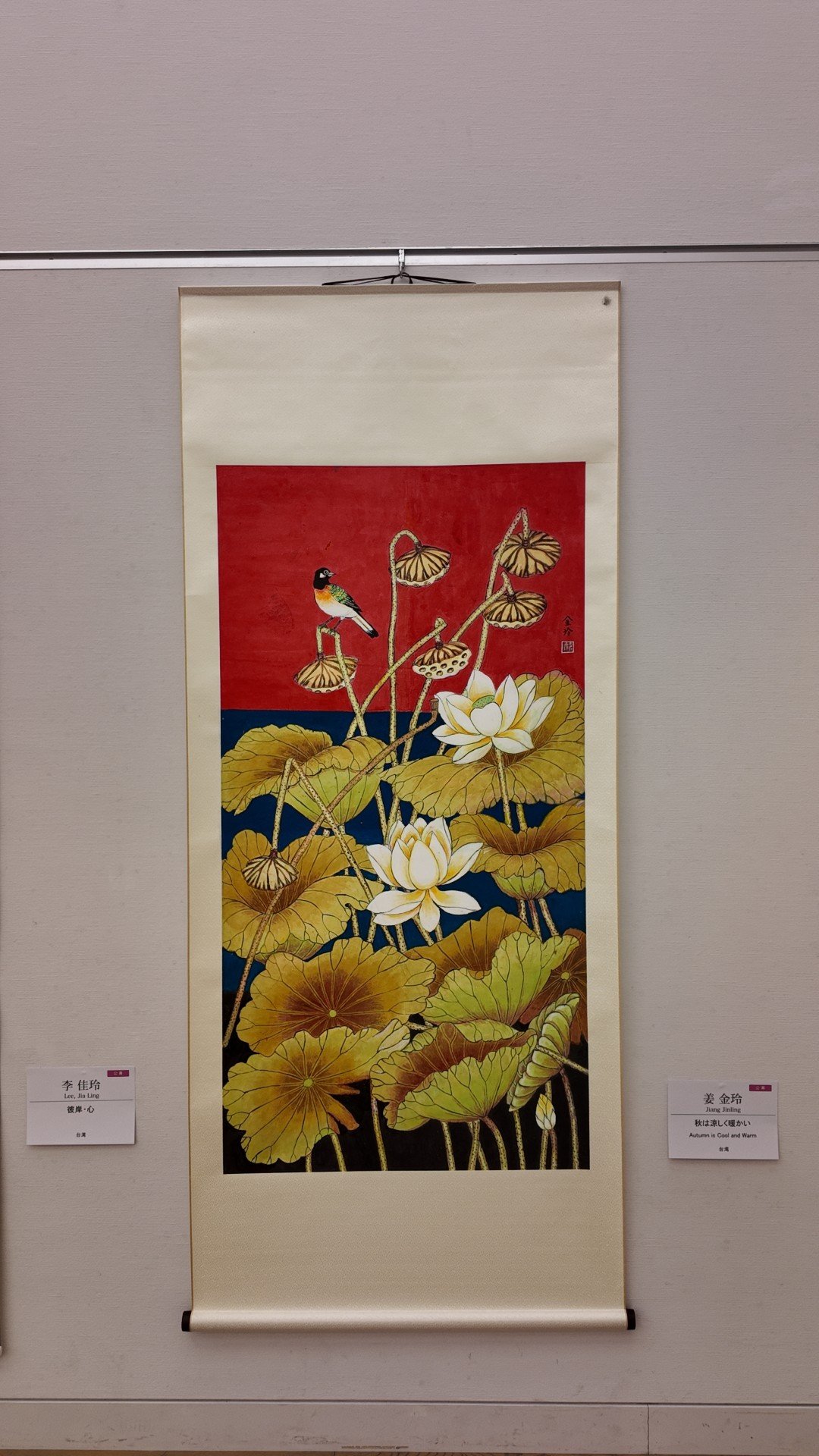
作品: 《秋高氣爽有暖風》
規格: 70 x 135 cm (立軸)
媒材: 水墨、工筆重彩 (Ink and Color on Paper)
這件作品最迷人之處,在於它同時使用了兩套視覺語言:背景的抽象 與 前景的寫實。
背景的革命(紅與藍的幾何對撞)
畫面背景被一條水平線一分為二。
- 上半部(約1/3): 是溫暖的 胭脂紅(或朱砂紅)。這象徵著標題中的「暖風」與「秋陽」。紅色給予了畫面一種喜氣與溫度,打破了傳統秋景畫常見的蕭瑟感。
- 下半部(約2/3): 是深沈的 普魯士藍(或花青)。這象徵著「池水」或「秋氣的清冷」。
- 解讀: 這種 「羅斯科(Mark Rothko)」 式的色域分割,是姜金玲最大的突破。她沒有畫水波,沒有畫雲彩,而是用純粹的色彩塊面來暗示環境。這使得作品瞬間脫離了寫實主義,進入了 象徵主義 的層次。
前景的細膩(殘荷與白蓮的生死辯證)
在抽象的背景前,是一叢極度寫實的荷花。
- 枯葉(金黃/赭石): 巨大的荷葉已經枯黃,邊緣捲曲,葉脈清晰可見。姜金玲運用了精湛的 「分染」 技巧,表現出葉片乾燥、脆裂的質感。這些金黃色的葉片在藍色背景的襯托下,顯得金碧輝煌,將「衰敗」轉化為一種「華麗」。
- 白蓮(純白): 在枯葉之間,竟然盛開著兩朵潔白的荷花與一個含苞待放的花蕾。這在自然界中或許少見(秋天荷花多已凋謝),但在藝術中,這是 「生命力」 的象徵。白色花瓣的邊緣或許用了 「白粉」 提亮,使其在深色背景中發光。
- 蓮蓬(高聳): 畫面頂端衝出幾支高聳的蓮蓬,裡面的蓮子飽滿。這象徵著生命的 「結實」 與 「輪迴」。
敘事的焦點
—— 那隻凝視遠方的伯勞鳥
在畫面左上方的蓮蓬上,棲息著一隻小鳥(推測為伯勞或鶲類)。
1. 動與靜的平衡
整幅畫面的植物是靜止的,而這隻鳥是唯一的 「動態」 元素。牠的爪子緊緊抓住蓮蓬,頭部轉向左方,眼神靈動。這個小小的生命體,為整幅裝飾性極強的畫面,注入了 「靈魂」。
2. 視線的引導
鳥的視線望向畫外,這引發了觀眾的好奇:牠在看什麼?是即將到來的冬天?還是另一隻同伴?這個 「畫外之意」,拓展了作品的心理空間,讓這幅畫不只是一個封閉的裝飾品,而是一個有故事的場景。
技法的當代轉譯
—— 「雙勾填彩」與「礦物顏料」的物質性
姜金玲的作品顯示了她深厚的傳統功底,但在材質運用上具有當代意識。
1. 雙勾填彩的嚴謹
工筆畫講究「三礬九染」。從畫面上看,姜金玲的線條(骨法)勁健有力,勾勒出荷葉的筋脈與花瓣的輪廓。色彩的填充則層次豐富,沒有流於單薄。這種對 「工藝性(Craftsmanship)」 的堅持,在當代藝術強調觀念而忽視技法的潮流中,顯得尤為珍貴。
2. 重彩的裝飾性
她似乎使用了 「礦物顏料(岩彩)」 或 「不透明水彩(Gouache)」 的概念。
荷葉的黃、背景的紅與藍,都具有很強的 「覆蓋力」 與 「飽和度」。這種厚重的色彩質感,讓宣紙產生了如同 畫布(Canvas) 般的份量感。她成功地將工筆畫從「清雅」推向了 「濃烈」。
系譜的對話
—— 從宋代院體畫到當代新工筆
將姜金玲置於藝術史的座標中,她處於 「新工筆(New Gongbi)」 的浪潮之中。
1. 承接宋人美學
她對殘荷的描繪,讓人聯想到宋代畫家對於 「格物致知」 的追求。那種對枯葉捲曲形態的精準捕捉,是對自然造化最謙卑的致敬。
2. 對話現代設計
然而,她的背景處理又是完全現代的。她拒絕了傳統的「知白守黑」,轉而擁抱 「平面設計」 的構成法則。這種 「主體寫實 + 背景抽象」 的手法,在當代插畫與設計中很常見,姜金玲將其回饋給傳統水墨,為其注入了新的時尚感。
—— NAU 展場中的「精緻」突圍
在 第 24 回 NAU21世紀美術連立展 中,姜金玲的作品提供了一種稀缺的 「精緻感」。
1. 距離的魔法
- 遠看: 它是一幅紅藍撞色的現代抽象畫(Abstract Art)。
- 近看: 它是一幅筆法嚴謹的傳統工筆畫(Fine Art)。
- 這種 「遠近的落差」,給觀眾帶來了驚喜。在充滿粗獷筆觸的展場中,姜金玲的作品邀請觀眾 「慢下來」,去品味那些細如髮絲的線條與暈染。
2. 溫度的傳遞
標題 《秋高氣爽有暖風》 定調了作品的氛圍。在充滿哲學思辨或社會批判的當代藝術展中,姜金玲提供了一種純粹的 「美」 與 「愉悅」。她用暖紅色的背景包裹著觀眾,傳遞出一種正向的、溫暖的生命態度。
傳統的現代溫度 —— 台灣工筆畫的新路徑
姜金玲在東京六本木的展出,是一次優雅的 「軟著陸」。
她證明了,傳統工筆畫不需要為了迎合當代而變得面目全非(例如變得怪誕或過度觀念化)。它可以保留最核心的 「筆墨技藝」,只需在 「色彩構成」 與 「空間觀念」 上做一點微調,就能與現代建築、現代審美完美融合。
《秋高氣爽有暖風》 是一扇窗,透過它,我們看到了傳統美學在當代陽光下的新生。
姜金玲用那一抹大膽的紅與藍,為台灣的工筆畫系譜,增添了一筆既古典又摩登的註腳。在國立新美術館的白牆上,這幅畫像是一枚精緻的琺瑯胸針,別在了東京這座巨大都市的衣襟上。
【藝術家檔案 Data File】
- 藝術家: 姜金玲 (Jiang, Jin-Ling)
- 入選展覽: 日本第24回 NAU21世紀美術連立展
- 展出地點: 日本東京・國立新美術館
- 參展作品:
- 題名: 《秋高氣爽有暖風》
- 規格: 70 x 135 cmz2
- 年代: 2024年10月
- 媒材: 水墨、工筆重彩、宣紙
- 圖像特徵: 紅藍幾何背景、寫實殘荷、白蓮、伯勞鳥
- 風格關鍵字: 新工筆 (New Gongbi)、裝飾美學、色域構成、雙勾填彩、工筆花鳥。
The Geometry of Poetics in the Warm Breeze: Jiang Jinling’s Contemporary Gongbi and Innovations in Color
The 24th NAU 21st Century Art Exhibition in Japan: A Complete Record and In-Depth Critical Review of Taiwanese Artist Jiang Jinling’s Participation
Curated and Written by Wang Muti
Autumn Light in Roppongi — When Classical Gongbi Meets Modern Abstraction
In early spring 2026, at the National Art Center, Tokyo (NACT) in Roppongi, Tokyo, light filtered through the vast glass curtain wall of this modernist building designed by Kisho Kurokawa, illuminating the exhibition halls of The 24th NAU 21st Century Art Exhibition in Japan.
Among many works pursuing monumental scale, wild brushwork, or digital conceptualism, Taiwanese artist Jiang Jin-Ling’s work, Autumn Clear and Crisp, with a Warm Breeze, hung quietly yet resolutely on the white wall like a refined classical quatrain. What Jiang represents is a kind of**“tenderness of order.”** She inherits the most rigorous gongbi technique of Song-dynasty academy painting, while boldly introducing the Color Field background of Western abstract art.
This is not merely a flower-and-bird painting, but a visual experiment concerning how tradition can become modern. With extreme patience, Jiang depicts the withering and flourishing of autumn lotus, yet places them within a surreal red-and-blue space, transforming “clear autumn air and a warm breeze” from a simple description of weather into a metaphor of visual psychology.
The Phenomenology of Place
Planting a “Garden of Color” Inside Kisho Kurokawa’s Glass Tower
To exhibit gongbi painting in a venue such as the National Art Center, Tokyo—a space that emphasizes contemporaneity and the avant-garde—the artist faces a central challenge: How can the work avoid being seen as an outdated traditional craft?
1. Visual Flatness
The NACT is filled with the cold, hard lines of steel and glass. Jiang Jinling’s strategy is to emphasize flatness.
Unlike traditional ink painting, which often uses empty space to suggest deep recession, Jiang in Autumn Clear and Crisp, with a Warm Breeze directly employs flatly painted background colors. This treatment gives the work a modern sensibility akin to Pop Art or graphic design. It is no longer “a window into antiquity,” but rather “a decorative panel hanging in the contemporary present.”
2. The Signaling Power of Color
In such a vast exhibition hall, delicate linework can easily be overlooked. Jiang therefore uses highly saturated red and deep blue as the background colors. These two hues catch the viewer’s eye even from a distance, functioning like a visual signal that draws one closer, where the subtle brush-and-ink details in the foreground can then be discovered.
A Deep Deconstruction of the Work
The Double Coding of Autumn Clear and Crisp, with a Warm Breeze
Work: Autumn Clear and Crisp, with a Warm Breeze
Size: 70 × 135 cm (Hanging Scroll)
Medium: Ink and Heavy Color Gongbi on Paper
The most fascinating aspect of this work lies in the fact that it simultaneously employs two visual languages: abstraction in the background and realism in the foreground.
The Revolution of the Background
The Geometric Collision of Red and Blue
The picture plane is divided into two parts by a horizontal line.
- Upper section (approximately one-third): a warm rouge red or cinnabar red, symbolizing the “warm breeze” and “autumn sunlight” in the title. This red lends the painting festivity and warmth, breaking away from the melancholy atmosphere commonly found in traditional autumn landscapes.
- Lower section (approximately two-thirds): a deep Prussian blue or indigo blue, symbolizing either “pond water” or the crisp chill of autumn air.
- Interpretation: This kind of Mark Rothko-like division of color fields is Jiang Jinling’s greatest breakthrough. She does not paint water ripples or clouds; instead, she uses pure blocks of color to suggest environment. As a result, the work instantly departs from realism and enters the realm of symbolism.
The Delicacy of the Foreground
The Dialectics of Life and Death in Withered Lotus and White Blossoms
Against this abstract background stands an intensely realistic cluster of lotus plants.
- Withered leaves (golden yellow / ochre): The large lotus leaves have already withered into yellow, their edges curling and their veins clearly visible. Jiang uses an exquisite graded wash technique to render the dry, brittle texture of the leaves. Against the blue background, these golden leaves appear radiant and magnificent, transforming “decay” into a form of “splendor.”
- White lotus blossoms (pure white): Among the withered leaves, two immaculate white lotus flowers bloom alongside a bud on the verge of opening. This may be uncommon in nature—lotus flowers have mostly faded by autumn—but in art, it becomes a symbol of vitality. The edges of the white petals appear to have been heightened with white pigment, allowing them to glow against the dark background.
- Lotus seedpods (rising upward): At the top of the composition, several tall seedpods rise into the air, their seeds full and ripe. They symbolize fruitfulness and the cyclical continuity of life.
The Narrative Focus
That Shrike Gazing into the Distance
Perched on a lotus seedpod in the upper left corner of the painting is a small bird, likely a shrike or perhaps a flycatcher.
1. The Balance of Motion and Stillness
The plants throughout the painting are still, while this bird is the only dynamic element. Its claws grip tightly to the seedpod; its head turns to the left, its eyes alert and lively. This small living creature injects a soul into an otherwise highly decorative composition.
2. The Guidance of the Gaze
The bird looks beyond the picture plane, prompting the viewer to wonder: What is it looking at? The winter that is approaching? Another bird nearby? This meaning beyond the image expands the psychological space of the work, making it more than a closed decorative object—it becomes a scene with a story.
The Contemporary Translation of Technique
The Materiality of Fine Double Outlining and Mineral-Rich Color
Jiang Jinling’s work reveals her deep grounding in tradition, while also displaying a contemporary awareness in the use of materials.
1. The Rigorous Precision of Double Outline and Color Filling
Gongbi painting speaks of**“three alum applications and nine dyeings.”** From the painting, one can see that Jiang’s linework—its structural “bone method”—is vigorous and forceful, outlining the veins of lotus leaves and the contours of flower petals. The color filling is rich in layers and never feels thin or superficial. Such an adherence to craftsmanship appears especially precious in a contemporary art climate that often emphasizes concept while neglecting technique.
2. The Decorative Quality of Heavy Color
She seems to employ the logic of mineral pigments or opaque gouache-like coloration.
The yellow of the lotus leaves and the red and blue of the background all possess strong covering power and saturation. This rich chromatic density gives the xuan paper the visual weight of canvas. She successfully pushes gongbi painting from the realm of restrained elegance into one of intensity.
A Dialogue of Genealogies
From Song Academy Painting to Contemporary New Gongbi
Placed within the coordinates of art history, Jiang Jinling belongs to the current of New Gongbi.
1. Continuing Song-Dynasty Aesthetics
Her depiction of withered lotus recalls the Song painters’ pursuit of investigating things to attain knowledge. The precise capture of the curling forms of dried leaves is a most humble homage to nature’s own creation.
2. A Dialogue with Modern Design
And yet her handling of the background is entirely modern. She rejects the traditional strategy of preserving the eloquence of blankness and instead embraces the compositional logic of graphic design. This approach—realistic subject + abstract background—is common in contemporary illustration and design. Jiang returns this method to traditional ink painting, infusing it with a new sense of fashion and modernity.
A Breakthrough of Refinement in the NAU Exhibition Space
At The 24th NAU 21st Century Art Exhibition, Jiang Jinling’s work offered a rare sense of refinement.
1. The Magic of Distance
- From afar: it appears to be a modern abstract painting in clashing red and blue.
- From up close: it reveals itself to be a rigorously executed traditional gongbi painting.
This difference between distance and proximity gives viewers a sense of surprise. In an exhibition filled with rough gestures and bold brushwork, Jiang’s work invites viewers to slow down, to savor lines as fine as hair and the subtle gradations of color.
2. The Transmission of Warmth
The title Autumn Clear and Crisp, with a Warm Breeze sets the emotional tone of the work. In a contemporary art exhibition dense with philosophical speculation or social critique, Jiang offers a pure sense of beauty and pleasure. With her warm red background, she envelops the viewer and conveys a positive, warm attitude toward life.
The Modern Warmth of Tradition — A New Path for Taiwanese Gongbi Painting
Jiang Jinling’s exhibition in Roppongi, Tokyo, is an elegant soft landing.
She proves that traditional gongbi painting does not need to disfigure itself in order to fit into the contemporary world—whether by becoming grotesque or excessively conceptual. It may preserve its essential brush-and-ink craftsmanship, and simply by making subtle adjustments in color composition and spatial conception, it can harmonize perfectly with modern architecture and modern aesthetics.
Autumn Clear and Crisp, with a Warm Breeze is a window through which we glimpse the rebirth of traditional aesthetics under contemporary sunlight.
With those bold passages of red and blue, Jiang Jinling adds a note to the genealogy of Taiwanese gongbi painting that is at once classical and modern. On the white walls of the National Art Center, Tokyo, this painting resembles a delicate enameled brooch, pinned to the lapel of the vast metropolis of Tokyo.
Artist Data File
- Artist: Jiang Jin-Ling
- Selected Exhibition: The 24th NAU 21st Century Art Exhibition in Japan
- Exhibition Venue: The National Art Center, Tokyo, Japan
- Exhibited Work:
- Title: Autumn Clear and Crisp, with a Warm Breeze
- Dimensions: 70 × 135 cm
- Date: October 2024
- Medium: Ink, Heavy-Color Gongbi, Xuan Paper
- Iconographic Features: Geometric red-and-blue background, realistic withered lotus, white lotus blossoms, shrike
- Style Keywords: New Gongbi, Decorative Aesthetics, Color-Field Composition, Double Outline and Color Filling, Gongbi Flower-and-Bird Painting
暖風の中の幾何学的詩学――姜金玲の現代工筆と色彩革新
日本第24回 NAU21世紀美術連立展――台湾人アーティスト姜金玲の出品全記録と詳細芸術評論
企画・執筆/王 穆提(WANG MUTI)
六本木の秋光――古典工筆が現代抽象と出会うとき
2026年初春、東京・六本木の 国立新美術館(NACT)。
黒川紀章 によって設計されたこのモダニズム建築では、巨大なガラスカーテンウォールを通して光が差し込み、「日本第24回 NAU21世紀美術連立展」 の展示空間を照らしていた。
巨大なサイズ、荒々しい筆致、あるいはデジタル的なコンセプトを追求する多くの作品が並ぶ中で、台湾人アーティスト 姜金玲(Jiang, Jin-Ling) の作品**《秋高気爽有暖風》** は、ひとつの洗練された**「絶句」** のように、静かに、しかし確固として白い壁に掛けられていた。姜金玲が体現しているのは、いわば**「秩序のぬくもり」** である。彼女は宋代院体画におけるもっとも厳密な 工筆 技法を継承しつつ、西洋抽象芸術の カラーフィールド(Color Field) 的背景を大胆に導入している。
これは単なる花鳥画ではない。むしろ、「伝統はいかにして現代化されうるか」 という問いをめぐる視覚的実験である。姜金玲は極度の忍耐をもって秋の蓮の枯栄を描き出しながら、それを赤と青の超現実的な空間の中に置くことで、「秋高気爽」を単なる季節描写にとどめず、視覚心理学 の隠喩へと変えている。
場の現象学
黒川紀章のガラスの巨塔の中に「色彩の庭園」を植え込む
国立新美術館のように、現代性 と 前衛性 を強く打ち出す場で工筆画を展示する場合、作家が直面する最大の課題はこうである。
いかにして作品が時代遅れの伝統工芸と見なされることを避けるか。
1. 視覚の平面性(Flatness)
NACTの空間は、鉄とガラスによる冷たく硬質な線に満ちている。
姜金玲の戦略は、「平面性を強調すること」 である。
伝統水墨が余白によって奥行きある空間を生もうとするのに対し、姜金玲は《秋高気爽有暖風》において、ベタ塗りの背景色 を直接用いている。
この処理によって作品は、ポップアート や グラフィックデザイン にも通じる現代的な感覚を獲得している。
それはもはや「古代へ通じる窓」ではなく、「現代に掛けられた装飾パネル」なのである。
2. 色彩の標示性
広大な展示空間では、繊細な線描は見落とされやすい。
だが姜金玲は、背景に高彩度の 赤 と 濃い青 を用いることで、それらの色を遠くからでも観者の視線を捉える**「視覚的シグナル」** として機能させている。そして観者は近づき、前景にある精微な筆墨の細部を発見することになる。
作品の深層解体
《秋高気爽有暖風》の二重コード
作品名:《秋高気爽有暖風》
**サイズ:**70 × 135 cm(立軸)
**素材:**水墨、工筆重彩(紙本)
この作品のもっとも魅力的な点は、二つの視覚言語 が同時に用いられていることにある。
すなわち、背景の抽象 と 前景の写実 である。
背景の革命
赤と青の幾何学的衝突
画面の背景は一本の水平線によって上下に二分されている。
- 上部(約3分の1): 温かみのある 臙脂紅、あるいは 朱砂の赤。これは題名にある「暖風」や「秋陽」を象徴している。赤は画面に祝祭性と温度を与え、伝統的な秋景画にしばしば見られる寂寥感を打ち破る。
- 下部(約3分の2): 深い プルシアンブルー、あるいは 花青。これは「池の水」あるいは「秋気の清冽さ」を象徴している。
- 解釈: このような マーク・ロスコ を思わせる色面分割こそ、姜金玲の最大の突破口である。彼女は水波も雲も描かず、純粋な色彩のブロックによって環境を暗示する。その結果、作品は瞬時に写実主義から離れ、象徴主義 の次元へと入っていく。
前景の繊細さ
枯蓮と白蓮に見る生と死の弁証法
抽象的な背景の前に、きわめて写実的な蓮の群生が立ち現れている。
- 枯葉(金黄/赭石): 大きな蓮葉はすでに黄ばみ、縁は巻き、葉脈は明瞭である。姜金玲は高度な 分染 技法を用い、葉の乾燥した、脆く裂けそうな質感を表している。これらの金色の葉は青い背景によっていっそう輝きを増し、「衰退」を一種の「華麗さ」へと転化している。
- 白蓮(純白): 枯葉のあいだには、二輪の白い蓮花と、今まさに開こうとする蕾が描かれている。秋には蓮花の多くがすでに散っているため、自然界ではやや稀かもしれない。しかし芸術においてこれは 生命力 の象徴となる。白い花弁の縁には 白粉 が施されているようにも見え、暗い背景の中で発光するかのようである。
- 蓮蓬(高く伸びる実り): 画面上部には数本の蓮蓬が高く突き出し、その中の蓮子はふっくらと実っている。これは生命の 結実 と 輪廻 を象徴している。
物語の焦点
遠方を見つめるあのモズ
画面左上の蓮蓬には、小鳥が一羽とまっている。
モズ あるいは ヒタキ類 と推測される。
1. 動と静の均衡
画面全体の植物は静止しているが、この鳥だけが唯一の 動的要素 である。
その爪は蓮蓬をしっかりとつかみ、頭部は左を向き、目は生き生きとしている。
この小さな生命体が、きわめて装飾性の高い画面全体に 魂 を吹き込んでいる。
2. 視線の誘導
鳥の視線は画面の外へ向けられている。
それは観者に、「何を見ているのだろうか」と問いを投げかける。
近づきつつある冬だろうか。あるいは別の仲間の鳥だろうか。
この**「画外の意味」** が作品の心理的空間を拡張し、この絵を単なる閉じた装飾品ではなく、物語をはらんだ場面へと変えている。
技法の現代的翻訳
「双勾填彩」と「鉱物顔料」の物質性
姜金玲の作品は、彼女の深い伝統的素養を示す一方で、素材の扱いにおいて明確な現代意識を備えている。
1. 双勾填彩の厳密さ
工筆画には**「三礬九染」** という言葉がある。
画面からは、姜金玲の線描(骨法)が力強く、蓮葉の筋脈や花弁の輪郭を的確に捉えていることが見て取れる。
彩色の埋め込みも豊かな層を持ち、薄さに流れていない。
このような クラフツマンシップ へのこだわりは、コンセプトを重視し技法を軽視しがちな現代美術の潮流の中で、殊に貴重である。
2. 重彩の装飾性
彼女は 鉱物顔料(岩彩)、あるいは 不透明水彩(ガッシュ) に近い発想を用いているように見える。
蓮葉の黄、背景の赤と青はいずれも強い 被覆力 と 彩度 を備えている。
この重厚な色彩の質感は、宣紙に キャンバス のような存在感を与えている。
彼女は工筆画を「清雅」の領域から「濃烈」へと押し広げることに成功している。
系譜の対話
宋代院体画から現代新工筆へ
姜金玲を美術史の座標の中に置くなら、彼女は**「新工筆(New Gongbi)」** の潮流の中に位置している。
1. 宋人の美学を継ぐ
彼女の枯蓮の描写は、宋代画家の**「格物致知」** の追求を思い起こさせる。
枯葉の巻き上がった形態を精密に捉えるその眼差しは、自然の造化に対するもっとも謙虚な敬意である。
2. 現代デザインとの対話
しかし背景処理は完全に現代的である。
彼女は伝統的な「知白守黒」を退け、代わりに 平面デザイン の構成原理を受け入れている。
この**「主体は写実、背景は抽象」** という手法は、現代イラストレーションやデザインの分野では一般的である。姜金玲はそれを伝統水墨へと還流させることで、新しいファッション性を吹き込んでいる。
NAU展会場における「精緻」の突破
第24回 NAU21世紀美術連立展 において、姜金玲の作品はきわめて希少な**「精緻さ」** を提示していた。
1. 距離の魔法
- 遠くから見れば: 赤と青のコントラストによる現代抽象画のように見える。
- 近くで見れば: 筆法の厳密な伝統工筆画であることがわかる。
この**「遠近の落差」** は観者に驚きをもたらす。
粗放な筆致が満ちる展示空間の中で、姜金玲の作品は観者に**「立ち止まること」** を求め、髪の毛のように細い線と、にじみの微細な階調を味わわせる。
2. 温度の伝達
題名**《秋高気爽有暖風》** は作品全体の雰囲気を規定している。
哲学的思索や社会批評に満ちた現代美術展の中で、姜金玲は純粋な**「美」** と**「愉悦」** を提示している。
赤い暖色の背景によって観者を包み込み、肯定的で温かな生命態度を伝えているのである。
伝統の現代的な温度――台湾工筆画の新たな道
姜金玲の東京・六本木での展示は、実に優雅な**「ソフトランディング」** であった。
彼女は、伝統的な工筆画が現代に迎合するために、奇矯になったり過度に観念化したりして、その本来の姿を失う必要はないことを証明した。
工筆画は、その最も核心である 筆墨技芸 を保ちながら、ただ 色彩構成 と 空間意識 にわずかな調整を加えるだけで、現代建築や現代的審美と見事に融合しうるのである。
《秋高気爽有暖風》 は一つの窓である。
その窓を通して、私たちは伝統美学が現代の陽光の下で新たに生まれ変わる姿を見る。
姜金玲はあの大胆な赤と青によって、台湾工筆画の系譜に、古典的でありながらモダンでもある新たな註釈を書き加えた。
国立新美術館の白い壁の上で、この作品はまるで一枚の精巧な 七宝のブローチ のように、東京という巨大都市の衣の襟元に留められていた。
【アーティスト・データファイル】
- アーティスト: 姜金玲(Jiang, Jin-Ling)
- 入選展覧会: 日本第24回 NAU21世紀美術連立展
- 展示会場: 日本・東京 国立新美術館
- 出品作品:
- 題名:《秋高気爽有暖風》
- **サイズ:**70 × 135 cm
- **制作年:**2024年10月
- **素材:**水墨、工筆重彩、宣紙
- 図像的特徴: 赤青の幾何学的背景、写実的な枯蓮、白蓮、モズ
- スタイル・キーワード: 新工筆(New Gongbi)、装飾美学、色面構成、双勾填彩、工筆花鳥画