存在之光的物質拓撲:李佳玲(Lee, Jia-Ling)《彼岸·心》於國立新美術館之本體論實踐
—— 評析 165 公分壓克力鉅作:從西洋畫技法層疊到西方存在哲學的跨時空對話
策劃・撰文 / 王穆提(WANG MUTI)
2026 年初春,亞洲藝術的最高權力場域——由建築大師 黑川紀章(Kisho Kurokawa) 設計的東京六本木 國立新美術館(The National Art Center, Tokyo, NACT),迎來了第 24 回 《NAU 21世紀美術連立展》。在這一集結全球前衛視角的盛會中,台灣藝術家 李佳玲(Lee, Jia-Ling) 的作品 《彼岸·心》(95x165cm),以其震撼的物質張力與純粹的本體論深度,成為學術界討論的核心。
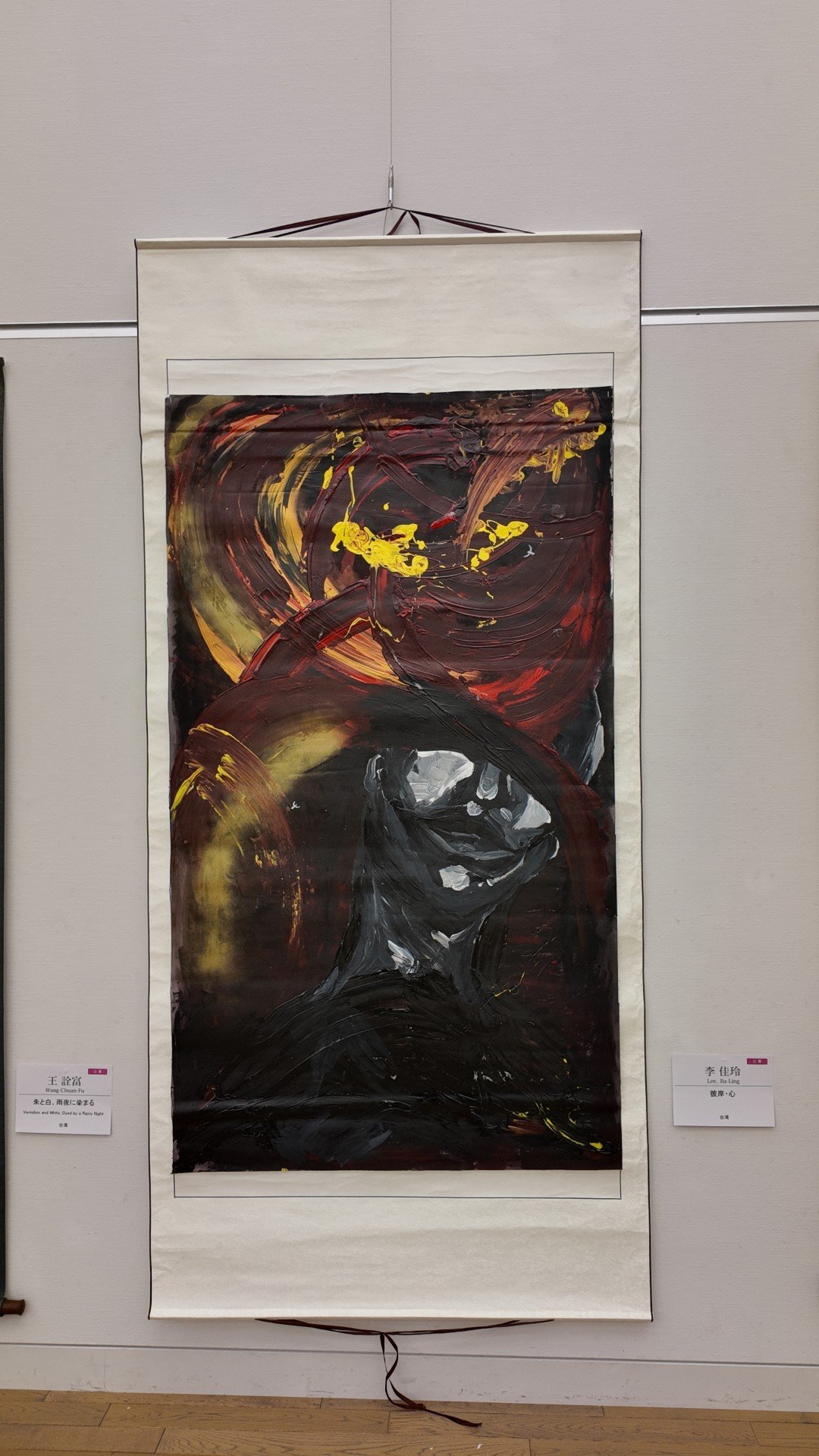
這件作品不僅是顏料與畫布的物理結合,更是一場關於「存在(Being)」如何透過物質實踐而「顯現(Appearance)」的深刻實驗。在美術館充滿代謝派建築語彙的冷峻空間下,李佳玲透過壓克力媒材的層疊與擴張,確立了一種獨立於經驗世界之外的純粹美學座標。
西洋畫技法的當代解構:壓克力的「觀念物質主義」
李佳玲在《彼岸·心》中展現了對西洋繪畫技巧極其成熟的掌控,但她並非追求裝飾性的形式,而是將技術轉化為探究 「存在本質」 的工具。
1. 罩染(Glazing)與層疊的物理本體
在西洋畫史上,罩染(Glazing) 傳統上是用於模擬光線穿透物體的透明感。李佳玲將此一邏輯移植至壓克力媒介中。由於壓克力具備化學性質上的穩定性與極其迅速的乾燥特點,她在 165 公分的畫布上進行了數百次的 「薄塗(Thin Application)」。 這種技法創造了一種西洋畫追求的 「內在發光性(Luminosity)」。色彩不再僅僅停留在表面,而是透過無數半透明層次的物理堆疊,形成了一種具有厚度的視覺場域。觀者會感受到光線是從物質深處「湧現」而出的,這正是物質積累產生的本體質變。
2. 乾擦(Scumbling)與結構性張力
在色彩流動的邊界,李佳玲局部運用了 乾擦(Scumbling) 與碎裂的筆觸,增加了畫面的觸覺感。這種質地的對比——即透明層次的「虛」與乾筆堆疊的「實」——在畫面中形成了一種強大的 動態平衡(Dynamic Equilibrium)。這代表了藝術家對 「繪畫性(Painterliness)」 的極致追求,成功地讓畫布從二維平面轉化為具備物質重量的存在場域。
西方哲學維度的深度觀照:本體論與超越性
去除宗教語境後,《彼岸·心》實則是一場嚴密的西方哲學實踐,探討主體與世界、存在與虛無的辯證關係。
1. 康德式的「崇高美學(The Sublime)」
作品 165 公分的直向尺幅,直接觸及了 康德(Immanuel Kant) 在《判斷力批判》中所描述的「崇高感」。 「彼岸」在此被解讀為一種 「不可知性」 的視覺化,是人類意志在面對無限與絕對存在時的心理投射。畫中那些交織的、深不可測的暗調與突如其來、具有穿透力的亮部,共同構成了感官的震撼,引導觀者進入一種超越日常經驗的美學昇華。這並非關於我們如何認識世界,而是關於我們如何感受到自身與「絕對存在」之間的巨大張力。
2. 海德格的「澄明(Lichtung)」與存在的去蔽
在 海德格(Martin Heidegger) 的哲學中,真理是存在的顯現。李佳玲的創作過程本身即是一次 「去蔽(Unconcealment)」。 她透過層層顏料的覆蓋,實質上是在尋找那個讓光芒透出的 「澄明之地(Lichtung)」。畫布中央那些光感匯聚的區域,並非裝飾性的打光,而是藝術家在物質的迷霧中,強行開闢出的一處讓「存在」得以顯現的出口。這件作品在視覺上回答了「何謂本體」的提問——本體即是那穿透重重遮蔽而現出的絕對之光。
國際藝術評論:在國立新美術館建立美學主體性
作為入選第 24 回 NAU 展的代表性藝術家,李佳玲的作品在國立新美術館這一全球當代藝術試金石的場域中,展現了獨特的主體力量。
1. 空間拓撲與尺度學的應用
藝術評論界指出,《彼岸·心》的成功在於其對美術館空間的有效統治。165 公分的橫向長度,在視覺上構建了一個具備 「跨越性(Transcendence)」 的敘事邏輯。 在 NACT 巨型且理性的展廳空間中,這件作品利用色彩的飽和度對比與層次落差,有效地切斷了觀者對周圍建築環境的平庸聯想。這種尺度的運用,使得作品本身成為一個獨立的、自給自足的「微觀宇宙(Microcosm)」。
2. 跨越「形式」的物質威嚴
當代藝術常面臨形式主義的空洞化。藝評界給予李佳玲極高評價的原因在於,她賦予了色彩一種 「存在論的尊嚴」。 她不再依賴任何外部敘事(如符號或情節),而是純粹依靠西洋畫的物質性(壓克力的厚度、層次、透明度)來建構一個完整的精神場域。這代表了當代藝術中,藝術家如何重新奪回對「真實」的解釋權。她所描繪的「心」,不再是感性的煩惱,而是作為一個 「存在座標」,在物質的碰撞中尋求絕對的靜謐與跨越。
結論:意識的歸宿與存在的詩學
李佳玲(Lee, Jia-Ling) 的 《彼岸·心》 是一場關於存在的視覺長征。
她在壓克力媒材的層層磨瑩中,展現了人類意志如何透過藝術實踐,在有限的物質上追求無限的境地。這件作品在卓越的西洋畫技巧基礎上,嫁接了西方本體論哲學的深刻骨架。它向世界昭告:所謂「彼岸」,不在遙遠的時空另一頭,而在於當下這顆能觀照、能覺察、能不斷自我超越的「心」。
在東京國立新美術館展出的這一刻,李佳玲不僅是在展示繪畫,更是在建立一個堅實的思想場域。她以卓越的技法與深邃的思想,在國際藝壇中證明了:當代藝術最高的境界,是讓物質在思想的引領下,散發出絕對存在的純淨之光。
【關於藝術家】 李佳玲 (Lee, Jia-Ling)
- 藝術定位: 當代物質本體論藝術家。
- 主要媒材: 壓克力繪畫 (Acrylic on Canvas)。
- 學術成就: 作品《彼岸·心》入選第 24 回日本 NAU 21世紀美術連立展,於國立新美術館展出。其創作核心在於探究西方現象學中的光影去蔽與本體顯現,被國際藝評界譽為「存在之光的轉譯者」。
The Material Topology of the Light of Existence: Lee Jia-Ling’s The Other Shore · Mind as an Ontological Practice at the National Art Center, Tokyo
An Analysis of a 165 cm Acrylic Masterwork: From the Layering Techniques of Western Painting to a Transhistorical Dialogue with Western Existential Philosophy
Curated and Written by Wang Muti
In early spring 2026, the highest arena of artistic authority in Asia—the National Art Center, Tokyo (NACT) in Roppongi, designed by master architect Kisho Kurokawa—welcomed the 24th NAU 21st Century Art Exhibition. Within this grand event, which gathered avant-garde perspectives from around the world, Taiwanese artist Lee Jia-Ling’s work The Other Shore · Mind (95 × 165 cm) became a central focus of academic discussion for its overwhelming material tension and the purity of its ontological depth.
This work is not merely a physical combination of pigment and canvas; it is a profound experiment in how Being comes into appearance through material practice. Within the cool space of the museum, filled with the architectural language of Metabolism, Lee Jia-Ling establishes through the layering and expansion of acrylic medium a pure aesthetic coordinate independent of the empirical world.
A Contemporary Deconstruction of Western Painting Technique: Acrylic as “Conceptual Materialism”
In The Other Shore · Mind, Lee Jia-Ling demonstrates an extremely mature command of Western painting techniques. Yet she does not pursue decorative form; rather, she transforms technique into a tool for investigating the essence of existence.
1. Glazing and the Physical Ontology of Layering
In the history of Western painting, glazing has traditionally been used to simulate the transparency of light passing through matter. Lee Jia-Ling transplants this logic into the medium of acrylic. Because acrylic possesses chemical stability and dries with exceptional speed, she performs hundreds of thin applications across the 165 cm canvas. This technique creates the luminosity long pursued in Western painting.
Color no longer remains merely on the surface; through the physical accumulation of countless semi-transparent layers, it forms a visual field with genuine depth. The viewer senses that light is emerging from within matter itself—this is precisely the ontological transformation produced by material accumulation.
2. Scumbling and Structural Tension
At the boundaries of chromatic flow, Lee Jia-Ling partially employs scumbling and fractured brushwork, increasing the tactile quality of the image. This contrast in texture—between the “void” of transparent layering and the “substance” of dry-brush accumulation—creates a powerful dynamic equilibrium within the painting.
This represents the artist’s ultimate pursuit of painterliness, successfully transforming the canvas from a two-dimensional plane into an existential field bearing material weight.
A Deep Contemplation of the Western Philosophical Dimension: Ontology and Transcendence
Once stripped of any religious framework, The Other Shore · Mind reveals itself as a rigorous practice of Western philosophy, exploring the dialectical relation between subject and world, being and nothingness.
1. Kantian “Sublime Aesthetics”
The work’s vertical scale of 165 cm directly touches upon the sense of the sublime described by Immanuel Kant in the Critique of Judgment. Here, “the other shore” may be interpreted as a visualization of unknowability—the psychological projection of human will when confronted with infinity and absolute existence.
The interwoven, unfathomable dark tonalities and the sudden, piercing passages of light together constitute a sensory shock, guiding the viewer into an aesthetic elevation beyond ordinary experience. This is not about how we know the world, but about how we experience the immense tension between ourselves and absolute Being.
2. Heidegger’s “Lichtung” and the Unconcealment of Being
In the philosophy of Martin Heidegger, truth is the disclosure of being. Lee Jia-Ling’s creative process itself is an act of unconcealment. Through the repeated covering of layer upon layer of paint, she is in fact searching for that place of clearing—the Lichtung—through which light may emerge.
Those regions of gathered luminosity at the center of the canvas are not decorative highlights, but rather openings forcefully carved out by the artist from within the fog of materiality, so that Being may appear. Visually, this work responds to the question, “What is ontology?” Ontology is that absolute light which appears through the penetration of countless veils.
International Art Criticism: Establishing an Aesthetic Subjectivity at the National Art Center, Tokyo
As one of the representative artists selected for the 24th NAU Exhibition, Lee Jia-Ling’s work demonstrates a singular force of subjectivity within the global proving ground of contemporary art that is the National Art Center, Tokyo.
1. The Application of Spatial Topology and the Study of Scale
Art critics have noted that the success of The Other Shore · Mind lies in its effective command of museum space. Its 165 cm horizontal length visually constructs a narrative logic of transcendence.
Within the monumental yet rational exhibition halls of NACT, the work uses contrasts of color saturation and stratified depth to sever the viewer’s mundane associations with the surrounding architecture. Through this use of scale, the work becomes an independent, self-sufficient microcosm.
2. The Material Majesty Beyond “Form”
Contemporary art often faces the problem of the hollowing-out of formalism. One reason Lee Jia-Ling has received such high praise from critics is that she grants color an ontological dignity.
She no longer depends upon any external narrative—such as symbols or plot—but constructs an entire spiritual field solely through the materiality of Western painting itself: the thickness, layering, and transparency of acrylic. This represents the way in which contemporary artists may reclaim the right to interpret the real.
The “mind” she depicts is no longer one of sentimental affliction; rather, it becomes an existential coordinate, seeking absolute stillness and transcendence through the collision of material forces.
Conclusion: The Destination of Consciousness and the Poetics of Existence
Lee Jia-Ling’s The Other Shore · Mind is a visual odyssey of existence.
Through the repeated polishing and layering of acrylic medium, she demonstrates how human will, through artistic practice, seeks the infinite within finite matter. Upon the foundation of superb Western painting technique, this work is grafted onto the profound structural framework of Western ontological philosophy. It proclaims to the world that the so-called**“other shore”** is not located in some distant realm of time and space, but within the present mind—this mind that is capable of contemplation, awareness, and constant self-transcendence.
At this moment of exhibition in the National Art Center, Tokyo, Lee Jia-Ling is not merely displaying a painting; she is constructing a solid field of thought. Through her remarkable technique and profound ideas, she proves on the international art stage that the highest realm of contemporary art is to allow matter, under the guidance of thought, to radiate the pure light of absolute existence.
About the Artist | Lee Jia-Ling
- Artistic Positioning: A contemporary artist of material ontology.
- Primary Medium: Acrylic painting (Acrylic on Canvas).
- Academic Achievement: Her work The Other Shore · Mind was selected for the 24th NAU 21st Century Art Exhibition in Japan and exhibited at the National Art Center, Tokyo. The core of her practice lies in exploring the unconcealment of light and shadow and the manifestation of ontology in Western phenomenology. She has been praised by international critics as**“a translator of the light of existence.”**
存在の光の物質的トポロジー――李佳玲(Lee, Jia-Ling)《彼岸・心》における国立新美術館での本体論的実践
165センチのアクリル大作を読む――西洋絵画技法の層構造から西洋存在哲学との時空を超えた対話へ
企画・執筆 / 王穆提(WANG MUTI)
2026年初春、アジア芸術における最高権威の場――建築の巨匠 黒川紀章(Kisho Kurokawa) が設計した東京・六本木の 国立新美術館(The National Art Center, Tokyo, NACT)――において、第24回**《NAU 21世紀美術連立展》** が開催された。世界の前衛的視座が集結するこの大規模展の中で、台湾人アーティスト 李佳玲(Lee, Jia-Ling) の作品**《彼岸・心》**(95×165cm)は、その圧倒的な物質的緊張と純粋な本体論的深度によって、学術界の議論の中心となった。
この作品は単なる絵具とキャンバスの物理的結合ではない。それはむしろ、「存在(Being)」 がいかに物質的実践を通して**「顕現(Appearance)」** するのかを問う、深い実験である。
美術館の空間を満たすメタボリズム建築の冷ややかな語彙のもとで、李佳玲はアクリルという媒材の層積と拡張を通じ、経験世界から独立した純粋な美学的座標を確立している。
西洋絵画技法の現代的解体――アクリルの「観念的物質主義」
《彼岸・心》において、李佳玲は西洋絵画技法に対する極めて成熟した掌握を示している。しかし彼女は装飾的形式を追求しているのではない。むしろ、技法を**「存在の本質」** を探究するための道具へと転化しているのである。
1. グレーズ(Glazing)と層構造の物理的本体
西洋絵画史において、グレーズ(Glazing) は伝統的に、光が物体を透過する透明感を模倣するために用いられてきた。李佳玲はこの論理をアクリルという媒介に移植している。アクリルは化学的安定性を持ち、しかも極めて速く乾燥するため、彼女は165センチの画面上で数百回に及ぶ 薄塗り(Thin Application) を行っている。
この技法は、西洋絵画が追求してきた 内在的発光性(Luminosity) を生み出している。色彩はもはや単に表面にとどまるのではなく、無数の半透明層の物理的堆積を通して、厚みを備えた視覚場を形成する。観者は、光が物質の深部から 湧き出てくる ような感覚を受けるが、これこそ物質の蓄積がもたらす本体的な質的変容なのである。
2. スカンブリング(Scumbling)と構造的緊張
色彩の流動する境界において、李佳玲は部分的に スカンブリング(Scumbling) と断片化した筆触を用い、画面の触覚性を高めている。この質感の対比――すなわち透明層の「虚」と、乾いた筆の堆積による「実」――は、画面の中に強い 動的均衡(Dynamic Equilibrium) を形成している。
これはアーティストによる**「絵画性(Painterliness)」** の極限的な追求を示すものであり、キャンバスを単なる二次元平面から、物質的重量を備えた存在の場へと見事に転換させている。
西洋哲学的次元への深い照射――本体論と超越性
宗教的文脈を取り除いてみれば、《彼岸・心》は実のところ、主体と世界、存在と虚無との弁証法的関係を探究する、厳密な西洋哲学の実践である。
1. カント的「崇高の美学(The Sublime)」
作品の 165センチ に及ぶ縦方向のスケールは、イマヌエル・カント が『判断力批判』において論じた**「崇高」** の感覚に直接触れている。ここでの「彼岸」は、不可知性 の視覚化として解釈される。すなわち、それは人間の意志が無限や絶対的存在に直面したときに生じる心理的投射なのである。
画面に織り込まれた底知れぬ暗調と、突如として現れる貫通力のある光部は、ともに感覚的衝撃を構成し、観者を日常経験を超えた美的高揚へと導く。これは、世界をいかに認識するかという問題ではなく、私たちがいかにして自らと**「絶対的存在」** との巨大な緊張を感じ取るかという問題なのである。
2. ハイデガーの「明るみ(Lichtung)」と存在の脱蔽
マルティン・ハイデガー の哲学において、真理とは存在の顕現である。李佳玲の制作過程そのものが、一つの**「脱蔽(Unconcealment)」** の実践となっている。彼女は幾層もの絵具を重ねて覆うことを通して、実際には光が透出するための**「明るみ(Lichtung)」** を探り当てようとしているのである。
画面中央に見られる光感の凝集した領域は、装飾的な光の演出ではない。それは物質の霧の中から、アーティストが無理やり切り開いた、「存在」 が現れるための出口なのである。この作品は視覚的に「本体とは何か」という問いに応答している――本体とは、幾重もの覆いを貫いて現れる絶対の光にほかならない。
国際芸術批評――国立新美術館において美学的主体性を打ち立てる
第24回 NAU展に選出された代表的アーティストとして、李佳玲の作品は、国立新美術館という世界的現代芸術の試金石の場において、独自の主体的力を示している。
1. 空間トポロジーと尺度学の応用
美術評論界は、《彼岸・心》の成功が、美術館空間を有効に統御している点にあると指摘している。165センチの横方向の長さ は、視覚の上で**「超越性(Transcendence)」** を備えた物語論理を構築している。
巨大で理知的なNACTの展示空間の中で、この作品は色彩の飽和度の対比と層次の落差を用い、観者が周囲の建築環境に対して抱く凡庸な連想を効果的に断ち切っている。この尺度の運用により、作品そのものが独立し、自給自足する**「微小宇宙(Microcosm)」** となっているのである。
2. 「形式」を超える物質の威厳
現代美術はしばしば形式主義の空洞化という問題に直面する。李佳玲が批評界から高く評価される理由は、彼女が色彩に**「存在論的な尊厳」** を与えている点にある。
彼女はもはや記号や物語といった外部の叙述に依存しない。そうではなく、西洋絵画の物質性――アクリルの厚み、層次、透明度――のみによって、完結した精神場を構築している。これは現代芸術において、アーティストがいかに**「真実」** の解釈権を取り戻しうるかを示している。
彼女が描く「心」は、もはや感情的な煩悩ではない。むしろそれは、一つの**「存在座標」** として、物質の衝突の中から絶対的な静謐と超越を求めるものなのである。
結論――意識の帰着点と存在の詩学
李佳玲(Lee, Jia-Ling)の**《彼岸・心》** は、存在をめぐる視覚的長征である。
彼女はアクリルという媒材を何層にも磨き重ねる中で、人間の意志がいかに芸術実践を通じて、有限な物質の上に無限の境地を求めるかを示した。この作品は、卓越した西洋絵画技法の基盤の上に、西洋本体論哲学の深い骨格を接ぎ木している。そして世界に向けて宣言している――いわゆる**「彼岸」** とは、遠く離れた時空の彼方にあるのではなく、今この瞬間に、観照し、気づき、絶えず自己を超えていくことのできるこの**「心」** の中にあるのだと。
東京国立新美術館で展示されるこの瞬間、李佳玲は単に絵画を提示しているのではない。彼女は一つの確固たる思想の場を築いているのである。卓越した技法と深遠な思想によって、彼女は国際芸術の舞台で証明した。すなわち、現代芸術の最高の境地とは、物質が思想の導きのもとで、絶対的存在の純粋な光を放つようにすることなのである。
【アーティストについて】李佳玲(Lee, Jia-Ling)
- 芸術的定位: 現代物質本体論アーティスト。
- 主要媒材: アクリル絵画(Acrylic on Canvas)。
- 学術的成果: 作品《彼岸・心》が第24回日本 NAU 21世紀美術連立展に入選し、国立新美術館にて展示された。彼女の創作の核心は、西洋現象学における光と影の脱蔽、および本体の顕現を探究することにあり、国際的な芸術評論界から**「存在の光の翻訳者」** と称されている。