Written by WANG MUTI
Artwork Information
Title: Numinous Realm: Alishan
Dimensions: 142 (W) × 399 (L) cm
Medium: Daisen paper (produced by Ozu Washi), ink, acrylic paint
Year: November 17, 2025
Abstract
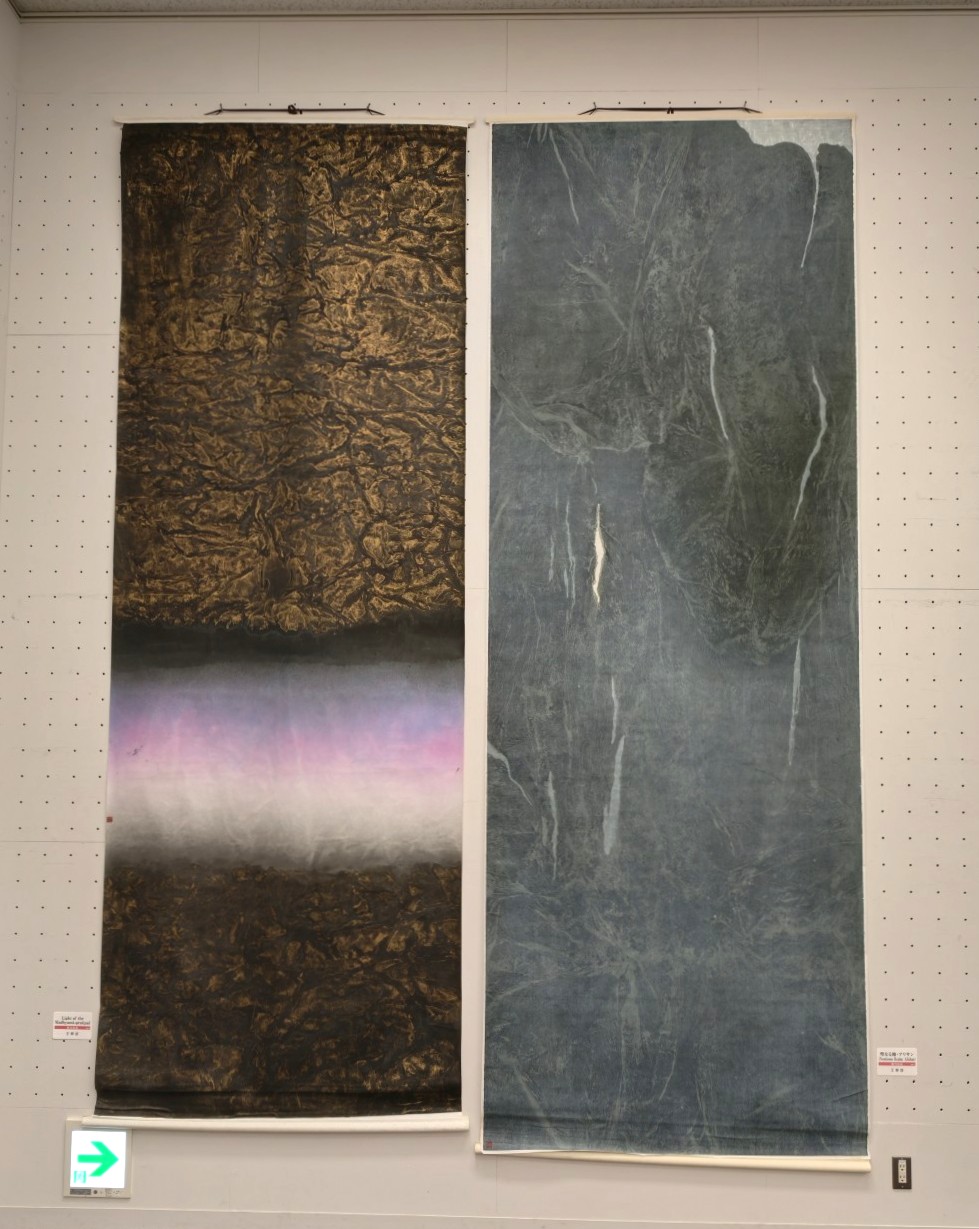
Wang Muti’s Numinous Realm: Alishan is a contemporary ink installation painting of colossal volume. On a sheet of Japanese Daisen paper measuring 399 centimeters in length, the artist utilizes the fusion of ink and acrylic paint to reconstruct the forest imagery of Alishan, Taiwan. Unlike traditional landscape painting, which focuses on depicting "scenery" (景, jing), this work leans heavily toward the distillation of a "realm" (境, jing). The interweaving of profound mineral green and ink black on the canvas resembles millennia-old moss or the bark of sacred trees, while white fissures cut through it like lightning. This essay will explore how the artwork redefines the "Sublime" in landscape painting and transforms Alishan into a spiritual symbol of pilgrimage through the permeation and accumulation of materials, the psychological suggestion of color, and its staggering vertical scale.
Vertical Presence: Scale and Bodily Phenomenology
Facing Numinous Realm: Alishan, what the viewer first experiences is not the content of the image, but the oppressive weight of its physical scale. A vertical scroll measuring 142 centimeters in width and 399 centimeters in length—this is a dimension that transcends the limits of conventional indoor display.
The Phenomenology of Looking Up
A height of 399 centimeters signifies that this artwork is an object that demands to be "looked up to." In human visual experience, looking upward is typically associated with the "sacred," the "unattainable," or "reverence" (such as gazing up at the dome of a cathedral or a towering ancient tree). Wang Muti utilizes this scale to force viewers to adjust their bodily posture before the artwork. We cannot look down and examine it playfully as we would a handscroll; we can only stand humbly before this massive "green wall."
This mode of viewing endows the painting with an architectural quality. It is no longer merely a painting hung on a wall; it has become a supporting pillar within the space, or rather, a "sacred tree" growing inside the exhibition hall. This "heaven-reaching and earth-standing" composition directly echoes the physical characteristics of Alishan's sacred tree clusters, translating the grandeur of nature into an experience of the sublime within an art space.
Endless Verticality
Unlike traditional vertical scroll landscapes, which typically encompass the three perspectives of "high distance, deep distance, and level distance" (gaoyuan, shenyuan, pingyuan), this work presents an "absolute verticality." There is no obvious horizon on the canvas, nor is there a vanishing point of perspective. It resembles a cross-section extracted from an infinite height, or an infinitely extending close-up. The viewer’s gaze is forced to wander up and down along those white textures; this visual movement simulates the dynamic sensation of climbing or falling, intensifying the uncontrollability of nature.
The Breathing of Paper: A Symphony of Daisen Paper and Medium
The choice of medium is the very soul of this work. The artist deliberately selected "Daisen paper (produced by Ozu Washi)," demonstrating his ultimate pursuit of the physical properties of the substrate.
The Memory and Bearing of Fibers
Ozu Washi is renowned for the resilience and absorbency of its fibers. In Numinous Realm: Alishan, this massive sheet of paper endures the permeation of ink and the covering of acrylic, yet it still maintains a "sense of breathing."
The textures on the canvas are not simple brushstrokes; they appear more like the results of physical interventions such as "crumpling, folding, dyeing, and rubbing" (拓, tuo). Under the artist's manipulation, the paper forms folds resembling the surface of rocks or the bark of old trees. These folds are not painted on; they are the physical memory formed by the drying and shrinking of the paper's fibers after absorbing pigment and moisture. This treatment generates a three-dimensional microscopic topography upon a two-dimensional painting, making the viewer feel as though they can reach out and touch the damp, coarse texture of Alishan.
The Symbiosis of Ink and Acrylic
Here, Wang Muti conducts an experiment concerning "water and polymer." Ink represents Eastern fluidity and permeation, while acrylic represents Western covering and materiality. In the painting, the profound black of the ink serves as the base color, establishing a heavy, solemn tone; meanwhile, the mineral-like green acrylic forms mottled color layers on the surface.
The two produce a marvelous reaction on the specially crafted Daisen paper: the acrylic does not entirely cover the ink, and the ink does not completely swallow the acrylic. They intermingle to form a turbid yet profound texture, perfectly simulating the complex ecology of a forest where light struggles to penetrate—a realm saturated with moisture and moss.
The Colors of Time: Mineral Green and Abyssal Black
Color is the most direct emotional carrier in Numinous Realm: Alishan. The artist abandons postcard-like blue skies and white clouds, opting instead to unearth the chromatic DNA hidden deep within Alishan.
Archaic Green
Occupying the main body of the canvas is an undefinable green. It is not the tender green of spring, nor the emerald green of summer, but an "archaic green" that mixes cyan-grey, deep blue, and ink black.
This color evokes malachite, the patina on ancient bronze vessels, or the moss deep in the mountains that never sees the sun year-round. It is a color that represents "time." It implies antiquity, profound silence, and slow growth. Psychologically, this abyssal green induces a sense of inner peace in the viewer, while simultaneously carrying a trace of fear toward the unknown abyss. Wang Muti has accurately captured the "time-frozen" chromatic atmosphere of Alishan's sacred forests.
The White Fissures
Scattered across the deep green-black tones are several striking white lines. They run vertically or diagonally, like lightning slashing through the night sky, like cracks in the bark of ancient trees, or even like the scars left by a landslide.
Formally, these white lines play the role of "breaking" (破, po), shattering the oppressiveness of the solid dark mass and introducing light and kinetic momentum to the canvas. Semiologically, they can be interpreted as the flow of natural energy (qi), or as a manifestation of the divine. Just as the title "Numinous Realm" suggests, these traces of light perhaps symbolize spiritual illumination piercing through the heavy wrappings of matter.
The Dialectic of Micro and Macro: Texture as Landscape
There exists an intriguing paradox of viewing distance when observing Numinous Realm: Alishan: from afar it is a mountain; up close it is a wall.
The Macroscopic Sublime
When we stand at a distance to view this nearly four-meter-tall work, it presents itself as a towering mountain mass or a giant tree touching the sky. Its overall momentum displays the "Monumental" tradition of Northern Song landscape painting—where mountains and rivers are not merely gardens for wandering and dwelling, but an awe-inspiring cosmic order.
The Microscopic Universe
However, as we approach the artwork, the macroscopic image disintegrates, replaced by a wealth of microscopic details. We see the tangling of paper fibers, the sedimentation of pigments, and the edges of watermarks. These minuscule textures inherently constitute independent abstract worlds of their own.
Through this treatment, the artist alludes to the Eastern philosophy of "To see a world in a grain of sand, and a Bodhi in a single leaf." The numinous realm of Alishan lies not only in its massive mountain body, but also within the microscopic textures of every inch of moss and every piece of bark.
Spiritual Geography: From Landscape to Numinous Realm
The artwork is titled Numinous Realm: Alishan, indicating that the artist's intention is not to sketch a physical location, but to forge a spiritual realm.
A De-landmarkized Landscape
There is no Alishan forest railway on the canvas, no figurative depiction of the sea of clouds or the sunrise, and no obvious markers of the Sister Ponds or the sacred trees. Wang Muti strips away all the tourist-postcard symbols, retaining only the "temperament" of Alishan.
This is a "de-landmarkized" treatment. Through abstraction, the artist sublimates the concrete Alishan into a universal symbol of a "numinous realm." This sacred space speaks of the primordial power of nature, the resilience of life, and the humility of humanity in the face of nature's grandeur.
An Animistic Stele
The painting itself resembles a stone stele erected in the exhibition hall. It is silent, heavy, and full of historical weight. Within the cultural context of Taiwan, the sacred trees of Alishan are often endowed with divine personhood. Wang Muti’s work acts as a monument to these sacred trees. Through painting, he recreates that religious-like experience of walking into a thousand-year-old cypress forest: where the air suddenly congeals, sound vanishes, and nothing remains but the heartbeat and breath.
Coordinates in Art History: The Exploration of Material Ink Art
By placing Wang Muti’s Numinous Realm: Alishan within the lineage of contemporary art, we can clearly identify its coordinates.
The Material Turn of Post-Ink Art
Traditional ink painting emphasizes "expressing the spirit" (xieyi), focusing on the calligraphic flavor of brush and ink. Wang Muti’s work, however, belongs to "Post-Ink" or "Material Ink Art." He focuses far more on the "Materiality" of the medium itself. He lets the paper speak, lets the pigments accumulate, and makes texture the protagonist. This approach shares a similar underlying concept with post-WWII Western Matter Painting (such as Antoni Tàpies), yet its inner core remains firmly rooted in an Eastern view of nature.
Echoes of Abstract Expressionism
The "All-over" composition of the canvas and its intense emotional tension also bring Abstract Expressionism to mind (such as the color-field paintings of Clyfford Still). But unlike Western artists who emphasize personal explosion and catharsis, Wang Muti’s canvas carries an additional layer of Eastern "subtlety" and "sedimentation." His passion is introverted, sealed beneath heavy textures.
Conclusion: A Frozen Natural History
In summary, Wang Muti’s Numinous Realm: Alishan is a masterpiece of profound impact.
With a grand scale of 399 centimeters, the artist challenges the viewer's visual limits and bodily experience. Through his precise mastery of the characteristics of Daisen paper and the innovative integration of ink and acrylic paint, he successfully translates the natural landscape of Alishan into a purely spiritual experience.
The deep, archaic green tones and mottled textures in the painting seem like rubbings of Alishan's geology and vegetation, recording millions of years of wind, rain, and growth. This is not a painting about a landscape; it is a monument to time and life. Facing this artwork, it is as if we can hear the breathing deep within the forest and feel the pulse of the earth.
With Numinous Realm: Alishan, Wang Muti proves that contemporary ink art still possesses the capacity to handle grand narratives and sublime aesthetics. He provides us with a portal, allowing us, amidst the clamor of modern life, to instantaneously traverse time and return to that ancient, tranquil, and deeply divine natural sanctuary.