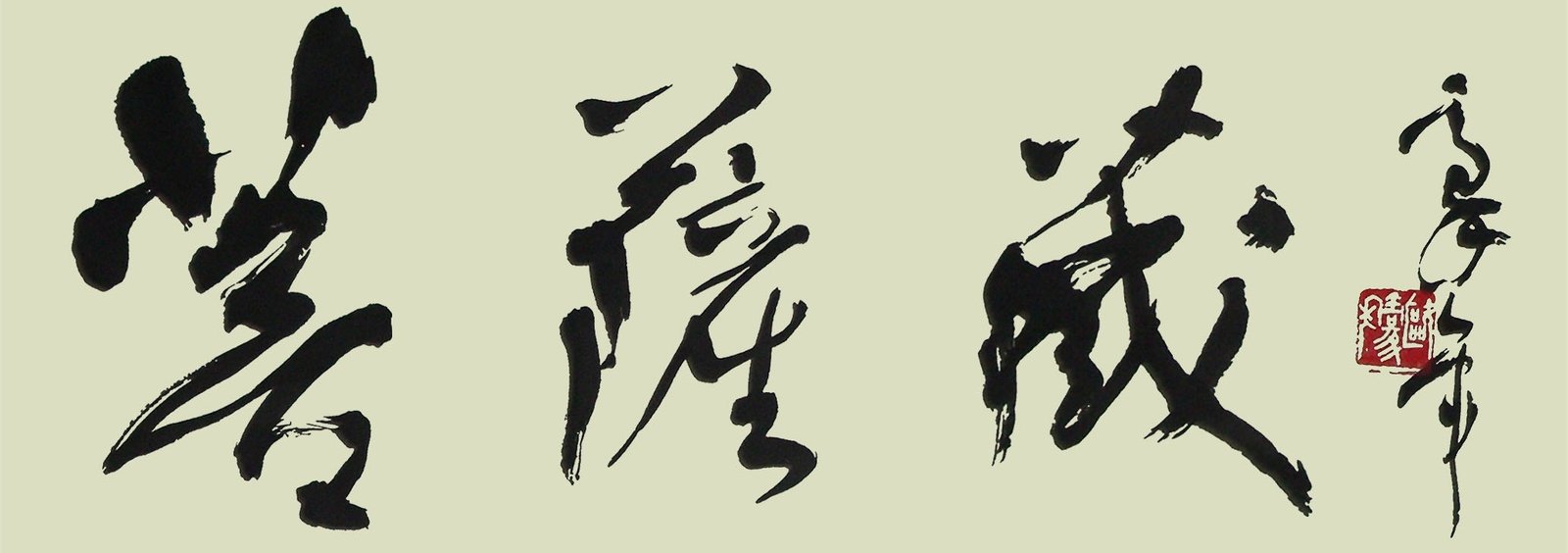
Resonance of the Primordial Source and Nature’s Music: Lien Jui-Fen’s Great Sound is Scarcely Heard No. 2 from the Perspectives of Kant’s "Dynamical Sublime" and Zhuangzi’s "Great Sound"
— An Analysis of Dynamic Logic and Transcendental Translation of Material Energy in a 180cm Diptych
Curated & Written by WANG MUTI
Introduction: The Pursuit of Being at NACT
At the National Art Center, Tokyo (NACT), designed by architectural master Kisho Kurokawa, the 24th "NAU 21st Century Art Association Exhibition" showcased the latest explorations into "Absolute Being." Taiwanese artist Lien Jui-Fen’s work, Great Sound is Scarcely Heard No. 2 (180x70cm x 2), constructs a colossal dynamic field through the use of canvas, Xuan paper, Chinese ink, and gouache. This work is a trans-temporal dialogue between Immanuel Kant’s "Dynamical Sublime" and the Taoist concept of "Nature’s Music" (Tianlai), leading the viewer from sensory shock to ontological stillness.
I. The Dynamic Logic of the Sublime: Majestic Eruption of Media
The momentum of ink on Lien's canvas precisely corresponds to Kant’s definition of the "Dynamical Sublime." It is a process where nature appears as a fearsome power, yet the subject perceives spiritual transcendence from a safe aesthetic distance.
- Absolute Momentum from Medial Conflict
- Mounting Xuan paper onto canvas creates a foundation of "heterogeneous conflict." The rapid absorption of ink by the capillaries of Xuan paper symbolizes an irresistible natural kinetic energy, while the structural tension of the canvas provides necessary braking. This "Dynamic Topology" allows the viewer to experience a profound tension that overwhelms the senses.
- Density Narrative of Gouache and Ink
- The opacity of gouache creates material "nodes" on the surface, contrasting with the transparent flow of ink. This "dialectics of gravity and buoyancy" contains an immense potential of dynamic power within its silence.
II. Infiltration of Zhuangzi’s Aesthetics: Great Sound and Tianlai
- Nature’s Music (Tianlai): The Sound of the Soundless
- According to Zhuangzi, Tianlai is the self-sounding of all things. When color and moisture achieve an ultimate dialogue on Xuan paper, an "absolute silence" arises. This is the "Great Sound" that appears silent to the senses because its frequency encompasses the entirety of the universe.
- Luminous Void (Xu Shi Sheng Bai): Clarity within Chaos
- In the most chaotic regions of ink, Lien preserves an ultimate void. This is the ontological practice of "The Empty Room Produces Light" (Xu Shi Sheng Bai). This light emerging from chaos symbolizes a stable center of wisdom established through spiritual purification (Xin Zhai).
III. The Realm of Ying-Ning: Micro-Technological Interaction at the Edges
- Ying-Ning: Stillness Attained Through Disturbance
- In Zhuangzi’s The Great Ancestral Teacher, "Ying-Ning" refers to a state of being achieved through conflict and chaos. The microscopic "folds" at the edges where ink meets gouache demonstrate physical disturbance (Ying), yet are sublime in their controlled stillness (Ning) within the 180cm field.
- The Micro-Battle of Light and Shadow
- The "abyssal" nature of the ink and the "solid" nature of the gouache collide at the edges, creating material faults. By preserving these raw physical frictions, Lien captures the residual shadows of the moment when existence undergoes transformation.
IV. Interstitial Aesthetics: Ontological Unity Through Rupture
The physical gap of a few centimeters between the two panels is the most energetic non-material field in this work.
- Dynamics of Rupture and Crossing
- As the viewer’s gaze moves from the left panel to the right, it must cross the physical void. This "rupture" prompts the intervention of reason, forcing the viewer to bridge the dynamic flow within their own spirit.
- The Interstice as a Spiritual Backbone
- This vertical gap acts as the "visual backbone" of the work. It is a crack through which one can glimpse the unified, primordial "Tao" that exists behind the complex material world.
V. Conclusion: A Dynamic Monument in Silence
Lien Jui-Fen has successfully integrated the materiality of Western painting with the Taoist wisdom of "Ying-Ning," establishing a spiritual coordinate that radiates the eternal light of the subject. This work proves that the most majestic "Great Sound" is not a physical acoustic, but the absolute silence that resonates within the "Primordial Source."
About the Artist: LIEN Jui-Fen
- Positioning: Contemporary Mixed Media Ontological Artist / Explorer of Visual Mechanics.
- Key Achievement: Selected for the 24th NAU Exhibition at the National Art Center, Tokyo.
- Core Philosophy: Translating "Force" and "Silence" into visual architecture through the physical interaction of diverse media.