The Wild Dance of Ink: Chen Fu-Chi’s Action Writing and the Rhythms of the Body
The 24th NAU 21st Century Art Exhibition in Japan: A Complete Record and In-Depth Critical Review of Taiwanese Artist Chen Fu-Chi’s Participation
Curated and Written by Wang Muti
A Whirlwind in Roppongi — When Taiji Calligraphic Art and Cursive Script Intervene in the White Cube
Early spring, 2026. Roppongi, Tokyo.
The National Art Center, Tokyo (NACT), designed by master architect Kisho Kurokawa, constructs a rational temple of art through its vast glass curtain wall and cool geometric structure.
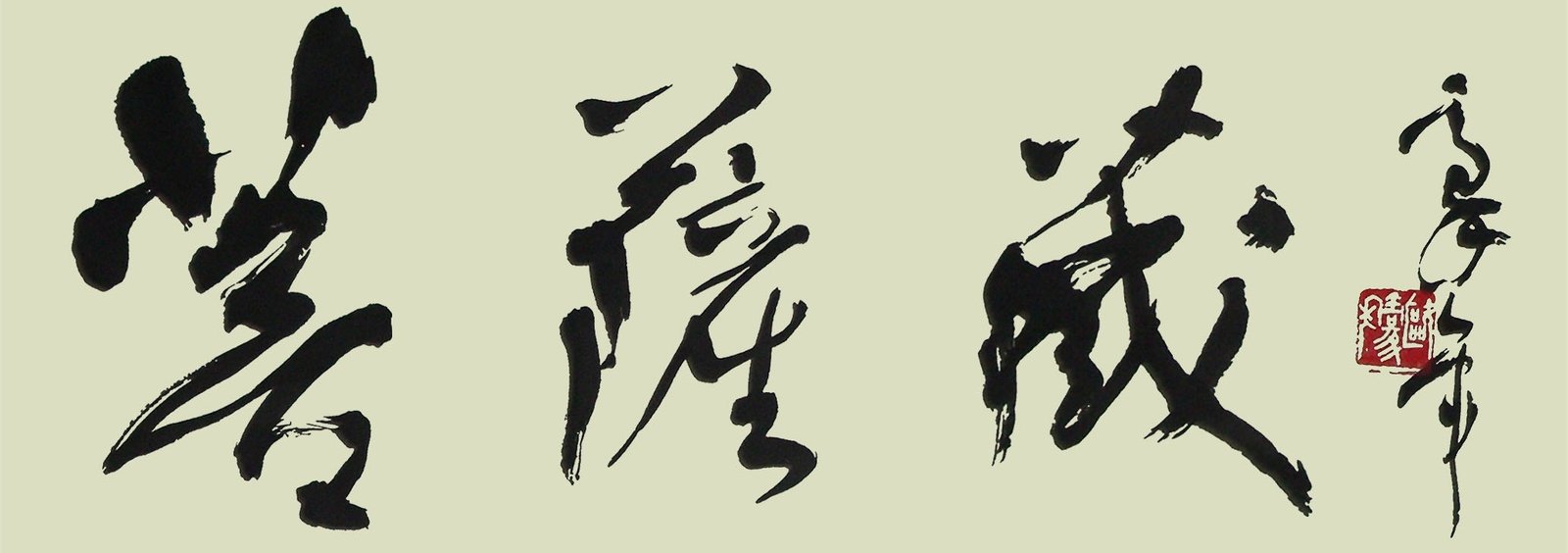
Yet within the exhibition halls of The 24th NAU 21st Century Art Exhibition in Japan, a black whirlwind from Taiwan shattered this stillness. It was the diptych hanging-scroll ink work by artist Chen Fu-Chi — Dance. Chen Fu-Chi is truly a**“dancer of ink.”** He abandons the depiction of external objects and instead uses the speed of line and the density of ink tones to leave upon paper a visual record of the rhythm of life.
This group of works is not merely painting hung on a wall, but more like a**“solidified performance site.”** The viewer seems almost able to hear the rustling sound of the brush rubbing against paper and to see the very instant when the ink splashes outward. With the most traditional of media, Chen Fu-Chi demonstrates the most contemporary kind of agency.
The Phenomenology of the Site
Exploding the Energy of Ink Within Kisho Kurokawa’s Quiet Vessel
To exhibit ink painting in a huge modernist space such as the National Art Center, Tokyo, the greatest challenge facing the artist is this: How can a flat sheet of paper generate a sense of volume capable of confronting the surrounding space?
1. The Contemporary Turn of the Hanging Scroll
Chen Fu-Chi chose the traditional hanging scroll format (137 × 69 cm). In ancient times, hanging scrolls were designed to suit the high walls of halls; in the contemporary museum, this verticality becomes a strong form of intervention.
Suspended upon the exhibition wall, the works resemble two bolts of black lightning slicing open the white space. This elongated proportion intensifies the force of the lines that pierce vertically through the picture, compelling the viewer’s gaze to move rapidly with the brushwork.
2. The Extreme Tension of Black and White
The exhibition halls of NACT are evenly and brightly lit. In such an environment, color can easily be diluted by ambient light, but black and white are intensified.
Chen Fu-Chi abandons all color and works only with pure ink. This minimalist strategy, set amid the complexity of contemporary art exhibitions, instead produces a kind of visual purification. That deep black becomes like a light-absorbing body, drawing in the surrounding noise and leaving only the vibration of pure energy.
A Deep Deconstruction of the Work
The Visual Rhetoric and Diptych Variation of Dance
This body of work is titled Dance, yet there is no dancer in the painting — only the trace of dance itself.
The Core of Concentration
The Weight of Ink
At the center of each composition is a large, dense mass of ink. This is not random smearing, but a highly controlled process of splashed ink and accumulated ink.
- Ink resonance: This mass of black ink is not dead black, but full of layers. At its outer edges are soft halos of diluted ink spreading through moisture by capillary action, while at the center it is so saturated that it seems almost ready to drip.
- Metaphor: This symbolizes the dancer’s dantian, or core energy center. All movement issues from here, and all breath-energy gathers here. It gives the composition a stable center of gravity, preventing the soaring lines from collapsing into disorder.
The Flight of Line
The Flow of Qi
Surrounding this central ink mass are countless flying lines.
- Brushwork: Chen Fu-Chi employs the brush spirit of wild cursive script, and perhaps even makes use of split brush tips or dry brush. At times the lines are coarse and forceful like iron whips; at other times they are as fine as drifting silk threads.
- Dynamics: These lines manifest a trajectory of centrifugal force. They shoot outward, rotate, and intertwine, like the sweeping water sleeves of a dancer or the whirling hem of a spinning skirt.
- Sense of speed: The viewer can clearly identify the speed of the brush — where it stops abruptly, where it accelerates, where it turns in a spiral. This visualization of speed is one of the most captivating aspects of Dance.
The Presence of the Body
A Cross-Disciplinary Translation from “Painting” to “Dance”
Chen Fu-Chi’s work embodies an important concept in contemporary art: corporeality.
1. Brush and Ink as Body
In traditional painting, the body is hidden, leaving behind only the image. But in Chen Fu-Chi’s work, the body is an absent presence.
Every brushstroke is a direct record of the artist’s arm swinging, waist twisting, and breathing in and out.
- When we see that long sweeping line cutting across the surface, we seem to feel the muscular tension in the artist’s arm as it swung.
- When we see that burst of splattered ink, we seem to feel the explosive force of the brush tip striking the paper.
- This is not painting a dance — this is itself a dance upon paper.
2. A Modern Interpretation of the Shared Origin of Calligraphy and Painting
Chinese aesthetics speaks of the principle that calligraphy and painting share the same origin. Chen Fu-Chi pushes the calligraphic spirit of xieyi — expressive writing — to an extreme.
He is no longer confined by the structure of written characters (even though there is a signature in the work, the main body is abstract). Instead, he extracts the aesthetics of line from calligraphy — lifting and pressing, pauses and turns, heaviness and lightness, slowness and urgency. He liberates calligraphy from the function of semantics and restores it to pure expression.
A Philosophical Gaze
Zhuangzi’s “Free and Easy Wandering” and the Freedom of Contemporary Ink
The title Dance recalls Nietzsche’s phrase: “Every day on which one has not danced is a loss to life.” Yet in an Eastern context, this is even closer to Zhuangzi’s idea of free and easy wandering.
1. The Liberated Spirit
The lines in the painting are unconstrained, breaking through the traditional demands of compositional balance and the conventions of empty space in ink painting. This is a kind of spiritual liberation.
Under the discipline of modern society, the human body and mind are often stiffened and constrained. Through such wild brush-and-ink expression, Chen Fu-Chi attempts to recover the most original form of free will in life.
2. Order Within Chaos
The lines may appear chaotic, but in fact they follow an inner order of rhythmic vitality. This is what Daoist thought calls**“the Way follows nature.”**
Disordered, yet ordered; dynamic, yet rooted. This painting presents a kind of dynamic equilibrium — within extreme turbulence, it still maintains a stable core (that dense mass of ink). This is precisely the wisdom of survival most needed by contemporary people in a world of constant flux.
A Dialogue of Genealogies
The Brush-and-Ink Connection Between Inoue Yuichi, Pollock, and Chen Fu-Chi
Placed within the coordinates of art history, Chen Fu-Chi’s work clearly reveals a convergence of Eastern and Western art.
1. The East: A Dialogue with Inoue Yuichi
The postwar Japanese calligraphy master Inoue Yuichi was famous for his “poor calligraphy” and bold single-character works. What Chen Fu-Chi shares with him is that same attitude of life struggling against itself.
Yet unlike Inoue Yuichi’s devotion to the character, Chen Fu-Chi moves toward a more radical abstraction. He retains the flesh and bones of calligraphy, while discarding the outer skin of the written word.
2. The West: A Dialogue with Jackson Pollock
The “drip paintings” of the great American Abstract Expressionist Jackson Pollock emphasized the process of action. Chen Fu-Chi’s work similarly possesses the qualities of action painting.
But unlike Pollock’s unconscious drip, every stroke by Chen Fu-Chi carries the control of Eastern brush-and-ink practice. It is the precise command of the brush tip acquired through long training. This is a kind of conscious wildness.
A Dynamic Breakthrough in the NAU Exhibition Space
At The 24th NAU 21st Century Art Exhibition, Chen Fu-Chi’s work possesses an exceptionally high degree of recognizability.
1. Visual Flow
Among many static paintings and installation works, Chen Fu-Chi’s Dance offers a powerful sense of movement.
As viewers pass by the work, their gaze is involuntarily drawn along the soaring lines. This gives the work a kind of guiding force within the exhibition, making it a visual climax along the route of movement.
2. At Once the Most Eastern and the Most Modern
Ink painting is Eastern; abstraction is modern. Chen Fu-Chi combines the two perfectly.
For Japanese viewers, the brushwork evokes a familiar calligraphic aesthetic; for Western viewers, the composition reveals the tension of Abstract Expressionism. This double readability is the key to his success in international exhibitions.
Ink Traces as Heart Traces — The Vital Force of Taiwanese Contemporary Ink
Chen Fu-Chi’s exhibition in Roppongi, Tokyo, is a victory of qi.
He relies neither on dazzling color nor on complicated concepts; with only one brush, one dish of ink, and one sheet of paper, he creates a visual force powerful enough to shake the heart.
Dance tells us this: ink painting has never become outdated, because it is directly connected to the human body and breath. As long as human beings continue to breathe and move, this art form — which records the rhythms of life — will always remain contemporary.
Under the spotlights of the National Art Center, Tokyo, those wildly soaring traces of ink left by Chen Fu-Chi stand as the finest proof of the vital force of Taiwanese contemporary ink art.
Artist Data File
- Artist: Chen Fu-Chi
- Selected Exhibition: The 24th NAU 21st Century Art Exhibition in Japan
- Exhibition Venue: National Art Center, Tokyo, Japan
- Exhibited Work:
- Title: Dance
- Format: Hanging Scroll
- Medium: Ink on Paper
- Dimensions: 137 × 69 cm (each panel)
- Year: 2023
- Style Keywords: Contemporary Ink, Taiji Calligraphic Art, Wild Cursive Brushwork, Action Painting, Abstract Expression, Rhythmic Vitality