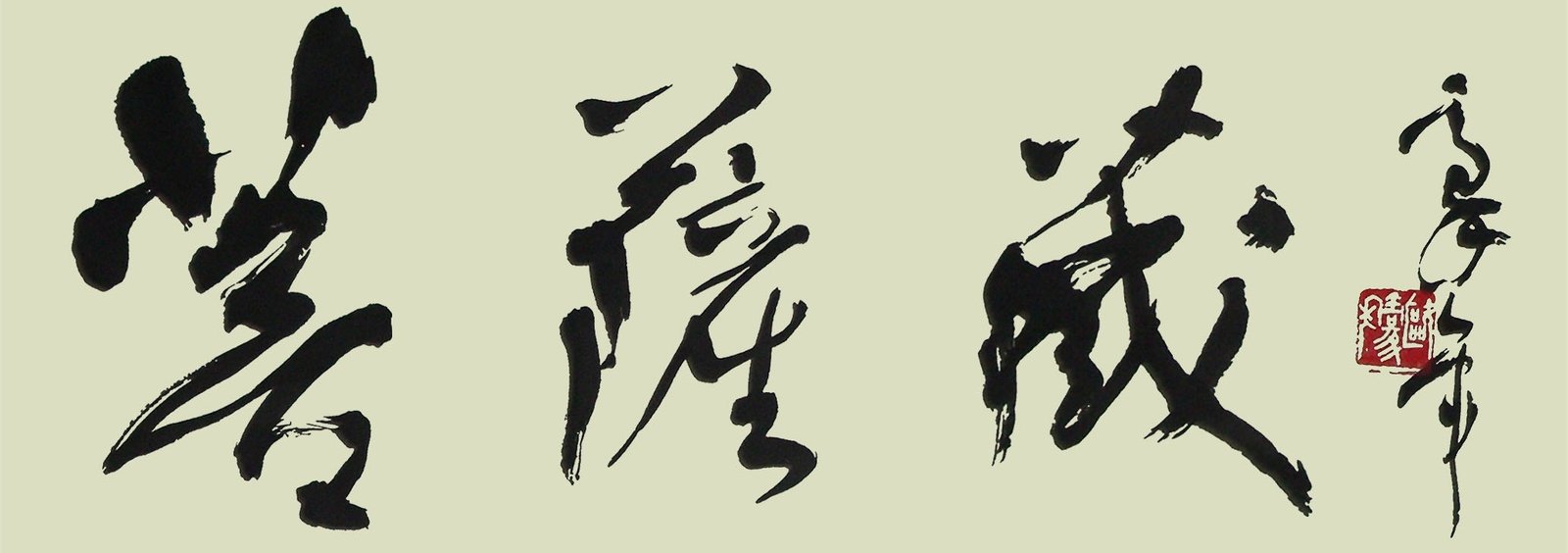
當代水墨的本體論轉向
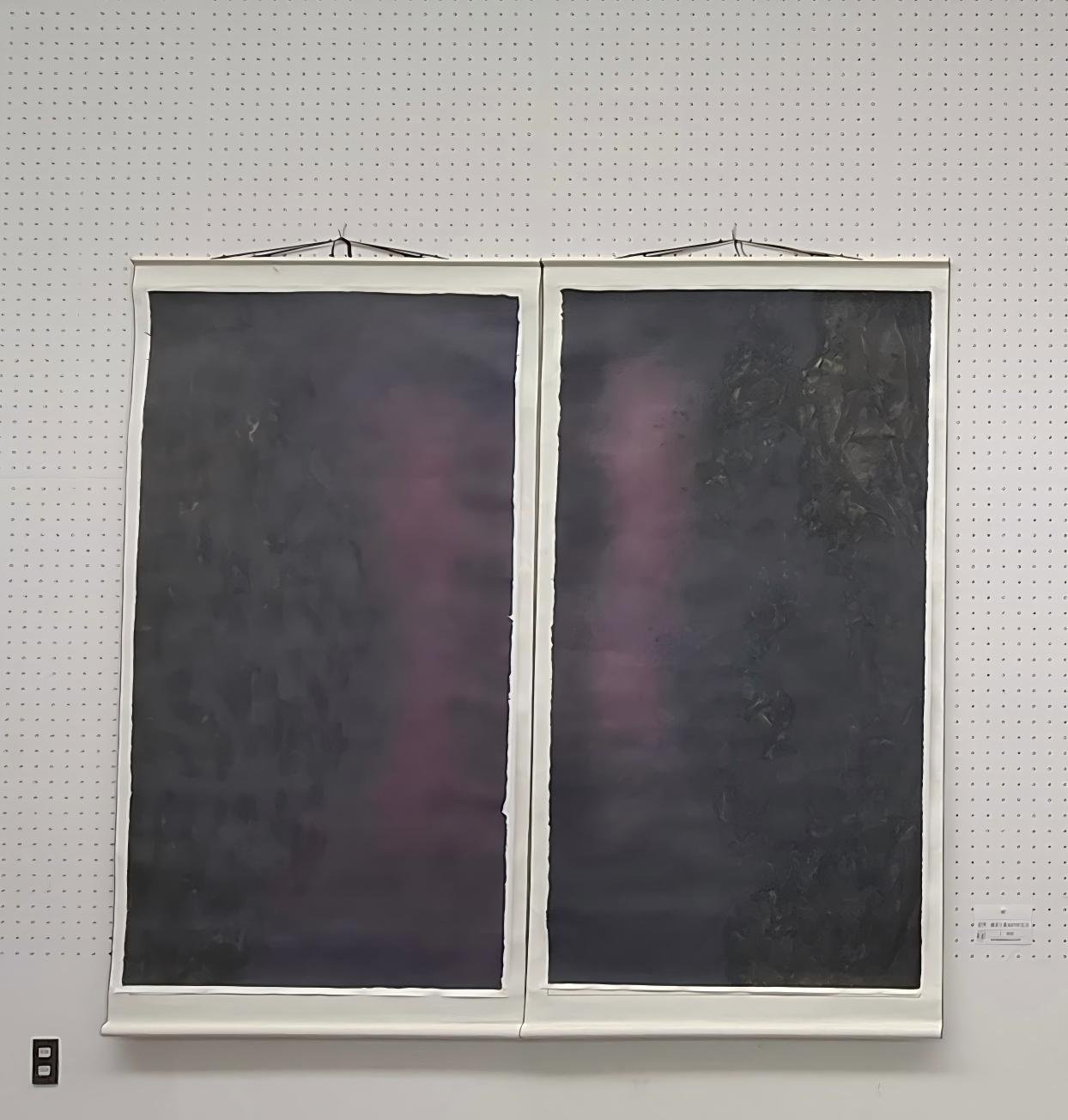
王穆提的作品標誌著一種從「再現自然」向「物質本體」與「超驗意識」的激進轉向。在這97x180cmx2 的巨幅場域中,他透過其標誌性的特殊技法與高密度的墨色沈積,構建了一個處於混沌與秩序、毀滅與新生邊緣的視覺圖騰。這不僅是視覺的呈現,更是一場關於佛教唯識學(Yogacara)中「識變」過程與中觀學(Madhyamaka)中「空性」真理的視覺實踐。
形式語言與材質現象學的解構
褶皺的本體論:技法的再進化
王穆提在宣紙上的處理,已不再僅僅是增加視覺肌理的手段,而演變成一種「身體性的體證」。在作品兩側邊緣,金色的光澤與墨跡在層疊的褶皺中遊走,這種處理創造了德勒茲(Gilles Deleuze)意義上的「褶皺」(The Fold)。
- 肌理的物質性:褶皺將二維的宣紙轉化為帶有深度、阻力與厚度的「地質剖面」。
- 光影的捕捉:金色的運用不再是裝飾性的點綴,而是如同拜占庭聖像畫中的「非自然光」,代表著神聖性在物質裂縫中的噴湧。
構圖的建築感:對稱與虛空的廊道
作品採取了強大的垂直軸線對位。兩側是沈重、粗糲、充滿質感的「實體」,中間則留出一條垂直的、瀰漫著紫色靈光的「虛空廊道」。
- 視覺的吸納:中央的廊道在視覺上形成了一種「隧道效應」,引導觀者的視點進入意識的深處。
- 靜謐的張力:這條廊道代表了「靜止的中心」,在兩側激烈的墨跡衝突中,維持了一種極其神聖的寧靜感。
佛教唯識學視角——阿賴耶識的圖譜
在唯識學(Vijnapti-matra)的框架下,世界並非外在於心的客觀存在,而是阿頼耶識(第八識)的變現。
識變(Vijnana-parinama):種子與現行的視覺化
唯識學認為,萬法皆由「阿賴耶識」(第八識)中的「種子」現行而生。
- 墨點與斑塊的隱喻:畫面上那些破碎、糾結、深淺不一的墨痕與金色斑點,隱喻著潛阿頼耶識(第八識)中不斷生滅的「業種子」。
- 變現過程:中央那條紫色的廊道,可以被視為「轉識成智」的過程——在混沌的識流中,清淨的能量正在上升。
三自性(The Three Natures)的視覺表現
我們可以將畫面的視覺元素與「三自性」一一對照:
1. 遍計所執性(Imagined Nature):觀者在那些複雜肌理中試圖看出的「山石」、「火光」或「星雲」等具象幻覺,是名言與概念對實相的遮蔽。
2. 依他起性(Dependent Nature):體現在墨色因紙張、水分、重力與色彩交織而成的網絡。畫面上沒有一個點是獨立存在的,它們相互依存,反映了緣起的動態過程。
3. 圓成實性(Perfected Nature):體現在那條中央廊道所透出的、不具形象的紫紅靈光。這代表了穿透表象後的、如其所是的「真如」。
中觀學視角——真空妙有與中道美學
中觀學的核心在於對「空性」(Sunyata)的體證,即萬物無自性,不落存在與不存在的兩邊。
緣起性空:色與空的辯證
王穆提在這件作品中完美演繹了「色即是空」。
- 色的沈重:兩側的岩層、金色光澤、深色背景,雖然在視覺上極其堅實(色),但細看之下,皆是宣紙褶皺與墨色偶然聚合的結果。這種堅實感是脆弱的,揭示了萬物「無自性」的本質。
- 空的妙有:中央的虛空(空性)並非一無所有。它散發著溫潤、深邃的紫色光華,這即是「真空妙有」。空不是斷滅的黑洞,而是孕育萬物的無限可能性。
二諦不異(The Non-duality of Two Truths)
- 俗諦(Conventional Truth):繁複的肌理、金色的閃爍、紫色的光流。
- 真諦(Ultimate Truth):作品整體的寂靜、超越形象的空靈。
藝術家讓這兩者在同一幅畫面上並存。正如中觀學所強調的,不離開世俗現象去尋找真理,真理就在現象的褶皺之中。
---
當代評論與藝術座標定位
靈光(Aura)的復歸
在本雅明(Walter Benjamin)感嘆機械複製時代靈光消逝的今天,王穆提的作品卻重新找回了那種「不可觸及」的藝術靈光。透過繁複的手工介入,他賦予了作品一種祭壇畫般的莊嚴,使觀者在作品前產生一種「臨場感」。
崇高美學(The Sublime)的東方轉譯
康德(Kant)認為,崇高來自於面對巨大的自然或力量時,人類理性的覺醒。王穆提的崇高感並非西方式的「外在擴張」,而是東方式的「內向收斂」。在 180 公分的高度面前,觀者感到渺小,但中央的廊道又給予了一種向上的、神聖的指引。
微觀的宇宙學——積墨、皺褶與「觸覺視覺」的深度
王穆提的作品拒絕了傳統水墨畫的「窗口透視」,轉而構建了一種「皮膚透視」。
褶皺作為意識的地理學
當觀者逼近這件雙聯作,視線會被那些如同地殼變動後留下的褶皺所捕獲。在宣紙纖維的斷裂與重組中,墨色不再是被動的塗抹,而是主動的沈積。
- 物理阻力與心理厚度:特殊技法產生的物理凹凸,迫使水墨在流動時產生了不可預測的停留與轉折。這象徵著意識在面對現實境遇(業力)時的阻礙與抗衡。
- 物質的受難與昇華:紙張在積墨的過程中獲得了如岩石、如鋼鐵般的意志感。這呼應了海德格爾(Heidegger)關於「大地」的論述——物質在作品中並未被消耗,而是獲得了自我的顯現。
金色與黑色:毀滅中的神聖顯現
作品邊緣處那些若隱若現的金粉色澤,在深邃的墨影中顯得格外跳脫。
- 非物質的光影:不同於西方的明暗對照法(Chiaroscuro),王穆提的金色光澤是從物質的「傷口」(褶皺)中滲透出來的。
- 煉金術的轉化:黑色代表著混沌(Chaos)與未分化的本初狀態,而金色則代表了覺醒的意志。兩者的糾纏,視覺化了精神在沈重的世俗生活中淬煉而出的過程。
---
中觀學進階分析——「八不中道」的構圖邏輯
中觀學的核心是透過否定兩極的「中道」來體證實相。王穆提的構圖精準地實踐了這一點。
不生不滅與不常不斷的空間
- 邊界的流動性:觀察作品的左右邊緣,墨跡並非終止於畫幅,而是以一種向外擴散的趨勢與白牆交融。這種「不生不滅」的邊界處理,暗示了法界(Dharmadhatu)的無限性。
- 光流的連續與斷裂:中央的紫色廊道呈現出一種瀰漫、非線性的流動感。它既不是恆常不變的實體,也不是斷滅的虛無。這種「不常不斷」的視覺節奏,讓觀者感受到生命能量的動態平衡。
一與異的對位
雙聯作(Diptych)的形式本身就是「不一不異」的寫照。
- 形式的對稱(不異):兩幅畫作共享相同的技法語彙、色彩邏輯與構圖氣勢,構成一個完整的「一」。
- 肌理的獨特性(不一):每一道褶皺、每一處墨漬都是因緣偶合下的孤品。這種「在統一中存在差異」的辯證,反映了萬事萬物互為因果、相依相待的實相。
唯識學的終極實踐——「轉依」與紫色的靈光
在這件作品中,最引人注目的是中央那抹幽深、神秘的紫色廊道。這在唯識學中具有極高的象徵意義。
轉識成智的視覺演喻
唯識學認為修行的過程是「轉識成智」,即將染污的八識轉化為清淨的四智。
- 墨與金的染污(阿賴耶識):兩側翻滾、厚重、帶有執取意味的墨塊,代表了「遍計所執」的妄想。
- 紫色的純淨(大圓鏡智):中央那道光。紫色在傳統中代表高貴與神聖,在這裡它被用來象徵「轉依」(Asraya-parivrtti)後、本自清淨的識體。它在黑與金的擠壓中,開闢出了一條通往解脫的虛擬路徑。
意識的深度與「現量」境界
王穆提的作品不提供可供解釋的對象,它只提供一種「現量」(Pratyaksha)的感知體驗。
- 無分別智的觀照:觀者在面對中央廊道的紫色瀰漫時,理性思維會短暫中斷。在那一瞬間,沒有「我看山」或「我看畫」的二元對立,只有純粹的、當下的「覺察」。
- 心靈的呼吸室:兩側的沈重迫使意識向內收斂,而中央的紫色則給予意識一個擴張、呼吸、進而消融的空間。
藝術評論——當代水墨的「負建築」與「內在風景」
王穆提的作品與現代建築大師隈研吾(Kengo Kuma)提出的「負建築」理念有著精神上的共通點。
消失的自我:反表現主義的書寫
儘管畫面張力巨大,但我們在畫面上幾乎找不到傳統水墨中那種誇張的、具有表演性的「個人筆蹤」。
- 技法的去中心化:將藝術家的手感隱藏在物質的隨機性背後。這是一種「無我的書寫」,藝術家將主觀意志讓位於物質與法性的自然運作。
- 紀念碑性的消解:作品雖巨大,卻不具有權威式的壓迫。它像是一座被時間風化的廢墟,邀請觀者進入,而非對觀者訓話。
全域繪畫(All-over Painting)的東方化
王穆提在 97x180cmx2 的垂直尺幅內,實踐了類似西方抽象表現主義的「全域繪畫」。
- 結構的消融:沒有山石的輪廓,只有肌理的波動。這種處理方式挑戰了觀者對「形」的依賴,引導我們去關注「氣」(Energy)與「韻」(Rhythm)。
神聖幾何學——中央廊道與「世界軸」(Axis Mundi)
在《寂照》這件作品中,中央那條瀰漫著紫色靈光的垂直廊道,是整個視覺系統的靈魂核心。
虛空的結構化
不同於傳統山水畫中作為背景的雲煙,這條廊道具有強烈的幾何驅動力。
- 垂直性的昇華:180公分的高度形成了一種向上的牽引力。在神聖建築學中,垂直線代表著天與地的溝通。這條廊道即是作品中的「世界軸」,是觀者意識從沈重的物質界(兩側墨跡)向超驗界(中央靈光)躍遷的通道。
- 對稱的穩定性:左右兩幅畫作的對位,形成了一種如同聖殿入口的儀式感。這種「對稱」並非機械的複刻,而是在「依他起性」的因緣流動中,尋求到的一種暫時性的、動態的定力。
紫色的現象學還原
紫色在光譜中位於可見光的極限,代表著「轉化」與「過渡」。
- 非具象的光照:這抹紫光並非來自太陽或月亮,而是藝術家透過「積墨」與「設色」交織出的心靈光輝。它代表了「真如」(Tathata)在現象界中的投影。
- 視覺的洗滌:觀者在被兩側密集的褶皺肌理所疲憊後,中央的紫色提供了一種「視覺消解」的功能,引導意識進入無分別的冥想狀態。
柏格森的「綿延」與水墨的沈積時間
王穆提的作品不只是空間的藝術,更是時間的藝術。
凝固的流動
透過反覆染墨,每一層墨跡的乾涸、滲透、再次重疊,都記錄了物理時間的流逝。
- 綿延(Duration)的具象化:柏格森認為時間是不可分割的質量疊加。在畫面上,觀者可以讀到藝術家創作時的律動與停頓。這種「積墨」的過程,就是將當下的意識片段,層層堆疊成永恆的視覺實體。
- 熵的逆轉:紙張的破碎本是趨向混亂(熵增),但藝術家透過水墨的梳理與結構的營造,使其轉化為高度有序的精神景觀。
剎那與永恆
每一處金色的閃爍,都代表了一個覺醒的「剎那」;而整幅雙聯作的沈穩構圖,則代表了意識的「永恆」。這對應了唯識學中「剎那生滅」與「種子恆隨」的辯證統一。
藝術史互文——從龔賢的積墨到紐曼的「拉鍊」
王穆提的作品在當代語境下,成功地在東西方大師之間開闢了第三條道路。
龔賢積墨的當代轉向
明末清初畫家龔賢以「積墨法」營造黑色的厚重感,但在王穆提手中,積墨與物質性(Materiality)結合得更為徹底。
- 從筆法到質感:龔賢追求的是「墨氣」,王穆提追求的是「物質的覺醒」。他讓宣紙本身參與到構建力量的過程中,使水墨畫具備了當代雕塑般的體感。
巴內特·紐曼(Barnett Newman)的東方回響
西方抽象大師紐曼以垂直的「拉鍊」(Zip)切開空間,追求「崇高」(Sublime)。
- 結構的共鳴:王穆提中央的紫色廊道,在形式上具有類似紐曼拉鍊的震撼力。
- 精神的分野:紐曼追求的是上帝創造世界時第一道光的絕對性;而王穆提追求的是「真空妙有」的圓融性。這是一道溫潤的、具有東方救贖意義的「慈悲之光」。
行為與修行——作為「精進」的創作
在 97x180cm 的垂直場域中進行如此高密度的創作,這本身就是一場「精進」(Virya)的修行。
具身認知的實踐
這不再是文人雅士的揮灑,而是修道者的苦行。
- 無我的勞作:在繁複的技法堆疊中,個人的小我被物質的巨大工作量所消解。這是在畫面上實踐「無我」(Anatta)的過程。
- 法性的流露:當體力與意志達到極限,畫面上出現的隨機性(如墨水的自然滲透、紙張的隨機斷裂),便成為了「大自然」或「佛性」的直接顯現。
最終合成——通向「真如」的門檻
這件雙聯作《寂照:識變與真如》,最終將觀者帶到了一個「不二」的境地。
視覺的「止觀」
- 止(Samatha):兩側深厚、沈穩的墨塊,提供了視覺的定力與壓艙石,讓散亂的心神在此安定。
- 觀(Vipassana):中央透明、流動的紫色光華,引發了心靈的覺察與智慧的啟迪。
王穆提的作品,是當代藝術在面對物質虛無與精神荒原時的一劑良藥。他透過對 97x180cm 宣紙 的極限干預,向我們證明了:
1. 水墨媒材依然具有處理人類最宏大、最深邃精神命題的能力。
2. 藝術創作可以是唯識學中「轉識成智」的現實操作。
3. 美學力量最終來自於對「空性」與「大愛」的視覺證悟。
這是一部寫在紙上的心經,一座立於當代的聖殿。在那些墨色與褶皺的深處,我們不僅看見了藝術家的才華,更看見了人類靈魂在漫長的流浪後,終於在這一抹紫色的寂照中,尋回了那個本自具足的、寂靜圓滿的家園。
相關內容:
【台日交流展】與莫內、畢卡索館藏同輝!台灣藝術家王穆提、廖純沂榮登日本MOMAS埼玉近代美術館《第49回埼玉現展》展出首位
格柵中的光影詩篇:日本MOMAS埼玉縣立近代美術館的建築、館藏與人文精神
王穆提參展作品《寂照:識變與真如》(日本49回埼玉現展,日本埼玉縣立近代美術館 (MOMAS),2026年3月)
【台日交流展】與日本忘年之交 Toshio Yoshizumi於MOMAS收藏展等展觀展略記
Wang MUTI, Still Illumination: Consciousness Transformation and Suchness — A Microscopic Cosmology of Ink Accumulation, Folds, and Haptic Visuality
The Ontological Turn of Contemporary Ink Painting
Wang Muti’s work marks a radical turn from the representation of nature toward material ontology and transcendental consciousness. Within this monumental field of 97 × 180 cm × 2, through his signature special techniques and the high-density sedimentation of ink, he constructs a visual totem poised on the threshold between chaos and order, destruction and rebirth. This is not merely a visual presentation, but also a visual practice of the process of “transformation of consciousness” in Yogācāra Buddhism and of the truth of “emptiness” in Madhyamaka philosophy.
The Deconstruction of Formal Language and the Phenomenology of Materiality
The Ontology of Folds: The Further Evolution of Technique
Wang Muti’s treatment of xuan paper is no longer merely a method for increasing visual texture, but has evolved into a form of embodied verification. Along the edges of the work, golden luster and traces of ink travel through layered folds, creating what Gilles Deleuze would call “the Fold.”
- The materiality of texture: The folds transform the two-dimensional xuan paper into a geological section endowed with depth, resistance, and thickness.
- The capture of light and shadow: The use of gold is no longer decorative embellishment, but resembles the non-natural light of Byzantine icon painting, representing the eruption of sacredness through fissures in matter.
The Architectural Sense of Composition: Symmetry and the Corridor of Emptiness
The work adopts a powerful vertical axis of correspondence. On both sides lie heavy, rough, and richly textured “substances,” while a vertical corridor of emptiness filled with violet spiritual radiance is left at the center.
- Visual absorption: The central corridor creates a kind of tunnel effect, drawing the viewer’s gaze into the depth of consciousness.
- The tension of stillness: This corridor represents a still center, maintaining an intensely sacred sense of tranquility amid the violent conflicts of ink traces on both sides.
A Yogācāra Perspective — A Cartography of the Ālaya Consciousness
Within the framework of Yogācāra (Vijñapti-mātra), the world is not an objective existence external to the mind, but a manifestation of the ālaya-vijñāna (the eighth consciousness).
Transformation of Consciousness (Vijñāna-pariṇāma): The Visualization of Seeds and Manifestation
Yogācāra holds that all dharmas arise through the manifestation of “seeds” stored in the ālaya-vijñāna.
- The metaphor of ink dots and patches: The fragmented, entangled, uneven traces of ink and golden specks on the surface metaphorize the karmic seeds in the ālaya-vijñāna, constantly arising and vanishing.
- The process of manifestation: The purple corridor in the center may be regarded as the process of “transforming consciousness into wisdom”—within the chaotic current of consciousness, pure energy is rising upward.
The Visual Expression of the Three Natures
The visual elements of the picture may be correlated one by one with the Three Natures:
- The Imagined Nature (Parikalpita-svabhāva): The concrete hallucinations that the viewer tries to discern from the complex textures—“mountains,” “fires,” or “nebulae”—are coverings of real suchness by names and concepts.
- The Dependent Nature (Paratantra-svabhāva): This is embodied in the web formed by ink as it interweaves with paper, moisture, gravity, and color. No point on the surface exists independently; all are interdependent, reflecting the dynamic process of dependent origination.
- The Perfected Nature (Pariniṣpanna-svabhāva): This appears in the imageless violet-red spiritual light透出 through that central corridor. It represents suchness as it is, after penetrating through appearances.
A Madhyamaka Perspective — True Emptiness, Marvelous Presence, and the Aesthetics of the Middle Way
The core of Madhyamaka lies in the realization of emptiness (śūnyatā), namely that all things are without self-nature and do not fall into the two extremes of existence and non-existence.
Dependent Origination as Emptiness: The Dialectic of Form and Emptiness
Wang Muti enacts the formula “form is precisely emptiness” with extraordinary precision in this work.
- The heaviness of form: The strata on both sides, the golden sheen, and the dark background appear visually solid and substantial. Yet, upon closer inspection, all are only the contingent aggregation of folds in the xuan paper and ink sedimentation. This solidity is fragile, revealing the nature of all things as without self-essence.
- The marvelous presence of emptiness: The central void is not a blank nothingness. It emits a warm and profound violet radiance—this is true emptiness, marvelous presence. Emptiness is not an annihilating black hole, but the infinite possibility that gives birth to all things.
The Non-Duality of the Two Truths
- Conventional truth: The dense textures, the flashing gold, the streams of violet light.
- Ultimate truth: The overall stillness of the work, and the emptiness beyond image.
The artist allows both to coexist within the same work. As Madhyamaka emphasizes, one does not leave conventional phenomena in order to seek truth; truth is found precisely within the folds of phenomena.
Contemporary Criticism and Artistic Positioning
The Return of Aura
In an age in which Walter Benjamin lamented the disappearance of aura in the era of mechanical reproduction, Wang Muti’s work recovers that sense of untouchable artistic aura. Through complex manual intervention, he grants the work an altarpiece-like solemnity, producing in the viewer a strong sense of presence before the work.
The Eastern Translation of the Sublime
Kant understood the sublime as arising when the human mind awakens in the face of huge natural forces. Wang Muti’s sublime, however, is not a Western mode of external expansion, but an Eastern mode of inward concentration. Before the height of 180 cm, the viewer feels small, yet the central corridor provides an upward and sacred guidance.
A Microscopic Cosmology — The Depth of Layered Ink, Folds, and Haptic Vision
Wang Muti’s work rejects the window perspective of traditional ink painting and instead constructs a kind of skin perspective.
Folds as a Geography of Consciousness
When the viewer approaches this diptych, the gaze is captured by the folds that resemble the traces left by tectonic shifts. Within the rupture and reorganization of xuan paper fibers, ink is no longer passively applied, but actively sedimented.
- Physical resistance and psychological thickness: The physical undulations created by special techniques force the ink to hesitate and turn unpredictably as it flows. This symbolizes the obstacles and resistances encountered by consciousness in confronting karmic conditions.
- The suffering and sublimation of matter: Through the process of layered ink, the paper acquires a will like rock or steel. This echoes Heidegger’s discourse on the earth—matter is not consumed in the artwork, but instead attains self-disclosure.
Gold and Black: The Sacred Manifestation Within Destruction
The faint golden dust-like tones along the edges of the work stand out with particular force against the deep shadows of ink.
- Immaterial light and shadow: Unlike Western chiaroscuro, Wang Muti’s golden luster seeps out from the wounds of matter—the folds themselves.
- Alchemical transformation: Black represents chaos and the primordial undifferentiated state, while gold represents awakened will. Their entanglement visualizes the process by which spirit is refined out of the heaviness of mundane life.
Advanced Madhyamaka Analysis — The Compositional Logic of the “Eight Negations”
The core of Madhyamaka is the realization of reality through the Middle Way that negates both extremes. Wang Muti’s composition enacts this with precision.
Neither Arising nor Ceasing; Neither Permanent nor Interrupted
- The fluidity of the boundary: When one observes the left and right edges of the work, the traces of ink do not terminate at the edge of the paper, but instead spread outward and merge with the white wall. This boundary treatment of neither arising nor ceasing suggests the infinity of the dharmadhātu.
- Continuity and rupture in the flow of light: The central violet corridor manifests a diffuse, nonlinear flow. It is neither an eternally fixed substance nor a ruptured void. This visual rhythm of neither permanence nor interruption allows the viewer to feel the dynamic balance of life energy.
The Counterpoint of Unity and Difference
The form of the diptych itself is an image of neither one nor different.
- Formal symmetry (non-difference): The two panels share the same technical vocabulary, chromatic logic, and compositional momentum, forming a complete one.
- The uniqueness of texture (non-identity): Every fold and every stain of ink is a singular object produced by a contingent conjunction of causes and conditions. This dialectic of difference within unity reflects the reality of all things as mutually causal and interdependent.
The Ultimate Practice of Yogācāra — “Transformation of Basis” and the Violet Aura
What is most striking in this work is the deep and mysterious violet corridor at the center. In Yogācāra, it carries a profound symbolic meaning.
A Visual Allegory of Transforming Consciousness into Wisdom
Yogācāra teaches that practice consists in transforming the defiled eight consciousnesses into the four wisdoms.
- The defilement of ink and gold (ālaya-vijñāna): The rolling, heavy, grasping masses of ink on both sides represent the delusions of the imagined nature.
- The purity of violet (Great Mirror Wisdom): The light in the center. Violet, which traditionally signifies nobility and sacredness, is here used to symbolize the originally pure nature of consciousness after transformation of basis (āśraya-parāvṛtti). Under the pressure of black and gold, it opens a virtual path toward liberation.
The Depth of Consciousness and the Realm of Direct Perception
Wang Muti’s work does not present an object to be interpreted; it offers instead an experience of direct perception (pratyakṣa).
- The contemplation of nondiscriminative wisdom: When the viewer confronts the spreading violet aura of the central corridor, rational thought is momentarily interrupted. In that instant, there is no longer the duality of “I see a mountain” or “I see a painting,” but only pure present awareness.
- A breathing chamber for the mind: The heaviness of the two sides forces consciousness inward, while the violet center offers a space in which awareness can expand, breathe, and dissolve.
Art Criticism — The “Negative Architecture” and “Inner Landscape” of Contemporary Ink
Wang Muti’s work shares a spiritual affinity with the concept of “negative architecture” proposed by the modern architect Kengo Kuma.
The Disappearing Self: An Anti-Expressionist Writing
Despite the enormous tension in the picture, one finds almost none of the exaggerated, performative traces of personal brushwork characteristic of traditional expressive ink painting.
- The decentering of technique: The artist hides his own hand behind the contingency of matter. This is a kind of egoless writing, in which subjective will yields to the natural operation of matter and dharmic suchness.
- The dissolution of monumentality: Although the work is huge, it does not oppress with authority. It is like a ruin weathered by time, inviting the viewer to enter rather than lecturing at them.
The Easternization of All-over Painting
Within the vertical dimensions of 97 × 180 cm × 2, Wang Muti enacts a form of all-over painting reminiscent of Western Abstract Expressionism.
- The dissolution of structure: There is no contour of mountain or rock, only waves of texture. This way of handling the picture challenges the viewer’s dependence upon form, guiding us to attend instead to energy and rhythm.
Sacred Geometry — The Central Corridor and the Axis Mundi
In the work Silent Illumination, the vertical corridor at the center, suffused with violet spiritual light, is the soul and core of the entire visual system.
The Structuring of Emptiness
Unlike the mist and clouds that serve as backgrounds in traditional landscape painting, this corridor possesses a strong geometric driving force.
- The sublimation of verticality: The height of 180 cm produces an upward traction. In sacred architecture, the vertical line represents communication between heaven and earth. This corridor is the axis mundi within the work—the passage through which the viewer’s consciousness leaps from the heavy material realm of the ink traces on either side toward the transcendental realm of central spiritual light.
- The stability of symmetry: The correspondence between the left and right panels creates a ritual atmosphere like the entrance to a sacred hall. This symmetry is not a mechanical duplication, but a temporary and dynamic meditative stability found within the dependent flow of causes and conditions.
A Phenomenological Reduction of Violet
Within the visible spectrum, violet lies at the edge of perceptibility and signifies transformation and transition.
- Non-figurative illumination: This violet light does not come from the sun or moon, but is a spiritual radiance woven by the artist through the interlacing of layered ink and color. It represents the projection of suchness (tathatā) within the phenomenal world.
- The cleansing of vision: After the viewer is wearied by the dense folded textures on both sides, the central violet offers a kind of visual dissolution, guiding consciousness into a nondiscriminative meditative state.
Bergson’s Duration and the Sedimented Time of Ink
Wang Muti’s work is not only an art of space, but also an art of time.
Frozen Flow
Through repeated layers of ink, each drying, seepage, and further layer records the passage of physical time.
- The concretization of duration: Bergson held that time is an indivisible accumulation of qualitative intensities. On the surface of the work, the viewer can read the rhythm and pauses of the artist’s creative process. The process of layered ink is thus a piling up of fragments of present consciousness into an eternal visual entity.
- The reversal of entropy: The fragmentation of paper tends toward disorder (entropy increase), yet the artist, through the ordering of ink and the construction of form, transforms it into a highly ordered spiritual landscape.
Momentariness and Eternity
Every glimmer of gold represents an awakened moment, while the stable composition of the diptych as a whole represents the eternity of consciousness. This corresponds to the dialectical unity, in Yogācāra, between momentary arising and ceasing and the continuous carrying of seeds.
Intertextuality in Art History — From Gong Xian’s Layered Ink to Barnett Newman’s “Zip”
Within the contemporary context, Wang Muti’s work successfully opens a third path between Eastern and Western masters.
The Contemporary Turn of Gong Xian’s Layered Ink
The late Ming–early Qing painter Gong Xian used layered ink to create a heavy black density. In Wang Muti’s hands, however, layered ink is joined much more thoroughly with materiality.
- From brushwork to texture: Gong Xian sought the spirit of ink; Wang Muti seeks the awakening of matter. He allows the xuan paper itself to participate in the construction of force, giving ink painting a sculptural corporeality in contemporary terms.
The Eastern Resonance of Barnett Newman
The Western abstraction master Barnett Newman cut through space with his vertical zip, pursuing the sublime.
- A resonance of structure: Wang Muti’s violet corridor at the center possesses a similar formal force to Newman’s zip.
- A difference of spirit: Newman sought the absoluteness of the first light in the creation of the world; Wang Muti seeks the rounded integration of true emptiness, marvelous presence. This is a warm light of compassion, filled with Eastern redemptive meaning.
Action and Practice — Creation as Vīrya
To carry out such high-density work within a vertical field of 97 × 180 cm is itself a practice of vīrya, or diligent exertion.
The Practice of Embodied Cognition
This is no longer the effortless brushplay of the traditional literatus, but the austerity of a practitioner.
- Egoless labor: In the dense accumulation of complex technique, the small personal self is dissolved by the massive workload of matter. This is a process of enacting non-self (anātman) on the picture plane.
- The disclosure of dharmic nature: When physical strength and will reach their limits, the contingencies that emerge on the picture plane—such as the natural seepage of ink or the accidental rupture of paper—become the direct manifestation of great nature or Buddha-nature.
Final Synthesis — The Threshold Toward Suchness
This diptych, Silent Illumination: Transformation of Consciousness and Suchness, ultimately brings the viewer to a state of nonduality.
Visual Samatha–Vipashyana
- Samatha: The dense, stable masses of ink on both sides provide a visual ballast and meditative grounding, allowing the scattered mind to settle.
- Vipashyana: The transparent, flowing violet radiance in the center gives rise to inner awareness and the awakening of wisdom.
Wang Muti’s work is a medicine for contemporary art when faced with material nihilism and spiritual wasteland. Through his extreme intervention into the 97 × 180 cm xuan paper, he proves to us that:
- The medium of ink painting still possesses the ability to address the grandest and deepest spiritual questions of humanity.
- Artistic creation can become a concrete operation of transforming consciousness into wisdom in Yogācāra thought.
- Aesthetic power ultimately arises from the visual realization of emptiness and great compassion.
This is a Heart Sutra written upon paper, a sanctuary standing in the contemporary age. In the depths of those ink tones and folds, we see not only the brilliance of the artist, but also the human soul which, after long wandering, finally rediscovers, within this violet silent illumination, its originally complete, serene, and perfect home.
王穆提《寂照:識変と真如》における微視的宇宙論――積墨・皺・触覚的ヴィジョンの深層
現代水墨における本体論的転回
王穆提の作品は、「自然の再現」 から 「物質の本体」 と 「超越的意識」 へと向かう急進的転回を示している。
この 97×180cm×2 に及ぶ巨大な場域の中で、彼は自身を特徴づける特殊技法と高密度の墨の沈積を通して、混沌と秩序、破壊と新生の境界に位置する視覚的トーテム を構築している。
それは単なる視覚表現ではない。むしろ、仏教唯識学(Yogācāra)における 「識変」 の過程と、中観学(Madhyamaka)における 「空性」 の真理をめぐる、ひとつの視覚的実践である。
形式言語と材質現象学の解体
褶皺の本体論――技法のさらなる進化
王穆提による宣紙への処理は、もはや単に視覚的テクスチャーを増幅させる手段ではなく、「身体性を伴う体証」 へと変化している。
作品両側の縁では、金色の光沢と墨跡が幾重にも重なる褶皺の中を走り、この処理はドゥルーズ(Gilles Deleuze)の意味における 「襞(The Fold)」 を生み出している。
- 肌理の物質性: 褶皺は二次元の宣紙を、深度・抵抗・厚みを備えた 「地質断面」 へと変換する。
- 光影の捕捉: 金色はもはや装飾的な点景ではなく、ビザンティン聖像画における 「非自然光」 のように、物質の裂け目から噴き出す神聖性を表している。
構図の建築性――対称と虚空の回廊
作品は強い垂直軸線の対位を採用している。
左右には、重く、粗く、濃密な質感を備えた 「実体」 があり、その中央には紫色の霊光が充満する垂直の 「虚空回廊」 が残されている。
- 視覚の吸引: この中央の回廊は視覚的に 「トンネル効果」 を生み、観者の視線を意識の深部へと導く。
- 静謐なる緊張: この回廊は 「静止した中心」 を表し、左右の激しい墨跡の衝突の中で、きわめて神聖な静けさを保っている。
仏教唯識学からの視座――阿頼耶識の図譜
唯識学(Vijñapti-mātra)の枠組みにおいて、世界は心の外部に客観的に実在するものではなく、阿頼耶識(第八識) の変現である。
識変(Vijñāna-pariṇāma)――種子と現行の視覚化
唯識学によれば、万法はすべて 阿頼耶識 の中に蔵された 「種子」 が現行することによって生起する。
- 墨点と斑塊の隠喩: 画面上の破砕され、もつれ、濃淡の異なる墨痕や金色の斑点は、阿頼耶識の中で不断に生滅する 「業の種子」 を隠喩している。
- 変現の過程: 中央の紫色の回廊は、「転識成智」 の過程とみなすことができる。混沌とした識の流れの中から、清浄なエネルギーが上昇しているのである。
三自性(The Three Natures)の視覚的表現
画面の視覚要素を 三自性 に対応させれば、次のように読める。
- 遍計所執性(Imagined Nature):
観者が複雑な肌理の中に「山石」「火光」「星雲」などの具象的形象を見出そうとするその幻視は、名言と概念が実相を覆い隠していることを示している。 - 依他起性(Dependent Nature):
これは墨色が紙・水分・重力・色彩と絡み合うことで形成されたネットワークに現れている。画面上のいかなる一点も独立存在ではなく、相互依存している。このことは、縁起のダイナミックな過程を反映している。 - 円成実性(Perfected Nature):
それは中央の回廊から透けて現れる、形象を持たない紫紅の霊光に体現されている。これは、表象を貫いたのちに現れる 「真如」 を表している。
中観学からの視座――真空妙有と中道美学
中観学の核心は、「空性(Śūnyatā)」 の体証にある。すなわち、万物は自性を持たず、有と無の二辺に堕ちないということである。
縁起性空――色と空の弁証法
王穆提はこの作品において、「色即是空」 を完璧に演じている。
- 色の重さ: 左右の岩層、金色の光沢、深色の背景は、視覚的にはきわめて堅固な 「色」 として現れる。しかし細かく見れば、それらはすべて宣紙の褶皺と墨色の偶然的凝集の結果にすぎない。その堅牢さは脆く、万物が 「無自性」 であることを露呈している。
- 空の妙有: 中央の虚空(空性)は決して無ではない。そこには温潤で深い紫色の光華が放たれている。これがすなわち 「真空妙有」 である。空とは断滅の虚無ではなく、万物を孕む無限の可能性なのである。
二諦不二(The Non-duality of Two Truths)
- 俗諦(Conventional Truth): 複雑な肌理、金色の閃光、紫色の光の流れ。
- 真諦(Ultimate Truth): 作品全体を覆う静けさと、形象を超えた空なる気配。
芸術家はこれら二つを同一画面の中に共存させている。
中観学が強調するように、現象世界を離れて真理を探すのではない。真理は現象の襞そのものの中にある。
現代批評と芸術的座標
アウラ(Aura)の復帰
ヴァルター・ベンヤミン(Walter Benjamin)が機械複製時代におけるアウラの消滅を嘆いた現代にあって、王穆提の作品は再び、その 「触れがたい」 芸術的アウラを取り戻している。
繁複な手作業の介入を通じて、彼は作品に祭壇画のような荘厳さを与え、観者に作品の前で特有の 「臨場感」 を生じさせる。
崇高美学(The Sublime)の東洋的翻訳
カント(Kant)によれば、崇高は巨大な自然や力に対面したとき、人間理性が覚醒するところに生じる。
しかし王穆提の崇高さは、西洋的な 「外への拡張」 ではなく、東洋的な 「内への収斂」 によって成立している。
180センチの高さを前にして観者は己の小ささを感じるが、中央の回廊は同時に上方へ向かう神聖な導きをも与える。
微視的宇宙論――積墨・襞・「触覚的視覚」の深度
王穆提の作品は、伝統水墨画における 「窓としての遠近法」 を拒否し、代わって 「皮膚としての遠近法」 を構築する。
襞を意識の地理学として
観者がこのディプティック作品に近づくとき、視線は地殻変動の痕跡のような褶皺に捕らえられる。
宣紙繊維の断裂と再構成の中で、墨色はもはや受動的に塗られているのではなく、能動的に沈積している。
- 物理的抵抗と心理的厚み: 特殊技法が生み出す凹凸は、水墨の流動に予測不可能な停留や屈折を強いる。これは、意識が現実の境遇(業力)に直面したときの障碍と抗衡を象徴している。
- 物質の受難と昇華: 紙は積墨の過程を通じて、岩石や鋼鉄のような意志感を獲得する。これはハイデガー(Heidegger)のいう 「大地」 への論述と呼応する。作品において、物質は消費されるのではなく、自己顕現を得るのである。
金と黒――破壊の中の神聖な顕現
作品の縁にほのかに現れる金粉のような光沢は、深い墨影の中でとりわけ際立って見える。
- 非物質的な光影: 西洋の明暗法(Chiaroscuro)とは異なり、王穆提の金色の光沢は、物質の 「傷口」(褶皺)から滲み出てくる。
- 錬金術的変容: 黒は混沌(Chaos)と未分化な始原状態を、金は覚醒した意志を表している。この二者の絡み合いは、精神が重い俗世の生活の中で錬磨されていく過程を視覚化している。
中観学の進階分析――「八不中道」の構図論理
中観学の核心は、両極を否定する 「中道」 を通じて実相を体証することにある。王穆提の構図は、それを精確に実践している。
不生不滅・不常不断の空間
- 境界の流動性: 作品の左右縁を観察すると、墨跡は画幅で終わらず、外へ拡散し、白壁と混じり合う傾向を見せる。この 「不生不滅」 的な境界処理は、法界(Dharmadhātu)の無限性を示唆している。
- 光流の連続と断絶: 中央の紫色の回廊は、瀰漫的で非線形的な流れを示す。それは恒常不変の実体でもなく、断滅した虚無でもない。この 「不常不断」 の視覚リズムは、生命エネルギーの動的均衡を感じさせる。
一と異の対位
ディプティック(Diptych)という形式自体が、「不一不異」 の写しである。
- 形式の対称(不異): 二つの画面は同一の技法語彙、色彩論理、構図の気勢を共有し、一つの完全な 「一」 を構成している。
- 肌理の固有性(不一): あらゆる褶皺、あらゆる墨痕は、因縁偶合によって生まれた唯一の存在である。この 「統一の中に差異がある」 という弁証法は、万事万物が相互因果・相依相待である実相を反映している。
唯識学の究極実践――「転依」と紫色の霊光
この作品でもっとも人目を引くのは、中央の奥深く神秘的な紫色の回廊である。唯識学において、それはきわめて高い象徴性を帯びている。
転識成智の視覚的寓意
唯識学は、修行の過程を 「転識成智」、すなわち染汚された八識を清浄な四智へと転換することだと考える。
- 墨と金の染汚(阿頼耶識): 左右にうねり、重く、執取を帯びた墨塊は、遍計所執 の妄想を表している。
- 紫の清浄(大円鏡智): 中央の光である。紫色は伝統的に高貴さと神聖さを表し、ここでは 「転依(Āśraya-parāvṛtti)」 の後にあらわれる、本来清浄なる識体を象徴している。黒と金の圧迫の中で、それは解脱へと通じる仮想の道を切り開いているのである。
意識の深度と「現量」の境地
王穆提の作品は、解釈可能な対象を与えない。ただ一つの 「現量(Pratyakṣa)」 の感覚経験を与えるのみである。
- 無分別智の観照: 観者が中央回廊の紫の瀰漫に向き合うとき、理性的思考は一瞬中断される。その瞬間には、もはや 「私が山を見る」 や 「私が絵を見る」 という二元対立はなく、ただ純粋な 「今ここでの覚知」 がある。
- 心の呼吸室: 左右の重さは意識を内へ収斂させるが、中央の紫は意識に拡張し、呼吸し、やがて溶解していくための空間を与える。
芸術批評――当代水墨における「負建築」と「内なる風景」
王穆提の作品は、現代建築家・隈研吾(Kengo Kuma)が唱えた 「負建築」 の理念と、精神的共通性を持っている。
消えゆく自己――反表現主義的な書写
画面の張力は巨大であるにもかかわらず、画面上には伝統水墨に見られるような誇張された、演技的な 「個人の筆跡」 がほとんど見出されない。
- 技法の脱中心化: 芸術家の手触りは、物質の偶然性の背後へと隠されている。これは 「無我の書写」 であり、芸術家の主観意志が物質と法性の自然な運行に場を譲る行為である。
- 記念碑性の解体: 作品は巨大であるにもかかわらず、権威的な圧迫感を持たない。それは時の風化を受けた廃墟のように、観者を招き入れるのであって、教え諭すのではない。
全域絵画(All-over Painting)の東方化
王穆提は 97×180cm×2 の垂直尺幅の中で、西洋抽象表現主義に類似した 「全域絵画」 を実践している。
- 構造の消融: そこには山石の輪郭はなく、ただ肌理のうねりのみがある。この処理は、観者の 「形」 への依存を揺さぶり、「気」 と 「韻」 へと意識を導いていく。
神聖幾何学――中央回廊と「世界軸(Axis Mundi)」
《寂照》において、中央に垂直に立ち上がる紫色の霊光に満ちた回廊は、作品全体の視覚システムの魂であり核心である。
虚空の構造化
これは、伝統山水画における背景の雲煙とは異なり、強い幾何学的駆動力を持っている。
- 垂直性の昇華: 180センチの高さは、上方へ引き上げる力を形成している。神聖建築学において、垂直線は天と地の交通を意味する。この回廊こそ、作品の中の 「世界軸」 であり、観者の意識が沈重な物質界(左右の墨跡)から、超越界(中央の霊光)へと跳躍していく通路である。
- 対称の安定性: 左右の画面の対位は、まるで聖堂の入口のような儀礼性を生み出している。この 「対称」 は機械的複製ではなく、依他起の因縁流動の中で見出された、一時的かつ動的な定力なのである。
紫色の現象学的還元
紫色は光のスペクトルの極限に位置し、「変容」 と 「移行」 を表している。
- 非具象の光: この紫の光は太陽や月から来るのではなく、芸術家が 「積墨」 と 「設色」 を編み合わせて作り出した心霊の光である。それは現象界における 「真如(Tathatā)」 の投影を表している。
- 視覚の洗滌: 観者が左右の濃密な褶皺肌理によって疲労したあと、中央の紫色は一種の 「視覚的消解」 を提供し、意識を無分別の瞑想状態へ導く。
ベルクソンの「持続」と水墨の沈積時間
王穆提の作品は空間の芸術であると同時に、時間の芸術でもある。
凝固した流動
繰り返し染墨を重ねることによって、それぞれの墨の乾き、浸透、再びの重なりが、物理的時間の経過を記録している。
- 持続(Duration)の具象化: ベルクソンによれば、時間とは分割不可能な質的重層である。画面上で観者は、芸術家が制作したときの律動と停止を読みとることができる。この 「積墨」 の過程そのものが、当下の意識断片を幾重にも積み重ねて、永遠の視覚的実体へと変える行為なのである。
- エントロピーの反転: 紙の破砕は本来、混乱(エントロピー増大)へ向かう。しかし芸術家は、水墨の整理と構造形成を通じて、それを高度に秩序だった精神景観へと変換している。
刹那と永遠
あらゆる金色の閃きは、一つの覚醒した 「刹那」 を表し、一方で双聯作全体の沈穏な構図は意識の 「永遠」 を表している。これは唯識学における 「刹那生滅」 と 「種子恒随」 の弁証的一致に対応している。
芸術史的互文――龔賢の積墨からバーネット・ニューマンの「ジップ」へ
王穆提の作品は、現代的文脈の中で、東西の巨匠のあいだに第三の道を切り開くことに成功している。
龔賢の積墨の現代的転向
明末清初の画家・龔賢は、積墨法によって黒の厚みを築いた。しかし王穆提の手において、積墨はさらに徹底的に 物質性(Materiality) と結びついている。
- 筆法から質感へ: 龔賢が追求したのは 「墨気」 であったが、王穆提が追求するのは 「物質の覚醒」 である。彼は宣紙そのものを力の構築過程に参加させ、水墨画に現代彫刻のような体感性を与えている。
バーネット・ニューマン(Barnett Newman)の東方的反響
西洋抽象の巨匠 バーネット・ニューマン は、垂直の 「ジップ(Zip)」 によって空間を裂き、崇高(Sublime)を追求した。
- 構造の共鳴: 王穆提の中央の紫色の回廊は、形式上、ニューマンのジップに似た震撼力を持っている。
- 精神の分岐: ニューマンが追求したのは、神が世界を創造したときの第一の光の絶対性である。それに対して王穆提が求めるのは、「真空妙有」 の円融性である。これは温潤で、東方的救済の意味を帯びた 「慈悲の光」 なのである。
行為と修行――「精進」としての創作
97×180cm の垂直場域でこれほど高密度の創作を行うこと、それ自体が 「精進(Vīrya)」 の修行である。
具身認知の実践
これはもはや文人雅士の揮灑ではなく、修道者の苦行である。
- 無我の労作: 複雑な技法の堆積の中で、個人的な小我は物質の巨大な作業量によって解消されていく。これは画面上において 「無我(Anattā)」 を実践する過程である。
- 法性の流露: 体力と意志が極限に達したとき、画面上に現れる偶然性――たとえば墨の自然浸透や紙のランダムな断裂――は、「大自然」 または 「仏性」 の直接的顕現となる。
最終総合――「真如」へ向かう敷居
この双聯作《寂照:識変與真如》は、最終的に観者を 「不二」 の境地へと導く。
視覚の「止観」
- 止(Samatha): 左右の深く安定した墨塊は、視覚の定力と重しを与え、散乱した心をそこに安住させる。
- 観(Vipashyanā): 中央の透明で流動する紫色の光華は、心の覚知と智慧の開示を引き起こす。
王穆提の作品は、物質的虚無と精神的荒野に直面する現代芸術に対する一剤の良薬である。
彼は 97×180cm の宣紙 への極限的介入を通して、私たちに次のことを証明している。
- 水墨という媒材は、なおも人類のもっとも壮大で深邃な精神命題を扱う能力を持っている。
- 芸術創作は、唯識学における「転識成智」の現実的操作になりうる。
- 美の力は、最終的には「空性」と「大いなる慈愛」に対する視覚的証悟から生まれる。
これは、紙の上に書かれた一部の般若心経であり、現代に立つ一つの聖殿である。
あの墨色と褶皺の深奥において、私たちは芸術家の才覚を見るだけでなく、人間の魂が長い漂泊ののち、ついにこの一抹の紫色の寂照の中で、本来自ら具えていた静寂円満の故郷を取り戻した姿を見るのである。