On How Light Acquires a Body, and How the Human Being Briefly Takes Form in Flux
— On Chou Jo-Mei’s Dance of Flowing Light
By WANG MUTI
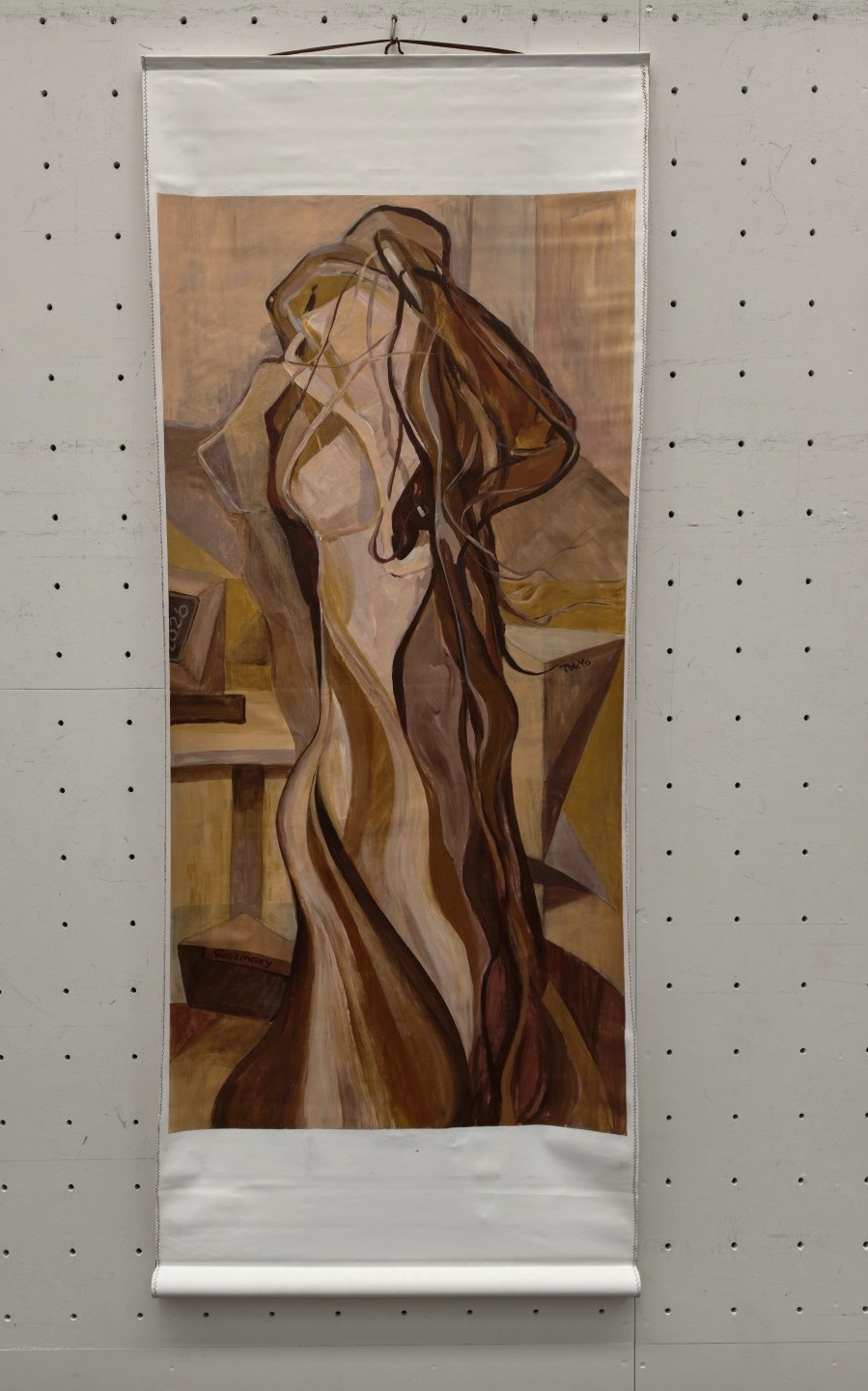
People are easily moved by “dance,” not necessarily because the dance posture itself is especially beautiful, but because dance more honestly than many other things admits a fundamental truth: the body has never been a static thing. In everyday life, when standing, speaking, or responding, people are always inclined to assume that they possess a stable contour, a clearly identifiable “self.” Yet once the body enters dance, everything begins to loosen—boundaries are stretched, centers of gravity shift, lines are dragged by time, and even the most certain posture is only a temporary lodging of an instant. In my view, Chou Jo-Mei’s Dance of Flowing Light does not merely depict a dancing figure; it reveals that a person, in truth, becomes oneself only briefly, and only within movement.
The composition is a tall vertical format. At the center stands a figure elongated, entwined, and repeatedly traversed by light as well as lines of brown, ochre, flesh-pink, and deep umber. This figure is not rendered according to anatomically stable contours, but appears to be formed from overlapping bands of transparent and semi-transparent color, brushwork, and light-shadow. The shoulders and arms seem raised or folded over one another; the torso twists upward from below; dark lines resemble strands of hair, traces of force, or script left by time upon the surface of the body. The background is not empty, but rather a strongly interior, warm-toned field—suggestions of a tabletop, slanted geometric planes, localized objects, and blocks of space emerge faintly behind, so that this “dance” seems not to take place upon a stage but rather within everyday life, within memory, at the very moment when light is about to slip across a room. Precisely for that reason, what is most moving in this work is not simply that it “looks like dance,” but that it makes one feel that light, body, and space are entwined, and that none of them is any longer merely its own isolated name.
I have always felt that truly fine painting does not merely make objects visible; it alters the very act of viewing itself. When facing Dance of Flowing Light, one is not permitted to employ the ordinary mode with which one typically identifies a human body. Very quickly one realizes that if one only wishes to know where the hand is, where the face turns, whether the posture is anatomically plausible, one loses the true force of the painting. For the work is quite evidently not describing an already completed pose, but depicting the instant in which posture itself is becoming. This makes me think of Bergson. Bergson distinguishes between mechanical time and true duration; the latter is not composed of discrete moments cut into equal segments, but of living time that continues to flow and penetrate itself from within. Chou Jo-Mei’s work, in this sense, paints duration itself. The body in the painting is not a halted body, but one being dragged by the previous motion and summoned by the next. What one sees is not the body “at this instant,” but a temporary contour precipitated from several overlapping moments.
For that reason, the phrase “flowing light” in the title is in truth more profound than “dance.” Dance may still be imagined as a skill, a set of movements, an outward performance. Flowing light is different. Light itself has no body and cannot be grasped, and “flowing light” especially carries the meaning of time—light is not only brightness; it flows, and thus brightness becomes evidence of passing, of transition, of what cannot remain. In classical Chinese there is already the phrase that “flowing time easily leaves human beings behind,” and its meaning lies precisely in the fact that light is not merely a natural phenomenon, but the gentlest and cruelest form of time. The light in Chou Jo-Mei’s painting is clearly not merely light illuminating a body; rather, it is as though the body itself were being reshaped by flowing light. Those transparent bands of ivory, amber, pale rose, and golden brown do not resemble light falling upon a surface, but rather light having itself grown into flesh. Thus the body no longer merely receives light; it appears to have been jointly fashioned by light and time. At this point I think of Nietzsche. Nietzsche never understood life as a stable substance, but as force, as becoming, as a process of continually exceeding fixed form. If one reads this work through Nietzsche, then the human figure in the painting is not simply “a person dancing,” but a force of life temporarily manifesting itself through human form. Precisely for this reason, the body in the painting always carries a certain intensity that cannot be fully fixed: it is not standing securely, but is in the act of becoming. I would go further and say that what matters most in this work may not be “movement” itself, but the simultaneous coexistence of movement and fragility. Most people, when speaking of dance, habitually praise freedom, lightness, extension. Yet what truly moves us is often not technical skill, but the fact that the dancer, while clearly inhabiting a deeply unstable condition, must nonetheless entrust oneself to that instability. The central figure in this painting has precisely that quality. Those deep brown and blackish lines look at once like supports and like restraints; those pale transparent layers resemble skin, yet also membranes on the verge of being torn open. One senses that this body is not invulnerable—on the contrary, it trembles, it is fragile, it tends almost toward dissolution. Here I think of Simone Weil. In speaking of gravity and grace, Weil reminds us that what truly moves us is not the absence of gravity, but the presence of a certain lightness within gravity. The “dance” in Chou Jo-Mei’s work exists precisely between gravity and grace. It is not an escape from the body, but the way the body gives rise to line from within weight; not a negation of restraint, but a preservation of movement within restraint. Those winding ascending bands of light and brown are like a lightness that grows from within heaviness itself—a kind of elegance that comes not from fantasy, but from endurance.
What I especially appreciate is that the artist does not place the figure against a purely blank, abstract background. Behind it one can discern a tabletop, objects, slanted geometric planes, an interior spatial structure—all of which are extremely important. For they prevent this “dance” from becoming a romantic scene detached from reality, and instead return it to a deeper and more reflective proposition: a person’s true transformation often does not occur in places remote from daily life, but precisely within daily life itself. Beside a table, inside a room, among objects, within a space tinged faintly with the light of late afternoon, the body is suddenly drawn away by light and becomes another mode of being. Here I think of Hannah Arendt. Arendt reminds us that human beings are not constituted solely by labor and work; they also possess action, and what is precious in action is that it momentarily frees a person from predetermined roles and discloses the unforeseeable self. In this sense, Dance of Flowing Light may be understood as a subtle “image of action”: the body here is not the person as defined within everyday order, but the self at the moment of a slight transgression through light and movement. This is not some grand drama, but it is nevertheless an extremely important existential instant: a person is not most fully oneself when one remains stable and unchanged, but rather when one is slightly unbalanced, slightly opened, slightly on the verge of leaving one’s assigned place—then one comes closer to the self that has not yet been fully told.
From another perspective, this work may also be understood as a philosophy of line. What speaks most strongly in the painting is not merely the broad color fields, but those brown and white lines that descend from above, move outward from within, entangle and trail. They resemble hair, drapery, traces of light, but also routes of consciousness, knots of emotion, threads of memory that refuse to break. If one borrows Deleuze’s language, these lines are not simply contours, but “lines of becoming”—they do not depict something as already thus, but allow the force of something in the process of becoming to leave its trace. These lines pass through the body and all but replace it; the body is no longer enclosed by line, but composed by line. This deepens the philosophical resonance of the work: is the self not perhaps also something like this—not a solid entity, but a temporary knot formed by the interweaving of emotions, time, gaze, memory, and desire? If so, then Dance of Flowing Light is not merely about dancing, but about how the self appears through interweaving, and how in appearing it simultaneously loses the security of its own fixed boundaries.
There is another point that must not be omitted: the color palette of the work is extraordinarily refined. If dance is often understood as movement, then Chou Jo-Mei’s painting turns dance into temperature. The overall palette contains no coldly stark contrast, but is built layer upon layer from rose-gray, nude pink, honey-brown, ochre, dark tea, and ivory. It resembles evening light, a wooden interior, the warmth of skin touched by light, and the faint yellowing left by time upon furniture and air. This palette makes “flowing light” more than a visual brightness; it gives it emotional maturity. It is not an aggressively blinding flash, but a light that has passed through daily life, interiority, and memory. This gives the work the rare quality of possessing two characteristics at once: on the one hand, a strength and extension akin to dance; on the other, the composure and intimacy of an interior still life. This juxtaposition is highly sophisticated, because it demonstrates that the most profound forms of movement do not always come from an external storm; sometimes they arise instead from the way a single beam of light slowly rewrites the shape of a person inside a room. Following Montaigne’s habit, I always like to turn my gaze back toward the human being after speaking of art. For I have never believed that viewing is merely enjoyment; it is more like a subtle self-examination. Perhaps what makes Dance of Flowing Light so difficult for me to leave behind is that it reminds me how easily people live as though they were fixed things—as roles, identities, duties, names, and expected forms. Yet perhaps true life has never really consisted of those stable labels, but is more like this body in the painting, briefly condensed by light and brown lines—now clear, now blurred; now formed, now on the verge of dispersing; now seeming ready to collapse, now somehow standing again upon some invisible axis. If we must all live in time, then perhaps each of us is in fact dancing this very dance: we believe we are preserving our shape, while in truth we are ceaselessly being lengthened by light, folded by daily life, entangled by memory, and summoned by the future. Maturity, then, may not necessarily mean fixing oneself more firmly; perhaps it means learning not to panic amid flow, learning to admit that one was never stone, but rather something closer to a light that can change its form. Thus, in the end, what I read in Dance of Flowing Light is not merely “dance” and “light,” but a deeper proposition:
A human being does not possess form only when standing still; rather, it is in movement that one is briefly seen by the world.
And if I were to conclude this work in a single sentence, I would say:
What Chou Jo-Mei’s Dance of Flowing Light depicts is not merely light flowing across the body, but how the body, within the light of time, dissipates and takes form at once.
Short Catalog / Wall Text Version
Chou Jo-Mei’s Dance of Flowing Light uses acrylic to depict a body in flux, suspended between figure, ribbons of light, and traces of time. The central form does not obey stable anatomical contours, but is woven from warm browns, ochres, skin-pinks, and milky whites, as though light and body were mutually penetrating and co-generating one another. The background—tabletop, geometric planes, and interior spatial elements—ensures that this “dance” is not a performance detached from everyday life, but rather an existential transformation occurring within ordinary space itself. Read through Bergson’s notion of duration and Deleuze’s concept of becoming, the work presents not a fixed dance pose but a body temporarily formed through overlapping layers of time. Ultimately, Dance of Flowing Light is not merely about movement; it is about how a person, in flux, loses boundaries and at the same time acquires light.