論光何以有身,與人如何在流動中暫時成形
——周若梅〈流光之舞〉
撰文:王穆提(WANG MUTI)
人之所以容易被「舞」打動,未必因為舞姿本身多麼優美,而是因為舞比其他許多事物更誠實地承認:身體從來不是靜止之物。人平日站立、言說、應對,總愛假定自己有一個穩固的輪廓,有一個可以清楚指認的「我」;然而一旦身體進入舞,一切便開始鬆動——邊界被拉長,重心被轉移,線條被時間拖曳,連最確定的姿態也只是剎那的暫住。周若梅這件〈流光之舞〉,於我眼中,正不是在描繪一個正在舞動的人形而已,而是在揭露:人原來正是在流動之中,才短暫地成為自己。
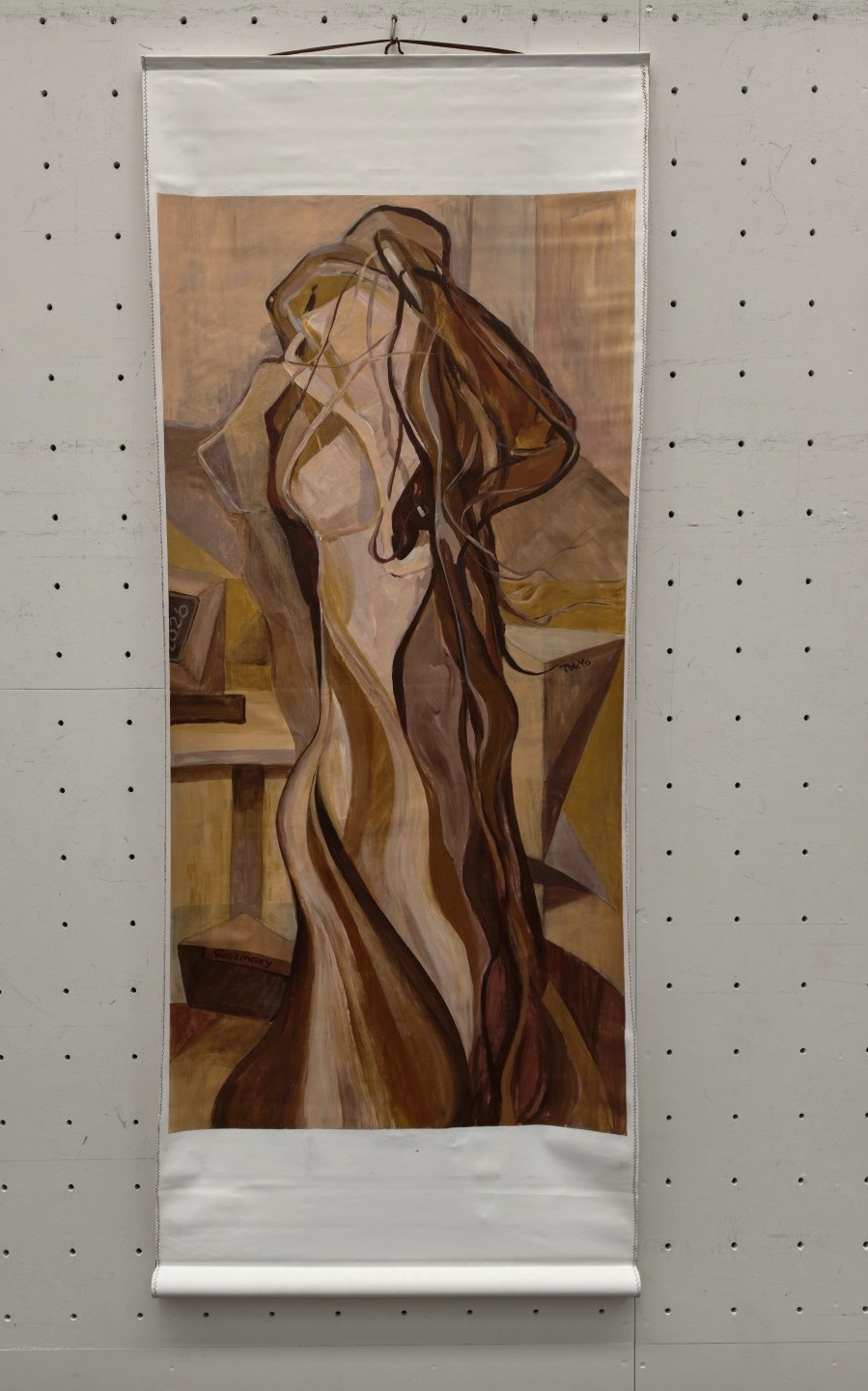
畫面為高幅直構,中央是一個被拉長、被纏繞、被光與褐色、赭色、粉膚色與深棕線條反覆穿越的人形。這個人形並不以解剖學的穩定輪廓被描繪,而像由多層透明與半透明的色帶、筆觸與光影併合而成:肩臂似乎上舉或交疊,身軀由下而上擰轉,深色線條如髮絲、如力的軌跡、如時間在身體表面留下的書寫。背景不是空無,而是室內感極強的暖色場——桌面、幾何斜面、局部物件與空間塊面在後方若隱若現,使這場「舞」並非發生在舞臺之上,而更像發生在一個日常內部、記憶內部、光正要滑過房間的一刻。正因如此,這件作品最動人的地方,並不只是「像舞」,而是它讓人感到:光、身體與空間彼此纏繞,誰也不再只是誰自己的名字。
我總以為,真正好的畫,從來不只是讓物件被看見,而是讓觀看這件事本身發生變化。〈流光之舞〉面對觀者時,並不允許人用一種平常辨識人體的方式去看。你很快會發現:若只想知道手在哪裡、臉朝哪裡、站姿是否合理,反而會失去這幅畫真正的力量。因為它顯然不是在描寫一個已經完成的姿態,而是在描寫姿態正在生成的瞬間。這便使我想到柏格森。柏格森區分機械式時間與真正的綿延;後者不是由一格一格切開的時刻組成,而是內部持續流動、互相滲透的活時間。周若梅這件作品,正是把這種綿延畫了出來。畫中之身不是停住的身,而是正在被前一個動作拖曳、被下一個動作召喚的身。你所見的不是「此刻」的身體,而是幾個時刻彼此重疊之後,沉積出來的一道暫時輪廓。
也因此,題名中的「流光」二字,實在比「舞」更深。舞至少還能被想像為某種技藝、某套動作、某個外在表演;可流光不同。光本無身,亦不可捉,而「流光」尤帶著時間的意味——光不只是亮,它在流,於是亮也就成了逝去、成了移行、成了不能久留的證據。中國古語早有「流光容易把人拋」,其意恰在於光不只是自然現象,而是時間最溫柔也最殘酷的形式。周若梅畫中的光,顯然不只是照亮人體的光,而更像人體本身被流光所重新塑形。那些乳白、琥珀、淡玫瑰與金棕色交錯出的透明帶狀,不像覆在身上的光斑,而像光自己長成了肉身。於是,身體不再只是承受光,而像由光和時間共同捏造出來。這時我便想到尼采。尼采從不把生命理解為穩定的本體,而視之為力、為成為、為不斷超出自身定形的過程。如果借尼采來讀這件作品,那麼畫中的人形便不是「一個人在跳舞」,而是一股生命的力正在暫時借由人體的形態顯形。正因如此,畫中的身體總帶著某種不能完全被固定的強度:它不是安穩地站著,而是正在成為。
我還願意更進一步地說:這件作品裡最重要的也許不是「動」,而是動與脆弱如何同時存在。多數人談舞,習慣讚美其自由、輕盈、伸展;可真正觸動人的,常常不是那份技巧,而是舞者明明處於極不穩定的狀態,卻仍必須把自己交付給那個不穩定。畫中的中心形象正有這種質地:那些深棕與黑褐的纏線像支撐,也像束縛;那些淺色透明層像皮膚,也像即將被撕開的薄膜。你會感到這身體並不是堅不可摧的,相反,它帶著顫、帶著易碎、帶著幾乎要融解的傾向。這時我想到西蒙娜・薇依。薇依在談重力與恩典時,總提醒我們:真正動人的,不是沒有重力,而是在重力之中仍然有某種輕。周若梅這件作品中的「舞」,便正是在重力與恩典之間成立。它不是逃離身體,而是讓身體在重量中生出線條;不是否定束縛,而是在束縛之中仍保留流動。那條條蜿蜒上升的光與褐線,便像一種從沉重內部長出的輕,一種不靠幻想,而靠承受才得以出現的優雅。
我尤其喜歡這件作品並不把人物放在純然空白的抽象背景中。後方可見桌面、物件、斜切的幾何面、室內空間,都是極重要的安排。因為它使這場「舞」不淪為脫離現實的浪漫,而回到一個更深的、值得反省的命題:人真正的變形,往往並不發生在遠離日常之處,而正發生於日常內部。 桌邊、房內、物件之旁、時間略帶黃昏感的空間裡,身體忽然被光拖走,成為另一種存在。這時我想到漢娜・鄂蘭。鄂蘭提醒我們,人不是只有勞動與工作的一面,人也有行動的一面;而行動之所以珍貴,正在它使人從既定角色中暫時脫出,顯露出不可預設的自己。若依此觀之,〈流光之舞〉便可理解為一種微妙的「行動圖像」:這身體並不是日常秩序裡那個被界定好的人,而是在光與流動中,自我稍稍越界的一瞬。這不是宏大的戲劇,卻是一個極重要的存在時刻:人不是在安穩不變時最像自己,反而是在略微失衡、略微被打開、略微要離開本來位置時,才更接近那尚未被說盡的自己。
從另一面說,這件作品也可以被理解為一種線之哲學。畫中最會說話的,不只是大色塊,而是那些從上而下、從內而外、或糾結或垂曳的褐色與白色線條。它們既像髮、像衣褶、像光跡,也像意識的路徑、情感的纏結、記憶不肯斷裂的絲。若套用德勒茲的說法,這些線不只是輪廓,而是「生成線」——不是畫出某物已然如此,而是讓某物在成為中的力量得以留下痕跡。這些線穿過身體,也幾乎取代身體;身體不再被線框起來,而是被線組成。這使作品的哲學意味更深一層:我們所謂的自我,是否也正像這樣,不是一塊明確實體,而是無數情感、時間、視線、記憶與慾望交織後的暫時束結?如果如此,那麼「流光之舞」畫的便不只是舞動,而是自我如何在交織中顯形,又如何在顯形時同時失去穩固界線。
還有一點不可不論:這件作品的色調極其講究。若說舞常被理解為動作,那麼周若梅這幅畫則把舞變成了溫度。畫面整體並無冷冽對比,而是由玫瑰灰、裸粉、蜂蜜棕、赭石、焦茶與象牙白層層構成,像夕光、像木質室內、像皮膚受光後的暖意,也像時間在家具與空氣中慢慢留下的微黃。這種色調使「流光」不只是視覺上的亮,而帶著情感上的熟度。它不是乍然刺目的閃光,而是一種經過日常、經過內在、經過記憶浸泡後的光。這便讓作品難得地兼具兩種品質:一方面有近乎舞蹈的力度與伸展,另一方面又有室內靜物般的安定與親密。這種並置非常高級,因為它證明了:最深刻的流動,不一定來自外部風暴,有時反而來自一個房間裡,一束光如何緩緩改寫一個人的身形。
若依蒙田之習,我總喜歡在談藝術之後,把目光再轉回人自身。因為我從不信觀看只是賞玩,它更像一次悄悄的自我檢驗。周若梅這件〈流光之舞〉之所以使我流連,也許正因它提醒了我:人活在世上,太容易把自己活成固定之物,活成角色、身分、責任、姓名與被期待的樣子。可是真正的生命,或許從來不是那些穩定標籤,而更像畫中這道由光與褐線暫時凝成的身——時而清楚,時而模糊;時而有形,時而幾乎要散;時而像要倒下,時而又在某條看不見的軸線上重新站住。若我們終究都活在時間裡,那麼每個人其實都在跳這樣一支舞:我們以為自己在保持形狀,實則無時無刻不在被光拉長、被日常折疊、被記憶纏住、被未來召喚。所謂成熟,不一定是把自己固定得更穩,或許更像是學會在流動之中仍然不慌,學會承認自己原也不是石,而更接近一道會變形的光。
所以,我看〈流光之舞〉,最終讀到的並不只是「舞」與「光」,而是一個更深的命題:
人並不是在停止時才擁有形體,反而是在流動之中,才短暫地被世界看見。
若要用一句話為此作作結,我會這樣說:
周若梅〈流光之舞〉所描寫的,不只是光在身上流動,而是身體如何在時間的光裡,一面消散,一面成立。
周若梅〈流光之舞〉以壓克力媒材描繪一個介於人形、光帶與時間軌跡之間的流動身體。作品中央的形象並不服從穩定的解剖輪廓,而是由暖褐、赭石、粉膚與乳白交織而成,彷彿光與身體彼此滲透,互為生成。背景中的桌面、幾何空間與室內結構,使這場「舞」並非遠離日常的表演,而更像發生於生活內部的一次存在變形。若借柏格森的綿延時間與德勒茲的生成觀點來看,作品所呈現的並非某一固定舞姿,而是身體在不同時間層疊之中暫時成形的狀態。整體而言,〈流光之舞〉不只是關於動作,更是關於人在流動中如何既失去邊界,又獲得光的問題。
其他相關內容:
【現場直擊】【台日交流展】東京都美術館開館100周年記念《第14回東京現展》展場:日本國立東京都美術館
台灣參展藝術家作品藝術評論
東京都美術館開館100周年記念【14回東京現展】廖純沂〈未盡・浮境〉未盡之物何以最能久留人心
東京都美術館開館100周年記念【14回東京現展】廖純沂〈游相〉花何以不止於花,與形相如何在漂游中成立
東京都美術館開館100周年記念【14回東京現展】廖純沂〈思域・沉靜〉沉靜何以不是空,與垂掛之物何以最像思念
東京都美術館開館100周年記念【14回東京現展】王詮富〈八月閑步一色秋〉的季節哲學、門徑意識與水墨的開敞性 在黑暗中閑步:秋色如何不是顏色,而是一種存在的轉身
東京都美術館開館100周年記念【14回東京現展】 王詮富〈一念菩提開翠微〉的開顯、同體、綿延與空性 一念未起,萬根已動
東京都美術館開館100周年記念【14回東京現展】蔡梅芳〈戀戀紫藤〉的痕跡、綿延與生成 花影之遲遲不散,與記憶如何在解構之後重返
東京都美術館開館100周年記念【14回東京現展】 王穆提《聖境・阿里山》蒼翠的紀念碑
東京都美術館開館100周年記念【14回東京現展】王穆提《中道之光》裂隙中的永恆
東京都美術館開館100周年記念【14回東京現展】吳心荷〈散落骨骼(一)〉散落之骨,與人之未能完全集成於自身
東京都美術館開館100周年記念【14回東京現展】陳福祺〈咖啡心音〉的存在寓言 沸點、晶化與心之熔爐
東京都美術館開館100周年記念【14回東京現展】張素蘭〈一棵開花的樹〉的場所哲學、過程生命與靜默中的新生
東京都美術館開館100周年記念【14回東京現展】吳亞倫〈藍與黑的交響詩(雙併)〉論藍何以不只為藍,黑何以不只為黑
東京都美術館開館100周年記念【14回東京現展】張碧鄉〈艷冠群芳〉的器物哲學、生成美學與過剩的顯現
東京都美術館開館100周年記念【14回東京現展】趙玉燕〈熾烈〉論火中的身體,與人何以不能只是自己
東京都美術館開館100周年記念【14回東京現展】許秀珠〈403地震後的太魯閣〉山川之裂,與人如何在震後重新學會自身的位置
東京都美術館開館100周年記念【14回東京現展】江麗香〈秋聲賦〉彩墨中的時間書寫 水痕與秋聲
東京都美術館開館100周年記念【14回東京現展】江麗香〈流轉的歲月〉水之無言,而歲月常藉其形以自見
東京都美術館開館100周年記念【14回東京現展】謝文倩〈驚夢〉的夢之碎片、感覺邏輯與夜的顯現
東京都美術館開館100周年記念【第14回東京現展】黃淑卿〈群鷗處處來(台灣澎湖)〉群鷗之所以來,與人終於學會不把世界全算作自己
東京都美術館開館100周年記念【14回東京現展】黃淑卿〈燕尾與戴勝(台灣金門)〉論屋脊、禽鳥與地方何以不只是地理
東京都美術館開館100周年記念【14回東京現展】謝正瑜〈蓮池映相〉的感知哲學與靈性空間
東京都美術館開館100周年記念【14回東京現展】周若梅〈流光之舞〉,光何以有身,與人如何在流動中暫時成形
On How Light Acquires a Body, and How the Human Being Briefly Takes Form in Flux
— On Chou Jo-Mei’s Dance of Flowing Light
By WANG MUTI
People are easily moved by “dance,” not necessarily because the dance posture itself is especially beautiful, but because dance more honestly than many other things admits a fundamental truth: the body has never been a static thing. In everyday life, when standing, speaking, or responding, people are always inclined to assume that they possess a stable contour, a clearly identifiable “self.” Yet once the body enters dance, everything begins to loosen—boundaries are stretched, centers of gravity shift, lines are dragged by time, and even the most certain posture is only a temporary lodging of an instant. In my view, Chou Jo-Mei’s Dance of Flowing Light does not merely depict a dancing figure; it reveals that a person, in truth, becomes oneself only briefly, and only within movement.
The composition is a tall vertical format. At the center stands a figure elongated, entwined, and repeatedly traversed by light as well as lines of brown, ochre, flesh-pink, and deep umber. This figure is not rendered according to anatomically stable contours, but appears to be formed from overlapping bands of transparent and semi-transparent color, brushwork, and light-shadow. The shoulders and arms seem raised or folded over one another; the torso twists upward from below; dark lines resemble strands of hair, traces of force, or script left by time upon the surface of the body. The background is not empty, but rather a strongly interior, warm-toned field—suggestions of a tabletop, slanted geometric planes, localized objects, and blocks of space emerge faintly behind, so that this “dance” seems not to take place upon a stage but rather within everyday life, within memory, at the very moment when light is about to slip across a room. Precisely for that reason, what is most moving in this work is not simply that it “looks like dance,” but that it makes one feel that light, body, and space are entwined, and that none of them is any longer merely its own isolated name.
I have always felt that truly fine painting does not merely make objects visible; it alters the very act of viewing itself. When facing Dance of Flowing Light, one is not permitted to employ the ordinary mode with which one typically identifies a human body. Very quickly one realizes that if one only wishes to know where the hand is, where the face turns, whether the posture is anatomically plausible, one loses the true force of the painting. For the work is quite evidently not describing an already completed pose, but depicting the instant in which posture itself is becoming. This makes me think of Bergson. Bergson distinguishes between mechanical time and true duration; the latter is not composed of discrete moments cut into equal segments, but of living time that continues to flow and penetrate itself from within. Chou Jo-Mei’s work, in this sense, paints duration itself. The body in the painting is not a halted body, but one being dragged by the previous motion and summoned by the next. What one sees is not the body “at this instant,” but a temporary contour precipitated from several overlapping moments.
For that reason, the phrase “flowing light” in the title is in truth more profound than “dance.” Dance may still be imagined as a skill, a set of movements, an outward performance. Flowing light is different. Light itself has no body and cannot be grasped, and “flowing light” especially carries the meaning of time—light is not only brightness; it flows, and thus brightness becomes evidence of passing, of transition, of what cannot remain. In classical Chinese there is already the phrase that “flowing time easily leaves human beings behind,” and its meaning lies precisely in the fact that light is not merely a natural phenomenon, but the gentlest and cruelest form of time. The light in Chou Jo-Mei’s painting is clearly not merely light illuminating a body; rather, it is as though the body itself were being reshaped by flowing light. Those transparent bands of ivory, amber, pale rose, and golden brown do not resemble light falling upon a surface, but rather light having itself grown into flesh. Thus the body no longer merely receives light; it appears to have been jointly fashioned by light and time. At this point I think of Nietzsche. Nietzsche never understood life as a stable substance, but as force, as becoming, as a process of continually exceeding fixed form. If one reads this work through Nietzsche, then the human figure in the painting is not simply “a person dancing,” but a force of life temporarily manifesting itself through human form. Precisely for this reason, the body in the painting always carries a certain intensity that cannot be fully fixed: it is not standing securely, but is in the act of becoming. I would go further and say that what matters most in this work may not be “movement” itself, but the simultaneous coexistence of movement and fragility. Most people, when speaking of dance, habitually praise freedom, lightness, extension. Yet what truly moves us is often not technical skill, but the fact that the dancer, while clearly inhabiting a deeply unstable condition, must nonetheless entrust oneself to that instability. The central figure in this painting has precisely that quality. Those deep brown and blackish lines look at once like supports and like restraints; those pale transparent layers resemble skin, yet also membranes on the verge of being torn open. One senses that this body is not invulnerable—on the contrary, it trembles, it is fragile, it tends almost toward dissolution. Here I think of Simone Weil. In speaking of gravity and grace, Weil reminds us that what truly moves us is not the absence of gravity, but the presence of a certain lightness within gravity. The “dance” in Chou Jo-Mei’s work exists precisely between gravity and grace. It is not an escape from the body, but the way the body gives rise to line from within weight; not a negation of restraint, but a preservation of movement within restraint. Those winding ascending bands of light and brown are like a lightness that grows from within heaviness itself—a kind of elegance that comes not from fantasy, but from endurance.
What I especially appreciate is that the artist does not place the figure against a purely blank, abstract background. Behind it one can discern a tabletop, objects, slanted geometric planes, an interior spatial structure—all of which are extremely important. For they prevent this “dance” from becoming a romantic scene detached from reality, and instead return it to a deeper and more reflective proposition: a person’s true transformation often does not occur in places remote from daily life, but precisely within daily life itself. Beside a table, inside a room, among objects, within a space tinged faintly with the light of late afternoon, the body is suddenly drawn away by light and becomes another mode of being. Here I think of Hannah Arendt. Arendt reminds us that human beings are not constituted solely by labor and work; they also possess action, and what is precious in action is that it momentarily frees a person from predetermined roles and discloses the unforeseeable self. In this sense, Dance of Flowing Light may be understood as a subtle “image of action”: the body here is not the person as defined within everyday order, but the self at the moment of a slight transgression through light and movement. This is not some grand drama, but it is nevertheless an extremely important existential instant: a person is not most fully oneself when one remains stable and unchanged, but rather when one is slightly unbalanced, slightly opened, slightly on the verge of leaving one’s assigned place—then one comes closer to the self that has not yet been fully told.
From another perspective, this work may also be understood as a philosophy of line. What speaks most strongly in the painting is not merely the broad color fields, but those brown and white lines that descend from above, move outward from within, entangle and trail. They resemble hair, drapery, traces of light, but also routes of consciousness, knots of emotion, threads of memory that refuse to break. If one borrows Deleuze’s language, these lines are not simply contours, but “lines of becoming”—they do not depict something as already thus, but allow the force of something in the process of becoming to leave its trace. These lines pass through the body and all but replace it; the body is no longer enclosed by line, but composed by line. This deepens the philosophical resonance of the work: is the self not perhaps also something like this—not a solid entity, but a temporary knot formed by the interweaving of emotions, time, gaze, memory, and desire? If so, then Dance of Flowing Light is not merely about dancing, but about how the self appears through interweaving, and how in appearing it simultaneously loses the security of its own fixed boundaries.
There is another point that must not be omitted: the color palette of the work is extraordinarily refined. If dance is often understood as movement, then Chou Jo-Mei’s painting turns dance into temperature. The overall palette contains no coldly stark contrast, but is built layer upon layer from rose-gray, nude pink, honey-brown, ochre, dark tea, and ivory. It resembles evening light, a wooden interior, the warmth of skin touched by light, and the faint yellowing left by time upon furniture and air. This palette makes “flowing light” more than a visual brightness; it gives it emotional maturity. It is not an aggressively blinding flash, but a light that has passed through daily life, interiority, and memory. This gives the work the rare quality of possessing two characteristics at once: on the one hand, a strength and extension akin to dance; on the other, the composure and intimacy of an interior still life. This juxtaposition is highly sophisticated, because it demonstrates that the most profound forms of movement do not always come from an external storm; sometimes they arise instead from the way a single beam of light slowly rewrites the shape of a person inside a room. Following Montaigne’s habit, I always like to turn my gaze back toward the human being after speaking of art. For I have never believed that viewing is merely enjoyment; it is more like a subtle self-examination. Perhaps what makes Dance of Flowing Light so difficult for me to leave behind is that it reminds me how easily people live as though they were fixed things—as roles, identities, duties, names, and expected forms. Yet perhaps true life has never really consisted of those stable labels, but is more like this body in the painting, briefly condensed by light and brown lines—now clear, now blurred; now formed, now on the verge of dispersing; now seeming ready to collapse, now somehow standing again upon some invisible axis. If we must all live in time, then perhaps each of us is in fact dancing this very dance: we believe we are preserving our shape, while in truth we are ceaselessly being lengthened by light, folded by daily life, entangled by memory, and summoned by the future. Maturity, then, may not necessarily mean fixing oneself more firmly; perhaps it means learning not to panic amid flow, learning to admit that one was never stone, but rather something closer to a light that can change its form. Thus, in the end, what I read in Dance of Flowing Light is not merely “dance” and “light,” but a deeper proposition:
A human being does not possess form only when standing still; rather, it is in movement that one is briefly seen by the world.
And if I were to conclude this work in a single sentence, I would say:
What Chou Jo-Mei’s Dance of Flowing Light depicts is not merely light flowing across the body, but how the body, within the light of time, dissipates and takes form at once.
Short Catalog / Wall Text Version
Chou Jo-Mei’s Dance of Flowing Light uses acrylic to depict a body in flux, suspended between figure, ribbons of light, and traces of time. The central form does not obey stable anatomical contours, but is woven from warm browns, ochres, skin-pinks, and milky whites, as though light and body were mutually penetrating and co-generating one another. The background—tabletop, geometric planes, and interior spatial elements—ensures that this “dance” is not a performance detached from everyday life, but rather an existential transformation occurring within ordinary space itself. Read through Bergson’s notion of duration and Deleuze’s concept of becoming, the work presents not a fixed dance pose but a body temporarily formed through overlapping layers of time. Ultimately, Dance of Flowing Light is not merely about movement; it is about how a person, in flux, loses boundaries and at the same time acquires light.
光はいかにして身体を持つのか、そして人はいかに流動の中でひととき形を得るのか
——周若梅《流光之舞》について
文:王穆提(WANG MUTI)
人が「舞」に心を動かされやすいのは、必ずしも舞姿そのものが格別に美しいからではない。むしろ舞が、他の多くの事物以上に正直に、身体とはもともと静止したものではないと認めているからである。人はふだん立ち、語り、応じるとき、自分には安定した輪郭があり、明確に指し示しうる「私」があると思い込みがちである。しかしひとたび身体が舞へ入ると、すべては緩みはじめる。境界は引き伸ばされ、重心は移され、線は時間に引かれ、もっとも確かな姿勢ですら一瞬の仮の宿にすぎなくなる。私にとって周若梅の《流光之舞》は、ただ舞っている人の姿を描いた作品ではない。それは、人がまさに流動の中においてこそ、ひととき自分になるのだということを明らかにしている作品なのである。 画面は縦長の構図を取り、中央には引き延ばされ、絡み合い、光と褐色、赭色、肌のような淡いピンク、そして深い茶線に何度も貫かれた人体が置かれている。この人体は解剖学的に安定した輪郭で描かれているのではなく、透明ないし半透明の色帯、筆触、光と影が重なり合ってできたもののように見える。肩や腕は上へ持ち上がるか重なり合い、胴体は下から上へねじれ、濃い線は髪のようでもあり、力の軌跡のようでもあり、時間が身体の表面に書き残した文字のようでもある。背景は空無ではない。そこには室内性のきわめて強い暖色の場があり、机の面、幾何学的な斜面、局所的な物、空間のブロックが背後にほのかに見えている。そのため、この「舞」は舞台上で行われているというよりも、日常の内部、記憶の内部、光がまさに部屋をすべり抜けようとする瞬間に起こっているもののように感じられる。だからこそこの作品の最も心を打つところは、単に「舞のように見える」ということではなく、光と身体と空間が互いに絡み合い、もはや誰も単独で自分自身の名前にとどまらないと感じさせる点にある。
私はいつも思う。ほんとうに優れた絵とは、単に物を見えるようにするだけではなく、「見る」という行為そのものの在り方を変えるものである、と。《流光之舞》に向き合うとき、鑑賞者はふだん人の身体を見分けるような仕方では見ることを許されない。すぐに気づくはずだ。手がどこにあるのか、顔がどちらを向いているのか、立ち姿が合理的かどうか、そうしたことだけを知ろうとすると、この絵の本当の力は失われてしまう。なぜなら、この作品は完成済みの姿勢を描いているのではなく、姿勢がまさに生成しつつある瞬間を描いているからである。ここで私はベルクソンを思う。ベルクソンは機械的な時間と、真の持続を区別した。後者は、一つ一つに切り分けられた瞬間の集合ではなく、内側で持続し、互いに浸透しあう生きた時間である。周若梅のこの作品は、その持続を描いている。画中の身体は止まった身体ではなく、ひとつ前の動作に引かれ、次の動作に呼び出されている身体である。私たちが見ているのは「いまこの瞬間」の身体ではなく、いくつかの瞬間が重なり、その沈殿として一時的に形を得た輪郭なのである。
だからこそ、題名の「流光」という二字は、「舞」よりもさらに深い。舞は少なくとも、ある技芸や動作の体系、外在的な表現として想像できる。しかし流光はそうではない。光にはもとより身体がなく、つかまえることもできない。そして「流光」はとりわけ時間の意味を帯びる。光はただ明るいだけではなく、流れている。ゆえに明るさそのものが過ぎ去り、移行し、留まりえぬものの証拠となる。中国の古い言い回しに「流光容易把人拋(流れる光は容易に人を置き去りにする)」という趣があるが、その意味はまさに、光が単なる自然現象ではなく、時間のもっとも優しく、もっとも残酷な形式であることにある。周若梅の絵の中の光もまた、ただ身体を照らす光ではなく、むしろ身体そのものが流光によって再びかたちづくられているように見える。乳白、琥珀、淡い薔薇色、黄金がかった褐色が交錯する透明な帯は、身体の上に落ちた光斑というよりも、光そのものが肉身へと成長したようである。すると身体は光を受けるだけではなく、光と時間によってともにつくられたもののようになる。ここで私はニーチェを思う。ニーチェは生命を安定した本体としてではなく、力として、生成として、つねに自身の定形を超えていく過程として捉えた。もしこの作品をニーチェ的に読むなら、画中の人影は「踊っている人」ではなく、生命の力が一時的に人体のかたちを借りて現れているものとなる。まさにそのために、画中の身体は決して完全には固定しえない強度を帯びるのだ。それは安定して立っているのではなく、まさに「なりつつある」。
さらに私は一歩進めて、この作品で最も重要なのは「動」そのものではなく、動と脆さが同時に存在していることではないかと言いたい。人は舞を語るとき、自由や軽やかさや伸びやかさを褒めることが多い。だが真に人を打つのは、技巧そのものではなく、舞う者が極めて不安定な状態にありながら、その不安定さへ自分を委ねなければならないという事実である。画面の中心像はまさにその質を持っている。深い褐色と黒褐色の絡む線は支えのようでもあり、束縛のようでもある。淡い透明な層は皮膚のようでもあり、今にも裂けそうな薄膜のようでもある。その身体は決して強固ではない。むしろ震えを帯び、壊れやすく、ほとんど溶けそうな傾向を持っている。ここで私はシモーヌ・ヴェイユを思う。ヴェイユは重力と恩寵を語り、真に人を動かすのは重力の不在ではなく、重力の中になお何ものかの軽さがあることだと示した。周若梅のこの作品における「舞」は、まさに重力と恩寵のあいだに成立している。それは身体から逃げることではなく、重さの中から線を生み出すことであり、束縛を否定することではなく、束縛の中に流動を残すことである。うねりながら上へ向かう光と褐色の線は、まさに重さの内部から生まれる軽さのようであり、幻想からではなく、耐えることによって初めて現れる優雅さのようである。
私はとりわけ、この作品が人物を完全な空白の抽象背景の中に置いていないことを好ましく思う。後方には机の面、物、斜めに切られた幾何学面、室内空間が見える。これはきわめて重要な配慮である。なぜなら、それによってこの「舞」は現実から切り離されたロマンへ堕することを免れ、より深く、考えるに値する命題へ戻ってくるからである。人が真に変形するのは、しばしば日常から遠く離れたところではなく、まさに日常の内部においてである。机のそば、部屋の中、物のかたわら、やや黄昏を帯びた時間の空間の中で、身体はふいに光に連れ去られ、別の存在となる。ここで私はハンナ・アーレントを思う。アーレントは、人間には労働と仕事だけではなく、行為の側面があり、行為が貴重なのは、それが人を既定の役割から一時的に外へ押し出し、予測しえぬ自己を露わにするからだと述べた。この観点からすれば、《流光之舞》は微妙な「行為のイメージ」とも理解できる。この身体は日常秩序の中で規定されている人物ではなく、光と流動の中で自己が少し越境するその一瞬なのである。それは大きな劇ではないが、きわめて重要な存在の瞬間である。人は安定し、不変であるときに最も自分らしいのではなく、むしろ少し不均衡で、少し開かれ、少し本来の位置から離れようとするときにこそ、まだ語り尽くされていない自己へより近づくのである。
別の面から言えば、この作品は一種の「線の哲学」としても読める。画中で最も雄弁なのは、大きな色面だけではなく、上から下へ、内から外へ、あるいは絡み、あるいは垂れながら走る褐色と白色の線である。それらは髪のようでもあり、衣の襞のようでもあり、光の軌跡のようでもあるが、同時に意識の道筋、感情のもつれ、記憶が断たれることを拒む糸のようでもある。もしドゥルーズの言葉を借りるなら、これらの線は単なる輪郭ではなく、「生成の線」である。つまり、何かがすでにそうであることを描くのではなく、何かが成りつつあるその力に痕跡を与える線である。これらの線は身体を貫き、ほとんど身体に取って代わっている。身体はもはや線によって囲まれているのではなく、線によって構成されているのである。ここに作品の哲学的意味はさらに深まる。私たちが自己と呼んでいるものもまた、このようなものではないだろうか。明確な実体ではなく、無数の感情、時間、視線、記憶、欲望が織り合わされた一時的な結び目ではないだろうか。もしそうなら、「流光之舞」が描いているのは単なる舞いではなく、自己が交錯の中でいかにして現れ、現れながら同時にその安定した境界を失ってゆくか、なのである。 なお、この作品の色調についても触れずにはいられない。もし舞がふつう動作として理解されるなら、周若梅のこの絵は舞を温度へと変えている。画面全体に冷たく鋭い対比はなく、薔薇灰、裸色の桃、蜂蜜色の褐色、赭石、焦茶、アイヴォリーが幾層にも重なっている。それは夕光のようであり、木質の室内のようであり、光を受けた肌の温もりのようであり、また家具や空気の中に時間が少しずつ残していった薄い黄ばみのようでもある。このような色調は、「流光」を視覚の明るさにとどめず、情緒の熟度をもたらす。それは瞬間的に眩い閃光ではなく、日常と内面と記憶を通り抜けてきた光である。これによって作品は稀有な二重性を得る。一方では舞に近い力と伸びやかさを持ち、他方では室内静物のような安定と親密さを持つ。この取り合わせはきわめて高い完成度を示す。もっとも深い流動は、必ずしも外の嵐から来るとは限らず、時にはひとつの部屋の中で、一筋の光がゆっくりと人の形を描き変えていくことから生じるのだと、この作品は証明しているのである。
モンテーニュの習いにならって言えば、私は芸術を語った後、つねに人間自身へと視線を返したくなる。鑑賞とは単なる享受ではなく、ひそかな自己点検のようなものだからである。おそらく《流光之舞》が私を長く引き止めるのは、それが私にこう思い出させるからだ。人はこの世で、あまりにも容易に自分を固定したものとして生きてしまう。役割、身分、責任、名前、期待された姿として。しかし本当の生命は、おそらくそれらの安定したラベルにあるのではなく、この絵の中の、光と褐色の線によって一時的に凝縮された身体のようなものなのだ。時に明瞭で、時に曖昧であり、時に形を持ち、時に今にも散りそうであり、時に倒れそうで、時にまた見えない軸の上に立ち直る。もし私たちが結局時間の中を生きるのなら、誰もがこのような舞を踊っているとも言える。私たちは自分の形を保っていると思いながら、実際には絶えず光に引き延ばされ、日常に折り曲げられ、記憶に絡め取られ、未来に呼び寄せられている。成熟とは、自分をより強固に固定することではなく、むしろ流動の中で慌てぬことを学ぶこと、自分がもともと石ではなく、形を変えてゆく光に近いものだと認めることなのかもしれない。
したがって、私が《流光之舞》から最終的に読み取るのは、単に「舞」と「光」ではなく、より深い命題である。
人は停止しているときに形を持つのではなく、むしろ流動の中においてこそ、ひととき世界に見出される。
そしてこの作品を一言で結ぶなら、私はこう言いたい。
周若梅《流光之舞》が描いているのは、単に光が身体の上を流れることではなく、身体が時間の光の中で、消散しながら、同時に成立してゆくことなのである。
周若梅《流光之舞》は、アクリルという媒材によって、人影・光の帯・時間の軌跡のあいだにある流動する身体を描き出している。中央の像は安定した解剖学的輪郭に従わず、暖かな褐色、赭石、肌色、乳白が絡み合って構成されており、まるで光と身体が互いに浸透し合い、互いを生成しているかのようである。背景に見える机面、幾何学的な空間、室内構造によって、この「舞」は日常から遠く離れた表演ではなく、生活の内部において起こる存在的変形として読まれる。ベルクソンの持続時間やドゥルーズの生成概念を借りて見るなら、この作品が示しているのは固定された舞の姿ではなく、異なる時間層の重なりの中で一時的に形を得る身体の状態である。総じて《流光之舞》は、単なる動作の絵ではなく、人が流動の中で境界を失いながら、同時に光を獲得することの問題を描いた作品である。