On Twilight, and the Weight of Gazing into Time
— Reflections on Keiichiro Hayami’s At Dusk (夕刻に)
Essay
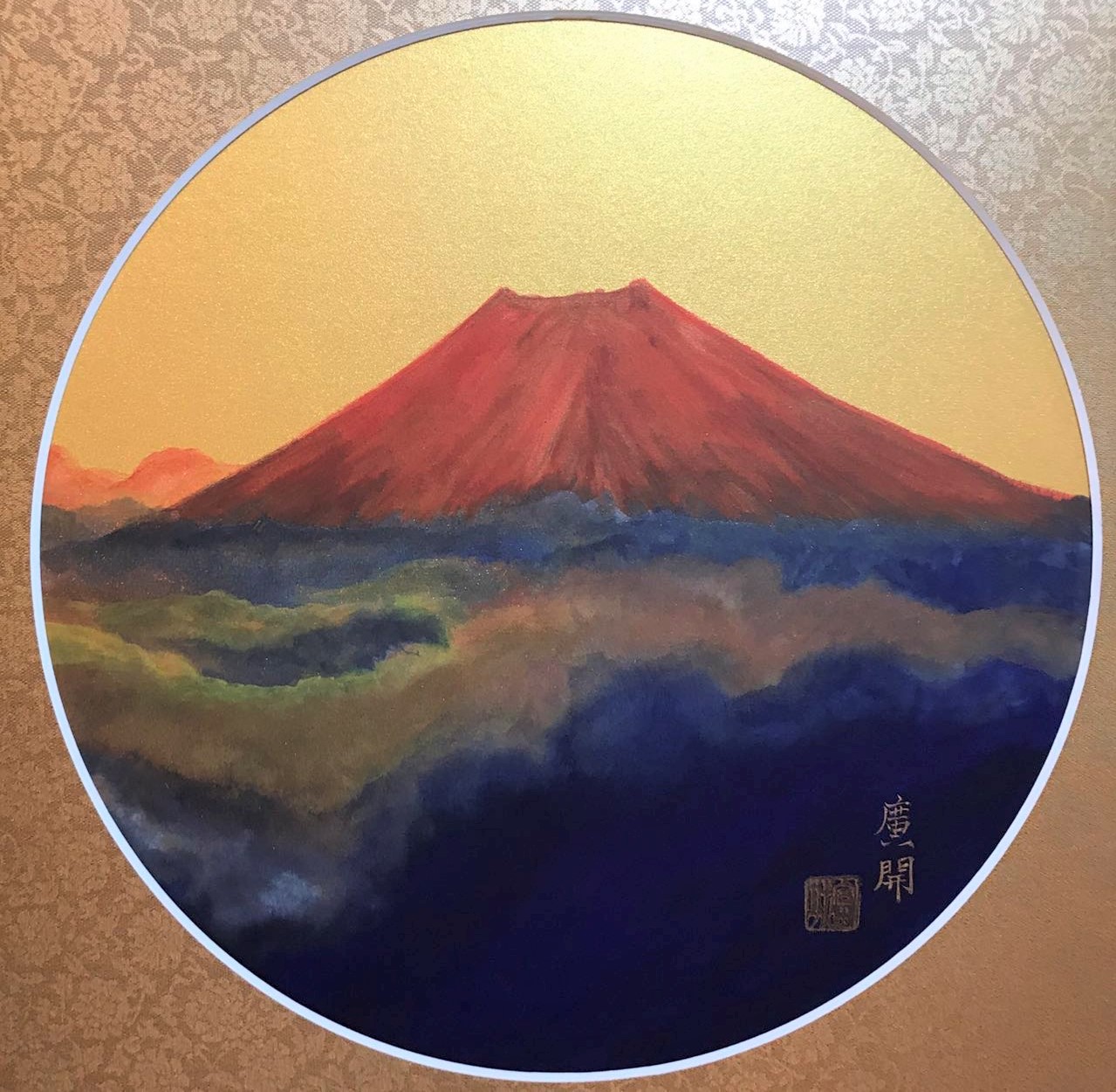
I often wonder why people are so fascinated by dusk. The ancients called it the “hour of meeting demons,” a crevice between day and night, when all things seem somewhat ambiguous, as though the contours of reality have loosened ever so slightly. Today, as I gazed at a painting by Keiichiro Hayami, In the Evening, that long-lost perplexity and awe once again surged into my heart. I do not intend to dissect his rules of perspective or theories of color; I only wish to speak about how this painting, on an ordinary afternoon, made me feel the weight of time’s ashes settling upon my shoulders.
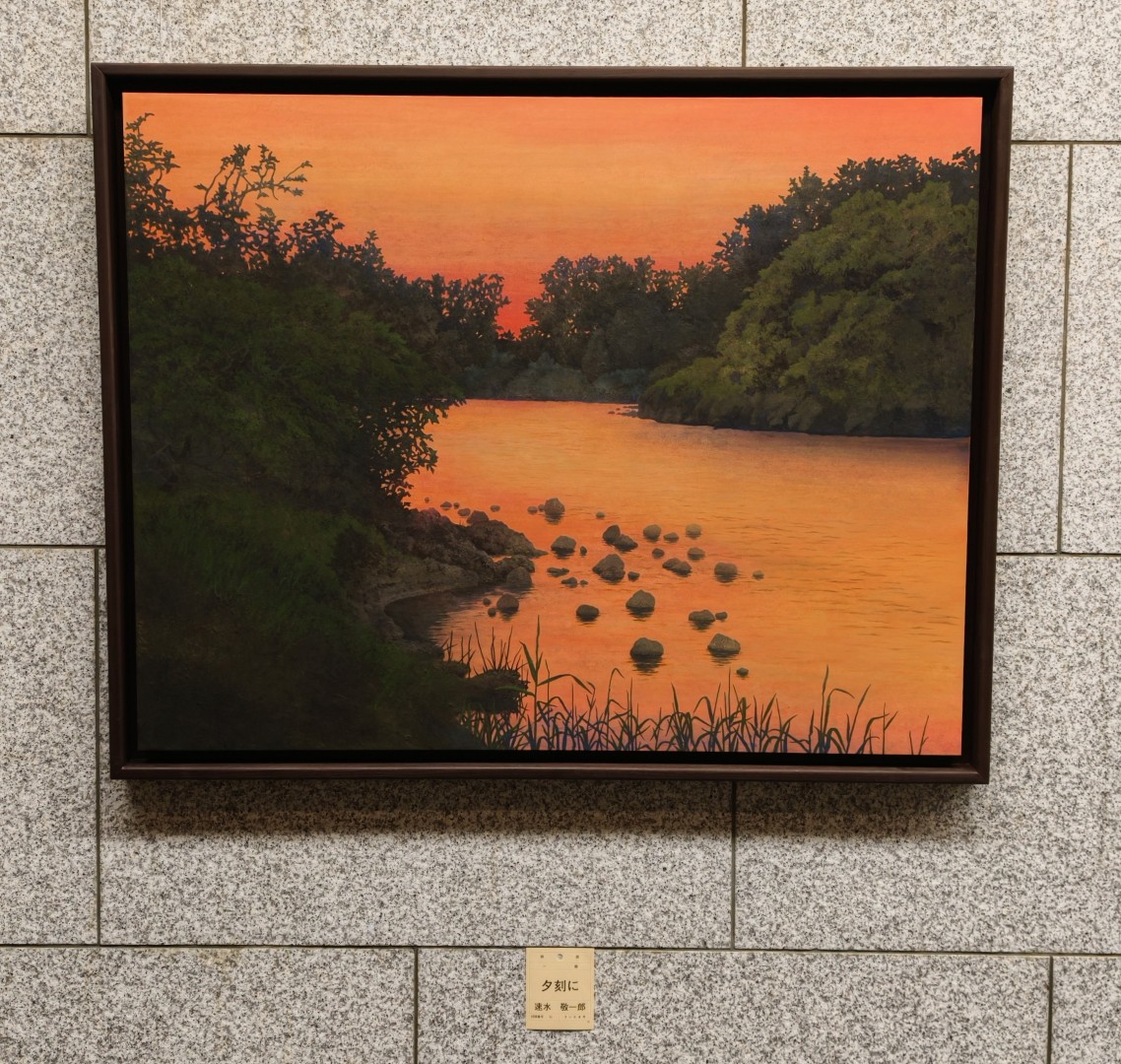
What first seized my soul in the painting was that boundless expanse of orange-red, almost on the verge of bursting into flame. It is not the sunset our naked eyes can capture in daily life, but a kind of pure radiance stripped of the impurities of reality. Here, sky and river lose their boundary; water is no longer a transparent liquid, but a dense medium that bears light. I often feel that time cannot be grasped, especially dusk: you watch it sink and dissipate before your eyes, yet you are powerless to stop it. But this painter seems to have used his brush to forcibly suspend that fleeting instant. He lets this luminous void remain upon the canvas, compelling us to look directly at that last breath—about to vanish, yet incomparably magnificent. It reminds me of human life: the most dazzling moments are often also the moments closest to the end. We are always seeking eternity amid impermanence, and this painting is precisely a delusion that freezes an instant into eternity.
Yet what makes me ponder this painting most deeply is not the light of that void, but the thickets and reefs that stand in front of the light.
If you move closer and look carefully, you will discover that those dark plants are not light, delicate leaves, but layers upon layers of extremely coarse and heavy mineral pigments. They look almost like cold volcanic rock or dried moss. I cannot help asking myself: why use such deathly still, heavy matter to depict plants that ought to be full of vitality?
Perhaps this is the true face of the world. Compared with that fleeting skylight, these weighty substances are what is cold and real. They have no consciousness, no emotion; they simply exist—absolutely and heavily. When that orange-red void attempts to devour everything, these black silhouettes built from fragments of mineral stone, their edges sharp as knives, are like one cold barrier after another, stubbornly declaring the inviolability of matter. Light and darkness, lightness and weight, are engaged here in a silent yet brutal struggle. We humans, who pride ourselves on being the most sentient of all things, cannot help but feel a trace of our own smallness and emptiness when faced with such pure material weight. What, after all, do our troubles, joys, and sorrows amount to before these heavy rocks and plants?
My gaze slid downward along the edges and finally came to rest at the very bottom of the painting—the row of reeds sketched with only a few sparse strokes.
Compared with the burning sky and the heavy rocks, they appear so fragile, as though a single breeze could snap them. But as I kept looking, I suddenly realized that those reeds are, in fact, “me.” Or rather, they are each of us standing before the painting, gazing at this world.
We stand upon the solid shore, our bodies as fragile as reeds, our lives as brief as morning dew, yet we possess a pair of eyes capable of gazing at time and contemplating existence. We cannot prevent dusk from descending, nor can we shake the heavy laws of matter, but we can stand upon this boundary and quietly watch the river of time burn the light of day into ashes.
Montaigne once said that to study philosophy is to learn how to die. I think gazing at a painting like this is much the same. In Keiichiro Hayami’s dusk, I do not see a landscape in the traditional sense; I see only the deepest contemplation an ordinary person can possess when facing the vastness of the universe and the mercilessness of time. We will eventually disappear like that setting sun, but before we disappear, at least we once stood on this shore and lucidly bore witness to this magnificent burning.