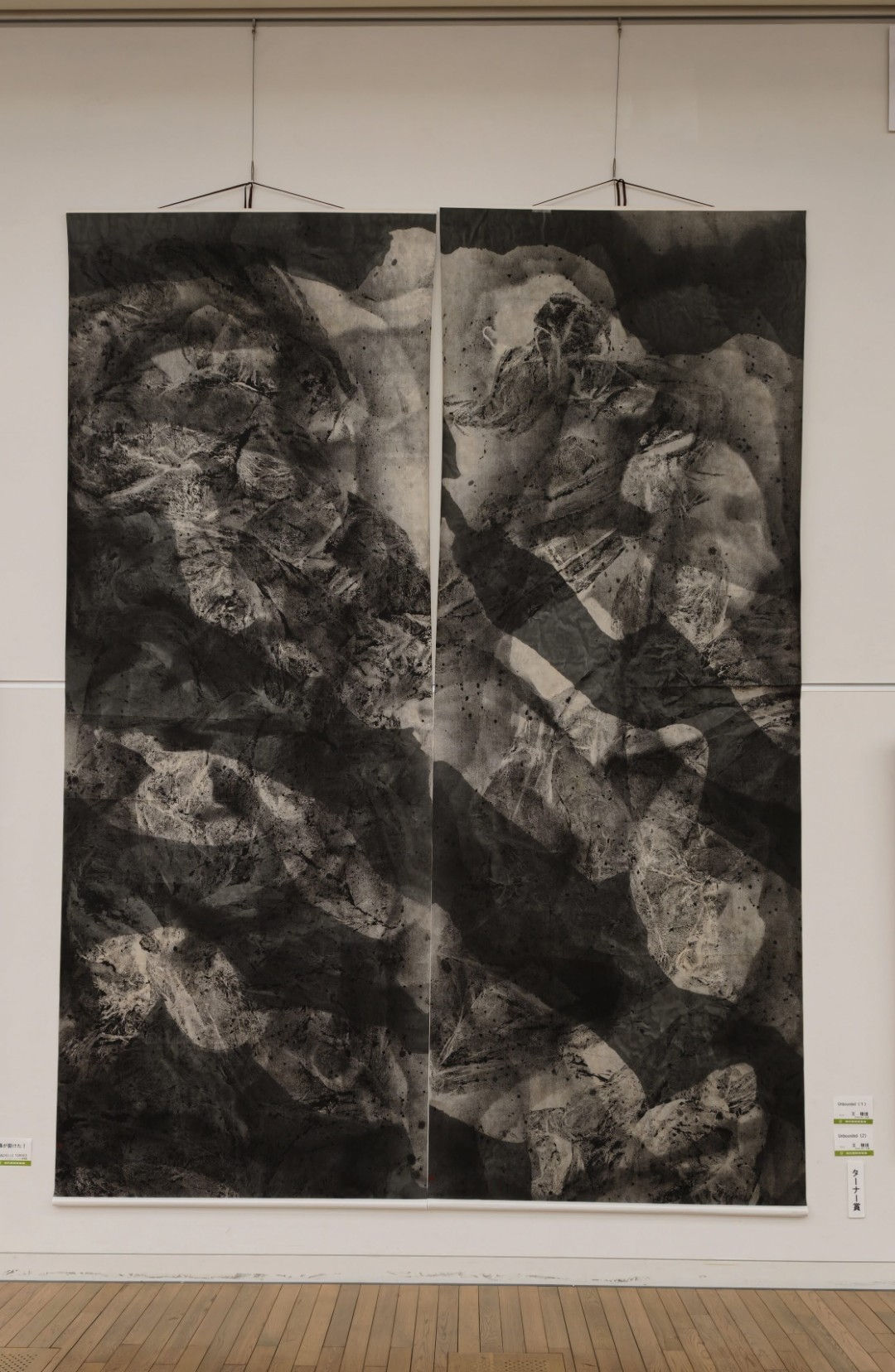
 藝術家:王穆提(WANG MUTI)
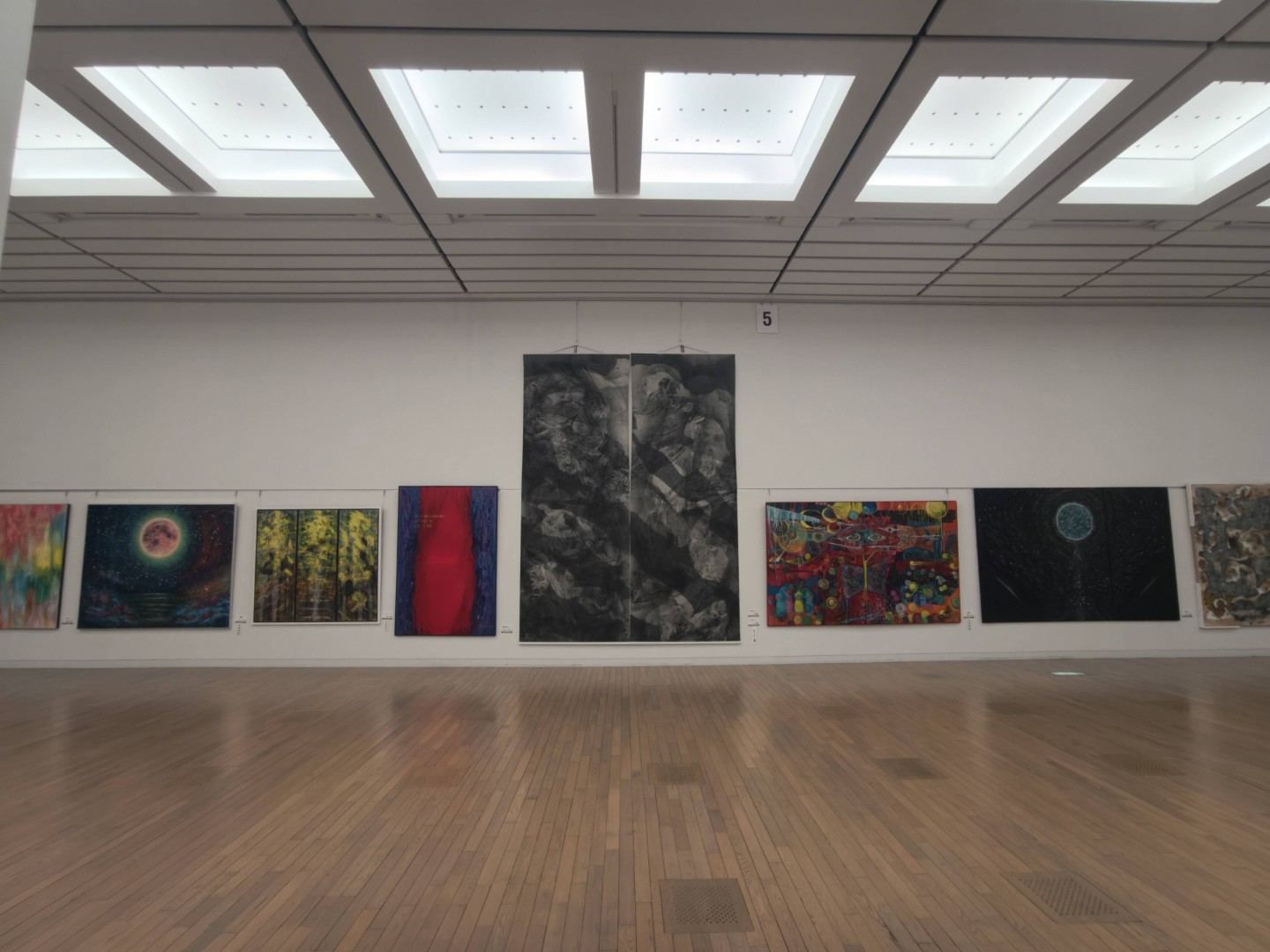
作品名稱:(Unbounded)《無界》
長度:387公分
寬度:291公分(日本國立新美術館、82回現展展場最大展示作品)
媒材:天然植物染料、日本墨、壓克力顏料、宣紙
王穆提 WANG MUTI
現展準會員的制度奇點與水墨幾何中的五蘊相續
撰文:王穆提(WANG MUTI)
一、藝術家位置:從參展者到現展準會員的制度奇點
在第82回日本「現展」台灣藝術家群像中,王穆提的位置具有壓軸性的制度意義。他被標示為「現展準會員,參展兩次即被推舉、與俊英作家展入選、日本透納賞、神奈川現展優秀賞、東京現展獎勵賞等賞」,這不僅是個人履歷上的亮點,更是台灣藝術家進入日本現代美術家協會制度結構後,成為台灣藝術家進入現展體系的重要案例。現展制度中存在入選、受賞、會友、準會員、會員等階梯,而王穆提參展兩次即被推舉為準會員,顯示其作品在日本現展場域中取得了高度辨識與制度認可。
若從現展制度本身來看,準會員並非單純稱號,而是一種象徵性位置。它意味著藝術家不再只是外部投稿者或一次性入選者,而是被納入現展內部評價與推舉系統之中。對台灣藝術家而言,這種推舉尤其具有跨國意義:作品必須跨越語言、媒材、文化脈絡與評審制度的差異,仍能被日本現代美術場域辨識為具有持續發展價值的創作。
王穆提的案例因此可被稱為「制度奇點」。所謂奇點,並非神話化個人成就,而是指出一個制度轉折點:台灣藝術家的參與不再只是展覽交流,而開始進入日本現展的內部身分結構。這種轉變,使台灣作品在現展中不只是「被看見」,也開始「被評價」「被推舉」與「被累積」。我們可以將這種過程描述為跨國象徵資本的累積,亦即藝術家透過入選、受賞、評論與推舉,將個人創作轉化為可被國際藝術場域承認的履歷資源。
因此,王穆提在本專題中的重要性,不只在於其作品具有哲學深度,也在於他體現了台灣藝術家如何透過現展制度取得更高層級的文化位置。他的作品與身分共同構成一個問題:當台灣當代水墨進入日本現代美術公募體系時,它如何不被視為傳統媒材的延續,而是被理解為具有當代思想強度與國際流通性的視覺語言?
二、作品作為哲學結構:王穆提並非單純畫水墨
王穆提作品最值得注意之處,在於它不能僅以「水墨作品」來概括。雖然作品使用宣紙、水墨、天然染料或類似東方紙本媒材,但其真正的核心並不在於傳統筆墨趣味,而在於將水墨的滲透、層疊、邊界、幾何與空間組織,轉化為一套高度哲學化的視覺結構。
我們以《 Unbounded》為例,指出王穆提的作品表面上是東方水墨與西方硬邊抽象的形式對話,但在更深層處,則牽涉世親菩薩《俱舍論・破執我品》中關於「假名我執」「五蘊相續」「因果繼承」與「無我」的問題。
王穆提作品不是在畫山水,也不是在重現傳統水墨意境,而是在視覺層面處理認識論與存在論問題。他關心的是:邊界如何形成?自我如何被建構?流動的身心現象如何被誤認為穩定主體?因果如何在沒有永恆實體的情況下延續?這些問題原本屬於佛教哲學與形上學討論,但王穆提將其轉化為可觀看的形式關係。
因此,在評析王穆提時,不能只問作品是否有墨韻、是否有構圖、是否有色彩,而應進一步追問:墨的層次如何成為時間的痕跡?幾何邊界如何成為認知框架?宣紙的滲透如何呈現因果相續?作品的「界」與「無界」如何讓觀者重新思考自我的生成?
這也是他在本次台灣群像中作為壓軸藝術家的原因:他的作品不只具有視覺強度,也具有高度理論負載,能夠把台灣當代水墨推向哲學思辨的層面。
三、幾何邊界:理性秩序與「假名我執」
王穆提作品中最具辨識度的形式語彙之一,是畫面上的幾何邊界。這些幾何形體往往帶有銳利斜角、硬邊結構、灰階層次或半透明色塊。它們與水墨在宣紙上的自然滲化形成明顯對比:一者冷靜、理性、界定;一者流動、暈散、不可完全控制。
在宣紙這種極具吸水性與毛細現象的材質上,王穆提以近乎精密的控制力徒手勒出邊界,使流動的液體被暫時約束,形成幾何學式的「界」。此處的界,可被理解為《俱舍論》中「假名我執」的視覺化。
「假名我執」可簡要理解為:人將不斷流動、剎那生滅的身心現象,誤認為背後存在一個穩定、獨立、永恆的「我」。這個「我」並非實體,而是由語言、概念、習慣與認知框架建構出的假名。王穆提的幾何邊界,正像是人類意識強加於流動現象之上的框架。
在作品中,幾何不是單純裝飾,也不是現代主義形式語言的引用而已。它象徵理性對混沌的切割,象徵意識對流動生命的框限,也象徵人為了獲得安全感而建立的自我邊界。這些邊界看似清楚,卻建立在流動的水墨之上;看似穩固,卻依賴材料瞬間的滲透、乾燥與凝固。
因此,王穆提的幾何邊界具有雙重性:它一方面展現藝術家的控制力,另一方面也暴露控制本身的虛妄。它讓觀者看見「界」如何被建立,也讓觀者意識到「界」其實只是暫時的、條件性的、被建構出來的。
四、宣紙物性:無法完全支配的流動場
若幾何邊界代表理性與控制,那麼宣紙與水墨則代表流動、滲透與不可完全支配的物質場。宣紙不是光滑封閉的表面,而是具有纖維、吸水性、滲化速度與毛細作用的活性媒介。水墨落在宣紙上後,不會像在塑膠或金屬表面那樣停留於表層,而會滲入、擴散、沉積並與紙張產生不可逆關係。
王穆提正是利用這種不可逆性建立作品深度。作品底層厚重沉積的黑色水墨塊面,是經由無數次墨水澆灌、滲透、乾燥與再積染形成;每一層墨痕都代表五蘊的剎那生滅,前一層雖已乾涸消失,卻改變紙張質地並影響下一層墨水的軌跡。
這一描述非常關鍵,因為它將作品的物質過程與哲學思想緊密連接。水墨的每一次滲透都不是孤立事件,而會改變後續可能性;紙張吸收過一次墨後,便不再是原來的紙。下一次墨水進入時,會受到之前痕跡、濕度、厚度與纖維狀態的影響。這正像因果相續:過去不以實體方式留存,但以條件方式影響現在。
因此,王穆提的宣紙不是被動背景,而是時間與因果的承載體。它記錄每一次水墨行動,也保存每一次行動所造成的條件改變。作品表面上是一幅靜止圖像,實際上卻是多重時間積累後的結果。
五、五蘊相續:沒有永恆自我,但因果不失
王穆提作品最具思想深度之處,在於它可被理解為「五蘊相續」的視覺演繹。佛教思想中的五蘊,指色、受、想、行、識五種構成身心經驗的聚合。五蘊並非固定不變,而是不斷生滅、相續、轉變。人之所以產生「我」的幻覺,是因為將這些流動聚合誤認為穩定實體。
《俱舍論》關於「非一非異」的因果思考:過去造業的五蘊與今日受報的五蘊並非同一實體,但也不是完全無關;它們處於同一相續流之中。
王穆提的水墨層疊正好使這一抽象理論可視化。每一層墨都已經過去,卻沒有完全消失;它留下痕跡,改變下一層條件。新的墨層不是舊墨層本身,但也不能與舊墨層截然分離。它們之間既非完全同一,也非完全不同。
這一點使作品超越一般抽象水墨。許多抽象水墨強調墨色韻味、空間節奏或精神抒發;王穆提則進一步使墨色層疊成為因果相續的視覺模型。觀者在畫面中看到的不只是墨,而是時間的非線性堆積;不只是形,而是存在如何在沒有固定自我的情況下持續流轉。
因此,王穆提作品中的「無界」不只是形式上的無邊無際,也不是簡單的自由抽象,而是指向無我而因果不斷的存在狀態。真正無界的,不是畫面沒有邊框,而是生命與因果本身無法被一個固定自我完全框住。
六、黑色墨層:深淵、地質與時間沉積
王穆提作品中的黑色水墨層常具有深淵感。它不是單一黑色,而是由多次滲透、乾燥、再覆蓋後形成的複雜結構。這種黑色不同於平塗,也不同於純粹視覺上的暗色;它像是地質剖面、時間沉積、深層記憶或不可見因果的聚集。
我們曾以「水墨粒子咬合而成的地質史」形容王穆提作品,指出其底層墨塊呈現深不可測的因果暗流。
這種地質感非常重要。地質層並不是一日形成,而是長時間堆積、壓縮、變質的結果;王穆提的墨層亦然。作品表面的每一處濃淡,都可能包含多次行動、等待、乾燥與覆寫。觀者看到的是一個凝結結果,卻可感受到其背後漫長的生成過程。
這使作品具有時間厚度。它不是瞬間筆觸的表演,而是反覆積累的結果。這種時間厚度與《俱舍論》中的相續思想相互呼應:存在不是一個固定點,而是一連串條件、痕跡與轉化的累積。
黑色也使作品具有深淵性。它讓觀者感受到自我底層的不可測,感受到生命並非透明可掌握,而是由無數不可見條件構成。幾何邊界試圖給予秩序,黑色深層則不斷提醒觀者:任何秩序都建立在更深、更流動、更不可完全控制的因果之上。
七、灰階與半透明:邊界不是絕對,而是濾鏡
王穆提作品中的幾何色塊往往不是完全不透明的實體,而是具有灰階、半透明或層次感。這一點相當重要。若幾何完全封閉,便會形成絕對分割;但半透明幾何使底層墨色仍然可見,代表理性邊界並不能完全遮蔽底層流動。
這種半透明性可被理解為「濾鏡」。人類的自我概念、語言分類與理性框架,並不是完全創造世界,也不是完全與世界無關;它們像濾鏡一樣,使我們以某種方式看見流動現象。王穆提的幾何色塊正是這種濾鏡的視覺化。
它們讓畫面看似被規劃、被切割、被秩序化,但底層墨痕仍然穿透而出。這意味著無論人如何建立自我邊界,五蘊與因果的流動仍然在邊界下方持續作用。界不是虛無,但界也不是實體;它是暫時的認知結構。
這種處理使王穆提的作品具有高度細膩性。他不是簡單地反對理性,也不是浪漫地歌頌混沌,而是讓理性與混沌、邊界與流動、控制與滲透同時存在。作品真正的思想力量,正來自這些矛盾的共存。
八、天然染料與水墨:材料倫理與時間感
若王穆提作品中使用天然染料,這一媒材選擇亦具有重要意義。天然染料與工業顏料不同,它往往與植物、礦物、土地、時間、氧化與變色有關。它不是完全穩定、完全標準化的色彩,而帶有自然材料的時間性與脆弱性。
當天然染料與水墨共同進入宣紙,作品便不只是視覺圖像,而成為自然物質與藝術行為的交互結果。染料可能滲入紙纖維,隨時間產生細微變化;水墨則以沉積與暈染留下痕跡。這些材料共同建立一種非工業化、非純粹數位化的時間感。
這與王穆提的哲學主題相互呼應。若作品要處理五蘊相續、因果條件與無常,那麼材料本身也必須能呈現變化、沉積與不可完全支配。天然染料與水墨的特性,正使作品在物質層面實踐了無常與相續。
因此,王穆提的材料不是中性工具,而是思想的一部分。材料會老化、滲透、沉澱、改變;作品也因此成為一個持續與時間發生關係的存在,而非固定不變的圖像。
九、水墨與硬邊抽象:東西方形式語言的交錯
王穆提作品常被理解為水墨與幾何抽象的結合。若從藝術史角度看,這涉及東方水墨與西方硬邊抽象之間的交錯。水墨強調流動、氣韻、滲化、偶發與筆性;硬邊抽象則強調幾何、平面、邊界、理性與構成。王穆提將兩者放在同一畫面中,並不是簡單拼貼,而是讓兩種視覺邏輯互相質疑。
水墨部分提醒觀者:世界是流動的、無常的、不可完全框限的。幾何部分則提醒觀者:人類總是試圖建立秩序、界線、分類與認知結構。兩者的衝突,正是作品的思想核心。
這種結合也讓王穆提作品具有跨文化可讀性。在日本現展場域中,觀者既能辨識東亞紙本與水墨的文化脈絡,也能感受到現代抽象繪畫的構成語言。作品不屬於純粹傳統,也不完全屬於西方抽象,而是在兩者之間建立一種台灣當代水墨的新位置。
這一點對台灣藝術尤其重要。台灣藝術長期處於東亞傳統、西方現代主義、日本美術制度與全球當代藝術之間。王穆提作品中的水墨幾何,正可視為這種多重脈絡的凝縮:它既回應東方哲學,也進入現代抽象;既使用傳統媒材,也具有當代形式意識。
十、無界:不是沒有邊界,而是看見邊界的條件性
若以《無界》作為王穆提作品思想的代表,必須注意「無界」並不等於完全取消邊界。相反地,王穆提正是透過大量邊界、幾何、層疊與墨痕,讓觀者看見邊界如何被建構、如何暫時成立、又如何被底層流動不斷質疑。
「無界」因此不是形式上的空泛自由,而是對「界」的深層反思。沒有界,便無從談無界;只有當觀者看見幾何邊界的強烈存在,才能進一步意識到它們並非終極真實。王穆提的作品並不輕易否定界,而是揭示界的條件性。
這與佛教無我思想相呼應。無我不是說人不存在,而是說不存在一個獨立、永恆、不變的實體我。人作為五蘊相續的現象仍然存在,因果仍然作用,經驗仍然發生;只是這一切不能被歸結為一個固定自我。王穆提的「無界」亦然:畫面中有界,但界不是絕對;有形,但形不自足;有相續,但無固定主體。
因此,王穆提作品最深刻之處,在於它不把哲學概念變成標語,而是讓觀者在觀看中親自經驗「界」與「無界」的相互生成。
十一、觀者的位置:觀看本身也是一種破執
王穆提作品對觀者提出了較高要求。它不是一眼即可消費的圖像,也不是以情節或明確符號引導觀者。觀者必須在幾何邊界、墨色層次、透明灰階與宣紙肌理之間反覆觀看,才能逐漸感受到作品的思想結構。
這種觀看過程本身,便具有破執意味。初看時,觀者可能先被幾何形體吸引,試圖理解構圖秩序;再看時,視線會被底層墨色拉入深處,意識到幾何之下仍有更複雜的流動;最後,觀者可能發現自己在「看見邊界」與「看見邊界不穩」之間來回擺動。
這正是一種視覺上的破執。作品讓觀者先建立認知,再鬆動認知;先看見界,再感受無界;先相信形,後意識到形的條件性。這種觀看過程與作品的佛學思維高度一致。
因此,王穆提作品的哲學性不是外加解說,而是內在於觀看經驗中。即使觀者不熟悉《俱舍論》,仍可能透過視覺經驗感受到:穩定自我與明確邊界並非理所當然,而是在流動條件中暫時生成。
十二、與前六位藝術家的關係:台灣群像的哲學壓軸
王穆提作為本專題藝術家評論的最後一位,能夠對前面六位藝術家的作品形成某種總結與提升。
蔡梅芳《戀戀紫藤》在自然崇高中尋找情感錨點;廖純沂《未盡・浮境》在液態現代性中呈現無根懸浮;姜金玲以《荷塘情旅》與《月桃盛開引禽来》釋放生命衝動;陳福祺《魚的樂趣》在數位擬像中重釋逍遙;王詮富《一念菩提開翠微》以留白與禽鳥開啟澄明;吳智勇《鄉愁之秋》在液態都市中尋找失去的歸屬。
王穆提則將這些問題推向更深層的存在論:情感、懸浮、生命、數位、澄明與鄉愁,最終都與「我」如何被建構、如何在時間中相續、如何在因果中流轉有關。若沒有固定自我,那麼誰在眷戀?誰在懸浮?誰在感受生命衝動?誰在逍遙?誰在一念澄明?誰在鄉愁?
王穆提作品不直接回答,而是以水墨幾何提出視覺提問。這使他成為台灣群像中的哲學壓軸:他不只是展示一種風格,而是將整個群像中反覆出現的現代主體問題,推向更根本的層面。
 【專題評論】日本第82回「現展」台灣藝術家群像
十三、與國立新美術館場域的關係:無典藏空間中的無我水墨
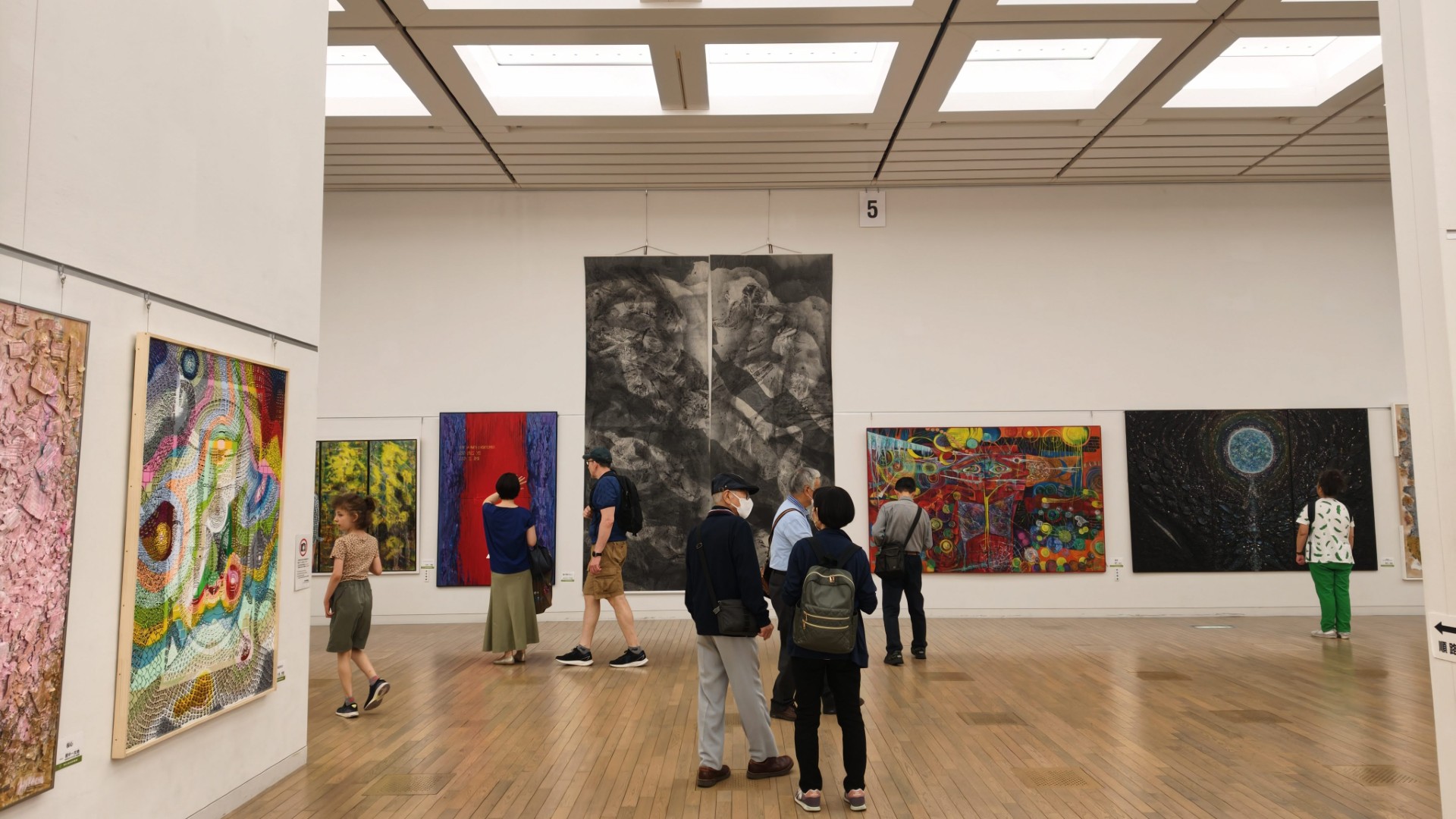
國立新美術館不設常設典藏,它是一個不斷清空、又不斷被展覽填滿的開放場域。 王穆提作品進入這樣的空間,具有特殊的象徵性。
一座無典藏美術館,並不以固定館藏建立永恆敘事;王穆提作品則不以固定自我建立存在基礎。展場與作品在此形成微妙呼應:美術館沒有永久典藏的「自我」,作品也質疑永恆不變的「我」。兩者都強調當下、事件、相續與臨時生成。
在國立新美術館的臨時展牆上,王穆提的水墨幾何像是一個關於時間與存在的視覺命題。展覽會撤展,作品會移動,觀眾會離開,但展覽經驗與數位檔案又會以另一種形式延續。這種展覽本身的相續性,也與王穆提作品中的因果相續形成呼應。
因此,王穆提作品不只是被放置於國立新美術館,而是在概念上與這座無典藏美術館產生對話。它們共同提出一個問題:如果沒有永久固定的中心,意義如何延續?如果沒有實體自我,因果如何不失?
十四、與掛軸展示的關係:重力、垂直性與因果下墜
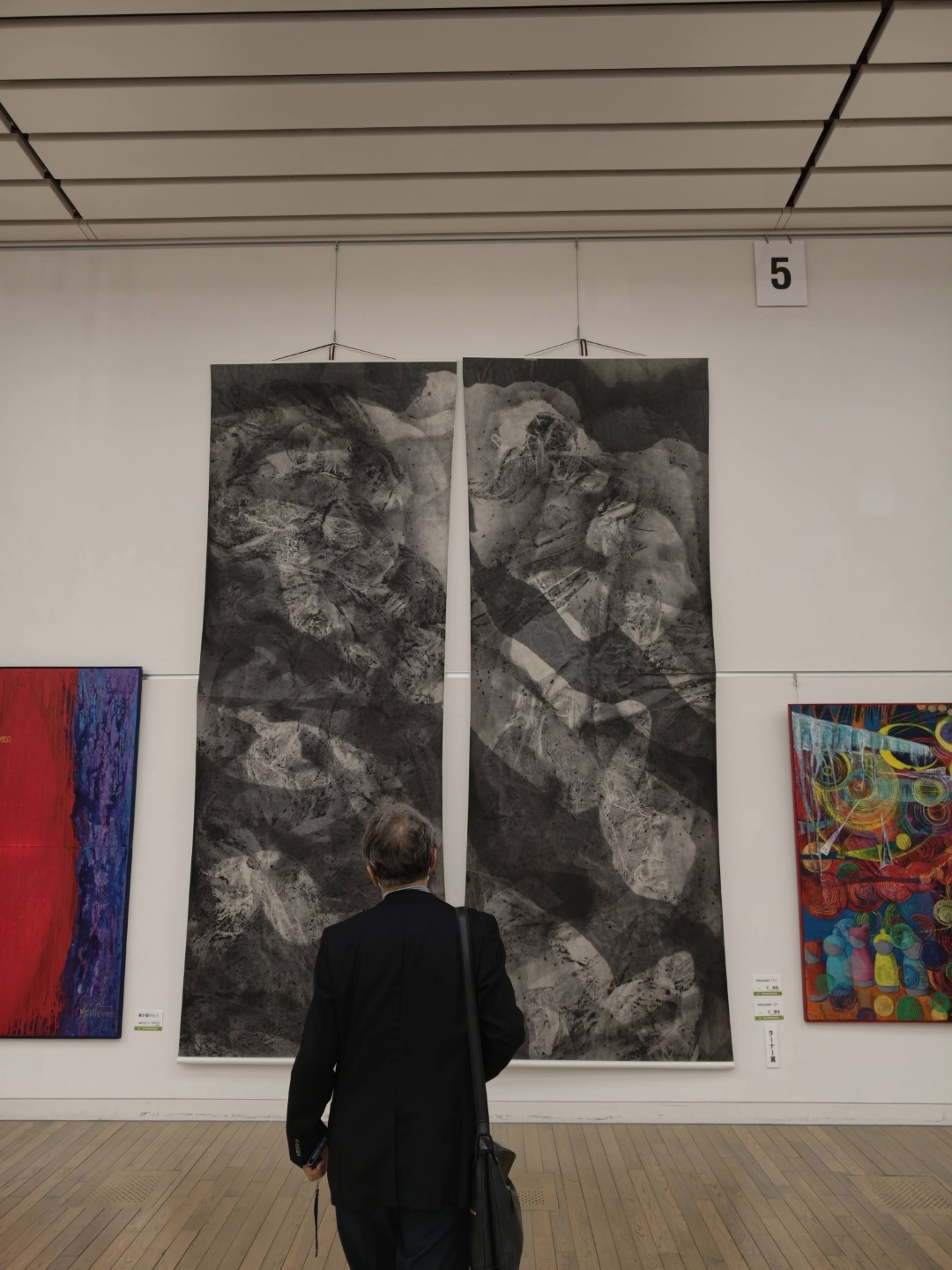
本屆台灣參展作品多採掛軸形式展示。對王穆提而言,掛軸不只是運輸與裝裱策略,更能強化其作品的時間性與因果性。掛軸的垂直性與水墨流動之間具有物理上的共謀;當近四公尺的巨幅作品被垂直懸掛,觀者視線由上而下游走,彷彿閱讀一部順著重力垂流而下的地質史。
這一點對王穆提作品尤其貼切。水墨在宣紙上本就受重力、水分與纖維牽引;掛軸展示則使這種垂直流動在展場中被重新感知。觀者站在作品前,視線可能隨著墨色層次向下移動,感受到一種時間、重量與因果的下墜。
掛軸也使作品保持柔性。它不是被厚重畫框封閉,而是以可捲收、可展開、可移動的方式存在。這與「無界」思想亦相呼應:作品不是被框死的物件,而是一個可展開的相續場。它可以在不同展場中被重新懸掛,每一次展示都形成新的觀看條件。
因此,掛軸不只是形式配套,而是作品思想的延伸。它讓水墨的重力、宣紙的柔性與因果相續的哲學,共同進入展場經驗。
十五、制度與作品的互文:準會員身份如何回到創作本身
王穆提的準會員身份不應與作品分析分離。制度位置與作品內容之間存在互文關係。現展準會員意味著他在日本藝術場域中取得一種被承認的相續位置;而其作品則思考沒有固定自我時,如何仍然存在因果相續。制度與作品在此形成有趣的對照。
藝術家身份的建立本身,也是一種「假名」。姓名、獎項、入選、準會員、受賞紀錄,都是制度賦予藝術家的符號與位置。它們並非藝術家的全部實體,卻真實影響藝術家如何被觀看、被邀請、被書寫與被記錄。
王穆提作品對「假名我執」的視覺反思,反過來也使我們更清楚看見藝術制度的運作:藝術家身分不是自然存在,而是由作品、展覽、評論、推舉、資料庫與公共記憶共同建構。這並不意味制度是虛假無用的,而是指出制度也是一種條件相續。
因此,王穆提的準會員身份與其作品哲學之間並不矛盾。相反地,它讓我們看見:藝術家在制度中被命名、被推舉、被記錄,正如作品中的幾何邊界暫時劃定流動現象。這些命名與邊界不是終極實體,但能產生真實效果。
十六、專業評論觀點:王穆提作品的五重價值
綜合以上分析,王穆提在第82回現展台灣藝術家群像中具有以下五重評論價值。
第一,制度價值
王穆提參展兩次即被推舉為現展準會員,並曾入選俊英作家展等賞,顯示其作品在日本現展制度中取得高度認可。此一制度位置使其成為台灣藝術家跨國象徵資本累積的重要案例。
第二,媒材價值
其作品以宣紙、水墨、天然染料與層疊技法,充分發揮東方紙本媒材的滲透性、時間性與不可逆性。材料不只是工具,而是因果與相續的物質載體。
第三,形式價值
幾何邊界、灰階色塊與硬邊結構,使作品與西方抽象形成對話;同時,底層水墨流動又保留東方媒材的氣韻與無常感。作品在理性秩序與物質流動之間建立高度張力。
第四,哲學價值
作品將《俱舍論》中的假名我執、五蘊相續、非一非異與無我因果等思想轉化為視覺結構,使抽象佛學問題成為可被觀看的形式經驗。
第五,群像價值
作為七位藝術家中的壓軸,王穆提將前述作品中關於情感、生命、懸浮、逍遙、澄明與鄉愁的問題,提升到主體如何生成與相續的存在論層面。
十七、本章小結:在界與無界之間觀看自我的生成
王穆提的作品之所以能成為本專題藝術家評論的壓軸,正在於它同時具備制度強度、媒材深度、形式辨識度與哲學思辨力。他的準會員身份顯示其創作已在日本現展體系中取得重要位置;其作品則透過水墨、宣紙、幾何與染料,將「我」「界」「因果」「相續」等深層問題轉化為視覺經驗。
在他的畫面中,幾何邊界像是理性與自我建立的框架;底層墨色則像因果與五蘊相續的深淵。邊界存在,卻不是絕對;墨痕流動,卻不是無序。作品真正讓人震動之處,正在於它使觀者意識到:自我也許不是固定實體,而是一連串條件、痕跡、命名與相續所形成的暫時現象。
因此,王穆提的「無界」不是空泛地取消邊界,而是在看見邊界之後,進一步看見邊界的條件性。它不是逃離形式,而是透過形式破除形式;不是否定自我,而是觀看自我如何被建構、被執著、又如何在因果中流轉。
在第82回日本現展的台灣藝術家群像中,王穆提代表了台灣當代水墨最具哲學強度的一端。他讓水墨不只是文化身份的象徵,也不只是傳統媒材的延續,而成為能夠與佛教認識論、現代抽象、跨國制度與當代主體問題對話的思想性藝術。
相關內容:
王穆提以現展台灣首位準會員參展日本第82回現展,水墨幾何回應五蘊相續與制度奇點
【現場直擊】82回現展 2026日本國立新美術館展「日本第82回現代美術家展」
影戲與實相:王穆提《虛空與法性的疊影》中的超驗空間與本體論建築
王穆提《寂照:識變與真如》微觀的宇宙學——積墨、皺褶與「觸覺視覺」的深度
台灣首位日本國立新美術館個展藝術家-王穆提續寫NAU前衛傳奇
王穆提獲日本透納賞,於日本國立新美術館展出《Unbounded》作品
王穆提台灣首位日本國立新美術館個展藝術家 續寫NAU前衛傳奇
【台日交流展】靈光、透明與流動的疆界:王穆提、林仁傑、曾興平三人聯展日本東京「Open World 2026」,後援:日本外務省國際交流基金、駐日蒙古國大使館
【台日交流展】與莫內、畢卡索館藏同輝!台灣藝術家王穆提、廖純沂榮登日本MOMAS埼玉近代美術館《第49回埼玉現展》展出首位
【王穆提藝術評論】〈繼而工畫於山水,落筆驚世而不苟名於時〉《詹昭倫八十五回顧展》,台灣台北,2020年1月
【台日交流展】【王穆提藝術評論】日本橫濱情報志「SAKURA」Vol.25刊登 [ 若水柔剛-台灣新水墨]
【台日交流展】【王穆提藝術評論】日本橫濱三年展 橫濱トリエンナーレ: ヨコハマトリエンナーレ2017 系列報導:日本橫濱情報志「SAKURA」Vol.24 刊登文章
【台日交流展】王穆提受邀參加日本NAU21世紀美術連立協會會員展(日本東京都CCAA藝術廣場)
【台日交流展】王穆提受邀日本東京都美術館《第13回東京現展》,作品為第一順位,打破外國人參展日本藝術展覽記錄
【台日交流展】台灣日本唯一參展兩回被推薦為現展準會員,王穆提於日本81回現展被推薦為準會員打破現代美術家協會記錄
【台日交流展】台灣藝術家 王穆提受邀參加《日本第四十回紀念茨城現展》:〈筑波美術館參展略記〉
【台日交流展】台灣藝術家王穆提受邀參加《台灣日本國際交流展》日本國立東京都美術館展-〈日本第十二回東京現展〉獲得【獎勵賞】
【台日交流展】台灣藝術家王穆提受邀參加2024日本《第56回神奈川現展》並且獲得日本現展優秀賞
【台日交流展】台灣藝術家 王穆提受邀日本第二十三回《NAU21世紀美術連立展》-東京國立新美術館展覽,並成為日本NAU21世紀美術連立展第一個也是唯一的台灣藝術家成員。【現場直擊】
Artist: WANG MUTI
Title: Unbounded
Dimensions: 387 × 291 cm (largest work exhibited in the 82nd GEHEN Exhibition, The National Art Center, Tokyo)
Medium: Natural plant dyes, Japanese ink, acrylic pigments, xuan paper
WANG MUTI
The Institutional Singularity of a Genten Associate Member and the Continuity of the Five Aggregates in Ink-Wash Geometry
Written by WANG MUTI
I. The Artist’s Position: The Institutional Singularity from Participant to Genten Associate Member
Among the portraits of Taiwanese artists in the 82nd Japan “Genten” Exhibition, Wang Muti’s position carries a concluding institutional significance. He is identified as “Genten associate member, recommended after only two participations, and previously selected for the Young Talented Artists Exhibition and other awards.” This is not only a highlight in an individual résumé, but also a representative case of a Taiwanese artist rapidly obtaining an evaluative position after entering the institutional structure of the Modern Art Association of Japan. The Genten system contains ladders such as selection, awards, associate friend, associate member, and member; Wang Muti’s recommendation as an associate member after only two participations shows that his work has achieved high recognizability and institutional recognition within the field of Genten in Japan.
Viewed from the Genten system itself, associate membership is not merely a title, but a symbolic position. It means that the artist is no longer simply an external submitter or one-time selected participant, but has been incorporated into Genten’s internal system of evaluation and recommendation. For Taiwanese artists, such recommendation is especially transnational in significance: the work must cross differences in language, medium, cultural context, and judging system, while still being recognized by the field of Japanese modern art as a creation with sustained developmental value.
Wang Muti’s case may therefore be called an “institutional singularity.” Singularity here does not mythologize personal achievement, but indicates an institutional turning point: Taiwanese artists’ participation is no longer only exhibition exchange, but begins to enter the internal identity structure of Japan’s Genten. This transformation means that Taiwanese works in Genten are not only “seen,” but also begin to be “evaluated,” “recommended,” and “accumulated.” We may describe this process as the accumulation of transnational symbolic capital; that is, through selection, awards, criticism, and recommendation, the artist transforms personal creation into résumé resources recognizable within the international art field.
Therefore, Wang Muti’s importance in this special topic lies not only in the philosophical depth of his work, but also in how he embodies the way Taiwanese artists acquire a higher-level cultural position through the Genten system. His work and status together constitute a question: when Taiwanese contemporary ink wash enters Japan’s modern art public-entry system, how can it avoid being regarded as merely a continuation of traditional media and instead be understood as a visual language with contemporary intellectual intensity and international circulation?
II. The Work as Philosophical Structure: Wang Muti Does Not Simply Paint Ink Wash
The most noteworthy aspect of Wang Muti’s work is that it cannot be summarized simply as “ink-wash work.” Although the work uses xuan paper, ink wash, natural dyes, or similar Eastern paper-based media, its true core does not lie in traditional brush-and-ink taste, but in transforming the penetration, layering, boundaries, geometry, and spatial organization of ink wash into a highly philosophical visual structure.
Taking Unbounded as an example, we point out that Wang Muti’s work appears on the surface to be a formal dialogue between Eastern ink wash and Western hard-edge abstraction, but on a deeper level it involves issues in Vasubandhu’s Abhidharmakośa: Refutation of the Self, including “attachment to a nominal self,” “continuity of the five aggregates,” “causal inheritance,” and “no-self.”
Wang Muti’s work does not paint landscape, nor does it reproduce traditional ink-wash mood. Instead, it addresses epistemological and ontological issues at the visual level. He is concerned with: How are boundaries formed? How is the self constructed? How are flowing physical and mental phenomena mistaken for a stable subject? How does causality continue without an eternal substance? These questions originally belong to Buddhist philosophy and metaphysical discussion, but Wang Muti translates them into visible formal relationships.
Therefore, when evaluating Wang Muti, one cannot merely ask whether the work has ink resonance, composition, or color; one must further ask: How do layers of ink become traces of time? How do geometric boundaries become cognitive frameworks? How does the penetration of xuan paper present causal continuity? How do the work’s “boundary” and “unboundedness” allow viewers to rethink the formation of the self?
This is also why he serves as the concluding artist in this Taiwanese portrait: his work possesses not only visual intensity, but also a high degree of theoretical charge, capable of pushing Taiwanese contemporary ink wash toward philosophical speculation.
III. Geometric Boundaries: Rational Order and “Attachment to a Nominal Self”
One of the most recognizable formal vocabularies in Wang Muti’s work is the geometric boundary on the picture surface. These geometric forms often carry sharp oblique angles, hard-edge structures, grayscale layers, or semi-transparent color blocks. They form an obvious contrast with the natural diffusion of ink wash on xuan paper: one is calm, rational, and defining; the other is flowing, diffusing, and not fully controllable.
On xuan paper, a material with strong absorbency and capillary action, Wang Muti uses almost precise control to draw boundaries by hand, temporarily restraining flowing liquid and forming a geometric “boundary.” This boundary may be understood as the visualization of “attachment to a nominal self” in the Abhidharmakośa.
“Attachment to a nominal self” may be briefly understood as follows: human beings mistake constantly flowing and momentarily arising-and-ceasing physical and mental phenomena for the existence of a stable, independent, and eternal “self” behind them. This “self” is not a substance, but a nominal construct formed by language, concepts, habits, and cognitive frameworks. Wang Muti’s geometric boundaries are like frameworks imposed by human consciousness upon flowing phenomena.
In the work, geometry is not merely decoration, nor merely a citation of modernist formal language. It symbolizes rational cutting into chaos, the consciousness’s framing of flowing life, and the self-boundaries people establish in order to gain a sense of security. These boundaries appear clear, yet are built upon flowing ink wash; they appear stable, yet depend on the momentary penetration, drying, and coagulation of material.
Therefore, Wang Muti’s geometric boundaries possess a dual nature: on the one hand, they demonstrate the artist’s control; on the other hand, they reveal the illusory nature of control itself. They let viewers see how “boundary” is established, and also make viewers realize that “boundary” is actually temporary, conditional, and constructed.
IV. The Materiality of Xuan Paper: A Flowing Field That Cannot Be Fully Dominated
If geometric boundaries represent rationality and control, then xuan paper and ink wash represent a material field of flow, penetration, and incomplete domination. Xuan paper is not a smooth, closed surface, but an active medium with fibers, absorbency, diffusion speed, and capillary action. After ink falls on xuan paper, it does not remain on the surface as it would on plastic or metal; it penetrates, spreads, sediments, and forms an irreversible relationship with the paper.
Wang Muti uses precisely this irreversibility to establish the depth of his work. The thick, sedimented black ink-wash blocks at the bottom layers of the work are formed through countless pourings, penetrations, dryings, and re-layerings of ink; each layer of ink trace represents the momentary arising and ceasing of the five aggregates. Although the previous layer has dried and disappeared, it changes the texture of the paper and affects the path of the next layer of ink.
This description is crucial because it closely connects the material process of the work with philosophical thought. Each penetration of ink is not an isolated event, but changes subsequent possibilities; after paper has absorbed ink once, it is no longer the same paper. When the next ink enters, it is affected by previous traces, humidity, thickness, and fiber conditions. This is like causal continuity: the past does not remain as a substance, but affects the present as a condition.
Therefore, Wang Muti’s xuan paper is not a passive background, but a carrier of time and causality. It records every ink-wash action and preserves the conditional changes caused by each action. On the surface, the work is a still image; in reality, it is the result of the accumulation of multiple times.
V. Continuity of the Five Aggregates: No Eternal Self, Yet Causality Is Not Lost
The deepest intellectual aspect of Wang Muti’s work lies in the fact that it may be understood as a visual enactment of the “continuity of the five aggregates.” In Buddhist thought, the five aggregates refer to form, feeling, perception, formations, and consciousness—the five aggregations that constitute bodily and mental experience. The five aggregates are not fixed and unchanging, but continuously arise, cease, continue, and transform. The illusion of “self” arises because these flowing aggregates are mistaken for a stable substance.
The Abhidharmakośa considers causality through the notion of “neither identical nor different”: the five aggregates that performed actions in the past and the five aggregates that receive effects today are not the same substance, but neither are they completely unrelated; they exist within the same stream of continuity.
Wang Muti’s layered ink wash precisely visualizes this abstract theory. Each layer of ink has already passed, yet has not completely disappeared; it leaves traces and changes the conditions for the next layer. The new ink layer is not the old ink layer itself, but it cannot be completely separated from it. They are neither entirely identical nor entirely different.
This point allows the work to transcend ordinary abstract ink wash. Many abstract ink-wash works emphasize ink resonance, spatial rhythm, or spiritual expression; Wang Muti further turns layered ink into a visual model of causal continuity. What viewers see in the image is not merely ink, but the nonlinear accumulation of time; not merely form, but how existence continues to flow without a fixed self.
Therefore, the “unboundedness” in Wang Muti’s work is not merely formal boundlessness, nor simple free abstraction, but points toward an existential state of no-self in which causality continues. True unboundedness does not mean the absence of a frame around the picture, but that life and causality themselves cannot be fully framed by a fixed self.
VI. Black Ink Layers: Abyss, Geology, and Temporal Sedimentation
The black ink-wash layers in Wang Muti’s work often possess a sense of abyss. It is not a single black, but a complex structure formed through repeated penetration, drying, and covering. This black differs from flat coloring and from purely visual darkness; it resembles a geological section, temporal sedimentation, deep memory, or the gathering of invisible causality.
We have described Wang Muti’s work as “a geological history formed by the interlocking of ink particles,” pointing out that its underlying ink blocks present unfathomable dark currents of causality.
This geological quality is very important. Geological strata are not formed in a single day, but are the results of long-term accumulation, compression, and transformation; Wang Muti’s ink layers are the same. Every lightness and darkness on the surface of the work may contain multiple actions, waits, dryings, and overwritings. What viewers see is a condensed result, yet they can sense the long generative process behind it.
This gives the work temporal thickness. It is not a performance of instantaneous brushstrokes, but the result of repeated accumulation. This temporal thickness resonates with the thought of continuity in the Abhidharmakośa: existence is not a fixed point, but an accumulation of conditions, traces, and transformations.
Black also gives the work an abyssal quality. It allows viewers to sense the unknowability at the bottom of the self, and to feel that life is not transparent or fully graspable, but constituted by countless invisible conditions. Geometric boundaries attempt to provide order, while the black depths continually remind viewers that any order is built upon deeper, more flowing, and less fully controllable causality.
VII. Grayscale and Semi-Transparency: Boundary Is Not Absolute, but a Filter
The geometric color blocks in Wang Muti’s work are often not completely opaque entities, but possess grayscale, semi-transparency, or layered qualities. This is quite important. If geometry were completely closed, it would form absolute division; but semi-transparent geometry allows the underlying ink color to remain visible, representing that rational boundaries cannot completely conceal underlying flow.
This semi-transparency may be understood as a “filter.” Human concepts of self, linguistic categories, and rational frameworks neither completely create the world nor are completely unrelated to it; they function like filters, allowing us to see flowing phenomena in certain ways. Wang Muti’s geometric color blocks are precisely the visualization of such filters.
They make the image seem planned, cut, and ordered, yet underlying ink traces still penetrate through. This means that no matter how humans establish self-boundaries, the flow of the five aggregates and causality continues to operate beneath those boundaries. Boundary is not nothingness, but neither is it substance; it is a temporary cognitive structure.
This treatment gives Wang Muti’s work great subtlety. He does not simply oppose rationality, nor romantically praise chaos, but lets rationality and chaos, boundary and flow, control and penetration coexist. The true intellectual force of the work comes precisely from the coexistence of these contradictions.
VIII. Natural Dyes and Ink Wash: Material Ethics and a Sense of Time
If natural dyes are used in Wang Muti’s work, this material choice also has important significance. Natural dyes differ from industrial pigments; they are often related to plants, minerals, land, time, oxidation, and color change. They are not completely stable or fully standardized colors, but carry the temporality and fragility of natural materials.
When natural dyes and ink wash enter xuan paper together, the work is no longer merely a visual image, but becomes the interactive result of natural material and artistic action. Dyes may penetrate paper fibers and produce subtle changes over time; ink wash leaves traces through sedimentation and diffusion. Together, these materials establish a sense of time that is neither industrialized nor purely digital.
This resonates with Wang Muti’s philosophical theme. If the work is to address the continuity of the five aggregates, causal conditions, and impermanence, then the materials themselves must also be able to present change, sedimentation, and incomplete domination. The qualities of natural dyes and ink wash enable the work to practice impermanence and continuity at the material level.
Therefore, Wang Muti’s materials are not neutral tools, but part of the thinking. Materials age, penetrate, sediment, and change; the work therefore becomes an existence that continues to relate to time, rather than a fixed and unchanging image.
IX. Ink Wash and Hard-Edge Abstraction: The Interweaving of Eastern and Western Formal Languages
Wang Muti’s work is often understood as a combination of ink wash and geometric abstraction. From the perspective of art history, this involves the interweaving of Eastern ink wash and Western hard-edge abstraction. Ink wash emphasizes flow, vital resonance, diffusion, accident, and brush nature; hard-edge abstraction emphasizes geometry, flatness, boundaries, rationality, and composition. Wang Muti places the two within the same picture not as simple collage, but as a way of making the two visual logics question one another.
The ink-wash part reminds viewers that the world is flowing, impermanent, and not fully frameable. The geometric part reminds viewers that human beings always attempt to establish order, boundaries, categories, and cognitive structures. The conflict between the two is precisely the intellectual core of the work.
This combination also gives Wang Muti’s work cross-cultural readability. Within the field of Japan’s Genten Exhibition, viewers can recognize both the cultural context of East Asian paper and ink wash and the compositional language of modern abstract painting. The work belongs neither to pure tradition nor entirely to Western abstraction, but establishes a new position for Taiwanese contemporary ink wash between the two.
This point is especially important for Taiwanese art. Taiwanese art has long existed among East Asian tradition, Western modernism, Japanese art institutions, and global contemporary art. The ink-wash geometry in Wang Muti’s work may be regarded as a condensation of these multiple contexts: it responds to Eastern philosophy while entering modern abstraction; it uses traditional media while possessing contemporary formal consciousness.
X. Unbounded: Not the Absence of Boundaries, but Seeing the Conditionality of Boundaries
If Unbounded is taken as representative of Wang Muti’s thought, one must note that “unbounded” does not mean the complete cancellation of boundaries. On the contrary, Wang Muti precisely uses numerous boundaries, geometry, layering, and ink traces to allow viewers to see how boundaries are constructed, how they temporarily take shape, and how they are continually questioned by underlying flow.
“Unbounded” is therefore not an empty formal freedom, but a deep reflection on “boundary.” Without boundary, there is no way to speak of unboundedness; only when viewers see the strong presence of geometric boundaries can they further realize that these boundaries are not ultimate truth. Wang Muti’s work does not easily deny boundary, but reveals its conditionality.
This resonates with the Buddhist thought of no-self. No-self does not mean that human beings do not exist; it means that there is no independent, eternal, and unchanging substantial self. Human beings as phenomena of the continuity of the five aggregates still exist, causality still operates, and experience still occurs; only all of this cannot be reduced to a fixed self. Wang Muti’s “unbounded” is the same: there are boundaries in the picture, but boundaries are not absolute; there is form, but form is not self-sufficient; there is continuity, but no fixed subject.
Therefore, the most profound aspect of Wang Muti’s work lies in the fact that it does not turn philosophical concepts into slogans, but allows viewers to personally experience the mutual generation of “boundary” and “unboundedness” through viewing.
XI. The Viewer’s Position: Viewing Itself as a Form of Breaking Attachment
Wang Muti’s work makes higher demands on viewers. It is not an image that can be consumed at a glance, nor does it guide viewers through plot or clear symbols. Viewers must repeatedly look among geometric boundaries, ink layers, transparent grayscale, and xuan-paper texture before gradually sensing the work’s intellectual structure.
This viewing process itself carries the meaning of breaking attachment. At first glance, viewers may be attracted by geometric forms and attempt to understand the compositional order; upon further viewing, the gaze is drawn into the depths by the underlying ink tones, realizing that beneath geometry there remains a more complex flow; finally, viewers may discover themselves moving back and forth between “seeing boundaries” and “seeing the instability of boundaries.”
This is precisely a visual form of breaking attachment. The work first allows viewers to establish cognition, then loosens that cognition; first to see boundary, then to feel unboundedness; first to believe in form, then to realize the conditionality of form. This viewing process is highly consistent with the Buddhist thinking of the work.
Therefore, the philosophical quality of Wang Muti’s work is not an external explanation, but is internal to the viewing experience. Even if viewers are not familiar with the Abhidharmakośa, they may still sense through visual experience that stable self and clear boundaries are not matters of course, but are temporarily generated within flowing conditions.
XII. Relationship with the Previous Six Artists: The Philosophical Finale of the Taiwanese Portrait
As the final artist discussed in this special-topic criticism, Wang Muti can form a kind of summary and elevation of the works of the previous six artists.
Tsai Mei-Fang’s Lingering Wisteria seeks an emotional anchor within natural sublimity; Liau Chun-Yi’s Unfinished・Floating Realm presents rootless suspension within liquid modernity; Jiang Jinling releases life impulse through Emotional Journey in the Lotus Pond and Shell Ginger in Full Bloom Attracts Birds; Chen Fu-Chi’s The Pleasure of Fish reinterprets free wandering within digital simulacra; Wang Chuan Fu’s One Thought of Bodhi Opens the Verdant Mist opens clarity through voids and birds; Wu Zhiyong’s Autumn of Nostalgia seeks lost belonging within a liquid city.
Wang Muti pushes these questions toward a deeper ontology: emotion, suspension, life, the digital, clarity, and nostalgia ultimately all concern how the “self” is constructed, how it continues through time, and how it flows within causality. If there is no fixed self, then who is lingering? Who is suspended? Who feels life impulse? Who wanders freely? Who opens clarity in one thought? Who feels nostalgia?
Wang Muti’s work does not answer directly, but raises visual questions through ink-wash geometry. This makes him the philosophical finale of the Taiwanese portrait: he does not merely display a style, but pushes the recurring questions of the modern subject throughout the entire portrait toward a more fundamental level.
【Special Review】Portraits of Taiwanese Artists at the 82nd Japan “Genten” Exhibition
XIII. Relationship with the Field of The National Art Center, Tokyo: No-Self Ink Wash in a Collectionless Space
The National Art Center, Tokyo has no permanent collection; it is an open field that is constantly emptied and constantly refilled by exhibitions. Wang Muti’s work entering such a space has special symbolic significance.
A collectionless museum does not establish an eternal narrative through fixed collections; Wang Muti’s work does not establish the foundation of existence through a fixed self. The exhibition site and the work form a subtle resonance here: the museum has no permanent-collection “self,” and the work also questions the eternal and unchanging “self.” Both emphasize the present, event, continuity, and temporary generation.
On the temporary exhibition walls of The National Art Center, Tokyo, Wang Muti’s ink-wash geometry appears like a visual proposition about time and existence. The exhibition will be dismantled, the work will move, and viewers will leave, yet the exhibition experience and digital archive will continue in another form. This continuity of the exhibition itself also resonates with the causal continuity in Wang Muti’s work.
Therefore, Wang Muti’s work is not merely placed in The National Art Center, Tokyo, but conceptually enters into dialogue with this collectionless museum. Together, they raise a question: if there is no permanent fixed center, how does meaning continue? If there is no substantial self, how is causality not lost?
XIV. Relationship with Hanging-Scroll Display: Gravity, Verticality, and the Descent of Causality
Many Taiwanese participating works in this exhibition are displayed in hanging-scroll form. For Wang Muti, the hanging scroll is not merely a transportation and mounting strategy, but can further strengthen the temporality and causality of the work. There is a physical complicity between the verticality of the hanging scroll and the flow of ink wash; when a nearly four-meter monumental work is hung vertically, the viewer’s gaze moves from top to bottom, as if reading a geological history flowing downward with gravity.
This point is especially fitting for Wang Muti’s work. Ink wash on xuan paper is already guided by gravity, moisture, and fibers; hanging-scroll display allows this vertical flow to be re-perceived within the exhibition site. Standing before the work, viewers may follow the layers of ink downward with their gaze and sense a descent of time, weight, and causality.
The hanging scroll also allows the work to retain flexibility. It is not enclosed by a heavy frame, but exists in a form that can be rolled, unfolded, and moved. This also resonates with the thought of “unboundedness”: the work is not a framed-dead object, but an unfoldable field of continuity. It can be rehung in different exhibition sites, and each display forms new viewing conditions.
Therefore, the hanging scroll is not merely a formal arrangement, but an extension of the work’s thought. It allows the gravity of ink wash, the flexibility of xuan paper, and the philosophy of causal continuity to enter the exhibition experience together.
XV. Intertextuality between Institution and Work: How Associate-Member Status Returns to Creation Itself
Wang Muti’s associate-member status should not be separated from the analysis of his work. There is an intertextual relationship between institutional position and work content. Genten associate membership means that he has obtained a recognized position of continuity within the Japanese art field; his work, meanwhile, considers how causal continuity still exists when there is no fixed self. Institution and work form an interesting contrast here.
The establishment of an artist’s identity itself is also a kind of “nominal designation.” Name, awards, selection, associate membership, and award records are all signs and positions given to the artist by institutions. They are not the artist’s entire substance, yet they truly affect how the artist is viewed, invited, written about, and recorded.
Wang Muti’s visual reflection on “attachment to a nominal self” also allows us, in turn, to see more clearly how art institutions operate: an artist’s identity is not naturally given, but is jointly constructed by works, exhibitions, criticism, recommendations, databases, and public memory. This does not mean that institutions are false and useless, but points out that institutions are also a kind of conditional continuity.
Therefore, Wang Muti’s associate-member status and the philosophy of his work are not contradictory. On the contrary, they allow us to see that the artist is named, recommended, and recorded within the institution, just as geometric boundaries in the work temporarily demarcate flowing phenomena. These names and boundaries are not ultimate substances, but they produce real effects.
XVI. Professional Critical Perspective: The Fivefold Value of Wang Muti’s Work
In summary, Wang Muti possesses the following fivefold critical value within the portraits of Taiwanese artists in the 82nd Genten Exhibition.
First, Institutional Value
Wang Muti was recommended as a Genten associate member after only two participations, and was previously selected for the Young Talented Artists Exhibition and other awards, showing that his work has achieved high recognition within Japan’s Genten system. This institutional position makes him an important case of Taiwanese artists’ accumulation of transnational symbolic capital.
Second, Material Value
His works use xuan paper, ink wash, natural dyes, and layering techniques to fully bring out the permeability, temporality, and irreversibility of Eastern paper-based media. Materials are not merely tools, but material carriers of causality and continuity.
Third, Formal Value
Geometric boundaries, grayscale color blocks, and hard-edge structures allow the work to enter into dialogue with Western abstraction; at the same time, the underlying flow of ink wash preserves the vital resonance and sense of impermanence of Eastern media. The work establishes high tension between rational order and material flow.
Fourth, Philosophical Value
The work transforms thoughts from the Abhidharmakośa—such as attachment to a nominal self, continuity of the five aggregates, neither identity nor difference, and no-self causality—into visual structures, making abstract Buddhist questions into formal experiences that can be viewed.
Fifth, Portrait Value
As the concluding figure among the seven artists, Wang Muti raises the questions of emotion, life, suspension, free wandering, clarity, and nostalgia found in the preceding works to the ontological level of how the subject is generated and continues.
XVII. Chapter Summary: Viewing the Generation of the Self between Boundary and Unboundedness
The reason Wang Muti’s work can serve as the finale of this special-topic artist criticism lies in its simultaneous possession of institutional strength, material depth, formal recognizability, and philosophical speculative power. His associate-member status shows that his creation has already obtained an important position within Japan’s Genten system; his works, through ink wash, xuan paper, geometry, and dyes, transform deep questions such as “self,” “boundary,” “causality,” and “continuity” into visual experience.
In his images, geometric boundaries resemble frameworks established by rationality and self; the underlying ink tones resemble the abyss of causality and the continuity of the five aggregates. Boundaries exist, yet are not absolute; ink traces flow, yet are not disorderly. What truly moves the viewer in the work is the way it makes one realize that the self may not be a fixed substance, but a temporary phenomenon formed by a series of conditions, traces, names, and continuities.
Therefore, Wang Muti’s “unboundedness” does not emptily cancel boundaries, but, after seeing boundaries, further reveals their conditionality. It does not escape form, but breaks form through form; it does not negate the self, but observes how the self is constructed, attached to, and then flows within causality.
Within the portraits of Taiwanese artists in the 82nd Japan Genten Exhibition, Wang Muti represents one of the most philosophically intense ends of Taiwanese contemporary ink wash. He makes ink wash not merely a symbol of cultural identity, nor merely a continuation of traditional media, but an intellectual art capable of entering dialogue with Buddhist epistemology, modern abstraction, transnational institutions, and contemporary questions of subjectivity.
作家: 王穆提(WANG MUTI)
作品名: 《Unbounded(無界)》
サイズ: 387 × 291 cm(第82回現展・国立新美術館における最大展示作品)
素材: 天然植物染料、日本墨、アクリル絵具、宣紙
王穆提 WANG MUTI
現展準会員の制度的特異点と水墨幾何における五蘊相続
執筆:王穆提(WANG MUTI)
一、芸術家の位置:出展者から現展準会員へという制度的特異点
第82回日本「現展」の台湾芸術家群像において、王穆提の位置は締めくくりとしての制度的意義を持っている。彼は「現展準会員、出展二回で推挙、俊英作家展等賞にも入選」と記されている。これは個人履歴上のハイライトであるだけでなく、台湾芸術家が日本現代美術家協会の制度構造に入り、迅速に評価上の位置を獲得した代表的事例でもある。現展制度には入選、受賞、会友、準会員、会員などの階梯が存在するが、王穆提が出展二回で準会員に推挙されたことは、その作品が日本の現展場域において高い識別性と制度的認可を獲得したことを示している。
現展制度そのものから見るなら、準会員は単なる称号ではなく、象徴的な位置である。それは芸術家がもはや外部からの投稿者、あるいは一回限りの入選者ではなく、現展内部の評価と推挙システムの中へ組み込まれたことを意味する。台湾芸術家にとって、この推挙はとりわけ越境的意味を持つ。作品は言語、メディア、文化的文脈、審査制度の差異を越えながら、なお日本現代美術の場域において持続的発展価値を持つ創作として識別されなければならないからである。
したがって、王穆提の事例は「制度的特異点」と呼ぶことができる。ここでいう特異点とは、個人的成果を神話化するものではなく、一つの制度的転換点を指している。台湾芸術家の参加は、もはや展覧会交流にとどまらず、日本現展の内部的身分構造へ入り始めている。この転換により、台湾作品は現展において単に「見られる」だけでなく、「評価され」「推挙され」「蓄積される」ようになる。この過程は、越境的象徴資本の蓄積として説明できる。すなわち、芸術家は入選、受賞、評論、推挙を通じて、個人の創作を国際的芸術場域に承認されうる履歴資源へと転化しているのである。
したがって、本特集における王穆提の重要性は、その作品が哲学的深度を持つことだけにあるのではなく、台湾芸術家がいかに現展制度を通じてより高次の文化的位置を獲得するかを体現している点にもある。彼の作品と身分は共に一つの問いを構成している。台湾現代水墨が日本現代美術の公募体系に入る時、それはいかにして伝統メディアの延長として見なされることを避け、現代的思想強度と国際的流通性を備えた視覚言語として理解されうるのか。
二、哲学的構造としての作品:王穆提は単に水墨を描いているのではない
王穆提作品において最も注目すべき点は、それを単に「水墨作品」として概括することができないことである。作品は宣紙、水墨、天然染料、あるいは類似した東方紙本メディアを用いているが、その真の核心は伝統的筆墨趣味にあるのではなく、水墨の浸透、層化、境界、幾何、空間組織を、高度に哲学化された視覚構造へと転化することにある。
私たちは《Unbounded》を例に取り、王穆提の作品が表面的には東方水墨と西方ハードエッジ抽象の形式的対話であるが、より深層では、世親菩薩『倶舎論・破我品』における「仮名我執」「五蘊相続」「因果継承」「無我」の問題に関わっていると指摘できる。
王穆提作品は山水を描いているのでも、伝統水墨の意境を再現しているのでもない。視覚的層面において認識論と存在論の問題を扱っているのである。彼が関心を向けるのは、境界はいかに形成されるのか、自己はいかに構築されるのか、流動する身心現象はいかに安定した主体として誤認されるのか、永遠の実体がない状況で因果はいかに継続するのか、という問いである。これらの問題は本来、仏教哲学と形而上学の議論に属するものだが、王穆提はそれらを鑑賞可能な形式関係へと転化している。
したがって、王穆提を評価する際には、作品に墨韻があるか、構図があるか、色彩があるかだけを問うべきではない。さらに、墨の層はいかに時間の痕跡となるのか、幾何的境界はいかに認知枠組みとなるのか、宣紙の浸透はいかに因果相続を提示するのか、作品の「界」と「無界」はいかに鑑賞者に自己の生成を再考させるのかを問うべきである。
これこそ、彼が今回の台湾群像において締めくくりの芸術家となる理由でもある。彼の作品は視覚的強度を持つだけでなく、高度な理論的負荷を備え、台湾現代水墨を哲学的思弁の層へと押し上げることができるからである。
三、幾何的境界:理性的秩序と「仮名我執」
王穆提作品において最も識別しやすい形式語彙の一つは、画面上の幾何的境界である。これらの幾何形体はしばしば鋭い斜角、ハードエッジ構造、グレースケールの層、あるいは半透明の色面を帯びている。それらは宣紙上における水墨の自然な浸透と明確な対比を形成する。一方は冷静、理性、界定であり、他方は流動、にじみ、完全には制御できないものである。
宣紙という極めて高い吸水性と毛細現象を持つ素材の上で、王穆提はほとんど精密な制御力によって手で境界を描き出し、流動する液体を一時的に拘束し、幾何学的な「界」を形成する。ここでの界は、『倶舎論』における「仮名我執」の視覚化として理解できる。
「仮名我執」は簡潔に言えば、人が絶えず流動し、刹那的に生滅する身心現象を、その背後に安定し、独立し、永遠である「我」が存在すると誤認することである。この「我」は実体ではなく、言語、概念、習慣、認知枠組みによって構築された仮名である。王穆提の幾何的境界は、人間の意識が流動現象の上に押しつける枠組みのようである。
作品において、幾何は単なる装飾でも、モダニズムの形式言語の引用にとどまるものでもない。それは理性が混沌を切断することを象徴し、意識が流動する生命を枠づけることを象徴し、人が安全感を得るために築く自己境界を象徴している。これらの境界は明確に見えるが、流動する水墨の上に築かれている。堅固に見えるが、素材の瞬間的な浸透、乾燥、凝固に依存している。
したがって、王穆提の幾何的境界は二重性を持つ。一方では芸術家の制御力を示し、他方では制御そのものの虚妄を露呈する。それは鑑賞者に「界」がいかに築かれるのかを見せると同時に、「界」が実は一時的で、条件的で、構築されたものであることを意識させる。
四、宣紙の物性:完全には支配できない流動場
幾何的境界が理性と制御を表すなら、宣紙と水墨は流動、浸透、完全には支配できない物質場を表す。宣紙は滑らかで閉じた表面ではなく、繊維、吸水性、浸透速度、毛細作用を持つ活性メディアである。水墨が宣紙に落ちると、プラスチックや金属表面のように表層に留まるのではなく、浸透し、拡散し、沈積し、紙と不可逆的な関係を生む。
王穆提はまさにこの不可逆性を利用して作品の深度を築いている。作品の底層にある厚く沈積した黒い水墨の塊は、無数回の墨水の注ぎ込み、浸透、乾燥、再積染によって形成されている。各層の墨痕は五蘊の刹那生滅を表しており、前の層はすでに乾いて消えたようでありながら、紙の質感を変え、次の墨水の軌跡に影響を与える。
この描写は非常に重要である。なぜなら、作品の物質的過程と哲学思想を緊密に結びつけているからである。水墨の各回の浸透は孤立した事件ではなく、後続の可能性を変える。紙は一度墨を吸収すると、もはや元の紙ではない。次の墨水が入る時、それは以前の痕跡、湿度、厚み、繊維状態の影響を受ける。これはまさに因果相続に似ている。過去は実体として残るのではないが、条件として現在に影響を与える。
したがって、王穆提の宣紙は受動的背景ではなく、時間と因果の担い手である。それは水墨の各行為を記録し、各行為がもたらした条件の変化を保存する。作品は表面上、一枚の静止画像であるが、実際には多重の時間が蓄積された結果である。
五、五蘊相続:永遠の自己はないが、因果は失われない
王穆提作品において最も思想的深度を持つ点は、それが「五蘊相続」の視覚的演繹として理解できることである。仏教思想における五蘊とは、色、受、想、行、識という、身心経験を構成する五種の集まりを指す。五蘊は固定不変ではなく、絶えず生滅し、相続し、転変する。人が「我」という幻覚を生むのは、これらの流動する集まりを安定した実体と誤認するからである。
『倶舎論』における「非一非異」の因果思考では、過去に業を造った五蘊と今日報いを受ける五蘊は同一の実体ではないが、完全に無関係でもない。それらは同じ相続流の中にある。
王穆提の水墨の層化は、この抽象理論をちょうど可視化している。各層の墨はすでに過ぎ去っているが、完全に消えてはいない。それは痕跡を残し、次の層の条件を変える。新しい墨層は旧い墨層そのものではないが、旧い墨層から截然と切り離すこともできない。それらの間には、完全な同一でも完全な相違でもない関係がある。
この点により、作品は一般的な抽象水墨を超えている。多くの抽象水墨は墨色の韻味、空間リズム、精神的抒発を強調する。王穆提はさらに、墨色の層化を因果相続の視覚モデルにしている。鑑賞者が画面の中で見るのは単なる墨ではなく、時間の非線形な堆積である。単なる形ではなく、固定された自己がない状況において存在がいかに持続的に流転するかである。
したがって、王穆提作品における「無界」は、形式上の果てしなさにとどまるものでも、単純な自由抽象でもない。それは無我でありながら因果が絶えない存在状態を指している。本当に無界であるのは、画面に枠がないことではなく、生命と因果そのものが一つの固定された自己によって完全には枠づけられないことである。
六、黒い墨層:深淵、地質、時間の沈積
王穆提作品における黒い水墨層は、しばしば深淵感を持っている。それは単一の黒ではなく、何度もの浸透、乾燥、再被覆によって形成された複雑な構造である。この黒は平塗りとも、純粋に視覚的な暗色とも異なる。それは地質断面、時間の沈積、深層記憶、あるいは不可視の因果の集積のようである。
私たちはかつて王穆提作品を「水墨粒子が噛み合って形成された地質史」と形容し、その底層の墨塊が測りがたい因果の暗流を呈していると指摘した。
この地質感は非常に重要である。地質層は一日で形成されるものではなく、長時間の堆積、圧縮、変質の結果である。王穆提の墨層もまた同様である。作品表面の一つ一つの濃淡には、複数回の行為、待機、乾燥、上書きが含まれている可能性がある。鑑賞者が見ているのは凝結した結果であるが、その背後にある長い生成過程を感じ取ることができる。
これにより作品は時間の厚みを持つ。それは瞬間的筆触のパフォーマンスではなく、反復的蓄積の結果である。この時間の厚みは『倶舎論』における相続思想と互いに呼応している。存在は固定された一点ではなく、一連の条件、痕跡、転化の蓄積である。
黒はまた作品に深淵性を与える。それは鑑賞者に自己の底層の不可測性を感じさせ、生命が透明で把握可能なものではなく、無数の不可視の条件によって構成されていることを感じさせる。幾何的境界は秩序を与えようとするが、黒い深層は鑑賞者に絶えず提醒する。いかなる秩序も、より深く、より流動し、より完全には制御できない因果の上に築かれているのである。
七、グレースケールと半透明:境界は絶対ではなくフィルターである
王穆提作品における幾何的色面は、しばしば完全に不透明な実体ではなく、グレースケール、半透明性、あるいは層次感を持っている。この点は非常に重要である。もし幾何が完全に閉じていれば、絶対的な分割が形成される。しかし半透明の幾何は底層の墨色をなお見えるものにし、理性的境界が底層の流動を完全には覆い隠せないことを表している。
この半透明性は「フィルター」として理解できる。人間の自己概念、言語分類、理性的枠組みは、世界を完全に創造するものでも、世界と完全に無関係なものでもない。それらはフィルターのように、流動現象をある方法で見せる。王穆提の幾何的色面は、まさにこのフィルターの視覚化である。
それらは画面が計画され、切断され、秩序化されているように見せるが、底層の墨痕はなお透過して現れる。これは、人がいかに自己境界を築いたとしても、五蘊と因果の流動は境界の下方でなお持続的に作用していることを意味する。界は虚無ではないが、実体でもない。それは一時的な認知構造である。
この処理により、王穆提の作品は高度な繊細さを持つ。彼は単純に理性に反対しているのでも、ロマンティックに混沌を称揚しているのでもない。理性と混沌、境界と流動、制御と浸透を同時に存在させている。作品の真の思想的力は、まさにこれらの矛盾の共存から来ている。
八、天然染料と水墨:材料倫理と時間感
王穆提作品に天然染料が用いられているなら、このメディア選択もまた重要な意味を持つ。天然染料は工業顔料とは異なり、しばしば植物、鉱物、土地、時間、酸化、変色と関係している。それは完全に安定し、完全に標準化された色彩ではなく、自然材料の時間性と脆弱性を帯びている。
天然染料と水墨が共に宣紙へ入る時、作品は単なる視覚図像ではなく、自然物質と芸術行為の相互作用の結果となる。染料は紙繊維へ浸透し、時間と共に微細な変化を生む可能性がある。水墨は沈積とにじみによって痕跡を残す。これらの材料は共に、非工業化、非純粋デジタル化の時間感を築く。
これは王穆提の哲学的主題と互いに呼応している。作品が五蘊相続、因果条件、無常を扱うのであれば、材料そのものも変化、沈積、完全には支配できないことを提示できなければならない。天然染料と水墨の特性は、作品に物質的層面で無常と相続を実践させている。
したがって、王穆提の材料は中性的な道具ではなく、思想の一部である。材料は老化し、浸透し、沈殿し、変化する。そのため作品は、固定不変の図像ではなく、時間と持続的に関係を結ぶ存在となる。
九、水墨とハードエッジ抽象:東西形式言語の交錯
王穆提作品はしばしば、水墨と幾何抽象の結合として理解される。美術史の角度から見るなら、これは東方水墨と西方ハードエッジ抽象の交錯に関わっている。水墨は流動、気韻、浸透、偶発性、筆性を強調する。ハードエッジ抽象は幾何、平面、境界、理性、構成を強調する。王穆提は両者を同じ画面に置いているが、それは単純なコラージュではなく、二つの視覚論理を互いに問い直させるものである。
水墨部分は鑑賞者に、世界は流動し、無常であり、完全には枠づけられないことを提醒する。幾何部分は鑑賞者に、人間は常に秩序、境界、分類、認知構造を築こうとすることを提醒する。両者の衝突こそ、作品の思想的核心である。
この結合はまた、王穆提作品に異文化的可読性を与える。日本現展の場域において、鑑賞者は東アジアの紙本と水墨の文化的文脈を識別できると同時に、現代抽象絵画の構成言語を感じることもできる。作品は純粋な伝統にも属さず、西方抽象に完全に属するわけでもなく、その両者の間に台湾現代水墨の新しい位置を築いている。
この点は台湾芸術にとって特に重要である。台湾芸術は長く、東アジア伝統、西洋モダニズム、日本美術制度、グローバル現代美術の間に置かれてきた。王穆提作品における水墨幾何は、まさにこの多重文脈の凝縮と見ることができる。それは東方哲学に応答しながら現代抽象へ入り、伝統メディアを用いながら現代的形式意識を持っている。
十、無界:境界がないことではなく、境界の条件性を見ること
《無界》を王穆提作品思想の代表として見るなら、「無界」は完全に境界を取消すことと同義ではないことに注意しなければならない。反対に、王穆提はまさに大量の境界、幾何、層化、墨痕を通じて、鑑賞者に境界がいかに構築され、いかに一時的に成立し、またいかに底層の流動によって絶えず問い直されるのかを見せている。
したがって、「無界」は形式上の空疎な自由ではなく、「界」に対する深層的反省である。界がなければ無界を語ることはできない。鑑賞者が幾何的境界の強烈な存在を見て初めて、それらが究極的真実ではないことをさらに意識できる。王穆提の作品は安易に界を否定するのではなく、界の条件性を明らかにしている。
これは仏教の無我思想と呼応している。無我とは、人が存在しないということではなく、独立し、永遠で、不変の実体的自己が存在しないということである。人は五蘊相続の現象としてなお存在し、因果はなお作用し、経験はなお発生する。ただし、それらすべては一つの固定された自己へ帰結されえない。王穆提の「無界」もまた同様である。画面には界があるが、界は絶対ではない。形があるが、形は自足しない。相続があるが、固定された主体はない。
したがって、王穆提作品の最も深い点は、哲学概念を標語に変えるのではなく、鑑賞者が鑑賞の中で「界」と「無界」の相互生成を自ら経験できるようにしている点にある。
十一、鑑賞者の位置:見ること自体もまた一種の破執である
王穆提作品は鑑賞者に比較的高い要求を提出している。それは一目で消費できる画像ではなく、筋書きや明確な記号によって鑑賞者を導くものでもない。鑑賞者は幾何的境界、墨色の層、透明なグレースケール、宣紙の肌理の間を反復して見なければ、作品の思想構造を徐々に感じ取ることはできない。
この鑑賞過程そのものが、破執の意味を持っている。初見では、鑑賞者はまず幾何形体に惹きつけられ、構図秩序を理解しようとするかもしれない。再び見る時、視線は底層の墨色によって深部へ引き込まれ、幾何の下になおより複雑な流動があることに気づく。最後には、鑑賞者は自分が「境界を見る」ことと「境界の不安定さを見る」ことの間を往復していることに気づくかもしれない。
これはまさに視覚上の破執である。作品は鑑賞者にまず認知を築かせ、その後に認知を緩める。まず界を見せ、その後に無界を感じさせる。まず形を信じさせ、その後に形の条件性を意識させる。この鑑賞過程は作品の仏学的思考と高度に一致している。
したがって、王穆提作品の哲学性は外から加えられた解説ではなく、鑑賞経験の内側にある。たとえ鑑賞者が『倶舎論』に詳しくなくても、視覚経験を通じて、安定した自己と明確な境界が当然のものではなく、流動する条件の中で一時的に生成されるものだと感じ取ることができる。
十二、前六名の芸術家との関係:台湾群像の哲学的締めくくり
王穆提は本特集の芸術家評論における最後の一人として、前の六名の芸術家の作品に対して、ある種の総括と深化を形成することができる。
蔡梅芳《恋恋紫藤》は自然崇高の中で感情の錨点を探す。廖純沂《未尽・浮境》は液状近代性の中で根なしの浮遊を提示する。姜金玲は《荷塘情旅》と《月桃盛開引禽来》によって生命衝動を解放する。陳福祺《魚の楽しみ》はデジタル擬像の中で逍遙を再解釈する。王詮富《一念菩提開翠微》は余白と禽鳥によって澄明を開く。吳智勇《郷愁の秋》は液状都市の中で失われた帰属を探す。
王穆提はこれらの問題をさらに深層の存在論へと押し進める。感情、浮遊、生命、デジタル、澄明、郷愁は、最終的にはすべて「我」がいかに構築され、時間の中でいかに相続し、因果の中でいかに流転するかに関わっている。もし固定された自己がないなら、誰が愛着するのか。誰が浮遊するのか。誰が生命衝動を感じるのか。誰が逍遙するのか。誰が一念の澄明にあるのか。誰が郷愁を抱くのか。
王穆提作品は直接答えるのではなく、水墨幾何によって視覚的な問いを提出する。これにより彼は台湾群像における哲学的締めくくりとなる。彼は単に一つの様式を展示しているのではなく、群像全体に繰り返し現れる現代主体の問題を、より根本的な層へと押し上げている。
【特集評論】日本第82回「現展」台湾芸術家群像
十三、国立新美術館という場との関係:コレクションを持たない空間における無我水墨
国立新美術館は常設コレクションを持たない。それは絶えず空にされ、また絶えず展覧会によって満たされる開かれた場域である。王穆提作品がこのような空間へ入ることは、特殊な象徴性を持つ。
コレクションを持たない美術館は、固定された所蔵品によって永遠の叙事を築くことはない。王穆提作品もまた、固定された自己によって存在の基礎を築くことはない。展示場と作品はここで微妙に呼応している。美術館には永久所蔵の「自己」がなく、作品もまた永遠不変の「我」を問い直す。両者はいずれも現在、事件、相続、一時的生成を強調している。
国立新美術館の臨時展示壁の上で、王穆提の水墨幾何は時間と存在に関する視覚的命題のようである。展覧会は撤収され、作品は移動し、観客は去る。しかし展覧会経験とデジタルアーカイブは別の形式で延続する。この展覧会そのものの相続性もまた、王穆提作品における因果相続と呼応している。
したがって、王穆提作品は単に国立新美術館に置かれているのではなく、概念的にこのコレクションを持たない美術館と対話している。それらは共に一つの問いを提出する。永久に固定された中心がないなら、意味はいかに延続するのか。実体的自己がないなら、因果はいかに失われないのか。
十四、掛軸展示との関係:重力、垂直性、因果の下降
本回の台湾出展作品の多くは掛軸形式で展示されている。王穆提にとって、掛軸は単なる輸送と表装の戦略ではなく、さらに作品の時間性と因果性を強化することができる。掛軸の垂直性と水墨の流動の間には、物理的な共謀関係がある。約四メートルに近い巨大な作品が垂直に掛けられる時、鑑賞者の視線は上から下へ移動し、まるで重力に沿って垂れ流れる地質史を読むかのようである。
この点は王穆提作品にとってとりわけ適切である。水墨は宣紙の上で本来、重力、水分、繊維に牽引されている。掛軸展示はこの垂直的流動を展示場の中で再び感知させる。鑑賞者が作品の前に立つ時、視線は墨色の層に沿って下方へ移動し、時間、重量、因果の下降を感じるかもしれない。
掛軸はまた作品に柔軟性を保たせる。それは重厚な額縁によって閉じられるのではなく、巻き取ることができ、展開でき、移動できる方法で存在する。これは「無界」の思想とも呼応している。作品は額によって死んだ物件ではなく、展開可能な相続場である。それは異なる展示場で再び掛けられることができ、各展示が新しい鑑賞条件を形成する。
したがって、掛軸は単なる形式的付属ではなく、作品思想の延伸である。それは水墨の重力、宣紙の柔軟性、因果相続の哲学を、共に展示場経験へと入らせる。
十五、制度と作品の相互テクスト性:準会員身分はいかに創作そのものへ戻るか
王穆提の準会員身分は、作品分析から切り離されるべきではない。制度的位置と作品内容の間には相互テクスト的関係が存在する。現展準会員とは、彼が日本芸術場域において承認された相続的な位置を獲得したことを意味する。一方、その作品は固定された自己がない時に、いかに因果相続がなお存在するのかを思考している。制度と作品はここで興味深い対照を形成している。
芸術家身分の確立そのものもまた、一種の「仮名」である。姓名、賞、入選、準会員、受賞記録は、すべて制度が芸術家に付与する記号と位置である。それらは芸術家の全実体ではないが、芸術家がいかに見られ、招かれ、書かれ、記録されるかに実際の影響を与える。
王穆提作品における「仮名我執」への視覚的反省は、反対に私たちに芸術制度の作動をより明確に見せる。芸術家身分は自然に存在するものではなく、作品、展覧会、評論、推挙、データベース、公共記憶によって共同で構築される。これは制度が虚偽で無用であることを意味するのではなく、制度もまた一種の条件相続であることを指摘している。
したがって、王穆提の準会員身分と彼の作品哲学の間に矛盾はない。むしろ、それは私たちに見せている。芸術家は制度の中で命名され、推挙され、記録される。それは作品中の幾何的境界が流動現象を一時的に区切ることと同じである。これらの命名と境界は究極的実体ではないが、現実の効果を生むことができる。
十六、専門的評論の観点:王穆提作品の五重の価値
以上の分析を総合すると、王穆提は第82回現展の台湾芸術家群像において、以下の五重の評論的価値を持っている。
第一、制度の価値
王穆提は出展二回で現展準会員に推挙され、また俊英作家展等賞にも入選したことがあり、その作品が日本現展制度の中で高度な認可を獲得していることを示している。この制度的位置は、彼を台湾芸術家による越境的象徴資本蓄積の重要な事例にしている。
第二、メディアの価値
その作品は宣紙、水墨、天然染料、層化技法を用い、東方紙本メディアの浸透性、時間性、不可逆性を十分に発揮している。材料は単なる道具ではなく、因果と相続の物質的担い手である。
第三、形式の価値
幾何的境界、グレースケールの色面、ハードエッジ構造は、作品を西方抽象との対話へ入らせる。同時に、底層の水墨の流動は東方メディアの気韻と無常感を保っている。作品は理性的秩序と物質的流動の間に高度な緊張を築いている。
第四、哲学の価値
作品は『倶舎論』における仮名我執、五蘊相続、非一非異、無我因果などの思想を視覚構造へと転化し、抽象的な仏学問題を鑑賞可能な形式経験にしている。
第五、群像の価値
七名の芸術家の締めくくりとして、王穆提は前述の作品における感情、生命、浮遊、逍遙、澄明、郷愁の問題を、主体がいかに生成し相続するかという存在論的層面へと高めている。
十七、本章小結:界と無界の間で自己の生成を見る
王穆提の作品が本特集の芸術家評論の締めくくりとなりうるのは、それが制度的強度、メディアの深度、形式的識別性、哲学的思弁力を同時に備えているからである。彼の準会員身分は、その創作がすでに日本現展体系の中で重要な位置を獲得していることを示している。彼の作品は水墨、宣紙、幾何、染料を通じて、「我」「界」「因果」「相続」などの深層的問題を視覚経験へと転化している。
彼の画面において、幾何的境界は理性と自己が築く枠組みのようであり、底層の墨色は因果と五蘊相続の深淵のようである。境界は存在するが、絶対ではない。墨痕は流動するが、無秩序ではない。作品が本当に人を震わせるのは、それが鑑賞者に、自己はおそらく固定された実体ではなく、一連の条件、痕跡、命名、相続によって形成された一時的現象であることを意識させる点にある。
したがって、王穆提の「無界」は、空疎に境界を取消すことではなく、境界を見た後、さらに境界の条件性を見ることである。それは形式から逃れることではなく、形式を通じて形式を破ることである。自己を否定することではなく、自己がいかに構築され、執着され、また因果の中で流転するのかを見ることである。
第82回日本現展の台湾芸術家群像において、王穆提は台湾現代水墨の中で最も哲学的強度を持つ一端を代表している。彼は水墨を単なる文化的身分の象徴にも、伝統メディアの延長にもとどめず、仏教認識論、現代抽象、越境制度、現代主体の問題と対話できる思想的芸術へとしている。