How Flowers Are More Than Flowers, and How Form and Manifestation Establish Themselves Within Drifting
— On Liao Chun-yi’s Drifting Manifestations (Youxiang)
Written by WANG MUTI
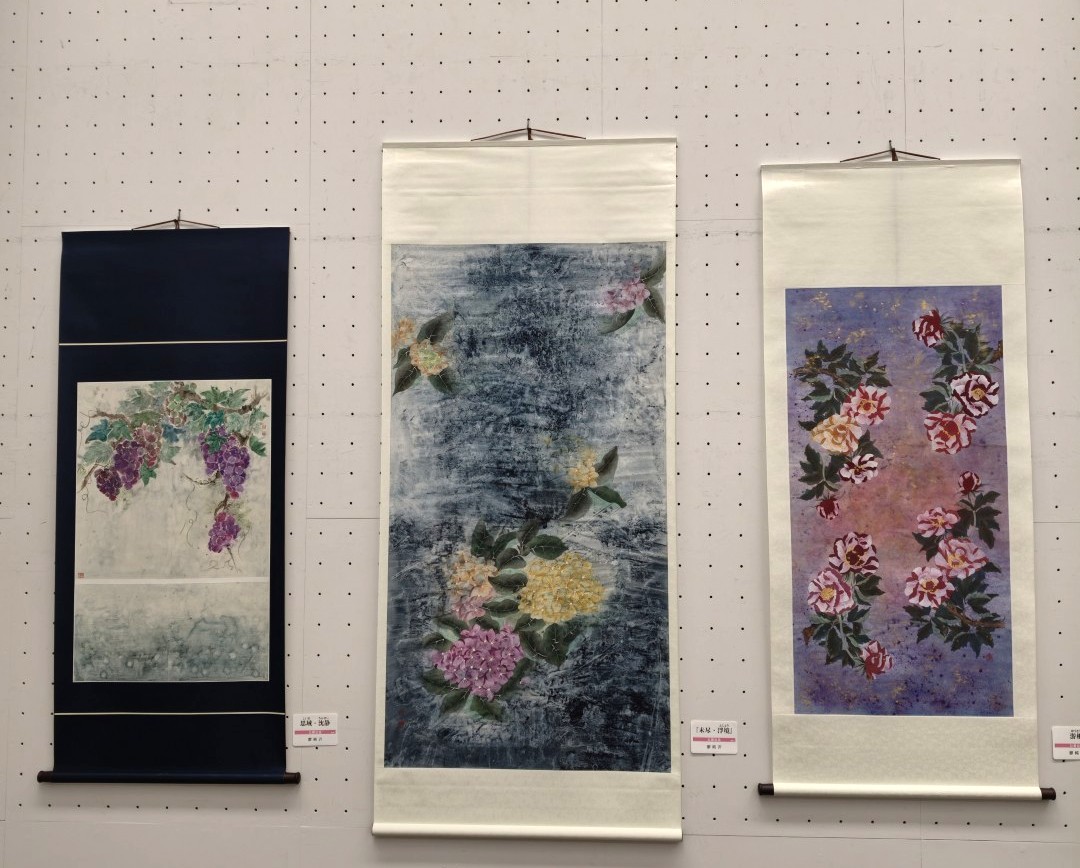
One of the most common mistakes people make when looking at flowers is treating them too quickly as an answer. The moment a flower appears, we call it "beauty"; when a flower is in full bloom, we call it "life"; when a flower is intricate, we call it "opulence." These descriptions cannot be considered inherently wrong, yet they are often too rapid—so fast that before one has even truly stood before the flower, one has already surrendered it to habitual language. However, truly excellent works of art never let viewers off so easily. They insist that the flower does not merely resemble a flower, the background does not merely resemble a background, and the act of viewing is no longer mere identification, but rather an experience of being slowly dragged into a deeper world. Liao Chun-yi’s Drifting Manifestations (Youxiang), in my eyes, is precisely such a work.
The painting does not simply depict a tree full of blossoms. Upon a cursory glance, the viewer will see several dark green branches bearing flowers of interlaced red-and-white, pale pink, and faint apricot hues, distributed along the left, right, and lower edges of the canvas. They seem to grow from bottom to top, or reach inward from the outside, gently enclosing a void in the center. The background, meanwhile, is not the blankness or pale wash commonly seen in traditional flower-and-bird painting. Instead, it is a deep, tender realm composed of purple, indigo, blue, pink-grey, and scattered golden glimmers. It resembles twilight, a water surface shrouded in mist, or the foundational hue of a dream that has not yet completely dried. These flowering branches do not densely cram the canvas; rather, they deliberately leave a breathing space in the center—like an invisible waterway, an incorporeal yet continuous central axis of the void that guides the gaze. Precisely because of this, the most moving aspect of this work is not how profusely the flowers are painted, but how they are arranged into a state of "drifting" (you). They are neither completely rooted in the earth nor entirely floating away from reality; rather, they are slowly lifted within a fluidity suspended between pausing and moving, gathering and dispersing, manifesting and hiding.
Whenever I encounter the word "drifting" (you), I cannot help but be more captivated by it than the word "flying" (fei). Flying is too fast, easily invoking thoughts of leaving the ground and transcendence. Drifting is different: drifting always remains interdependent with a certain medium—with water, with wind, with breath, with an invisible yet tangible flow that sustains all things. Therefore, the brilliance of Drifting Manifestations lies not in specifying which forms exist within the painting, but in its implication: these forms were never static from the very beginning. They are not patterns pinned to paper, but manifestations residing within a certain drift. If the word "manifestation" (xiang) here is viewed within a Buddhist context, it naturally evokes the idea of "form and appearance" (xiangzhuang), reminding one of the visible shapes of all things in the world. Yet, to stop there would be too superficial. For Liao Chun-yi's mastery lies precisely in the fact that she does not paint "manifestation" as a solid, graspable outward appearance; instead, she ensures that during its manifestation, it perpetually retains a quality of still flowing, still migrating, and not yet completely fixed. Thus, this is not merely the manifestation of flowers, but how manifestation itself drifts.
If one were to seek a philosophical path for this sensation, the first thing that comes to mind is not the Western theories eager to dismantle form, but Kitaro Nishida’s comprehension of "place" (basho). Nishida posited that what is truly important is not just the object itself, but the "place" that accommodates the object, enabling it to manifest, to encounter, and to mutually permeate. Reading Drifting Manifestations through this lens, the first element in the painting to be re-understood is that entire expanse of purple-blue background. That background is not a foil for the flowering branches, nor is it a convenient color to fill the canvas; it functions more like a true "place"—a soft, profound, breathable field that allows form to slowly surface without closing it off too prematurely.
This purple-blue field is exceedingly fascinating. It is not flat, hard, or dry. Within it, there are occasional flashes like gold dust, faint abrasions, and cloud-like transitions, making it resemble the sky, the water’s surface, the night, and the underlying emotional layer deep within memory that has not yet crystallized. Consequently, the flowers and leaves are not patterns pasted onto a flat surface, but appear to be slowly pushed out from such a field. Without this field, a flower is just a flower; with this field, the flower acquires the capacity to "drift." Thus, the true protagonist of the painting may not necessarily be the flowers, but rather this intermediate space that allows the flowers to float, breathe, and remain incompletely connected yet mutually drawn to one another. This makes one realize: the beauty of Drifting Manifestations is not solely due to the flowers themselves, but because these flowers are indeed placed within a field sufficient to keep their manifestation fluid.
However, speaking only of "place" is still insufficient. What makes this work truly thought-provoking is its sense of time. Flowers are inherently prone to be painted as objects of the "present moment": blooming right before our eyes, flourishing today, perfectly suited for viewing right now. Yet, the flowers in Liao Chun-yi’s painting do not belong exclusively to the present moment. Those interlaced red-and-white concentric petal patterns, the nearly vortex-like floral faces, and the soft, lubricated transitions of several pale apricot and pink-white flowers are not merely fresh blossoms; they carry a certain softness as if steeped in time. They do not look as though they were just plucked from the branch; rather, they seem to have already drifted for a period through air, moisture, memory, and viewing. At this moment, I am reminded of Henri Bergson.
Bergson distinguished between clock time and the "duration" (durée) truly experienced by life. True time does not pass in uniform, segmented ticks, but is an internal thickness where different layers of sensation, memory, past, and present mutually permeate and overlap. The flowers in Drifting Manifestations belong to such time. They are not flowers frozen by a camera in the "present moment," but resemble flowers floating within duration. When the viewer looks at them, they see not only the shape of the flower but simultaneously sense a certain process: as if the flower was once closer, and is now slightly farther; once more vivid, and is now slightly softer; once swinging violently in the wind, and now leaving only that post-drift equilibrium on the canvas. This transforms "drifting" from merely spatial movement into a temporal drift. The flowers are not statically stationed before the eyes; they appear to slowly remain on the paper, carrying traces of prior motion and the lingering ripples of time that have not yet fully subsided.
Precisely because of this, the negative space (liubai) and the hollowness in the center of this work deserve special scrutiny. If one views the central area un-filled by flowering branches merely as "breathing space" in composition, it remains too shallow an interpretation. That central realm of emptiness, in my view, acts as the very soul of the entire work. It is not explained, not filled, not forcefully occupied by any single flower, yet precisely because of this, it becomes an invisible waterway. This brings to mind a phrase by Zhuangzi that is often spoken too lightly: "The empty room gives birth to white light" (xushi shengbai). The world frequently interprets this as the aesthetics of negative space, yet overlooks its deeper layer: it is not that because it is empty, there is nothing; rather, because it is empty, that which can truly happen is allowed to happen. The emptiness in Drifting Manifestations is exactly this. This central void is not a lack, but a crucial key. If the flowers completely occupied the canvas, nothing would remain but gaudiness; precisely because of this void, they possess lingering resonance, a sense of back-and-forth movement, and a rhythm of echoing each other as if floating within the same invisible water current.
Consequently, the branches in the work are no longer merely botanical carriers, but function more like conductive wires for visual rhythm. You will notice that they do not rigidly prop the flowers upward; instead, they bend, curve, turn, droop, and lift, threading every single flower into a larger flow in an exceptionally rhythmic manner. This treatment reminds me of Gilles Deleuze’s concept of "becoming" (devenir). What Deleuze truly cared about was never how a fixed object is steadily depicted, but how things manifest force in the process of becoming something else. The flowers in Drifting Manifestations are precisely not fixed objects, but flowers in the state of becoming: the flower is becoming a flow, the flow is becoming a form, and forms are becoming echoes of one another. The most enchanting aspect of this painting is not an objective quantity like "there are nine or ten flowers," but how the entirety forms an indivisible sense of motion. Flower and leaf, color and void, gathering and dispersing—none have reached their final, completed state; they appear to always still be becoming.
To take a step deeper, I even feel a highly Taiwanese, and highly East Asian, dialectic of "manifestation and non-manifestation" (xiang yu wuxiang) within this work. Looking at these flowers, one can certainly say: they are flowers, and quite figurative ones at that; the concentric patterns of the petals are clear, the leaf shapes are distinct, and the branches are vigorous. Yet, if you pause a little longer, you will realize that the reason these flowers are moving is not solely because they are figurative, but because they never completely fall into the secure classification of being "just flowers." At this moment, I cannot help but recall the line from the Diamond Sutra that people often recite but rarely truly understand: "All manifestations are illusions. If one sees that all manifestations are non-manifestations, then one sees the Tathagata." I do not wish to brutally drag any artwork into religious interpretation, but this sentence holds profound meaning here. For Liao Chun-yi does not want the viewer to stop at the surface of the flowers; she wants people, through the flowers, to realize: the reason a manifestation is moving is not because of how completely it can be grasped, but because it perpetually carries a void—a state of being about to form yet not fully formed, about to disperse yet not fully dispersed. In other words, a truly deep manifestation never relies on complete fixation; it always shines within a state that has not been spoken to death.
And such voidness does not make the work float away into emptiness; rather, it makes it truer. Because the things we truly remember are inherently rarely completely clear, entirely frozen, or devoid of flow. We remember a person not because their facial features can be traced item by item, but because of their breath, their posture, their turn, and the rhythm left behind when they speak. We remember a season not because all its details are clear, but because of that air, that light, that color that refuses to sink to the bottom of our hearts. The flowers in Drifting Manifestations are much like this: what they make you remember is not only themselves, but concurrently a sense of drifting, a stability within uncertainty, and a sense of life suspended between anchoring and journeying far away.
This also brings to mind Gaston Bachelard. Bachelard always reminds us that certain images possess poetic quality not because they tell a story, but because they awaken our ancient feelings toward a certain material state. The strongest material sense in Drifting Manifestations is not the softness of the petals, but the overall floating and lubrication. The background seems to contain water, the color layers seem to have a faint flowing light, the gold dots seem to sink and float, and the texture of the sized Xuan paper (shuxuan) retains the pigment and ink in a state just shy of drying completely. This makes the entire work look almost unlike a painting hung on a wall, but like a climate preserved on paper. From Bachelard's perspective, these flowers are no longer just plants, but belong to a broader, wet world: belonging to mist, belonging to twilight, belonging to the soft ripples left behind after memory slowly diffuses over the water's surface. This wetness does not make the canvas sticky; instead, it makes it light. Because true floating originates precisely from a certain liquid buoyancy. The flowers are not supported by the land, but are gently held up by the wetness of the entire field.
Following my personal habits, I always like to return to the human condition after observing objects. For I never believe that viewing is merely judging an artwork; it is far more about using the artwork to reflect upon oneself. The reason Liao Chun-yi’s Drifting Manifestations makes me linger repeatedly is perhaps that it speaks of something we all understand, yet often find hard to admit: being human, much of the time, is nothing more than clusters of "drifting manifestations." Today we feel stable, tomorrow we have already slightly shifted; relationships we once believed unbreakable are later revealed to be mere temporary dependencies within a larger flow; and the so-called self is not always a stone standing firmly on the ground, but resembles these flowers—manifesting temporarily, elegantly, and with its own shape within a world that still holds moisture and can still sustain drifting.
Therefore, when I look at Drifting Manifestations, I am ultimately not just looking at flowers, but asking: Must a manifestation stand firmly to be considered as existing? The answer provided by this work is quiet yet clear: Not necessarily. Certain existences come closer to their true state precisely because they refuse to root themselves rigidly to death; certain images manage to stay behind precisely because they perpetually carry a bit of wandering; and certain beauty is perhaps fundamentally not a "fixed beauty," but a "beauty still in flow."
If I were to conclude with a single sentence, I would say it thus:
What Liao Chun-yi paints in Drifting Manifestations is not merely the shape of flowers, but how form, before being permanently sealed, continues to drift within the world in the softest yet firmest manner.
Summary Note: Liao Chun-yi’s Drifting Manifestations (Youxiang) utilizes sized Xuan paper, ink wash, mineral pigments, and mixed media to construct a floating field situated between flowers, mist, light, and memory. The flowering branches in the work are not solidly anchored to a natural space but maintain an ambivalent, shifting relationship within a wet, purple-blue background, as if gently supported by un-solidified air currents and time. Drawing upon Kitaro Nishida’s concept of "place" (basho), the background is not a secondary foil, but a deep foundational place that enables the flowers' manifestation. Viewed through Henri Bergson’s duration of time and Gilles Deleuze’s philosophy of becoming, these flowers are not static images, but "drifting manifestations" that continue to become themselves within time and flow. Overall, Drifting Manifestations touches upon not only the beauty of flora, but how form and manifestation, before being permanently fixed, retain their truest spiritual vitality and breath.