On the Silence of Water, and How Time Constantly Manifests via Its Form
— On Chiang Li-hsiang’s The Flowing Years
Written by WANG MUTI
I have often thought that although humans interact with time daily and are constantly measured by it, those who truly understand what time actually is may not be many. What most people know is nothing more than the number of years, the calendar, or the external, countable traces such as the transition from spring to autumn, the whitening of hair, the fading of youth, the young growing up, and the old gradually passing away. As for how time truly invades us, it often relies not on numbers but on perception; it is driven not by clocks and drums but by the state of flux. It does not clarify itself through scales, but rather through the ceaseless flow of water, the fleeting nature of light, and the gradual appearance of marks on mountain rocks, which ultimately brings us to a startling realization of its presence.
Therefore, when I first saw Chiang Li-hsiang’s The Flowing Years, the first thing that arose in my heart was neither awe at the grandeur of the mountains nor admiration for the gleam of the water. Rather, it was as if I suddenly heard something that had long coexisted with me, yet went unnoticed, whispering softly within the painting. This sound is not an audible tone, but an echo of lived experience. It made me realize that what flows in the painting, though resembling water, moves people far beyond the properties of water itself. Instead, it feels as though Time itself has occasionally assumed the form of mountains and rivers, allowing the viewer to perceive its traces through the eyes first, and later absorb its immersion in the heart, without relying on abstract thoughts.
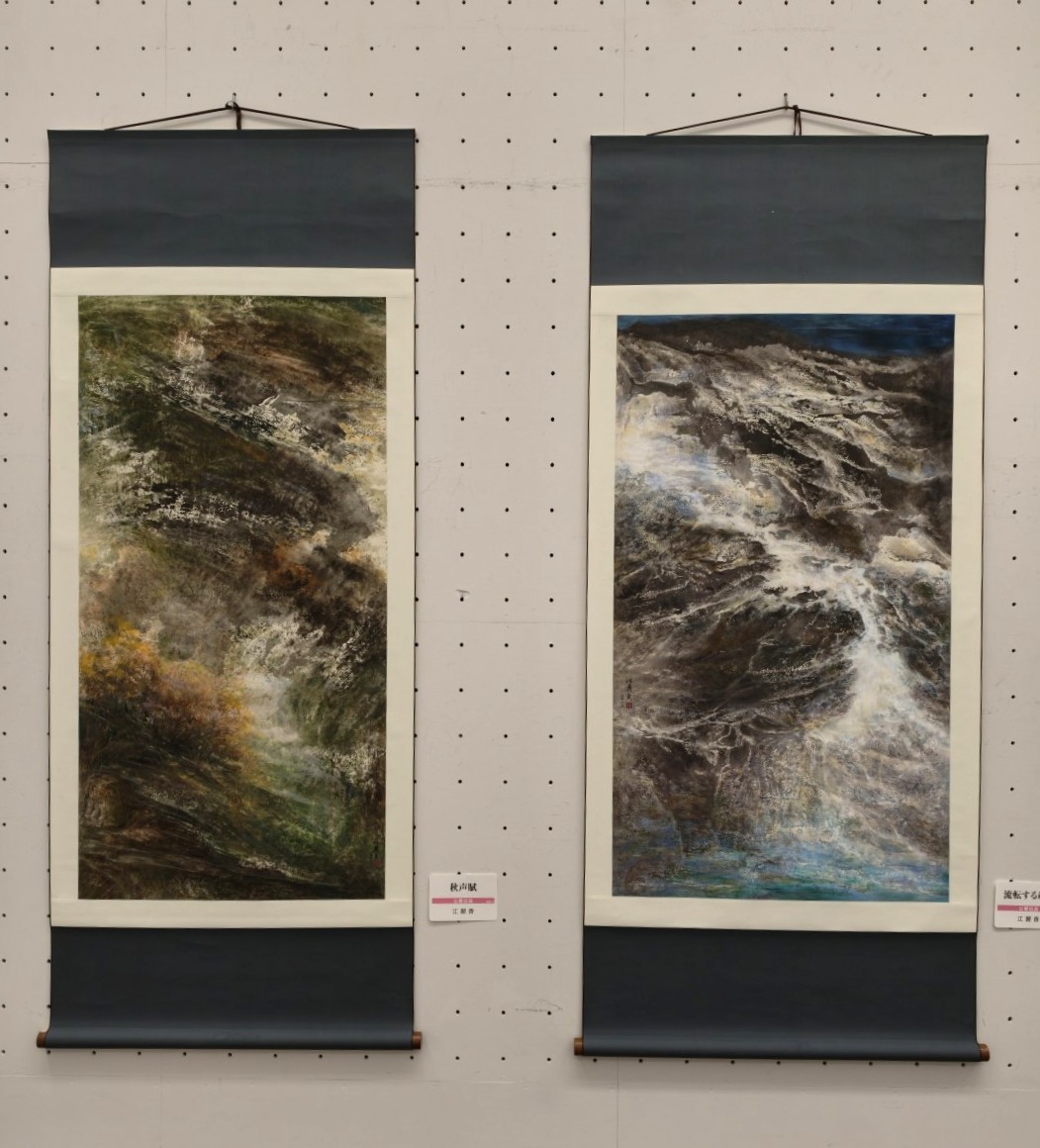
Water, as an element, is the softest thing in the world, yet its power is often the least to be underestimated. Clocks can tell time, but their function lies in severing—making one hour a distinct hour and one moment a distinct moment, each isolated from the other, much like official ledgers that are clearly itemized but lacking in vitality. Water is different; it refuses to demarcate itself rigidly. It always carries the next drop with the previous one, connecting one current to the next in an endless, continuous succession. This reveals the truth of time: it lies not in fragmentation, but in continuity; not in "this moment has passed," but in "that which has passed still leaves its wet traces upon this very moment." This is precisely why I have a partiality for this painting. The artist did not merely paint a landscape that can be labeled as a mountain or a waterfall; rather, through the bleeding, shifting, and layering of ink and color, she allowed the cascading white traces, grey tones, cold blues, and ink blacks to infuse and entangle with one another.
Consequently, what I see is no longer just water among the mountains, but almost an entire, unbreakable sequence of time that has found a physical form to dwell upon on the paper. It is as if time does not reside in the pages of a calendar, but precisely within this repetitive washing, gradual reshaping, and never-ending motion. In the upper portion of the painting, a smear of deep blue settles composedly. It is not showy, yet it carries an air of distance—resembling both the faint, lingering light of dusk before total darkness and the cold air of high altitudes. It quietly anchors the entire piece, ensuring that the downward plunge and flow of the composition do not degenerate into a reckless rush, but maintain a certain somber and contemplative origin. The middle section features layered mountain rocks where ash grey, ochre brown, ink black, and pale white intersect. Each stroke eschews rigid precision; everywhere looks as if it is about to disperse yet remains intact, as if it has coagulated yet continues to flow. The textures within resemble the folds of old fabric or a weathered terrestrial surface that, after countless instances of rain erosion and wind shifting, finally reveals its own scarred texture from surviving vicissitudes. As for the most captivating element, it is undoubtedly those lines of bright and dimming white water—rushing, swirling, shattering, or merging. Instead of showing off with a single, flashy brushstroke, they incorporate ink accumulation, splashed ink, negative space, and wet traces into one another, creating a current that seems chaotic yet possesses its own internal logic, appearing scattered yet subtly aligning with a singular direction. If one judges such a scene solely by its subject matter, it is admittedly nothing more than mountains and water. Yet, if one gazes a little longer, one realizes why it induces a meditative stillness rather than the mere pleasure of sightseeing. It is because the flow in this painting is not created solely for natural phenomena; it has been guided by the artist toward a profound allegory about life, time, and how human beings are subconsciously reshaped amidst silent attrition.
I have never much liked paintings that merely aim for precise representation without asking if they reflect the human heart. I believe that while mountains and waters are indeed mountains and waters, if the painted landscape cannot make me feel a thing or two about my own existence beyond its external form, it is merely like a good travelogue or a fine spectacle—pleasant to the eyes but unable to touch the soul. Chiang Li-hsiang’s work, however, is quite the opposite. Its title, The Flowing Years, could easily lapse into a platitude. In this world, discussions about old age, time, and looking back often rely on such words for self-embellishment—sounding touching but ring empty in reality. Yet the excellence of this painting lies in the fact that it does not let the title dictate the art; rather, the imagery reverses roles to validate the credibility of the title. Even if viewers do not know the title beforehand, seeing those countless traces of passage hidden within the textures of the stone and the pathways of the water, they would naturally understand: this is not a scenery of a single moment, but of multiple moments; not a single instance of flow, but a prolonged flow; not a sudden white waterfall witnessed after a chance downpour in the mountains, but the accumulation of silent, unnoticed erosion over several years, seasons, and instances that ultimately formed this terrain, this light and color, and this viewable order. Thus, the words "flowing years" are no longer just an extrapolation outside the theme, but have become the true protagonist of the painting. Moreover, this protagonist is particularly unique because it does not manifest as a human figure or narrate through a concrete story. Instead, through the rewriting of the earth's surface, the deep penetration into rock crevices, the gathering and dispersing of foam, and the flickering of damp light, it slowly teaches one to perceive the nature of a transformation where everything has never stopped, yet has never been clamorous.
I particularly love how she paints stones without making them rigidly blocked, and water without making it slick or superficial. Mediocre painters strive for harsh rigidity when painting stones, as if only then can the "bones of the mountain" be revealed; when painting water, they often use brisk, flying-white strokes, terrified that its movement might not be apparent. However, both approaches easily fall into clichés. What is wonderful about Chiang Li-hsiang is that her stones are not dead stones, and her water is not merely water. Upon those rock faces, there are highlights and shadows, accumulated ink resembling old scars, swept white resembling illumination, and areas that seem fractured yet moist. They connect fluidly, making one see that the stones are no longer their original selves, but stones that have long been consulted and repeatedly debated by the water. The water, too, is not simply water that comes from high places and is destined to go to low places; it is a water that bends because of stones, alters because of crevices, quickens because of obstacles, and gains momentum because of guidance. Consequently, the most fascinating aspect of the painting lies not in the independence of the water and stone, but in the relationship between the two—where neither can completely dominate the other, yet neither can detach from the other. This relationship reminds me of human existence: rather than saying we are passed by time, it is more accurate to say that we and time etch each other. We are certainly worn down by time, but time also gains its countenance through us. Without human memory, hesitation, loss, regret, and looking back, the so-called "flowing years" would be nothing but an empty name. Just as in the painting, if there were no stones to bear the water, the water's course would not show its twists and turns; if there were no water entering the stones, the veins of the stone would not display their vicissitudes.
Therefore, when I view this painting, I always see more than natural scenery; I see the principles of existence hidden within: anything that can shape form permanently is rarely done by violence, but by continuous, gentle force; anything that ultimately changes a person's outlook is rarely accomplished in one blow, but through day-after-day soaking, grinding, carrying, and washing.
There is another layer here especially worthy of detailed discussion: the use of white in the painting. Chinese painting has always emphasized the use of white, which carries multiple meanings: it can represent void, emptiness, vital energy (qi), or unexpressed thoughts. Sometimes white does not depict objects but the absence of objects; sometimes it does not paint form but the space in between. However, in this work, the function of white takes on an additional dimension. While it is certainly a negative space (liubai), it is also water, light, the mist rising after an impact, the fleeting boundary between flowing and dispersing, and the temporary trace of something untamable caught momentarily by the eye. Therefore, this white, on one hand, carries the legacy of Chinese ink painting, giving the artwork its ethereal spirituality; on the other hand, it does not stop at abstract "energy" but tangibly becomes the developer of time. If one observes closely, one realizes that the brightest part of the painting is precisely the most ungraspable part; it is bright because it is exactly at the juncture of flowing and vanishing. Is this not similar to human life? The moments that we find most unforgettable are often not those solid, permanent things, but rather the instances that are about to pass but have not yet passed, about to disperse but have not yet dispersed, about to be spoken but have not yet been said—a look in the eyes, a wisp of time, an unfinished conversation, a love already distant. Yet, precisely at the moment it is about to be lost, its meaning becomes deeper and its trace becomes longer. If there is a philosophy in Chiang Li-hsiang’s use of white, it lies exactly here: what shapes a person most profoundly does not always have to be the weightiest events; instead, it is often those experiences that seem light and fleeting, yet can neither be retained nor erased.
I also think that although this painting is titled after time, it does not induce anxiety, or at least it does not make me feel that shallow, worldly sorrow of lamenting autumn. For though its water flows downward, its sentiment is not depressed; though its stones are old, their light is not withered. The water surface below carries a hint of bluish-green, retaining a thread of vitality. It does not become a turbid pond or a dead swamp after enduring endless impacts; instead, it seems to achieve a kind of crystal clarity after a long period of washing. This is a point I especially appreciate. When people talk about time, most only know what it takes away, not what it gives; they only know its erosion, not its fulfillment; they only know that it strips away the splendor of youth, not that it also strips away superficiality, impetuosity, and unnecessary attachments. The water in the painting certainly keeps carrying things away, but it also keeps cleansing; it erodes the mountain face, but it also reveals the textures; it blurs the contours, but it also makes the truly durable structure visible. Viewing human life through this lens, time is not entirely like a thief, but also like a craftsman. It takes away a part of what we love, which is admittedly painful, but it also uses the opportunity of taking away to allow another, deeper part of ourselves to slowly emerge. The reason this painting does not fall into sentimental clichés is precisely because it does not depict flowing away entirely as loss; within loss, it still retains the possibility of order, cleansing, and renewed clarity. Is this not the feeling of true maturity? For only those who have experienced the world know that life should not just demand compensation from what has passed, but should also pay respects to what remains.
If I follow my own habit, whenever I finish looking at a painting, I cannot help but pull the external scenery back to myself. For I have never believed that viewing can be absolutely isolated within an object. What keeps me lingering before Chiang Li-hsiang’s painting for so long is that it involuntarily makes me think: Has my own life not been like the water in this painting? In my youth, I once thought that the value of life lay in establishing a will, setting a direction, and pursuing high and distant goals, as if as long as my mind was set right, the path ahead could be chosen by me. As I grew older, I came to realize that while a person can indeed have aspirations, "how I became the person I am today" is often not entirely decided by my own initiative. Rather, it is co-authored by the rocks I encountered, the narrow straits I passed through, the obstacles I endured, and the terrain where I had no choice but to turn. Thus, while I thought I was moving forward, I was actually being written by the terrain; while I thought I was preserving myself, I had actually, through the long washing of time, had a few degrees of my arrogance rubbed away and a few degrees of gentleness and patience added. Such things are not necessarily felt daily, until suddenly a painting presents that long-term shaping process clearly before my eyes, and I suddenly awaken: It turns out I have never formed myself through a single instant, but through the process of flowing and turning. It turns out those minor damages, minor losses, minor alterations, and minor retreats that I paid no mind to in those years have, like water stains, accumulated over the years, and finally brought me to the landscape of who I am today.
What is particularly precious is that the artist does not let this work degenerate into contrived profoundness. Today, those who discuss art love to throw around big words like time, memory, life, and existence, speaking of them as if they were vast clouds and mist, yet the canvas may not necessarily bear them. Chiang Li-hsiang is different. She honestly and steadily uses color and ink to write out layer by layer how the water falls, how the stone receives it, how the light flashes, and how the mist arises, and a certain greater meaning naturally grows from this. This is just like being a person: those who talk big do not necessarily possess deep insight; only those who can see endurance in the ordinary, notice transformation in the subtle, and perceive the irreversible amidst silence are capable of truly approaching the simple truth of life. The Flowing Years possesses this simplicity, and its simplicity is not shallow, but a concise thickness formed after sedimentation. It does not seek victory through bizarre peaks and strange rocks, nor does it capture attention through dramatic composition; rather, with a brushwork that borders on patience, it writes out how the world reshapes its own countenance over a long span of time. Therefore, if viewers are willing to stand before it for a long time, they will understand that this painting is not meant for instant infatuation, but is suited for prolonged gazing. The longer one looks, the more one feels that it is not a waterfall flowing therein, but a certain segment of time in one's own heart, difficult to articulate, that is also descending with it, dispersing with it, and quietly arriving at a lower, deeper, and wider place.
Therefore, I wish to conclude this piece with a single phrase, which can also serve as my overall critique of this work: Chiang Li-hsiang’s The Flowing Years does not merely paint the forms of mountains and rivers. Rather, through the silence of water, the etching of stone, the sudden appearance of white light, and the coming and going of mist, it slowly writes out how time does not manifest its immense power through violence, but through continuity, penetration, repetition, and imperceptible ways, simultaneously completing its sculpture on the surface of the world and within the human heart. If viewers pause their feet for a moment before this painting and lay down their eagerness to identify and categorize, they will ultimately understand: so-called "flowing and turning" is not merely departure, but a process of taking shape while departing; revealing while fading; leaving something behind while carrying something away. And the life of a human being is much like this—not watching time from outside of time, but precisely within its silent washing away, being slowly polished, slowly carried afar, and slowly brought toward a form that can better bear oneself.