論水之無言,而歲月常藉其形以自見
——江麗香〈流轉的歲月〉
撰文:王穆提(WANG MUTI)
我每常以為,人之於歲月,雖日日與之相接,時時受之裁量,然而真能明白歲月為何物者,卻未必多,蓋多數人所知者,不過年數耳,不過曆法耳,不過春來秋往、髮白顏衰、少者長成而老者漸去之類外在可數之跡耳;至若歲月之真正侵入吾人者,則往往不憑數字而憑感觸,不由鐘鼓而由流轉,不以刻度自明,而以水之不住、光之易改、山石之漸見其痕而終教人悚然知之。是故我初見江麗香所作〈流轉的歲月〉,心中最先起者,非驚其山勢,亦非歎其水光,乃是忽然如聞一種久已與我同在而我常不自察之物,在畫面中微微發聲;而此聲非可聽之音,實一種經歷之回響,使我知畫中所流者,雖似水,而其所以動人,則遠不止於水,反若歲月本身,偶假山川之形而來,使觀者得以不藉抽象之思,先於眼中見其行跡,後於心中受其浸潤。
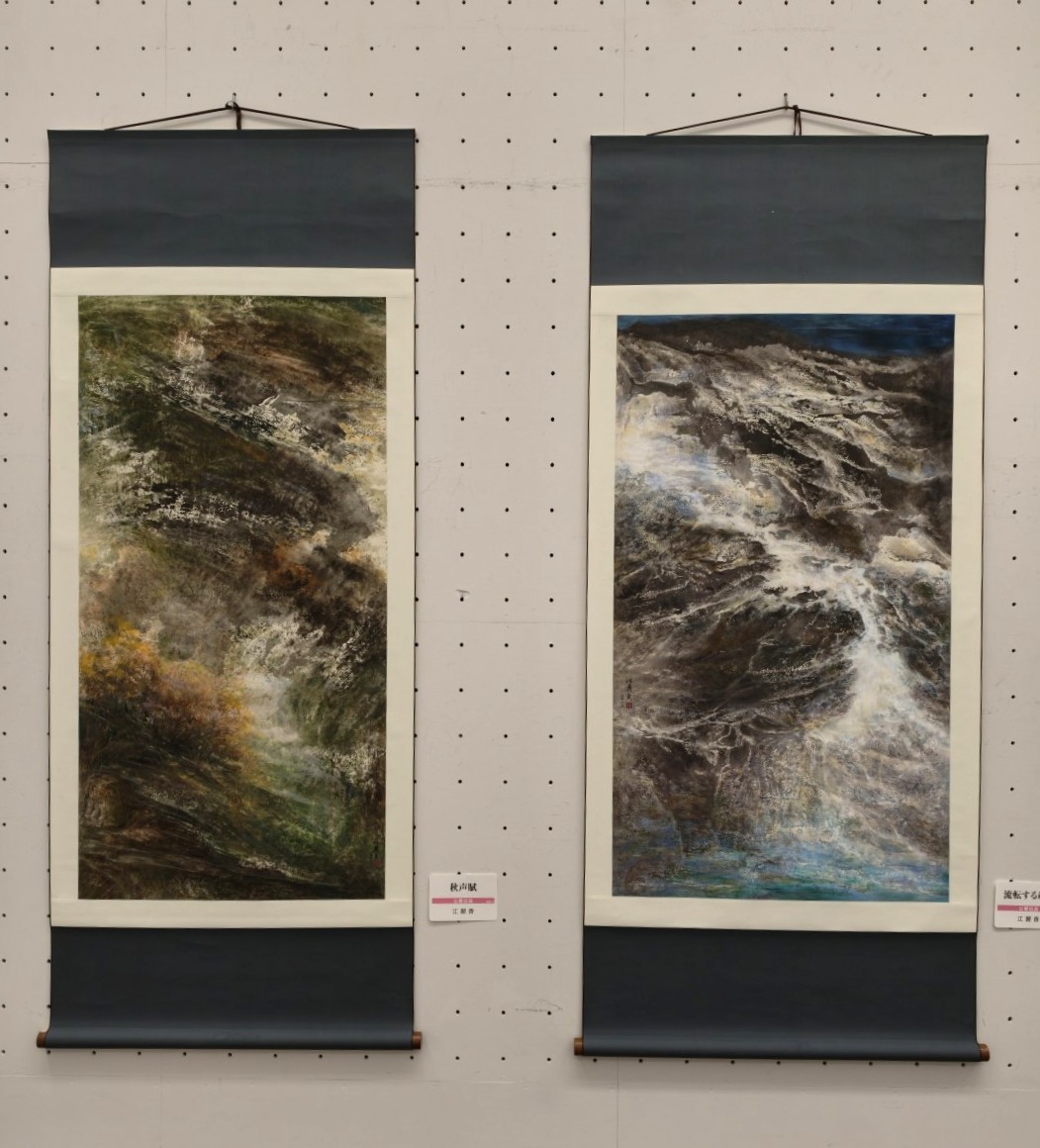
夫水之一物,於世最柔,而其為力,往往最不可輕。鐘可以告時,然鐘之功在切斷,使一時成為一時,一刻成為一刻,皆各自孤立,如官府簿冊,分條列項,明白有餘,而生意不足;惟水不同,水不肯截然自界,水總由前一滴挾後一滴,由前一道接後一道,綿綿不絕,續續相因,使人知時間之真相,多不在斷,而在連;不在「此刻已過」,而在「已過者猶以其濕痕留於此刻」。我之所以偏愛此畫,亦正在此。畫家並未徒然為我畫一座可供名之曰山或曰瀑之地景,而乃藉彩墨之滲化與層擦,使那由高處傾瀉而下之白痕、灰痕、冷藍與墨色互相侵染、彼此牽纏,遂使我所見者不再僅是山間之水,而幾乎是一整段不可截斷之時序,在紙上尋得了可供棲止之形體,宛若歲月原不居於年月簿中,而正居於此等反覆沖刷、漸次改形、未嘗終止之運動裡。
畫中上方,一抹深藍沉著,不甚炫耀,卻有遠氣,既如天色向晚時尚未盡黑之幽光,亦如高處寒意,靜靜壓住全幅,使整個畫面之下墜與流行,不至流為輕率之奔赴,而仍保有某種沉鬱的起點;中段則山石層疊,蒼灰、赭褐、墨黑與淡白相交,筆筆不求工整,處處若將散而未散,若已凝而仍流,其間紋理有如舊日布帛之皺摺,亦若一張受盡天候之地表,在無數次雨蝕風移之後,終於顯出自身歷劫之肌理;至於最動人心目者,自是那一道道明滅相生之白水,或奔,或迴,或碎,或合,不以單一筆勢逞奇,反藉積染、破墨、留白與濕痕之彼此含納,而成一種似亂而自有其脈絡、似散而暗通其方向之流。此等景象,人若只以題材論之,固可說不過山水耳;然若稍稍久看,便知其所以使心不起於遊覽之快,而起於沉思之靜者,蓋在於此畫中之流,乃非單為自然物象而設,實已被畫家引向一種關於生命、關於時間、關於人如何在默然耗損中不知不覺被改造之深長寓意。
我向不甚喜那些只圖狀物精肖而不問其是否足以返照人心之畫,蓋我以為山水誠為山水,然畫中山水若不能叫我於其外形之外,另感自身處境之一二,則不過如一篇好旅行記,一番佳賞耳,雖足怡目,而不能留心。江麗香此作,卻恰與此相反。其題曰「流轉的歲月」,本是最易流於泛泛之語,世間凡論老境、論光陰、論回首,多喜借此等字樣自飾,說來動聽,實則空泛;然而此畫之佳,正在它並不以題名牽畫,乃以畫面反過來證成題名之可信。觀者即使不先知畫名,只見那無數重經過之痕,都已藏於石理與水路之中,亦當自然明白:此非一時之景,而是多次之景;非一次之流,而是長久之流;非偶然一日山中驟雨之後忽見白瀑,乃是若干年、若干季、若干次無聲無息而幾不為人察之沖蝕積累,方造成此一地貌、此一光色、此一可供觀看之秩序。那麼,「歲月」二字便不再只是題外之意,而成了畫中真正的主角;且此主角尤為奇異,因其不以人物形象現身,不以具體故事自述,而乃藉地表之改寫、自石縫之深入、水沫之聚散、濕光之明滅,緩緩教人領受何謂一切並未停止卻也未曾喧嘩之變動。
我尤喜其畫石而不堅塞,畫水而不滑薄。世之庸手,畫石則務求峻硬,彷彿惟其如此,方能見山骨;畫水則多作輕捷飛白,生怕不顯其流。然此兩者皆易落於習套。江麗香所妙者,在於其石非死石,水亦非僅為水。那些岩面之上,有陰有陽,有積墨如舊痂,有掃白如光照,有若裂若潤之處,婉轉銜接,使人見石早已非原石,而是經水長久商量過、反覆辯論過之石;水也非單是自高處來而命定要往低處去之水,乃是一種因石而折、因縫而改、因阻而急、因受引而成勢之水。於是畫中最有意思者,竟不在水石各自之獨立,而在二者之間那種誰也不能全然主宰誰、卻又誰也不能脫離誰之關係。此一關係,使我想到人在世間,與其說是被歲月經過,不如說是與歲月互相刻畫。我們固然受時間磨損,然時間也藉我們而取得面貌;若無人的記憶、遲疑、失落、悔恨與回首,則所謂歲月亦不過空名耳。正如畫中若無石承水,水勢不足見其曲折;若無水入石,石脈亦不足見其滄桑。故我觀此畫,輒不止於自然之景,而更見存在之理藏焉:凡能久長塑形者,多非暴力為之,而是綿力為之;凡最終使人改觀者,多非一擊而成,而是日復一日之浸、之磨、之帶、之洗。
此中又有一層,尤宜細論,便是畫中白色之用。中國繪畫向來重白,而白中含義甚多:或為虛,或為空,或為氣,或為未盡之意;有時白不畫物而畫無物,有時白不畫形而畫其間。然在此作之中,白之作用又添一重。它固是留白,然亦是水,是光,是撞擊之後升起之霧,是流與散之短暫交界,是無法久執之物暫時被眼力捕捉到的片刻痕跡。故此白,一面有中國水墨之遺意,使畫得其空靈;一面又不止於抽象之「氣」,而切切實實成為時間之顯影。人若細察,便知畫中最亮之處,恰也是最不可把握之處;其所以亮,乃因其正處在流與消之際。這不正與人生相類乎?我輩所最不能忘之時刻,往往並非那些最堅定最停留之物,反是那些將逝未逝、將散未散、將言未言之瞬間;一種神色,一縷光陰,一回話未竟,一段情已遠,而偏偏在其欲失之時,其意乃愈深,其痕乃愈長。江麗香之白,若有哲理,便正在此:最能塑成人者,不必總是最厚重之事,反常是那些看似輕渺、其實無從挽留而又無從磨滅之經過。
我又思及,此畫雖題歲月,卻不令人生憂,或至少不使我感那種世俗悲秋之淺愁。蓋其水雖下,其意不沉;其石雖老,其光不枯;下方水面略帶青碧,尚存一線生意,並不因歷盡沖擊而成濁潭死沼,反似凡經長久滌洗之後,終得一種澄然。此一點我尤為賞重。世人談時間,多但知其奪,不知其予;但知其削,不知其成;但知其剝去青春榮澤,不知其亦剝去虛浮、急躁與不必要之執念。畫中之水,固然不停帶走,卻也不停清理;固然使山面受蝕,卻也使紋理顯現;固然教輪廓模糊,卻也使真正耐久之結構因此可見。若以此觀人生,則歲月實不盡如盜賊,亦如匠人;它取走一部分吾人所愛,誠然可痛,然亦藉取走之機,令另一部分更深層之我慢慢顯出。此畫所以不落哀傷濫調,正在於其不把流逝全畫成失去,而於失去之中仍保有整飭、洗滌與新明之可能。此豈非真正成熟之感乎?蓋唯有稍經世故者,方知人生並非只宜向逝者索償,亦應向留下者致意。
若依我之習氣,凡看畫至終,總不能不把外部之景牽回己身。蓋我素不信觀看可絕然止於物。江麗香此畫,令我久久不能去者,便在於其使我不由自主地思及:我之一生,亦何嘗不若畫中之水?我初少之時,嘗以為人生貴在立志、定向、求其高遠,彷彿只要心志既正,則前路可由我選;及其漸長,方知人誠可有其志,然「如何成其為今日之我」者,常並不全由我之主動決定,而更由所遇之岩石、所經之窄處、所受之阻撓與所不得不轉彎之地勢所共同編成。是我一面自以為前行,一面其實亦被地形所寫;一面以為保存自我,一面其實已於日久之沖刷中被磨去幾分盛氣、添得幾分寬緩。此等事,日常未必覺之,直至忽有一幅畫,將那種久遠之塑形作用明明白白陳於眼前,我方醒悟:原來我從來不是以剎那成我,乃是以流轉成我;原來那些當年不以為意之小損、小失、小改、小退,竟也如水痕一般,長年累積,終於把我帶向今日之路貌。
尤可珍者,畫家並未使這幅作品流於故作玄遠。今日論藝術者,動輒喜談時間、記憶、生命、存在等大詞,說得雲煙浩渺,畫面卻未必能承之。江麗香則不然。她只是老老實實地藉彩墨把水如何落、石如何受、光如何閃、霧如何生,一層一層沉著寫出,而某種更大的意義便自然由此生長。此正如做人,未必好大言者便真有深識,惟能於尋常處見其久、於細微中見其變、於不聲不響之中見其難以逆返者,方有可能真正接近生命之樸實真相。〈流轉的歲月〉便有此樸實,而其樸實又非淺白,乃經沉澱後所成之簡厚。它不以奇峰怪石求勝,不以戲劇構圖奪目,而以一種近乎忍耐的筆意,寫出世界如何在長時間中自我改貌。故觀者若肯久立,便會明白,這畫不是供一眼驚艷之用,而是宜於久看;愈久看,愈覺其中不是瀑布在流,而是心中某段不易道出的光陰,也在隨之一同下行,一同散開,一同靜靜抵達更低、更深而亦更廣的所在。
故我願終以一語收束此篇,而此語亦可作我看此作之總評:江麗香之〈流轉的歲月〉,非徒畫山川之形,實藉水之無言、石之受刻、白光之驟現與霧氣之往還,徐徐寫出歲月如何不以暴烈顯其巨力,而以持續、以滲入、以反覆、以不容察覺之方式,於世界之表、亦於人心之內,同時完成其雕琢。觀者若於此畫前稍稍停足,稍稍放下急於辨認之心,則終當懂得:所謂流轉,原非只是離去,乃是一邊離去,一邊成形;一邊沖淡,一邊顯露;一邊帶走,一邊留下。而人之一生,亦大抵如此——並非在時間之外觀看時間,而正是在其無聲的流瀉之中,被慢慢磨亮,被慢慢帶遠,也被慢慢帶向更能承受自身的模樣。
其他相關內容:
【現場直擊】【台日交流展】東京都美術館開館100周年記念《第14回東京現展》展場:日本國立東京都美術館
台灣參展藝術家作品藝術評論
東京都美術館開館100周年記念【14回東京現展】廖純沂〈未盡・浮境〉未盡之物何以最能久留人心
東京都美術館開館100周年記念【14回東京現展】廖純沂〈游相〉花何以不止於花,與形相如何在漂游中成立
東京都美術館開館100周年記念【14回東京現展】廖純沂〈思域・沉靜〉沉靜何以不是空,與垂掛之物何以最像思念
東京都美術館開館100周年記念【14回東京現展】王詮富〈八月閑步一色秋〉的季節哲學、門徑意識與水墨的開敞性 在黑暗中閑步:秋色如何不是顏色,而是一種存在的轉身
東京都美術館開館100周年記念【14回東京現展】 王詮富〈一念菩提開翠微〉的開顯、同體、綿延與空性 一念未起,萬根已動
東京都美術館開館100周年記念【14回東京現展】蔡梅芳〈戀戀紫藤〉的痕跡、綿延與生成 花影之遲遲不散,與記憶如何在解構之後重返
東京都美術館開館100周年記念【14回東京現展】 王穆提《聖境・阿里山》蒼翠的紀念碑
東京都美術館開館100周年記念【14回東京現展】王穆提《中道之光》裂隙中的永恆
東京都美術館開館100周年記念【14回東京現展】吳心荷〈散落骨骼(一)〉散落之骨,與人之未能完全集成於自身
東京都美術館開館100周年記念【14回東京現展】陳福祺〈咖啡心音〉的存在寓言 沸點、晶化與心之熔爐
東京都美術館開館100周年記念【14回東京現展】張素蘭〈一棵開花的樹〉的場所哲學、過程生命與靜默中的新生
東京都美術館開館100周年記念【14回東京現展】吳亞倫〈藍與黑的交響詩(雙併)〉論藍何以不只為藍,黑何以不只為黑
東京都美術館開館100周年記念【14回東京現展】張碧鄉〈艷冠群芳〉的器物哲學、生成美學與過剩的顯現
東京都美術館開館100周年記念【14回東京現展】趙玉燕〈熾烈〉論火中的身體,與人何以不能只是自己
東京都美術館開館100周年記念【14回東京現展】許秀珠〈403地震後的太魯閣〉山川之裂,與人如何在震後重新學會自身的位置
東京都美術館開館100周年記念【14回東京現展】江麗香〈秋聲賦〉彩墨中的時間書寫 水痕與秋聲
東京都美術館開館100周年記念【14回東京現展】江麗香〈流轉的歲月〉水之無言,而歲月常藉其形以自見
東京都美術館開館100周年記念【14回東京現展】謝文倩〈驚夢〉的夢之碎片、感覺邏輯與夜的顯現
東京都美術館開館100周年記念【第14回東京現展】黃淑卿〈群鷗處處來(台灣澎湖)〉群鷗之所以來,與人終於學會不把世界全算作自己
東京都美術館開館100周年記念【14回東京現展】黃淑卿〈燕尾與戴勝(台灣金門)〉論屋脊、禽鳥與地方何以不只是地理
東京都美術館開館100周年記念【14回東京現展】謝正瑜〈蓮池映相〉的感知哲學與靈性空間
東京都美術館開館100周年記念【14回東京現展】周若梅〈流光之舞〉,光何以有身,與人如何在流動中暫時成形
On the Silence of Water, and How Time Constantly Manifests via Its Form
— On Chiang Li-hsiang’s The Flowing Years
Written by WANG MUTI
I have often thought that although humans interact with time daily and are constantly measured by it, those who truly understand what time actually is may not be many. What most people know is nothing more than the number of years, the calendar, or the external, countable traces such as the transition from spring to autumn, the whitening of hair, the fading of youth, the young growing up, and the old gradually passing away. As for how time truly invades us, it often relies not on numbers but on perception; it is driven not by clocks and drums but by the state of flux. It does not clarify itself through scales, but rather through the ceaseless flow of water, the fleeting nature of light, and the gradual appearance of marks on mountain rocks, which ultimately brings us to a startling realization of its presence.
Therefore, when I first saw Chiang Li-hsiang’s The Flowing Years, the first thing that arose in my heart was neither awe at the grandeur of the mountains nor admiration for the gleam of the water. Rather, it was as if I suddenly heard something that had long coexisted with me, yet went unnoticed, whispering softly within the painting. This sound is not an audible tone, but an echo of lived experience. It made me realize that what flows in the painting, though resembling water, moves people far beyond the properties of water itself. Instead, it feels as though Time itself has occasionally assumed the form of mountains and rivers, allowing the viewer to perceive its traces through the eyes first, and later absorb its immersion in the heart, without relying on abstract thoughts.
Water, as an element, is the softest thing in the world, yet its power is often the least to be underestimated. Clocks can tell time, but their function lies in severing—making one hour a distinct hour and one moment a distinct moment, each isolated from the other, much like official ledgers that are clearly itemized but lacking in vitality. Water is different; it refuses to demarcate itself rigidly. It always carries the next drop with the previous one, connecting one current to the next in an endless, continuous succession. This reveals the truth of time: it lies not in fragmentation, but in continuity; not in "this moment has passed," but in "that which has passed still leaves its wet traces upon this very moment." This is precisely why I have a partiality for this painting. The artist did not merely paint a landscape that can be labeled as a mountain or a waterfall; rather, through the bleeding, shifting, and layering of ink and color, she allowed the cascading white traces, grey tones, cold blues, and ink blacks to infuse and entangle with one another.
Consequently, what I see is no longer just water among the mountains, but almost an entire, unbreakable sequence of time that has found a physical form to dwell upon on the paper. It is as if time does not reside in the pages of a calendar, but precisely within this repetitive washing, gradual reshaping, and never-ending motion. In the upper portion of the painting, a smear of deep blue settles composedly. It is not showy, yet it carries an air of distance—resembling both the faint, lingering light of dusk before total darkness and the cold air of high altitudes. It quietly anchors the entire piece, ensuring that the downward plunge and flow of the composition do not degenerate into a reckless rush, but maintain a certain somber and contemplative origin. The middle section features layered mountain rocks where ash grey, ochre brown, ink black, and pale white intersect. Each stroke eschews rigid precision; everywhere looks as if it is about to disperse yet remains intact, as if it has coagulated yet continues to flow. The textures within resemble the folds of old fabric or a weathered terrestrial surface that, after countless instances of rain erosion and wind shifting, finally reveals its own scarred texture from surviving vicissitudes. As for the most captivating element, it is undoubtedly those lines of bright and dimming white water—rushing, swirling, shattering, or merging. Instead of showing off with a single, flashy brushstroke, they incorporate ink accumulation, splashed ink, negative space, and wet traces into one another, creating a current that seems chaotic yet possesses its own internal logic, appearing scattered yet subtly aligning with a singular direction. If one judges such a scene solely by its subject matter, it is admittedly nothing more than mountains and water. Yet, if one gazes a little longer, one realizes why it induces a meditative stillness rather than the mere pleasure of sightseeing. It is because the flow in this painting is not created solely for natural phenomena; it has been guided by the artist toward a profound allegory about life, time, and how human beings are subconsciously reshaped amidst silent attrition.
I have never much liked paintings that merely aim for precise representation without asking if they reflect the human heart. I believe that while mountains and waters are indeed mountains and waters, if the painted landscape cannot make me feel a thing or two about my own existence beyond its external form, it is merely like a good travelogue or a fine spectacle—pleasant to the eyes but unable to touch the soul. Chiang Li-hsiang’s work, however, is quite the opposite. Its title, The Flowing Years, could easily lapse into a platitude. In this world, discussions about old age, time, and looking back often rely on such words for self-embellishment—sounding touching but ring empty in reality. Yet the excellence of this painting lies in the fact that it does not let the title dictate the art; rather, the imagery reverses roles to validate the credibility of the title. Even if viewers do not know the title beforehand, seeing those countless traces of passage hidden within the textures of the stone and the pathways of the water, they would naturally understand: this is not a scenery of a single moment, but of multiple moments; not a single instance of flow, but a prolonged flow; not a sudden white waterfall witnessed after a chance downpour in the mountains, but the accumulation of silent, unnoticed erosion over several years, seasons, and instances that ultimately formed this terrain, this light and color, and this viewable order. Thus, the words "flowing years" are no longer just an extrapolation outside the theme, but have become the true protagonist of the painting. Moreover, this protagonist is particularly unique because it does not manifest as a human figure or narrate through a concrete story. Instead, through the rewriting of the earth's surface, the deep penetration into rock crevices, the gathering and dispersing of foam, and the flickering of damp light, it slowly teaches one to perceive the nature of a transformation where everything has never stopped, yet has never been clamorous.
I particularly love how she paints stones without making them rigidly blocked, and water without making it slick or superficial. Mediocre painters strive for harsh rigidity when painting stones, as if only then can the "bones of the mountain" be revealed; when painting water, they often use brisk, flying-white strokes, terrified that its movement might not be apparent. However, both approaches easily fall into clichés. What is wonderful about Chiang Li-hsiang is that her stones are not dead stones, and her water is not merely water. Upon those rock faces, there are highlights and shadows, accumulated ink resembling old scars, swept white resembling illumination, and areas that seem fractured yet moist. They connect fluidly, making one see that the stones are no longer their original selves, but stones that have long been consulted and repeatedly debated by the water. The water, too, is not simply water that comes from high places and is destined to go to low places; it is a water that bends because of stones, alters because of crevices, quickens because of obstacles, and gains momentum because of guidance. Consequently, the most fascinating aspect of the painting lies not in the independence of the water and stone, but in the relationship between the two—where neither can completely dominate the other, yet neither can detach from the other. This relationship reminds me of human existence: rather than saying we are passed by time, it is more accurate to say that we and time etch each other. We are certainly worn down by time, but time also gains its countenance through us. Without human memory, hesitation, loss, regret, and looking back, the so-called "flowing years" would be nothing but an empty name. Just as in the painting, if there were no stones to bear the water, the water's course would not show its twists and turns; if there were no water entering the stones, the veins of the stone would not display their vicissitudes.
Therefore, when I view this painting, I always see more than natural scenery; I see the principles of existence hidden within: anything that can shape form permanently is rarely done by violence, but by continuous, gentle force; anything that ultimately changes a person's outlook is rarely accomplished in one blow, but through day-after-day soaking, grinding, carrying, and washing.
There is another layer here especially worthy of detailed discussion: the use of white in the painting. Chinese painting has always emphasized the use of white, which carries multiple meanings: it can represent void, emptiness, vital energy (qi), or unexpressed thoughts. Sometimes white does not depict objects but the absence of objects; sometimes it does not paint form but the space in between. However, in this work, the function of white takes on an additional dimension. While it is certainly a negative space (liubai), it is also water, light, the mist rising after an impact, the fleeting boundary between flowing and dispersing, and the temporary trace of something untamable caught momentarily by the eye. Therefore, this white, on one hand, carries the legacy of Chinese ink painting, giving the artwork its ethereal spirituality; on the other hand, it does not stop at abstract "energy" but tangibly becomes the developer of time. If one observes closely, one realizes that the brightest part of the painting is precisely the most ungraspable part; it is bright because it is exactly at the juncture of flowing and vanishing. Is this not similar to human life? The moments that we find most unforgettable are often not those solid, permanent things, but rather the instances that are about to pass but have not yet passed, about to disperse but have not yet dispersed, about to be spoken but have not yet been said—a look in the eyes, a wisp of time, an unfinished conversation, a love already distant. Yet, precisely at the moment it is about to be lost, its meaning becomes deeper and its trace becomes longer. If there is a philosophy in Chiang Li-hsiang’s use of white, it lies exactly here: what shapes a person most profoundly does not always have to be the weightiest events; instead, it is often those experiences that seem light and fleeting, yet can neither be retained nor erased.
I also think that although this painting is titled after time, it does not induce anxiety, or at least it does not make me feel that shallow, worldly sorrow of lamenting autumn. For though its water flows downward, its sentiment is not depressed; though its stones are old, their light is not withered. The water surface below carries a hint of bluish-green, retaining a thread of vitality. It does not become a turbid pond or a dead swamp after enduring endless impacts; instead, it seems to achieve a kind of crystal clarity after a long period of washing. This is a point I especially appreciate. When people talk about time, most only know what it takes away, not what it gives; they only know its erosion, not its fulfillment; they only know that it strips away the splendor of youth, not that it also strips away superficiality, impetuosity, and unnecessary attachments. The water in the painting certainly keeps carrying things away, but it also keeps cleansing; it erodes the mountain face, but it also reveals the textures; it blurs the contours, but it also makes the truly durable structure visible. Viewing human life through this lens, time is not entirely like a thief, but also like a craftsman. It takes away a part of what we love, which is admittedly painful, but it also uses the opportunity of taking away to allow another, deeper part of ourselves to slowly emerge. The reason this painting does not fall into sentimental clichés is precisely because it does not depict flowing away entirely as loss; within loss, it still retains the possibility of order, cleansing, and renewed clarity. Is this not the feeling of true maturity? For only those who have experienced the world know that life should not just demand compensation from what has passed, but should also pay respects to what remains.
If I follow my own habit, whenever I finish looking at a painting, I cannot help but pull the external scenery back to myself. For I have never believed that viewing can be absolutely isolated within an object. What keeps me lingering before Chiang Li-hsiang’s painting for so long is that it involuntarily makes me think: Has my own life not been like the water in this painting? In my youth, I once thought that the value of life lay in establishing a will, setting a direction, and pursuing high and distant goals, as if as long as my mind was set right, the path ahead could be chosen by me. As I grew older, I came to realize that while a person can indeed have aspirations, "how I became the person I am today" is often not entirely decided by my own initiative. Rather, it is co-authored by the rocks I encountered, the narrow straits I passed through, the obstacles I endured, and the terrain where I had no choice but to turn. Thus, while I thought I was moving forward, I was actually being written by the terrain; while I thought I was preserving myself, I had actually, through the long washing of time, had a few degrees of my arrogance rubbed away and a few degrees of gentleness and patience added. Such things are not necessarily felt daily, until suddenly a painting presents that long-term shaping process clearly before my eyes, and I suddenly awaken: It turns out I have never formed myself through a single instant, but through the process of flowing and turning. It turns out those minor damages, minor losses, minor alterations, and minor retreats that I paid no mind to in those years have, like water stains, accumulated over the years, and finally brought me to the landscape of who I am today.
What is particularly precious is that the artist does not let this work degenerate into contrived profoundness. Today, those who discuss art love to throw around big words like time, memory, life, and existence, speaking of them as if they were vast clouds and mist, yet the canvas may not necessarily bear them. Chiang Li-hsiang is different. She honestly and steadily uses color and ink to write out layer by layer how the water falls, how the stone receives it, how the light flashes, and how the mist arises, and a certain greater meaning naturally grows from this. This is just like being a person: those who talk big do not necessarily possess deep insight; only those who can see endurance in the ordinary, notice transformation in the subtle, and perceive the irreversible amidst silence are capable of truly approaching the simple truth of life. The Flowing Years possesses this simplicity, and its simplicity is not shallow, but a concise thickness formed after sedimentation. It does not seek victory through bizarre peaks and strange rocks, nor does it capture attention through dramatic composition; rather, with a brushwork that borders on patience, it writes out how the world reshapes its own countenance over a long span of time. Therefore, if viewers are willing to stand before it for a long time, they will understand that this painting is not meant for instant infatuation, but is suited for prolonged gazing. The longer one looks, the more one feels that it is not a waterfall flowing therein, but a certain segment of time in one's own heart, difficult to articulate, that is also descending with it, dispersing with it, and quietly arriving at a lower, deeper, and wider place.
Therefore, I wish to conclude this piece with a single phrase, which can also serve as my overall critique of this work: Chiang Li-hsiang’s The Flowing Years does not merely paint the forms of mountains and rivers. Rather, through the silence of water, the etching of stone, the sudden appearance of white light, and the coming and going of mist, it slowly writes out how time does not manifest its immense power through violence, but through continuity, penetration, repetition, and imperceptible ways, simultaneously completing its sculpture on the surface of the world and within the human heart. If viewers pause their feet for a moment before this painting and lay down their eagerness to identify and categorize, they will ultimately understand: so-called "flowing and turning" is not merely departure, but a process of taking shape while departing; revealing while fading; leaving something behind while carrying something away. And the life of a human being is much like this—not watching time from outside of time, but precisely within its silent washing away, being slowly polished, slowly carried afar, and slowly brought toward a form that can better bear oneself.
水の無言、そして歳月は常にその形を借りて自ずからを現す
——江麗香(チアン・リーシアン)〈流転の歳月〉に寄せて
執筆:王穆提(ワン・ムーティ)
私は常々、人間は歳月と日々接し、常にその裁量を受けているものの、歳月とは何かを真に理解している者は必ずしも多くはないのではないか、と考えている。多くの人が知っているのは、せいぜい年の数であり、暦であり、あるいは春が去り秋が来ること、髪が白くなり顔が衰えること、若者が成長し老兵が静かに去っていくといった、外部に現れる数え切れない「痕跡」に過ぎない。しかし、歳月が真に私たちを侵食するとき、それは往々にして数字によるものではなく肌の感覚によるものであり、鐘や太鼓の音によるものではなく流転によるものである。それは刻度(目盛り)によって自らを証明するのではなく、水の流れて止まないこと、光の移ろいやすさ、そして山石に刻まれた傷痕が次第に露わになることによって、最終的に人を戦慄させ、その存在を知らせしめるのである。
ゆえに、私が初めて江麗香の描いた〈流転の歳月〉を目にしたとき、心に真っ先に湧き起こったのは、その山勢の険しさに驚くことでも、水光の美しさに感嘆することでもなかった。それは、長い間私と共にありながら、普段は自覚することのなかった「あるもの」が、画面の中でかすかに声を上げているのを突如として聴いたかのようであった。そしてこの声は、耳で聴こえる音ではなく、実際には経験の残響であり、画の中に流れるものが水に似てはいるものの、それが人を感動させる理由は決して水そのものにとどまらないことを私に気づかせた。それはまるで歳月そのものが、たまさか山川の形を借りて現れ、鑑賞者が抽象的な思考に頼ることなく、まず眼によってその行跡を捉え、次いで心によってその浸潤を受け入れるかのように思わせるのである。
水というものは、この世で最も柔らかなものであるが、その力は往々にして最も軽んじ得ないものである。時計は時を告げることができるが、時計の功績は「切断」にあり、一時(いっとき)を一時とし、一刻を一刻とすることで、それぞれを孤立させる。それは官府の帳簿のように、箇条書きにされ、明瞭ではあるが生気に欠ける。しかし水は違う。水はきっぱりと自らを境界づけることを拒む。水は常に前のひと雫が後ろのひと雫を伴い、前の流れが後ろの流れへと繋がり、綿々と絶えることなく、連綿と相因る。これにより、時間の真相とは、多くの場合「切断」にあるのではなく「連続」にあり、「この瞬間が過ぎ去った」ことにあるのではなく、「過ぎ去ったものがなお、その潤いの痕跡をこの瞬間に留めている」ことにあるのだと人に教える。私がこの画を偏愛する理由も、まさにここにある。画家は、単に「山」や「滝」と名付けられるような風景を私のために描いたのではない。彩墨の滲みや擦れの層を重ねることで、高所から激しく流れ落ちる白き痕、灰色の痕、冷たい藍色、そして墨色が互いに侵食し合い、絡み合うように仕向けたのである。その結果、私の目に映るものは、もはや山間の水だけではなく、紙の上に安住の形を見出した、切り離すことのできない一続きの時間そのものであるかのように思えてくる。それは、歳月が年月を記した帳簿の中に居座るのではなく、まさにこうした反復される衝洗(洗い流し)、漸次的な改形、そして終わることのない運動の中にこそ存在していることを示している。
画の上方には、一抹の深い藍色が落ち着き払って座している。それは決して誇示するものではないが、遥かなる気配を湛えている。日が暮れかかる頃の、まだ完全に闇に染まりきらない幽かな光のようでもあり、高所の寒気のようでもあって、静かに全幅を押し留めている。これにより、画面全体の落下と流行が、軽率な疾走へと流れるのを防ぎ、ある種の沈鬱な出発点を保たせている。中段では、山石が幾重にも重なり合い、蒼灰、赭褐、墨黒、そして淡白が交錯している。一筆一筆は整然たる精巧さを求めず、至る所が散りそうでいて散らず、すでに凝固していながらなお流れるかのようである。その質感の紋理は、往時の布帛(布地)の皺のようでもあり、あるいはあらゆる天候に耐え抜いた地表のようでもあって、無数の雨蝕と風移(風化)を経た後、ついに自らがくぐり抜けてきた災劫の肌理(きめ)を現している。そして最も人の心を動かすのは、言うまでもなく、明滅を繰り返しながら生まれる一筋一筋の白い水流である。あるものは走り、あるものは巡り、あるものは砕け、あるものは合流する。単一の筆勢で奇を衒う(てらう)ことなく、むしろ積染、破墨、留白(余白)、そして湿痕が互いを受け入れ合うことで、一見乱れているようでいて自ずから脈絡があり、散乱しているようでいて密かにその方向を通わせる流れを形成している。このような情景は、人がただ題材のみによって論じるならば、単なる「山水」に過ぎないと言うこともできよう。しかし、もしほんの少し長く見つめるならば、この画の中の流れが、単に自然の物象のために設けられたものではないことに気づくはずだ。それは画家によって、生命について、時間について、そして人間が黙然たる耗損(目立たぬ消耗)の中でいかに知らず知らずのうちに改造されていくかという、深長な寓意へと導かれている。それゆえ、心に湧き起こるのは遊覧の快楽ではなく、沈思の静寂なのである。
私はかねてより、ただ事物の精巧な描写のみを追求し、それが人の心を照らし出すに足るものであるかを問わない画をあまり好まない。山水は確かに山水であるが、画の中の山水が、その外形を超えて私自身の処遇(生きている状況)を何がしか感じさせてくれないのであれば、それは優れた紀行文や一時の佳景を賞賛するようなものに過ぎない。目を喜ばせるには足りるが、心に留めることはできない。しかし、江麗香のこの作品は、まさにそれとは正反対である。その題名は「流転の歳月」であり、本来ならば最も平凡な表現へと流されやすい言葉である。世の間で老境を論じ、光陰を論じ、回首(振り返り)を論じるとき、多くの人が好んでこうした言葉を使って自らを飾り立てるが、それは耳に心地よくとも、実のところ空疎である。しかし、この画の素晴らしさは、題名によって画を引っ張るのではなく、画面そのものが逆に題名の確かさを実証している点にある。鑑賞者が仮に画の題名をあらかじめ知らなくとも、石の肌理や水路の中に隠された無数の「通り過ぎた痕跡」を見るだけで、自然と理解するはずだ。これは一時の景色ではなく、幾度も積み重なった景色である。一度限りの流れではなく、長きにわたる流れである。偶然ある日、山中での俄か雨の後に不意に現れた白い滝なのではなく、何年、何季節、何回にもわたる、無声無息でほとんど人に気づかれることのない衝蝕(侵食)の積み重ねが、ようやくこの地貌、この光色、そしてこの鑑賞に堪えうる秩序を作り上げたのである。そうなれば、「歳月」という二文字はもはや題外の意(付け足しの意味)ではなく、画の中の真の主人公となる。しかも、この主人公は特に奇妙である。なぜなら、人物の形象として現れることもなく、具体的な物語として自らを語ることもないからだ。それはただ、地表の書き換え、石の隙間への深い侵入、水飛沫の合散、そして湿った光の明滅を通じて、一切が停止していないものの、決して喧騒ではない変動とは何かを、人々に緩やかに受け入れさせるのである。
私は特に、彼女が岩を描きながらも頑なに着色せず、水を描きながらも軽薄に流さないその筆致を好む。世の凡庸な描き手は、岩を描くとなれば峻険で硬い質感ばかりを追い求め、まるでそうしなければ「山の骨」を表せないかのように思い込む。また、水を描くとなれば軽快な飛白(かすれ)を多用し、その流れが際立たないことを恐れる。しかし、これらはいずれも型にはまりやすい。江麗香の妙なる部分は、その石が死んだ石ではなく、水もまた単なる水ではないという点にある。それらの岩面の上には、陰があり陽があり、古い瘡蓋(かさぶた)のような積墨があり、光の照射のような掃白(白い擦れ)があり、裂けているようでいて潤っている部分がある。それらがしなやかに繋がり合っているため、人が見る石はもはや元の石ではなく、水と長きにわたり相談し合い、反復して弁論を重ねてきた石なのだと感じさせる。水もまた、単に高い所から来て低い所へと行くことが定められた水ではない。それは石によって折れ、隙間によって変わり、阻まれることで急流となり、導かれることで勢いを成す水である。こうして画の中で最も興味深い部分は、水と石がそれぞれ独立していることではなく、二者の間にある「どちらも相手を完全に支配することはできないが、どちらも相手から離れることはできない」という関係性そのものになる。この関係は、私に人間の在り方を思い起こさせる。人は世において、歳月に通り過ぎられるというよりは、むしろ歳月と互いに刻み合っているのだ。私たちは確かに時間によって摩滅させられるが、時間もまた私たちを通じてその貌(かたち)を獲得する。もし人間の記憶、躊躇、喪失、悔恨、そして回首がなければ、いわゆる歳月もまた空名(うつろな名前)に過ぎない。画の中で水を受け止める石がなければ、水勢はその曲折(紆余曲折)を表すには足りない。また、石に入る水がなければ、石の脈もその滄桑(波乱万丈の変転)を表すには足りない。それゆえ、私がこの画を観るとき、それは常に自然の景色にとどまらず、存在の理(ことわり)がそこに隠されているのを見るのである。凡そ(おおよそ)長きにわたり形を形作ることができるものは、多くは暴力によってなされるのではなく、綿密な力によってなされる。最終的に人の見方を変えさせるものは、多くは一撃によって成されるのではなく、一日また一日と繰り返される浸透、摩擦、牽引、そして洗浄によるものなのである。
ここにはまた、特に細かく論じるべきもう一つの階層がある。それは画中における「白」の用い方である。中国絵画は古来より白を重んじてきたが、白に含まれる意味は極めて多い。あるときは「虚」であり、あるときは「空」であり、あるときは「気」であり、あるいは語り尽くせぬ余情(未尽之意)でもある。時には白が事物を描くのではなく「無物」を描き、時には形を描くのではなく「その間(あいだ)」を描く。しかし、この作品において、白の作用はもう一重の広がりを見せている。それは確かに「留白(余白)」であるが、同時に水であり、光であり、衝突の後に立ち上る霧であり、流れと霧散の短い境界であり、長く留めることのできないものが一瞬だけ眼力によって捉えられた片時の痕跡である。ゆえにこの白は、一面において中国水墨の遺意(伝統的な精神)を宿し、画に空霊(あわく清らかな精神性)をもたらしている。その一方で、単なる抽象的な「気」にとどまることなく、切切(ひしひし)と時間の顕影(現れ)となっている。人が細かく観察すれば、画の中で最も明るい場所こそが、皮肉にも最も捉え難い場所であることに気づくだろう。そこが明るいのは、まさにそれが流転と消滅の際(きわ)にあるからだ。これは人間の人生と酷似しているではないか。私たちが最も忘れることのできない瞬間とは、往々にして最も強固で最も留まっている事物ではなく、むしろ去ろうとしてまだ去りきらず、散ろうとしてまだ散りきらず、語ろうとしてまだ語りきらない瞬間である。ある眼差し、一縷の光陰、語り終えぬ言葉、すでに遠ざかった情愛。それらがまさに失われようとするとき、その意味はますます深まり、その痕跡はますます長くなる。江麗香の白に哲理があるとすれば、まさにここにある。人を最も形作るものは、必ずしも常に最も重厚な出来事であるとは限らない。むしろ、一見軽妙で、実のところ引き留める術もなく、さりとて消し去る術もない「通り過ぎていった経験」であることが多いのである。 私はまた、この画が歳月を題材としながらも、人に憂いを与えず、少なくとも世俗的な悲秋の浅い愁いを感じさせない点が素晴らしいと思う。その水は下へと流れるが、その意(情調)は沈まない。その石は老いているが、その光は枯れていない。下方の水面はかすかに青碧を帯び、なお一線のみずみずしい生気を残している。あらゆる衝撃を経験したからといって、濁った池や死んだ沼になることはなく、むしろ長きにわたる滌洗(洗い流し)を経た後、最終的にある種の澄み切った境地(澄然)を得たかのようである。この点を私は特に称賛したい。世の人は時間を語るとき、多くはその「奪う」ことばかりを知り、「与える」ことを知らない。その「削る」ことばかりを知り、「成す」ことを知らない。それが青春の栄華を剥ぎ取ることは知っていても、同時に虚浮(軽薄さ)、急躁(焦り)、そして不必要な執着をも剥ぎ取ってくれることを知らない。画の中の水は、確かに絶えず持ち去っていくが、同時に絶えず清めている。確かに山の面を侵食するが、同時にその紋理を現れさせる。確かに輪廓を曖昧にするが、同時に真に耐久性のある構造をそれによって見えやすくしている。もしこの視点で人生を見るならば、歳月とは実のところすべてが「盗賊」のようなものではなく、「職人」のようなものでもある。それは私たちが愛する一部を奪い去り、それは確かに痛ましいことではあるが、その奪い去る機会を借りて、もう一つの、より深い階層にある「私」を緩やかに現れさせてくれるのである。この画が哀傷の陳腐な調子に落ち入らない理由は、まさに流逝(流れ去ること)のすべてを「喪失」として描くのではなく、喪失の中に依然として整頓、洗浄、そして新たなる明晰さの可能性を保っているからである。これこそが、真に成熟した感性ではないだろうか。けだし(思うに)、少しばかり世慣れた者だけが、人生とはただ過ぎ去ったものに補償を求めるべきではなく、残されたものに対しても敬意を表すべきであることを知るのである。
私の習性として、画を見終えるときには、いつも外部の景色を己の身へと引き戻さずにはいられない。私は、鑑賞という行為が客観的な事物だけで完全に完結するとは決して信じていないからだ。江麗香のこの画が私を長い間立ち去らせない理由は、それが私に、否応なしに次のことを考えさせるからである。「私の一生もまた、どうしてこの画の中の水と異なると言えようか」と。私がまだ若かった頃、人生で貴いのは志を立て、方向を定め、高遠なるものを求めることであり、心志さえ正しければ、前方の道は自分が選ぶことができると考えていた。しかし、年齢を重ねるにつれて、人は確かに志を持つことができるものの、「いかにして今日の私に成ったか」というプロセスは、往々にして私の能動的な決定によるものだけではないことを知るようになった。それはむしろ、出会った岩石、通り抜けた狭い場所、耐え忍んだ阻害、そして曲がらざるを得なかった地勢によって、共同で編み上げられたものなのである。私は一面において自ら前進しているつもりであったが、実際には地形によって「書かれて」もいたのだ。一面において自己を保存しているつもりであったが、実際には長年の衝洗の中で、いくらかの盛気(尖ったプライド)を磨り減らされ、いくらかの寛緩(ゆとりと穏やかさ)を付け加えられていたのである。こうしたことは、日常の中では必ずしも自覚できない。しかし、突如として一枚の画が、あの気の遠くなるような時間をかけた「形作りの作用」をありありと目の前に提示したとき、私は初めて目を覚ます。「そうか、私は決して刹那(瞬間)によって私を成したのではなく、流転によって私を成したのだ」と。あの当時、気に留めていなかった小さな損傷、小さな喪失、小さな変更、小さな後退が、奇しくも水痕のように長年積み重なり、最終的に私を今日の路貌(道のり、あるいは今の姿)へと導いたのである。
特に尊いのは、画家がこの作品をわざとらしく玄妙で遠大なものへと流さなかったことだ。今日、芸術を論じる者は、とかく時間、記憶、生命、存在といった大文字の言葉(大きな主調)を語りたがり、雲煙が広がるかのように壮大に語るものの、画面が必ずしもそれを支えきれているとは限らない。しかし江麗香は違う。彼女はただ誠実に彩墨を借りて、水がいかに落ち、石がいかにそれを受け止め、光がいかに閃き、霧がいかに生まれるかを、一層一層落ち着いて書き出している。そして、ある種の一層大きな意味が、そこから自然と成長してくるのである。これは人間としての生き方と同じだ。大言壮語を好む者が必ずしも真の深い見識を持っているわけではない。ただ尋常(普段)の場所にその「持続」を見出し、細微の中にその「変化」を見出し、不声不響(物音ひとつしない静けさ)の中にその「逆転し難きもの」を見出すことができる者だけが、初めて生命の素朴な真相に真に近づくことができる。〈流転の歳月〉にはこの素朴さがあり、その素朴さは浅薄なものではなく、沈殿を経た後に成された「簡厚(簡潔にして重厚)」である。それは奇峰怪石によって勝とうとせず、劇的な構図によって目を奪おうともしない。ただ、忍耐に近い筆意をもって、世界がいかに長い時間の中で自らの貌(かたち)を変えていくかを書き出している。それゆえ、鑑賞者がもし長く佇むことを厭わないならば、この画が一目見て驚嘆するためのものではなく、長く観るに適していることを理解するだろう。観れば観るほど、その中で流れているのは滝ではなく、自分自身の心の中にある、言葉にし難いある光陰もまた、それと共に下へと行き、共に散らばり、共により低く、より深く、そしてより広い場所へと静かに到着していくのを感じるのである。
ゆえに、私は最後の一言をもってこの稿を締めくくりたい。そしてこの言葉は、私が本作を鑑賞した総評とも言える。江麗香の〈流転の歳月〉は、単に山川の形を描いたものではない。それは実のところ、水の無言、石の受刻(刻まれること)、白光の驟現(突如とした現れ)、そして霧気の往還を借りて、歳月がいかに暴烈さによってその巨力を現すのではなく、持続によって、滲入(浸透)によって、反復によって、そして気づかれぬ方式によって、世界の表面、また人間の心の内において、同時にその彫刻を完成させていくかを、徐々に書き出しているのである。鑑賞者がこの画の前でほんの少し足を止め、何であるかを急いで識別しようとする心をほんの少し下ろすならば、最終的には理解するはずだ。いわゆる「流転」とは、本来ただ去りゆくことだけではなく、去りゆきながら形を成し、淡くなりながら露わになり、持ち去りながら残していくことなのだと。そして、人間の一生もまた概ね(おおむね)このようなものである。時間の外側から時間を眺めるのではなく、まさにその無声の流瀉(流れ去ること)の中において、緩やかに磨き上げられ、緩やかに遠くへと運ばれ、そして緩やかに、より自己を受け止めることのできる貌(かたち)へと導かれていくのである。