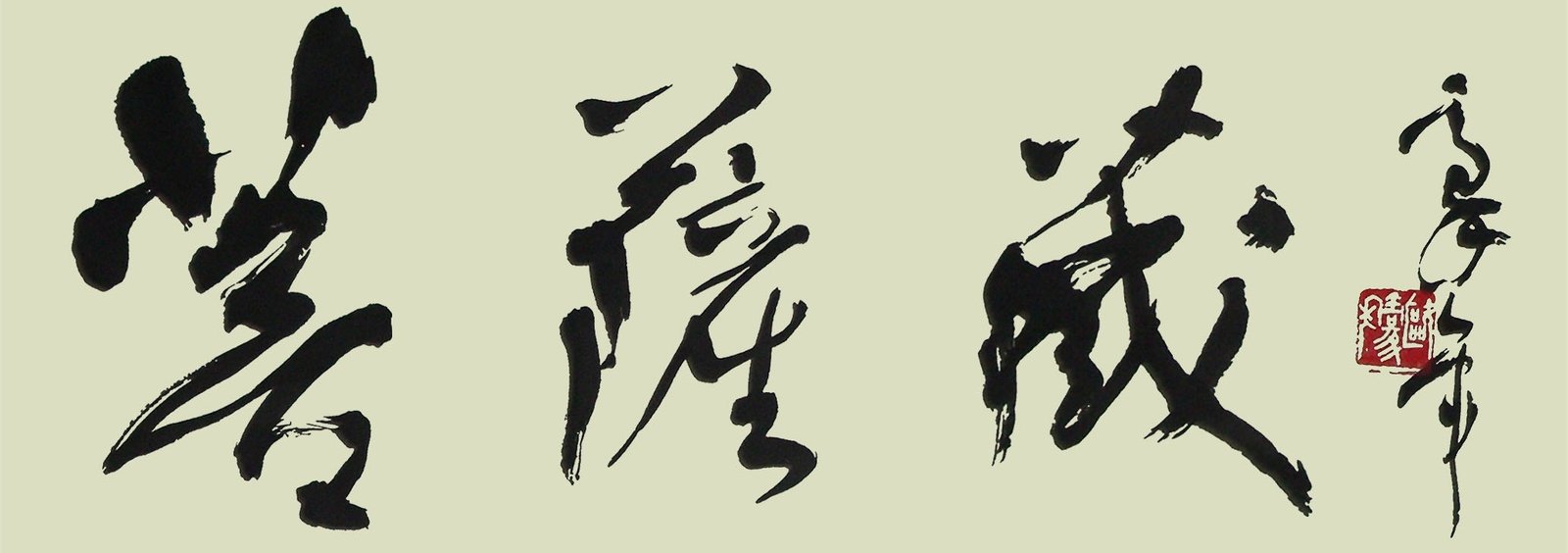
What Manner of Light Exists Above the Flowers? — On the Object Philosophy, Aesthetics of Becoming, and Manifestation of Excess in Chang Bi-hsiang’s Magnificent Among Blossoms
Written by WANG MUTI
When flowers cease to be merely flowers, and vases cease to be merely vases. Humanity's misunderstanding of flowers closely mirrors its misunderstanding of beauty. We often assume that what makes a flower moving lies in its color, fragrance, and blooming posture—as if beauty were an affair occurring solely on the surface. Yet, the flowers that linger longest in our memory are rarely the most realistic, opulent, or lifelike. Instead, they are those that make us suddenly realize: a flower is not merely a botanical entity, but a mode through which existence manifests itself.
Chang Bi-hsiang’s Magnificent Among Blossoms does not treat flowers as mere specimens of nature. Rather, it propels flowers, leaves, branches, vessels, background color-fields, and linear contours simultaneously into a more complex state. There, a flower is no longer just a flower, a vase is no longer just a vase, and even "brilliance" (yan) ceases to be mere visual gorgeousness, becoming an interrogation of manifestation, excess, overflow, and the self-glorification of existence.
The composition is vertical and soaring, with the overall background unfolding into a dreamlike field of blue and red. The blue is layered across large areas—resembling smoke, mist, or a night sky churned by an internal light. The red emerges within it like flower shadows, optical traumas, or heat continuously bleeding from the depths of cold tones. Distributed along the center, top, and bottom of the canvas are several vessel-like forms. Tinged with green and possessing a semi-transparent quality, they look like glass containers or vessels cleaved like bamboo joints.
Upon and between them grow a profusion of flowers and leaves outlined in delicate pale gold-white and milky-white lines. The lines are not heavy but clear, resembling both botanical veins and a luminescent nervous system. These line-drawn flowers and leaves weave, interlace, entangle, and extend—as if sprouting from the vessels, or self-propagating in midair. Thus, the foundational charm of the entire painting lies here: it does not simply depict a "vase of flowers," but portrays how the boundaries between object, plant, and light are radically reopened.
The Philosophy of the Title: What is "Magnificent Among Blossoms"?
If read merely as an everyday compliment, the four Chinese characters of the title, Yan Guan Qun Fang (艷冠群芳, "Magnificent Among Blossoms"), seem only to praise a floral beauty that surpasses its peers. Yet, upon deeper scrutiny, this title carries immense philosophical import. The so-called "flock of fragrance" (qunfang) does not refer to a singular flower, but to an entire world of blossoms. To be "reigning in brilliance" (yanguan) implies a mode of manifestation that does not merely participate, but transcends, stands out, captures the eye, and forces itself into focus. In other words, this is not a simple motif regarding beauty; it is a question of what can emerge from multiplicity and firmly demand our gaze.
Martin Heidegger once posited that the mission of an artwork is not to reproduce ready-made things, but to allow truth to "set itself into work" within the creation. Viewed from this perspective, what truly "reigns supreme" in Magnificent Among Blossoms is perhaps not any specific, concrete flower, but manifestation itself: that power by which, amidst multiplicity, overlapping, proliferation, and the surge of color, a certain form suddenly stands out, illuminates, and demands to be seen. The "brilliance" (yan) here is therefore not just the brilliance of a flower, nor is it decorative opulence. It is a profound ontological event—existence refusing to be concealed, forcefully bodying itself forth among a multitude of forms.
This also explains why the flowers in the painting do not crown a single fixed point as king. There is no singular "main flower" realistically rendered to overpower the rest. Instead, "brilliance" happens across the entire canvas: every line-drawn flower, every leaf, and every green vessel is drawn into the same high-tension manifestation. Consequently, "Magnificent Among Blossoms" no longer means a certain protagonist transcending the group; rather, it resembles the group itself collectively illuminating upon the exact same energetic plane. This constitutes a non-centric opulence, as well as a more contemporary aesthetic ethic.
The Metamorphosis of Vessels
A crucial secret of this painting lies in those green vessel shapes. From a mundane perspective, one would easily dismiss them as accessories in a flower-and-vase painting—vases merely intended to sustain the blossoms. Yet, in Magnificent Among Blossoms, the vessels are manifestly more than containers. They possess volume, a transparent or semi-transparent texture, a rhythmic arrangement, and even a sense of growth. The vessels look as though they are pierced by plants, or as if they themselves have sprouted branches and leaves. No clear hierarchy of master and servant exists between flower and object; instead, they share a body caught in the state of becoming.
When Heidegger discusses the vessel in his essay The Thing, he argues that the essence of a jug lies not merely in its material, but in its capacity to "hold." An object is an object not because it is a lump of matter, but because it allows a certain "gathering" and "giving" to take place. Applying this to the artwork, the vessels in Chang Bi-hsiang’s painting do not merely hold flowers; they visually reaffirm a truth: beauty does not blossom out of nothingness—it must always cling to, pass through, and be gathered by some form.
Yet, there is an even subtler nuance here: the vessels within the work do not appear completely stable. They are unlike the securely anchored containers found in traditional flower-and-vase paintings; instead, they seem to float, overlap, remain semi-transparent, and be permeated by vegetation within the color-field. This ensures they cease to be merely functional containers and further become a philosophical mediation: they bear the flowers, but are rewritten by them; they provide a structure, yet forfeit their own explicit closure within that very structure. From this perspective, the object here is not background, but one of the necessary conditions through which beauty manifests.
Perhaps precisely because of this, the work ultimately proposes not a classical thesis that "the flower is more beautiful than the vase," but a more complex inquiry: If all manifestation requires form to receive it, does form itself come alive when penetrated by that very manifestation?
The Lines of Becoming
I am inclined to argue that the most brilliant aspect of this work lies not in its color, but in its lines. Those lines of milky-white, pale gold, and near-luminescent texture outline blossoms, leaves, and spreading tendrils. Yet, this delineation does not resemble traditional fine-line brushwork (gongbi) that remains stable, definitive, and submissive to the logic of contours. Instead, it resembles a locus of life that is continuously spreading, bifurcating, and extending tentacles toward one another. They do not simply trace pre-existing objects; they manifest the very process of "sprouting" directly upon the canvas.
Gilles Deleuze distinguished between the "forms of being" and the "lines of becoming." For Deleuze, what matters is not what a thing already is, but how it continuously becomes something else. This view is exceptionally suited for reading Magnificent Among Blossoms. The flowers and leaves in the work are never fixed into a botanical chart; they permanently exist in a state of becoming: the flower resembles a leaf, the leaf resembles a line, and the line resembles a nerve or a water current; the vase resembles a vessel, and the vessel resembles a biological organism ascending joint by joint; the background resembles flower shadows, and the flower shadows resemble color-clouds floating across the sky. Thus, the entire painting is no longer composed of separate, static objects, but rather of currents of lines of becoming that traverse one another. This endows the work with an exceptionally powerful "dynamic sense of presence." Even though the canvas itself is static, the viewer senses that it is continuously occurring. The dense entanglement of lines, the floating background color-blocks, the overlapping vessels, and the bending and extending of branches and leaves all transform the canvas into a continuously expanding organic system. This organicity is not naturalistic, but belongs to the aesthetics of becoming: the flower is not merely a flower—it is becoming air; the vessel is not merely a vessel—it is becoming a plant; the background is not merely a background—it is becoming the flip side of the flower shadow.
Therefore, these lines are by no means mere "contours." They are lines of relationship, lines of becoming, lines of permeation, and lines of escape (lignes de fuite). They propel the flower from a singular beautiful object toward a more open state of existence: The flower no longer merely blooms; it continuously diffuses itself across the entire canvas.
Nietzschean Intensity and Bataillean Excess
If lines provide the becoming, then color provides the undeniable intensity of this work. The blue and red background is not a naturalistic depiction of sky and flower clusters; it is an intense, almost excessive emotional field. The blue here is both deep and luminous, like the inversion of a quiet night; the red continuously surfaces within the blue like heat, a trauma, or the embers of a flower shadow. Such colors do not seek harmony; they exist to maintain the canvas in a perpetual state of high tension.
Here, I am reminded of Friedrich Nietzsche. Nietzsche posited that life is fundamentally not conservative, but is force, intensity, and an impulse to continuously exceed its own forms. The "brilliance" (yan) in Magnificent Among Blossoms comes remarkably close to a Nietzschean affirmation of life: it is not the docile beauty of a flower, but a vital tension that refuses to grow dim, refuses to contract, and refuses to survive solely on the margins. This tension does not rely on a single subject; it relies on the entire canvas being elevated together. Flowers, leaves, vessels, and background all exist in a state of mutual competition, mutual enhancement, and mutual intensification. Thus, "brilliance" is no longer a superficial luxury, but an excessive manifestation of life-force itself. Taking a step further, one can even invoke Georges Bataille. Bataille’s reflections on "excess" and "expenditure" reveal that true magnificence is rarely utilitarian; it is an expenditure that exceeds necessity. From an everyday perspective, the flowers need not be this numerous, the colors need not be this rich, and the lines need not be this entangled. Yet, the moving power of art lies precisely in this generosity toward the "unnecessary." Magnificent Among Blossoms exhibits this Bataillean excess: it does not merely allow the flower to exist—it forces the flower to over-exist; it does not merely ask the vessel to hold—it demands that the vessel illuminate; it does not merely establish a background—it allows the background itself to become a secondary layer of blossoming profusion.
Therefore, the "brilliance" within this work must not be misconstrued as vulgar gaudiness. It resembles far more a mode of manifestation charged with philosophical weight: how life, in places where it need not be so prosperous, resolutely insists on prosperity; how, in realms where it need not be so striking, it resolutely insists on illuminating.
Contemporary Vision and the Aura of Dignity
In discussing floral imagery today, one of the greatest perils is how easily it lapses into decoration. Because flowers are so frequently consumed as pretty, pleasing, and visually friendly, viewers often fail to truly look before automatically categorizing them under the label of "beautiful." The reason Chang Bi-hsiang’s work stands a tier higher than ordinary decorative floral images is that she refuses to let the flower remain merely at the level of passive reception. Instead, she endows the flower with an irreplaceable presence.
When Walter Benjamin discussed "aura," he noted that a truly moving existence always preserves a certain distance that defies complete reproduction and immediate consumption. The flowers in Magnificent Among Blossoms, though bright, abundant, and passionate, still retain this aura. The reason is that they are not flattened patterns; they appear within a world that resists stable naming:
- It resembles a vase of flowers, yet differs from a still life;
- It resembles a garden, yet differs from a natural landscape;
- It resembles decoration, yet continuously exceeds decoration;
- It is recognizable, yet always deviates from its original category within its becoming.
This condition—at once familiar and alien—endows the artwork with a visual sense of distance. The viewer cannot categorize it entirely at a single glance. It is precisely this un-consumable, un-co-optable dimension that grants the work its aura. From this perspective, what Chang Bi-hsiang truly addresses is not the flower itself, but how beauty can still preserve its dignity within contemporary visual experiences. At a time when all images are prone to being quickly viewed, quickly liked, and quickly forgotten, Magnificent Among Blossoms manages to retain a deeper layer of hesitation, turning the act of viewing into something that must be learned anew.
The Material Logic of Polyphony
The work employs mixed media, a choice that is by no means a formal footnote but constitutes a core part of its meaning. The overall visual effect of this piece stems precisely from its "multi-layered surfaces": the spraying and bleeding of the background, the transparent overlapping shadows of the vessels, the luminescent fine lines of the flowers and leaves, and the mutual overwriting of disparate colors within the same zone. These layers are not a straightforward narrative; they represent the simultaneous existence of plural realities. This brings to mind the famous statement by Paul Klee: "Art does not reproduce the visible; rather, it makes visible." Chang Bi-hsiang does not reproduce a ready-made world of flowers here; she makes visible a relationship that was originally invisible: the interdependence between flower and vessel, the mutual infiltration of color and line, the mutual fulfillment of light and dark, and that relationship between form and life that both sustains and penetrates one another. Mixed media thus becomes the most appropriate instrument, for it allows the world to exist not as a single layer, but to manifest through multiple layers, multiple densities, and multiple speeds simultaneously.
The work consequently possesses a near-philosophical polyphony: the flower is not an isolated reality, the vessel is not a singular reality, and the background is not a reality of emptiness. Each carries a mode of existence with a distinct density, collectively composing the world through which this "brilliance" can be established.
True brilliance lies not on the surface of the flower, but in existence’s absolute refusal to grow dim. Chang Bi-hsiang’s Magnificent Among Blossoms utilizes mixed media to construct a composite world situated between flora, vessels, and a dreamlike color-field. The green vessel forms in the painting are no longer mere containers carrying flowers; instead, they penetrate and mutually become with the blossoms and leaves outlined in milky-white and gold lines. The interwoven background of blue and red constitutes a high-tension emotional field, granting the overall canvas an ontological depth that transcends mere gorgeousness. Drawing upon Heidegger’s comprehension of "the thing," the vessel here serves as a necessary condition for manifestation to materialize. Seen through Deleuze’s philosophy of becoming, the lines are by no means simple contours, but the lifelines through which the flower and the world permeate each other. On the whole, Magnificent Among Blossoms does not merely showcase the opulence of flourishing flowers; it elevates "brilliance" into a philosophical proposition concerning manifestation, excess, and life's stubborn refusal to be dimmed.