在花之上,還有何種光?
——張碧鄉〈艷冠群芳〉的器物哲學、生成美學與過剩的顯現
撰文:王穆提(WANG MUTI)
當花不再只是花,瓶也不再只是瓶。人對花的誤解,和人對美的誤解極其相似。人總以為花之所以動人,在於花有顏色、有香氣、有盛放的姿態,所以美像是一件開在表面上的事;然而真正使人長久不能忘懷的花,往往並非最寫實、最繁華、最逼真之花,而是那些使人忽然意識到:花原來不只是植物,而是一種存在現身的方式。張碧鄉這件〈艷冠群芳〉,恰恰不是把花畫成自然物的標本,而是將花、葉、枝、瓶、背景色場與線描輪廓,一併推向一種更複合的狀態:在那裡,花不再只是花,瓶不再只是瓶,甚至「艷」也不再只是視覺上的豔麗,而成為一種有關顯現、過剩、溢出與存在自我炫耀的問題。
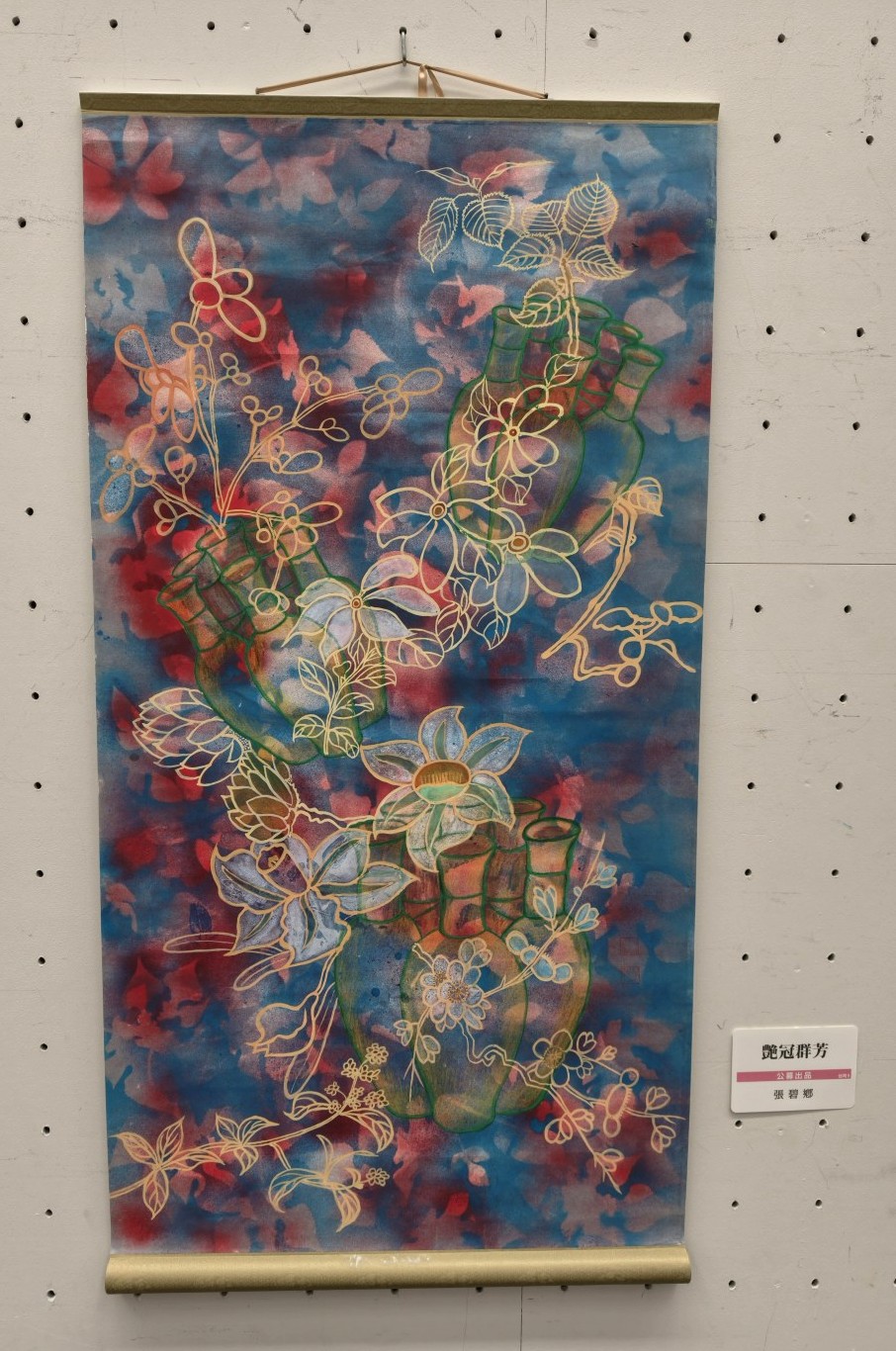
畫面為縱向高幅構圖,整體背景鋪展成一片近乎夢境式的藍與紅:藍色大面積鋪陳,如煙、如霧、如夜空被內在光翻湧著;紅色則在其間浮現,如花影、如光傷、如熱度在冷色深處不斷滲出。畫面中央與上下分佈著數個近似瓶器的形體,色調偏綠,帶半透明感,像玻璃容器,又像竹節般被切開的器皿;其上與其間,則生長出大量以淡金白色、乳白色細線勾勒的花與葉——線條不厚重,卻清楚,既像植物脈絡,又像發光的神經系統。這些線描花葉穿梭、牽連、纏繞、伸展,像從瓶中長出,也像在空中自行繁生。於是整幅畫的根本魅力便在於:它不是單純畫「瓶花」,而是在畫器物、植物與光的邊界如何被重新打開。
名題的哲學:何謂「艷冠群芳」?作品題名為「艷冠群芳」,這四字若只作日常讚語來讀,似乎不過是在說繁花之美超越同類;然而若稍微深究,這題目其實極具哲學意味。所謂「群芳」,並非一朵花,而是一整個花的世界;而「艷冠」則意味著某種不只參與其中,而是凌駕、突出、奪目、成為焦點的顯現方式。換句話說,這不是一個單純關於美的題目,而是一個關於何者能從繁多之中出現,並強行要求我們觀看的題目。
海德格曾說,藝術作品的使命並非複製現成之物,而是讓真理以某種方式「自行設立」於作品之中。若借此來看,〈艷冠群芳〉真正「冠」者,未必是某朵具體的花,而是那種顯現本身:那種在繁多、重疊、蔓延與色彩湧動之中,某種形態忽然站出來、發光、要求被看見的力量。這裡的「艷」,因此不只是花之艷,也不是裝飾性的華麗,而是一種更深的存在事件——存在不甘隱沒,而在眾形之中強烈現身。
這也解釋了為何作品中的花並不以單一定點為王者。畫中沒有唯一主花,沒有一朵被寫實地畫到最奪目;反而是整個畫面都在發生「艷」:每一朵線描花、每一片葉、每一個綠色器物,都被拉進同一種高張度的顯現之中。如此一來,「艷冠群芳」不再是某個主角超越群體,而更像是群體本身在同一個能量平面上共同發光。這是一種非中心式的華麗,也是一種更現代的美學倫理。
這幅畫的一個重要秘密,是那些綠色器形。若只從日常觀看出發,人會很容易把它們視為瓶花畫中的附屬物:瓶子不過拿來承載花朵。然而在〈艷冠群芳〉中,瓶器顯然不只是容器。它們有其體積、有其透明或半透明的質感、有其節奏性排列,甚至有其生長感。那些器皿像被植物穿透,又像自己也長出了枝葉;花與器物之間並無明確的主從關係,反而彼此共享一種生成中的身體。
海德格在〈物〉中討論器皿時,說壺杯的本質不僅在其材質,而在其「容納」的能力;器物之為器物,不是因為它是一塊物體,而是因為它讓某種「盛載」與「給予」得以發生。若套用到此作,張碧鄉畫中的器皿並非僅僅盛花,而是在視覺上重申了一件事:美不是憑空綻放的,它總要依附、總要穿越、總要被某種形式承接。
然而這裡又有一個更妙的地方:作品中的器皿似乎也不完全穩定。它們不像傳統瓶花圖裡那種安穩端坐的容器,而更像在色場裡漂浮、交疊、半透明、被植物滲透。這使它們不再只是功能性容器,而進一步成為一種哲學性的中介:它們承載花,但也被花改寫;它們提供結構,卻也在結構中失去自己明確的封閉性。從這個角度看,器物在這裡不是背景,而是美之所以得以顯現的條件之一。
也許正因如此,作品最終提出的並非一個「花比瓶美」的古典命題,而是更複雜的問題: 若一切顯現都需要形式來承接,那麼形式本身是否也會因被顯現穿透,而變得活起來?
我願意說,這件作品最精彩之處,不在色,而在線。那些乳白、淺金、近發光質地的線條,勾勒出花朵、葉片、枝蔓,但那種勾勒並不像工筆那樣穩定、明確、服從輪廓邏輯,而更像一種正在蔓延、正在分叉、正在彼此伸出觸角的生命軌跡。它們不是單純將既有物件描出,而像在畫面上直接發生「長出來」的過程。
德勒茲區分「存在的形」與「生成的線」。對德勒茲而言,重要的並不是事物已經是什麼,而是它如何持續變成別的東西。這個觀點特別適合閱讀〈艷冠群芳〉。作品中的花葉並不被固定為植物學圖譜,而總處於一種生成之中:花像葉,葉像線,線又像神經或水流;瓶像器,器又像節節上升的生物體;背景像花影,花影又像漫天浮動的色雲。於是整幅畫不再由一個個固定對象構成,而更像由一股股彼此穿越的生成線構成。
這讓作品具有一種極強的「動態存在感」。即使畫面本身靜止,觀者仍會感到它在持續發生。線條的細密纏繞、背景色塊的浮動、器皿之間的交疊、枝葉的彎轉與伸探,都讓畫面像一個不斷擴張的有機系統。這種有機性不是自然主義的,而是生成美學的:花不只是花,花正在成為空氣;器物不只是器物,器物正在成為植物;背景不只是背景,背景正在成為花影的另一側。
因此,這些線條絕非「輪廓」而已。它們是關係線、生成線、滲透線,也是逃逸線。它們把花從單一的美物,推向一種更開放的存在狀態: 花不再只是開著,而是在整個畫面裡持續擴散自己。
若說線提供了生成,那麼色彩則提供了這件作品最不可忽視的強度。藍與紅的背景不是自然寫生式的天空與花叢,而是一種強烈、近乎過剩的情感場。藍在此既深且亮,像靜夜的反面;紅則在藍中不斷浮現,如熱、如傷、如花影的餘燼。這樣的色彩不是為了和諧,而是為了使畫面始終處於某種高張度之中。
這裡我想到尼采。尼采說生命本質上不是保守的,而是力,是強度,是不斷超出自身形式的衝動。〈艷冠群芳〉中的「艷」,便極接近尼采式的生命肯定:它不是柔順的花之美,而是一種拒絕黯淡、拒絕收縮、拒絕只在邊緣生存的生命張力。這種張力不靠單一主體,而靠整體畫面一起被推高。花、葉、器、背景,全都處於一種彼此競放、彼此烘托、彼此增強的狀態。於是,「艷」不再是表面之華,而是生命力本身的一種過度顯現。
若更往前一步,甚至可引巴塔耶來讀。巴塔耶對「過剩」與「耗費」的思考,讓人明白,真正的華美常常不是功利性的,而是一種超出必要的支出。從日常角度看,花不必這麼多、色不必這麼濃、線不必這麼纏繞;但藝術的動人,恰恰在這種對「不必要」的慷慨。〈艷冠群芳〉便有這種巴塔耶式的過剩:它不只是要讓花存在,而是要讓花過度存在;不只是要讓器皿承載,而是要讓器皿也發光;不只是要有背景,而是讓背景本身成為第二層繁花。
因此,這件作品中的「艷」不應被誤解為庸俗的豔麗。它更像是一種有哲學重量的顯現方式: 生命如何在不必如此繁盛的地方,仍執意繁盛;如何在不必如此奪目的地方,仍執意發光。 今天談花卉圖像,最大的危險之一,就是它太容易落入裝飾。因為花太常被消費成好看、愉悅、視覺友善,於是觀者常常來不及真正觀看,就已經先把它歸入「美麗」那一欄。張碧鄉這件作品之所以比一般裝飾性花卉圖像更高一層,便在於它沒有讓花只停留在被接受的層次,而是讓花帶著某種不可替代的在場性。
班雅明談「靈光」時,指出真正動人的存在,總保有某種不可完全被複製、不可被立即消費的距離。〈艷冠群芳〉中的花,雖然明亮、豐富、熱烈,卻仍有這種靈光。原因在於它們不是平面化的圖案,而是出現在一個近乎不可穩定命名的世界裡:
- 它既像瓶花,又不像靜物;
- 既像花園,又不像自然風景;
- 既像裝飾,又在不斷超出裝飾;
- 既可辨認,又總在生成中偏離原有類別。
這種既熟悉又陌生的狀態,使作品保有了一種視覺上的距離感。觀者不能一眼便將其全數歸類。正是這種不能被完全消費、完全收編的部分,使作品獲得了靈光。
從這個角度說,張碧鄉真正處理的不是花本身,而是美如何在當代視覺經驗中仍能保有尊嚴。當一切圖像都容易被快速觀看、快速喜歡、快速遺忘時,〈艷冠群芳〉仍設法保留一層更深的停頓,使觀看變成一種需要重新學習的事。
作品使用綜合媒材,這一點在此作中絕非形式附註,而是意義的一部分。因為這件作品整體的視覺效果,正來自「多層表面」:有背景的噴灑與暈染,有器物的透明疊影,有花葉的細線發光,有不同顏色在同一區域彼此覆寫。這些層不是平鋪直敘,而是一種複數現實的同時存在。
這使我想到保羅.克利曾說過的話:藝術不是再現可見,而是使其可見。張碧鄉在這裡沒有再現一個現成的花世界,而是使某種原本不可見的關係變得可見:花與器的互依、色與線的互滲、明與暗的互相成全,以及形式與生命之間那種既支撐又彼此穿透的關係。綜合媒材於是成為最合適的手段,因為它允許世界不是單層存在,而是以多層次、多密度、多速度同時顯現。
作品因此具有一種近乎哲學上的複調性:花不是孤立現實,器不是單一現實,背景也不是空無的現實;它們各自帶著不同密度的存在方式,共同構成這一幅「艷」之所以能成立的世界。 真正的艷,不在花之表面,而在存在之不肯黯淡。張碧鄉〈艷冠群芳〉以綜合媒材建構出一個介於花卉、器物與夢境色場之間的複合世界。畫中綠色器形不再只是承載花朵的容器,而與乳白、金色線描的花葉彼此穿透、互相生成;藍紅交織的背景則構成一個高張度的情感場,使整體畫面在華美之外更具存在論深度。若借海德格對「物」的理解,可見器皿在此是顯現得以成立的條件;若從德勒茲的生成哲學觀之,線條亦非單純輪廓,而是花與世界彼此滲透的生命軌跡。整體而言,〈艷冠群芳〉不僅展現繁花之盛,更將「艷」提升為一種關於顯現、過剩與生命不肯黯淡的哲學命題。
其他相關內容:
【現場直擊】【台日交流展】東京都美術館開館100周年記念《第14回東京現展》展場:日本國立東京都美術館
台灣參展藝術家作品藝術評論
東京都美術館開館100周年記念【14回東京現展】廖純沂〈未盡・浮境〉未盡之物何以最能久留人心
東京都美術館開館100周年記念【14回東京現展】廖純沂〈游相〉花何以不止於花,與形相如何在漂游中成立
東京都美術館開館100周年記念【14回東京現展】廖純沂〈思域・沉靜〉沉靜何以不是空,與垂掛之物何以最像思念
東京都美術館開館100周年記念【14回東京現展】王詮富〈八月閑步一色秋〉的季節哲學、門徑意識與水墨的開敞性 在黑暗中閑步:秋色如何不是顏色,而是一種存在的轉身
東京都美術館開館100周年記念【14回東京現展】 王詮富〈一念菩提開翠微〉的開顯、同體、綿延與空性 一念未起,萬根已動
東京都美術館開館100周年記念【14回東京現展】蔡梅芳〈戀戀紫藤〉的痕跡、綿延與生成 花影之遲遲不散,與記憶如何在解構之後重返
東京都美術館開館100周年記念【14回東京現展】 王穆提《聖境・阿里山》蒼翠的紀念碑
東京都美術館開館100周年記念【14回東京現展】王穆提《中道之光》裂隙中的永恆
東京都美術館開館100周年記念【14回東京現展】吳心荷〈散落骨骼(一)〉散落之骨,與人之未能完全集成於自身
東京都美術館開館100周年記念【14回東京現展】陳福祺〈咖啡心音〉的存在寓言 沸點、晶化與心之熔爐
東京都美術館開館100周年記念【14回東京現展】張素蘭〈一棵開花的樹〉的場所哲學、過程生命與靜默中的新生
東京都美術館開館100周年記念【14回東京現展】吳亞倫〈藍與黑的交響詩(雙併)〉論藍何以不只為藍,黑何以不只為黑
東京都美術館開館100周年記念【14回東京現展】張碧鄉〈艷冠群芳〉的器物哲學、生成美學與過剩的顯現
東京都美術館開館100周年記念【14回東京現展】趙玉燕〈熾烈〉論火中的身體,與人何以不能只是自己
東京都美術館開館100周年記念【14回東京現展】許秀珠〈403地震後的太魯閣〉山川之裂,與人如何在震後重新學會自身的位置
東京都美術館開館100周年記念【14回東京現展】江麗香〈秋聲賦〉彩墨中的時間書寫 水痕與秋聲
東京都美術館開館100周年記念【14回東京現展】江麗香〈流轉的歲月〉水之無言,而歲月常藉其形以自見
東京都美術館開館100周年記念【14回東京現展】謝文倩〈驚夢〉的夢之碎片、感覺邏輯與夜的顯現
東京都美術館開館100周年記念【第14回東京現展】黃淑卿〈群鷗處處來(台灣澎湖)〉群鷗之所以來,與人終於學會不把世界全算作自己
東京都美術館開館100周年記念【14回東京現展】黃淑卿〈燕尾與戴勝(台灣金門)〉論屋脊、禽鳥與地方何以不只是地理
東京都美術館開館100周年記念【14回東京現展】謝正瑜〈蓮池映相〉的感知哲學與靈性空間
東京都美術館開館100周年記念【14回東京現展】周若梅〈流光之舞〉,光何以有身,與人如何在流動中暫時成形
What Manner of Light Exists Above the Flowers? — On the Object Philosophy, Aesthetics of Becoming, and Manifestation of Excess in Chang Bi-hsiang’s Magnificent Among Blossoms
Written by WANG MUTI
When flowers cease to be merely flowers, and vases cease to be merely vases. Humanity's misunderstanding of flowers closely mirrors its misunderstanding of beauty. We often assume that what makes a flower moving lies in its color, fragrance, and blooming posture—as if beauty were an affair occurring solely on the surface. Yet, the flowers that linger longest in our memory are rarely the most realistic, opulent, or lifelike. Instead, they are those that make us suddenly realize: a flower is not merely a botanical entity, but a mode through which existence manifests itself.
Chang Bi-hsiang’s Magnificent Among Blossoms does not treat flowers as mere specimens of nature. Rather, it propels flowers, leaves, branches, vessels, background color-fields, and linear contours simultaneously into a more complex state. There, a flower is no longer just a flower, a vase is no longer just a vase, and even "brilliance" (yan) ceases to be mere visual gorgeousness, becoming an interrogation of manifestation, excess, overflow, and the self-glorification of existence.
The composition is vertical and soaring, with the overall background unfolding into a dreamlike field of blue and red. The blue is layered across large areas—resembling smoke, mist, or a night sky churned by an internal light. The red emerges within it like flower shadows, optical traumas, or heat continuously bleeding from the depths of cold tones. Distributed along the center, top, and bottom of the canvas are several vessel-like forms. Tinged with green and possessing a semi-transparent quality, they look like glass containers or vessels cleaved like bamboo joints.
Upon and between them grow a profusion of flowers and leaves outlined in delicate pale gold-white and milky-white lines. The lines are not heavy but clear, resembling both botanical veins and a luminescent nervous system. These line-drawn flowers and leaves weave, interlace, entangle, and extend—as if sprouting from the vessels, or self-propagating in midair. Thus, the foundational charm of the entire painting lies here: it does not simply depict a "vase of flowers," but portrays how the boundaries between object, plant, and light are radically reopened.
The Philosophy of the Title: What is "Magnificent Among Blossoms"?
If read merely as an everyday compliment, the four Chinese characters of the title, Yan Guan Qun Fang (艷冠群芳, "Magnificent Among Blossoms"), seem only to praise a floral beauty that surpasses its peers. Yet, upon deeper scrutiny, this title carries immense philosophical import. The so-called "flock of fragrance" (qunfang) does not refer to a singular flower, but to an entire world of blossoms. To be "reigning in brilliance" (yanguan) implies a mode of manifestation that does not merely participate, but transcends, stands out, captures the eye, and forces itself into focus. In other words, this is not a simple motif regarding beauty; it is a question of what can emerge from multiplicity and firmly demand our gaze.
Martin Heidegger once posited that the mission of an artwork is not to reproduce ready-made things, but to allow truth to "set itself into work" within the creation. Viewed from this perspective, what truly "reigns supreme" in Magnificent Among Blossoms is perhaps not any specific, concrete flower, but manifestation itself: that power by which, amidst multiplicity, overlapping, proliferation, and the surge of color, a certain form suddenly stands out, illuminates, and demands to be seen. The "brilliance" (yan) here is therefore not just the brilliance of a flower, nor is it decorative opulence. It is a profound ontological event—existence refusing to be concealed, forcefully bodying itself forth among a multitude of forms.
This also explains why the flowers in the painting do not crown a single fixed point as king. There is no singular "main flower" realistically rendered to overpower the rest. Instead, "brilliance" happens across the entire canvas: every line-drawn flower, every leaf, and every green vessel is drawn into the same high-tension manifestation. Consequently, "Magnificent Among Blossoms" no longer means a certain protagonist transcending the group; rather, it resembles the group itself collectively illuminating upon the exact same energetic plane. This constitutes a non-centric opulence, as well as a more contemporary aesthetic ethic.
The Metamorphosis of Vessels
A crucial secret of this painting lies in those green vessel shapes. From a mundane perspective, one would easily dismiss them as accessories in a flower-and-vase painting—vases merely intended to sustain the blossoms. Yet, in Magnificent Among Blossoms, the vessels are manifestly more than containers. They possess volume, a transparent or semi-transparent texture, a rhythmic arrangement, and even a sense of growth. The vessels look as though they are pierced by plants, or as if they themselves have sprouted branches and leaves. No clear hierarchy of master and servant exists between flower and object; instead, they share a body caught in the state of becoming.
When Heidegger discusses the vessel in his essay The Thing, he argues that the essence of a jug lies not merely in its material, but in its capacity to "hold." An object is an object not because it is a lump of matter, but because it allows a certain "gathering" and "giving" to take place. Applying this to the artwork, the vessels in Chang Bi-hsiang’s painting do not merely hold flowers; they visually reaffirm a truth: beauty does not blossom out of nothingness—it must always cling to, pass through, and be gathered by some form.
Yet, there is an even subtler nuance here: the vessels within the work do not appear completely stable. They are unlike the securely anchored containers found in traditional flower-and-vase paintings; instead, they seem to float, overlap, remain semi-transparent, and be permeated by vegetation within the color-field. This ensures they cease to be merely functional containers and further become a philosophical mediation: they bear the flowers, but are rewritten by them; they provide a structure, yet forfeit their own explicit closure within that very structure. From this perspective, the object here is not background, but one of the necessary conditions through which beauty manifests.
Perhaps precisely because of this, the work ultimately proposes not a classical thesis that "the flower is more beautiful than the vase," but a more complex inquiry: If all manifestation requires form to receive it, does form itself come alive when penetrated by that very manifestation?
The Lines of Becoming
I am inclined to argue that the most brilliant aspect of this work lies not in its color, but in its lines. Those lines of milky-white, pale gold, and near-luminescent texture outline blossoms, leaves, and spreading tendrils. Yet, this delineation does not resemble traditional fine-line brushwork (gongbi) that remains stable, definitive, and submissive to the logic of contours. Instead, it resembles a locus of life that is continuously spreading, bifurcating, and extending tentacles toward one another. They do not simply trace pre-existing objects; they manifest the very process of "sprouting" directly upon the canvas.
Gilles Deleuze distinguished between the "forms of being" and the "lines of becoming." For Deleuze, what matters is not what a thing already is, but how it continuously becomes something else. This view is exceptionally suited for reading Magnificent Among Blossoms. The flowers and leaves in the work are never fixed into a botanical chart; they permanently exist in a state of becoming: the flower resembles a leaf, the leaf resembles a line, and the line resembles a nerve or a water current; the vase resembles a vessel, and the vessel resembles a biological organism ascending joint by joint; the background resembles flower shadows, and the flower shadows resemble color-clouds floating across the sky. Thus, the entire painting is no longer composed of separate, static objects, but rather of currents of lines of becoming that traverse one another. This endows the work with an exceptionally powerful "dynamic sense of presence." Even though the canvas itself is static, the viewer senses that it is continuously occurring. The dense entanglement of lines, the floating background color-blocks, the overlapping vessels, and the bending and extending of branches and leaves all transform the canvas into a continuously expanding organic system. This organicity is not naturalistic, but belongs to the aesthetics of becoming: the flower is not merely a flower—it is becoming air; the vessel is not merely a vessel—it is becoming a plant; the background is not merely a background—it is becoming the flip side of the flower shadow.
Therefore, these lines are by no means mere "contours." They are lines of relationship, lines of becoming, lines of permeation, and lines of escape (lignes de fuite). They propel the flower from a singular beautiful object toward a more open state of existence: The flower no longer merely blooms; it continuously diffuses itself across the entire canvas.
Nietzschean Intensity and Bataillean Excess
If lines provide the becoming, then color provides the undeniable intensity of this work. The blue and red background is not a naturalistic depiction of sky and flower clusters; it is an intense, almost excessive emotional field. The blue here is both deep and luminous, like the inversion of a quiet night; the red continuously surfaces within the blue like heat, a trauma, or the embers of a flower shadow. Such colors do not seek harmony; they exist to maintain the canvas in a perpetual state of high tension.
Here, I am reminded of Friedrich Nietzsche. Nietzsche posited that life is fundamentally not conservative, but is force, intensity, and an impulse to continuously exceed its own forms. The "brilliance" (yan) in Magnificent Among Blossoms comes remarkably close to a Nietzschean affirmation of life: it is not the docile beauty of a flower, but a vital tension that refuses to grow dim, refuses to contract, and refuses to survive solely on the margins. This tension does not rely on a single subject; it relies on the entire canvas being elevated together. Flowers, leaves, vessels, and background all exist in a state of mutual competition, mutual enhancement, and mutual intensification. Thus, "brilliance" is no longer a superficial luxury, but an excessive manifestation of life-force itself. Taking a step further, one can even invoke Georges Bataille. Bataille’s reflections on "excess" and "expenditure" reveal that true magnificence is rarely utilitarian; it is an expenditure that exceeds necessity. From an everyday perspective, the flowers need not be this numerous, the colors need not be this rich, and the lines need not be this entangled. Yet, the moving power of art lies precisely in this generosity toward the "unnecessary." Magnificent Among Blossoms exhibits this Bataillean excess: it does not merely allow the flower to exist—it forces the flower to over-exist; it does not merely ask the vessel to hold—it demands that the vessel illuminate; it does not merely establish a background—it allows the background itself to become a secondary layer of blossoming profusion.
Therefore, the "brilliance" within this work must not be misconstrued as vulgar gaudiness. It resembles far more a mode of manifestation charged with philosophical weight: how life, in places where it need not be so prosperous, resolutely insists on prosperity; how, in realms where it need not be so striking, it resolutely insists on illuminating.
Contemporary Vision and the Aura of Dignity
In discussing floral imagery today, one of the greatest perils is how easily it lapses into decoration. Because flowers are so frequently consumed as pretty, pleasing, and visually friendly, viewers often fail to truly look before automatically categorizing them under the label of "beautiful." The reason Chang Bi-hsiang’s work stands a tier higher than ordinary decorative floral images is that she refuses to let the flower remain merely at the level of passive reception. Instead, she endows the flower with an irreplaceable presence.
When Walter Benjamin discussed "aura," he noted that a truly moving existence always preserves a certain distance that defies complete reproduction and immediate consumption. The flowers in Magnificent Among Blossoms, though bright, abundant, and passionate, still retain this aura. The reason is that they are not flattened patterns; they appear within a world that resists stable naming:
- It resembles a vase of flowers, yet differs from a still life;
- It resembles a garden, yet differs from a natural landscape;
- It resembles decoration, yet continuously exceeds decoration;
- It is recognizable, yet always deviates from its original category within its becoming.
This condition—at once familiar and alien—endows the artwork with a visual sense of distance. The viewer cannot categorize it entirely at a single glance. It is precisely this un-consumable, un-co-optable dimension that grants the work its aura. From this perspective, what Chang Bi-hsiang truly addresses is not the flower itself, but how beauty can still preserve its dignity within contemporary visual experiences. At a time when all images are prone to being quickly viewed, quickly liked, and quickly forgotten, Magnificent Among Blossoms manages to retain a deeper layer of hesitation, turning the act of viewing into something that must be learned anew.
The Material Logic of Polyphony
The work employs mixed media, a choice that is by no means a formal footnote but constitutes a core part of its meaning. The overall visual effect of this piece stems precisely from its "multi-layered surfaces": the spraying and bleeding of the background, the transparent overlapping shadows of the vessels, the luminescent fine lines of the flowers and leaves, and the mutual overwriting of disparate colors within the same zone. These layers are not a straightforward narrative; they represent the simultaneous existence of plural realities. This brings to mind the famous statement by Paul Klee: "Art does not reproduce the visible; rather, it makes visible." Chang Bi-hsiang does not reproduce a ready-made world of flowers here; she makes visible a relationship that was originally invisible: the interdependence between flower and vessel, the mutual infiltration of color and line, the mutual fulfillment of light and dark, and that relationship between form and life that both sustains and penetrates one another. Mixed media thus becomes the most appropriate instrument, for it allows the world to exist not as a single layer, but to manifest through multiple layers, multiple densities, and multiple speeds simultaneously.
The work consequently possesses a near-philosophical polyphony: the flower is not an isolated reality, the vessel is not a singular reality, and the background is not a reality of emptiness. Each carries a mode of existence with a distinct density, collectively composing the world through which this "brilliance" can be established.
True brilliance lies not on the surface of the flower, but in existence’s absolute refusal to grow dim. Chang Bi-hsiang’s Magnificent Among Blossoms utilizes mixed media to construct a composite world situated between flora, vessels, and a dreamlike color-field. The green vessel forms in the painting are no longer mere containers carrying flowers; instead, they penetrate and mutually become with the blossoms and leaves outlined in milky-white and gold lines. The interwoven background of blue and red constitutes a high-tension emotional field, granting the overall canvas an ontological depth that transcends mere gorgeousness. Drawing upon Heidegger’s comprehension of "the thing," the vessel here serves as a necessary condition for manifestation to materialize. Seen through Deleuze’s philosophy of becoming, the lines are by no means simple contours, but the lifelines through which the flower and the world permeate each other. On the whole, Magnificent Among Blossoms does not merely showcase the opulence of flourishing flowers; it elevates "brilliance" into a philosophical proposition concerning manifestation, excess, and life's stubborn refusal to be dimmed.
花の上にある、いかなる光か?——張碧鄉(チャン・ビーシアン)〈艷冠群芳(えんかんぐんほう)〉における器物の哲学、生成の美学、然後して過剰なる顕現
執筆:王穆提(ワン・ムーティ)
花が単なる花であることをやめ、瓶が単なる瓶であることをやめるとき。人間が花に対して抱く誤解は、美に対する誤解と酷似している。人は、花が人の心を動かす理由は、その色彩、香気、然後して咲き誇る姿にあると思い込みがちだ。まるで、美とは表面だけで起こる出来事であるかのように。然而しながら、真に長配置憶に残る花とは、往々にして最も寫実的で、最も繁華で、最も真に迫った花ではない。それは、次の一事を人間に突如として悟らせる花である。——花とは本来、單なる植物ではなく、存在が姿を現す(顕現する)ための一つの在り方なのだ、と。
張碧鄉の〈艷冠群芳〉は、まさに花を自然物の標本として描いたものではない。それは花、葉、枝、瓶、背景の色彩磁場(色場)、然後して線描の輪郭を、一気により複合的な状態へと押し進める。そこでは、花はもはや単なる花ではなく、瓶もまた単なる瓶ではない。さらに「艷(えん)」という言葉すら単なる視確的な艶麗さを超え、顕現、過剰、溢出、然後して存在の自己顕示(自我炫耀)をめぐる問いとなるのである。
画面は縦に長い高幅の構図を持ち、背景全体は夢幻的な青と赤の色場として広がっている。大面積に敷き詰められた青は、煙のようでもあり、霧のようでもあり、內なる光によって沸き立つ夜空のようでもある。その間に浮かび上がる赤は、花の影のようでもあり、光の傷痕のようであって、寒色(冷たい色)の深部から絶えず滲み出る熱を思わせる。画面の中央および上下には、瓶や器に近似したいくつかの形体が配置されている。それらは緑がかった色調で、半透明の質感を持ち、ガラス容器のようでもあり、あるいは竹の節のように切り開かれた器のようでもある。
その上や損の間には、淡い金白色や乳白色の細線によって輪郭を描かれた大量の花と葉が生い茂っている。線は重々しくはないが明瞭であり、植物の脈絡のようでもあり、発光する神経システムのようでもある。これらの線描された花葉は、交差し、牽引し合い、絡み合い、伸展する。それは瓶から生え出たようでもあり、あるいは空中を自在に自生(繁生)しているかのようでもある。それゆえ、この画の根源的な魅力は次の一点にある。すなわち、単に「瓶花(花瓶に生けられた花)」を描くのではなく、器物、植物、然後して光の境界がいかにして新しく切り開かれるかを描き出している点にある。
題名の哲学:「艷冠群芳」とは何か?
作品の題名である「艷冠群芳(えんかんぐんほう)」という四文字は、日常的な賛辞として読むならば、単に群生する花々の美しさが同類を凌駕していることを意味しているに過ぎないように思える。然而しながら、少し深く探求してみるならば、このテーマは極めて哲学的意味を帯びている。いわゆる「群芳(ぐんほう)」とは、一輪の花ではなく、花々が織り成す「世界全体」を指す。然後して「艷冠(えんかん)」とは、単にその中に參與するだけでなく、それを凌駕し、突出し、目を奪い、焦点となるような「顕現の方式」を意味している。言い換えるならば、這是單なる美に関するテーマではなく、「数多の(繁多な)ものの中から何が出現し、いかにして私たちのまなざしを強烈に要求しうるか」をめぐる問いなので何。
マルティン・ハイデッガーはかつて、芸術作品の使命とは既成の事物を複製することではなく、真理を作品の中に「自ら定置(自行設立)させる」ことにあるとした。この視点を借りるならば、〈艷冠群芳〉において真に「冠」たる(頂點に立つ)ものは、必ずしも特定の具体的な一輪の花ではない。それは「顕現そのもの」である。すなわち、繁多、重複、蔓延、然後して色彩の奔流のなかにあって、ある形態が突如として立ち上がり、発光し、見出されることを要求するあの「力」なのだ。ここでの「艷」は、それゆえ単なる花の艶やかさではなく、裝飾的な華麗さでもない。それはさらに深い「存在のイベント(事件)」である。——存在が隠蔽されることを潔しとせず、無数の形態の中で強烈に姿を現す(現身する)出來事なのだ。
這は、作品の中の花々が、なぜ特定の単一の定点を「王者」として崇めないのかという理由をも説明している。画中には、寫実的に最も目立つように描かれた唯一の「主花」は存在しない。そうではなく、画面全体において「艷」が発生しているのだ。一輪一輪の線描された花、一枚的葉、すべての緑色の器物が、同じ高張度の顕現の中へと引き込まれている。その結果、「艷冠群芳」とはもはや特定の主人公が群れを超えること外なく、むしろ群れそのものが同一の「エネルギー平面」の上で共同で発光しているかのように思わせる。這は非中心的な華麗さであり、より現代的な美学の倫理でもある。
器物の変容
この画の重要なる秘密は、あの緑色の器の形状にある。日常的なまなざしから出発するならば、人はそれを単に瓶花画における「付属品」と見なしがちである。瓶とは、単に花を受け止めるための道具に過ぎない、と。然而しながら、〈艷冠群芳〉において、瓶や器は明らかに単なる容器にとどまらない。それらは独自の体積を持ち、透明あるいは半透明の質感を持ち、リズム感のある配列を持ち、さらにして独自の「成長感」すら備えている。それらの器は植物に貫通されているようでもあり、あるいは器自体が枝葉を生やしたかのようでもある。花と器物の間には明確な主従関係は存在せず、むしろ「生成」の中にある一つの身体を互いに共有し合っている。
ハイデッガーは『物』のなかで器について議論した際、水差しや杯の本質はその材質にあるのではなく、その「容納(受け入れること)」の能力にあるとした。器物が器物たる理由は、それが一個の物体だからではなく、ある種の「保持(盛載)」と「贈与(給予)」を発生させるからである。これを本作に当てはめるならば、張碧鄉の画における器は単に花を盛り付けるだけでなく、視確的に次の一事を再確認させている。——美とは、何もない空中から咲き誇るものではない。それは常に何かに依拠し、何かを突き抜け、ある「形式」によって受け止められねばならないのだ、と。
然而しながらここにはさらに妙なる部分がある。作品における器は、決して完全に安定してはいない。それらは伝統的な瓶花図にあるような、どっしりと据え置かれた容器とは異なり、色場のなかで浮遊し、重なり合い、半透明であり、植物に浸透されているかのように見える。これにより、それらは単なる機能的な容器であることをやめ、一步進んで「哲学的媒介(メディエーション)」となる。それらは花を受け止めつつも、花によって自らも書き換えられる。構造を提供しつつも、その構造のなかで自らの明確な閉鎖性(自己完結性)を喪失していく。この角度から見れば、器物はここでの背景ではなく、美が顕現しうるための「条件」の一つなのである。 おそらくそれゆえにこそ、作品が最終的に提示しているものは「花は瓶よりも美しい」という古典的な命題ではなく、さらに複雑な問いなのである。——「もしすべての顕現が受け止めるための『形式』を必要とするならば、形式そのものもまた、顕現によって突き抜けられることで、生命を帯びて生き生きと動き出すのではないか?」という問いだ。
生成の線
私は、この作品の最も素晴らしい部分は、色彩ではなく「線」にあると言いたい。あの乳白色、淡い金色の、さながら発光するような質感を持つ線条(ライン)は、花々、葉、然後して枝蔓の輪郭を描き出す。然而しながらその描写は、伝統的な工筆画のように安定的で明確であり、輪郭のロジックに服従するようなものではない。それはむしろ、今まさに蔓延し、分枝し、互いに触手を伸ばし合っている「生命の軌跡」に近い。それらは単に既存の物体を描き出す(トレースする)のではなく、画面の上で直接「生え出てくる(長出来)」プロセスを発生させているのである。
ジル・ドゥルーズは「存在の形(フォルム)」と「生成の線(ライン)」を区別した。ドゥルーズにとって重要なのは、事物がすでに「何であるか」ではなく、それが「いかにして別のものへと変わり続けるか」である。この観点は、〈艷冠群芳〉を読み解く上で特に適している。作品における花葉は、植物学的な図譜として固定されることはない。それは常に一種の「生成」の中に置かれている。花は葉のようであり、葉は線のようであり、線は神経や水流のようでもある。瓶は器のようであり、器は一節一節上昇していく生物体のようでもある。背景は花の影のようであり、花の影は天に満ちて浮遊する色彩の雲のようでもある。こうして、画全体は一つ一つの固定されたオブジェクトによって構成されるのではなく、むしろ互いに突き抜け合う幾筋もの「生成の線」によって構成されるようになる。
これにより、作品には極めて強い「動的な存在感(ダイナミック・プレゼンス)」が宿る。画面自体は静止しているにもかかわらず、鑑賞者はそれが持続的に「発生している」のを感じる。線の細密な絡み合い、背景の色塊の浮遊、器同士の重なり合い、然後して枝葉の湾曲と伸展は、すべて画面を一新して「絶えず拡張し続ける有機的なシステム」へと変容させている。この有機性は自然主義的なものではなく、生成の美学に属するものだ。花は単に花であるだけでなく、今まさに空気になろうとしている。器物は単に器物であるだけでなく、今まさに植物になろうとしている。背景は単に背景である貼ら、今まさに花の影の向こう側になろうとしているのである。
したがって、これらの線条は決して単なる「輪郭」などではない。それらは関係の線であり、生成の線であり、浸透の線であり、然後して「逃走の線(ライン・オブ・フライト)」でもある。それらは花を単一の「美しい物(オブジェクト)」から、より開かれた存在状態へと押し進める。——花はもはや単に咲いているのではなく、画面全体の中で自らを絶えず拡散させ続けているのだ。
ニーチェ的強度とバタイユ的過剰
線が「生成」を提供するのだとすれば、色彩はこの作品において最も無視できない「強度(インテンシティ)」を提供する。青と赤の背景は、自然を寫生した空や花むら(花叢)などではない。それは強烈で、ほとんど過剰なほどの「感情の磁場(エモーショナル・フィールド)」である。ここでの青は深く、かつ明るく、さながら静夜の反転のようである。その青のなかで絶えず浮かび上がる赤は、熱のようでもあり、傷痕のようでもあって、花の影の余燼(燃え残り)を思わせる。このような色彩は調和(ハーモニー)のためにあるのではなく、画面を常に一種の高張度のなかに留め置くためにある。
ここで私はフリードリヒ・ニーチェを思い出す。ニーチェは、生命とは本質的に保守的なものではなく、「力」であり、「強度」であり、自らの形式(フォルム)を絶えず超え出ようとする衝動なのだとした。〈艷冠群芳〉における「艷」は、まさにこのニーチェ的な「生命の肯定(アファメーション)」に極めて近い。それは従順な花の美しさ端なく、暗滅することを拒み、収縮することを拒み、単に世界の周辺(エッジ)だけで生き長らえることを拒絶する「生命的張力」なのだ。この張力は単一の主体に依存せず、画面全体が一丸となって押し上げられる(推高される)ことによって達成される。花、葉、器、背景のすべてが、互いに競い合い、互いを引き立て合い、互いを増強し合う状態にある。こうして、「艷」はもはや表面的な華やかさではなく、生命力そのものの「過度なる顕現」となるのである。
さらに一歩進めれば、ジョルジュ・バタイユを引用して読み解くことすら可能だ。バタイユによる「過剰」と「耗費(消尽)」への思索は、真の華美というものが往々にして功利的なものではなく、必要性を超え出た支出(エクスぺンディチャー)なのだということを人に理解させる。日常の視点から見れば、花はこれほど多くある必要はなく、色はこれほど濃い必要はなく、線はこれほど絡み合う必要はない。然而しながら、芸術が人の心を動かす理由は、まさにこの「不必要なもの」に対する寛大さ(慷慨)にこそある。〈艷冠群芳〉には、まさにこのバタイユ的な過剰が存在する。単に花を存在させるだけでなく、花を「過度(過剰)に存在」させるのだ。単に器に受け止めさせるだけでなく、器をも発光させる。単に背景を設けるだけでなく、背景そのものを「第二の繁花(花の層)」へと変容させるのである。
したがって、この作品における「艷」を、通俗的な派手さ(艶麗さ)と誤解してはならない。それはむしろ、哲学的重量を備えた顕現の方式なのだ。——生命がいかにして、這ほど繁栄する必要のない場所においてなお頑なに繁栄し、這ほど目を奪う必要のない場所においてなお頑なに発光しうるのかという提示なのである。
現代の視覚経験とアウラの尊厳
今日、花卉(かき)の図像を語る際、最大の危険の一つは、それが極めて容易に「装飾」へと転落してしまう点にある。花はあまりにも頻繁に「見栄えが良いもの」「愉悦をもたらすもの」「視確的に親しみやすいもの」として消費されるため、鑑賞者は真に観照する間もなく、それをあらかじめ「美」という棚へと分類してしまう。張碧鄉のこの作品が一般的な装飾的花卉図像よりも一段高い次元にある理由は、まさに花を単に「受容される(消費される)」レベルに留め置かなかった點にある。彼女は花に、ある種の「代替不可能な在場性(プレゼンス)」をまとわせたのである。
ヴァルター・ベンヤミンが「アウラ」を語った際、真に人を動かす存在とは、完全に複製されることなく、即座に消費されることのない、ある種の「距離(ディスタンス)」を常に保っているとした。〈艷冠群芳〉における花々は、明るく、豊かで、熱烈でありながらも、なおこのアウラを保持している。その理由は、それらが平面化された図案ではなく、さながら「安定して命名することのできない世界」の中に現れているからだ。
- それらは瓶花のようでありながら、静物画(スティルライフ)のようではない。
- 庭園のようでありながら、自然の風景のようでもない。
- 装飾のようでありながら、絶えず装飾を超え出ようとしている。
- 識別可能(認識可能)でありながら、生成(なること)のなかで常に元のカテゴリーから逸脱していく。
このような「親しみ深くもあり、同時に見知らぬものでもある(既視感と未視感の同居する)」状態は、作品に視覚的な距離感をもたらしている。鑑賞者は一目でそれを完全に分類し尽くすことができない。まさにこの、完全に消費されず、完全に回収(収編)されない部分こそが、作品にアウラをもたらしているのだ。この角度から言えば、張碧鄉が真に処理している(扱っている)ものは花そのものではなく、「美が現代の視覚経験においていかにしてなおその尊厳を保ちうるか」という問題なのである。あらゆる図像が、瞬時に消費され、瞬時に好まれ、瞬時に忘れ去られていく現代にあって、〈艷冠群芳〉はなお、より深い「一時の立ち止まり(停頓)」を保留することに成功している。それにより、観照という行為を「新しく学び直さねばならない出来事」へと変容させているのである。
ポリフォニー(複調性)の物質的論理
作品にミクストメディア(綜合媒材)が使用されている点も、本作においては決して形式的な付け足し(注釈)ではなく、意味の根幹をなしている。なぜなら、この作品の全体的な視覚効果は、まさに「多層的な表面(マルチ・レイヤード・サーフェス)」から来ているからだ。背景のスパッタリング(噴灑)と滲み(暈染)、器物の透明な重なり(畳影)、花葉の細線による発光、然後して同じ領域内で互いに上書き(覆寫)し合う異なる色彩。これらの「層」は単なる平坦な説明ではなく、一種の「複数の現実(リアリティ)」の同時存在なのだ。
これは、パウル・クレーが遺した高名な言葉を思い起こさせる。——「芸術は可視的なものを再現するのではない。見えないものを可視化するのだ。」張碧鄉はここで、既成の花の世界を再現したのではない。彼女は、本来は見えないはずの「関係性」を可視化したのである。花と器の相互依存、色と線の相互浸透、明與暗の相互の成就(成全)、然後して形式(フォルム)と生命の間にある、支え合いながらも互いを突き抜け合う関係性。ミクストメディアは、それゆえ最もふさわしい手段となった。なぜなら、それが世界を単層的な存在としてではなく、多層的、多密度、然後して多速度において同時に顕現させることを可能にするからである。
作品はそれゆえ、一種の哲学的とも言える「複調性(ポリフォニー)」を帯びている。花は孤立した現実(リアリティ)ではなく、器も単一の現実ではなく、背景もまた空無の現実ではない。それらはそれぞれ異なる密度的存在方式を携え、この「艷」が成立しうる世界を共同で構成しているのである。
真正の「艷」とは、花の表面にあるのではなく、存在が暗滅することを拒むその意志の中にある。張碧鄉の〈艷冠群芳〉は、ミクストメディア(綜合媒材)を用いて、花卉、器物、然後して夢幻的な色場の狭間に位置する複合的な世界を構築している。画中の緑色の器の形状は、もはや単に花を受け止めるだけの容器であることをやめ、乳白色や金色の線描による花葉と互いに突き抜け合い、相互に生成し合う(互相生成)。青と赤が交織する背景は、高張度の感情磁場を構成し、画面全体に華麗さを超えた「存在論的(オントロジカル)な深度」を付與している。ハイデッガーによる『物』への理解を借りるならば、ここでの器は顕現が成立するための条件(前提)として機能している。また、ドゥルーズの生成の哲学から見るならば、線条は単なる輪郭線ではなく、花と世界が互いに浸透し合う生命の軌跡なのだ。総じて、〈艷冠群芳〉は単に咲き誇る花々の盛大さを展示するだけでなく、「艷」という概念を、顕現、過剰、然後して生命が頑なに暗滅を拒むプロセスをめぐる、一つの深遠な哲学的命題へと高めた成熟の傑作である。