On Scattered Bones, and the Human Inability to Fully Integrate Within the Self
— On Wu Xinhe’s Scattered Bones (I)
By WANG MUTI
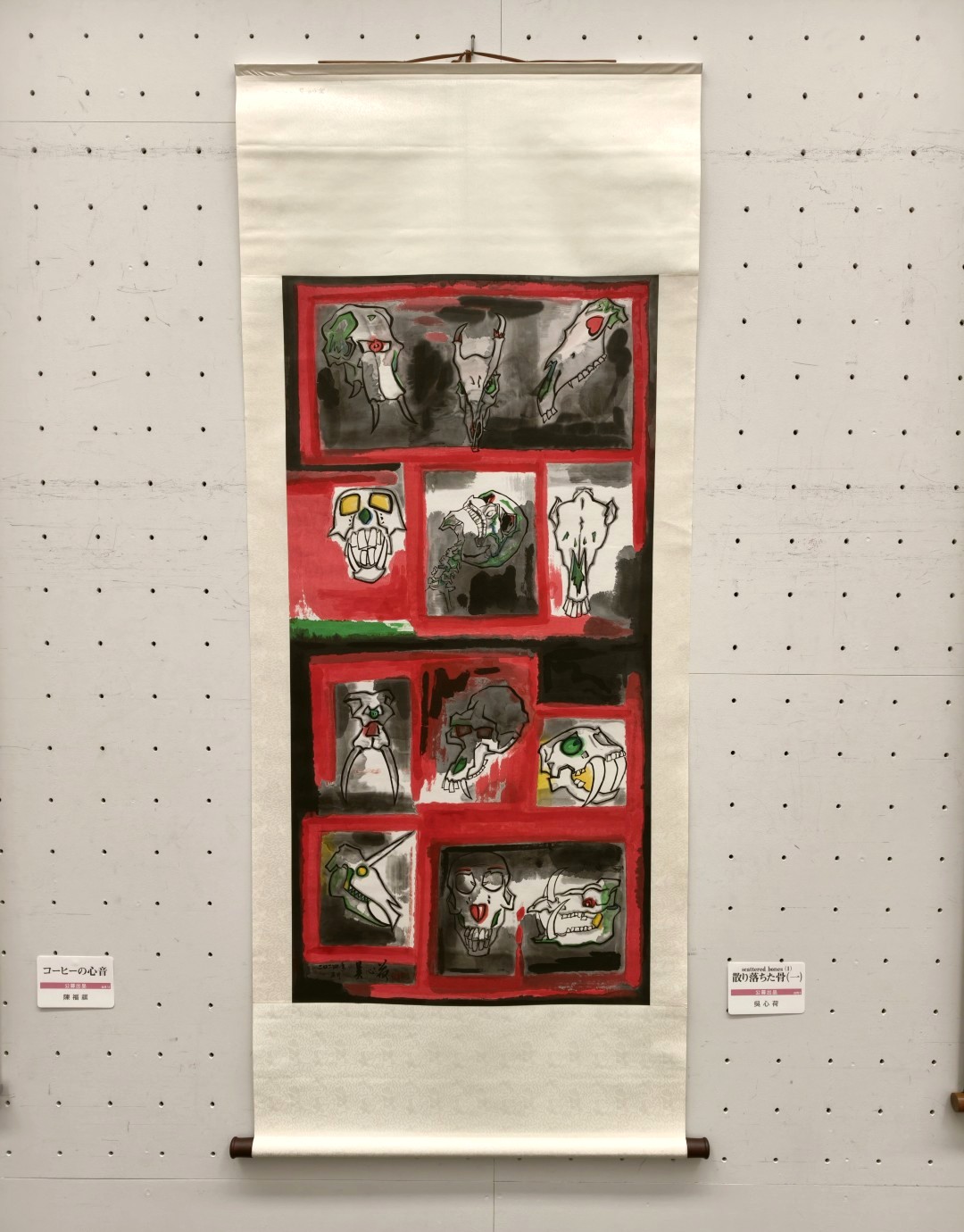
I have often felt that what makes people fear bones is not merely their closeness to death, nor only the fact that flesh has fallen away and their true form is laid bare, but rather that bones are too honest. Flesh can sometimes deceive; skin can be adorned; clothing can conceal; and language, more often than not, leads people away from themselves. Bones alone do not. Bone is a form of existence that permits no argument. It does not seek affection, nor does it flatter. Unlike flowers and plants, it does not make beauty through blooming; unlike tools, it cannot justify itself through function. It lies deep within the body, silent all day long. As long as it remains unseen, it goes unnoticed; but once it is exposed, it almost always signifies stripping-away, exposure, depletion—or at the very least, that what was once whole has lost the surface by which it could be smoothly accepted in everyday life. Thus when I first beheld Wu Xinhe’s Scattered Bones (I), what first arose in me was neither horror nor grotesquerie, but rather a feeling of being forced into honesty. It was as if all that once clung to living flesh—softness, warmth, blood color, expression—had withdrawn, leaving only a number of structures that could no longer pretend to be anything else, scattered across the paper, allowing me to look at them one by one, and to admit one by one: that existence, in the end, does not always present itself as a whole; more often, its skeletal truth is revealed only after fracture.
The title Scattered Bones (I) itself is telling. In my view, the word “scattered” is even more profound than “bones.” Bones may still be understood as structure, and may still retain something of order and support. But to be scattered is something else. Whatever is scattered has already lost its original place, its original state of being integrated, named, and absorbed into function. If the pages of a book are scattered, they may still be rebound; if the objects in a room are in disarray, they may still be tidied. But if bones are scattered, what they summon is not merely formal disorder; it is more like the condition in which something that once lived, something that once possessed wholeness, has now been dismantled into fragments and forced to meet the world again in partial form. This makes me think: is not human life itself much the same? We ordinarily take ourselves to be continuous, complete, coherent beings; yet after even slight setbacks, memory collisions, estrangements, or losses of speech, we begin to realize that such coherence is often only a useful fiction for daily living. In truth, a person is frequently held together by many misaligned parts. The self of yesterday and the self of today do not necessarily recognize one another, and the thoughts within us often conflict with one another. If we still appear to remain somehow “one,” it is only because some invisible habit continues provisionally to stitch together these scattered bones.
The composition of this painting demonstrates this with unusual clarity. The picture does not center upon a single skeleton. Instead, a number of beast-like or near-beastly skulls and bone structures are distributed within multiple red frames, as if each were stored in a compartment of a specimen cabinet, or in separate memory drawers, or like divided units of consciousness, each occupying its own narrow territory. Among them are horned forms, fanged forms, frontal skulls, profile skulls, and hybrid forms whose species cannot be clearly determined. They seem related, yet not entirely of the same species; they seem to emerge from natural anatomy, yet also from psychic deformation. This condition—at once familiar and estranging—greatly appeals to me. For those images that one can return to again and again are seldom those wholly unknown, nor those wholly legible, but those that stand at the threshold between the two: you know they come from a world you once understood, yet something within them has been twisted, and so you must look again. Wu Xinhe’s scattered bones belong precisely to this order. They evoke museums, specimen studies, mortal remains, natural-historical charts; yet they also recall those things in dreams that are strangely clear and yet impossible to verify—like truths remembered from memory, and at the same time formations of the subconscious.
What is especially worth discussing is the relationship between color and ink in this work. The phrase “colored ink on paper” here is not merely a statement of medium; it almost constitutes the work’s entire temperament. The overall image is grounded in gray, black, and white. The bones are largely outlined in white, while the ink remains moist, diffused, and heavy, forming a background that is at once like smoke, like sediment, and like residue. Most striking of all are the vivid red boundaries, along with certain local accents of green, yellow, and red. If we speak of the red alone, it plays a double role. On the one hand, it cuts the image into order, preventing the scattered bones from falling into total visual homelessness; on the other hand, it resembles wounds, warnings, blood traces, or the afterglow of danger, preventing these exposed bones from sinking into too cool a taxonomic gaze. This red is not decorative red, but the remainder of heat itself: as if life had already withdrawn, yet its violence, its trauma, its history once wrapped in flesh had not entirely dispersed. As for the green and yellow, they resemble the strange light on pathological slides, but also the doubleness of mildew, corrosion, toxicity, and growth. Thus the entire work is not simply an exhibition of death; rather, it becomes a visual zone where death and life, residue and mutation, composure and stimulation intertwine. I have never much believed that a purely deathly image could truly move anyone. If death is only death, then sooner or later it remains only a symbol. Only when death still carries traces of life, possibilities of change, some atmosphere not yet extinguished—only then can it approach the human heart. Scattered Bones (I) possesses exactly this quality. These bones are not entirely dry, nor entirely still. Within the fields of ink and colored marks, they seem still to hold some force that might reawaken under the act of being seen. Above all, their horned, toothed forms—bearing hints of animality and myth—make them more than corpselike remains; they become relics summoned from prehistory, from dreams, or from the deep strata of collective imagination. Thus I would rather say that this is not merely a work about death, but a work about how remnants continue to speak. A person dies, and bones remain; but the remaining of bone is not merely material persistence. Bone also carries a memory of form. “This was once a body”; “this once occupied a place in the world”; “this once had force, desire, movement, and the power to bite”—all these return wordlessly through these skeletal forms onto paper.
If we look more closely at the formal composition, what I especially admire is this almost collage-like, compartmentalized, even faintly comic-strip-like way of dividing the image. It prevents the act of viewing from taking in the whole at one sweep, and instead makes it a process of entering, identifying, and accumulating unease frame by frame. Each compartment is like a fragment, but also like a testimony. They do not combine into a single narrative; instead, they jointly construct an environment of already fragmented narration. This structure corresponds closely to the truth of contemporary memory. We seldom recall the world any longer in total form; more often we remember it through fragments: a face, a sentence, a detail as sharp as a tooth, a moment enclosed by bright color and impossible to forget. Thus the work not only “depicts” scattered bones; it enacts scattering at the level of form. Not only is the subject fragmented, but the mode of looking itself becomes fragmented. Such correspondence between subject and method seems to me a sign of rare maturity.
Yet if I were to say that the work concerns only death, specimens, and the scattering of memory, that would still be insufficient. For in my view, it carries another, darker layer: it concerns how human beings confront their own animality and cruelty. These skulls are not predominantly human skulls, but mostly beast-like, and many bear teeth, horns, biting force, piercing menace. This choice shifts the work away from simple mourning and into a more shadowed psychological field. One feels safer looking at animal bones than human bones, because fear may be projected outward. Yet what truly unsettles us is precisely the knowledge that we are not wholly separate from the beast. In this world, those instincts of tearing, devouring, competing, and surviving do not belong solely to the wild; they are deeply hidden beneath civilization as well. These bones thus resemble impulses stripped of flesh and surface, displayed before us so that, under the license of art, we are forced once again to look at those parts of ourselves we ordinarily refuse to acknowledge. They are the remains of the dead, but they also resemble the predatory drives, desires, and defensive postures that did not disappear even while alive. Thus what this work reveals may be not only that “we all become bone,” but that “we have never truly been far from bone”—never far from that hard structure which shapes us, and by which we wound one another.
As for my own disposition, I have always liked to draw the discussion of art back to the question of how one lives. For I do not believe that seeing can ever be entirely separated from existing. If a work cannot in any way illuminate the human condition, then however skillful it may be, it remains only craft. What makes me willing to linger over Wu Xinhe’s painting is precisely that it makes me think: in this life, perhaps what people fear is not only disappearance, but scattering before they disappear. Some are scattered in memory; some in relationships; some by the cuts of history; and some, even while the body still seems whole, are already inwardly falling apart. In such a case, bone becomes a strange symbol: at once the last thing left, and the first thing that supported us; a sign both of deprivation and of essence. When every surface has been stripped away, what remains? Perhaps not soul, not name, not honor or disgrace, but only a few joints that still barely indicate a shape. The answer is not comforting, yet it bears a kind of near-clean severity. And yet I would not wish to read this work too pessimistically. For wherever there are bones, there was once structure; and whatever can be scattered and yet remain recognizable still indicates that form has not been entirely destroyed. In other words, scattering is separation, but not necessarily nothingness. These bones, having been placed upon paper, framed in red boundaries, and once more endowed with ink and color, have thereby been summoned again into the order of visibility. What art does here may not be mourning, but arrangement; not resurrection, but the granting of place to what remains. This is among the most solemn and restrained functions of art: it cannot restore the dead to life, nor mend the broken back into wholeness, yet it can allow what has been scattered to be recognized again in another form. In this sense, Scattered Bones (I) achieves more than an image; it becomes a re-situation of what remains. It does not speak on behalf of bone, yet it gives bone a place to be seen. It does not beautify damage, yet it prevents damage from being discarded into namelessness.
If I may add one final remark, it is this: what makes the work unforgettable lies not only in its strangeness, nor entirely in its chromatic conflict, but in its successful transformation of bones on paper into something between specimen, dream image, and self-portrait. A self-portrait, after all, need not always depict a face. Sometimes the truest likeness of a person lies not in features, but in the fissures preserved, the images summoned, the remains one refuses to forget. If read this way, these scattered bones may be natural bones, but they may equally be bones of memory, bones of time, bones of trauma. Each occupies its own compartment, each disconnected from the others, yet all clearly belong to the same sheet—just as the interior of a person is often composed of many parts that cannot be seamlessly fitted together. The artist has refused to force them into a single intact corpse. This is precisely where her honesty lies. For what matters in art is not the fabrication of a pleasing whole for the world, but the courage to admit that fracture is itself one of the truths of contemporary experience.
Thus I would close with this sentence: Wu Xinhe’s Scattered Bones (I) does not merely display the traces of death; rather, through the collision of color and ink and the partitioning of framed spaces, it elevates “what remains” into a state of being that can be contemplated. It makes bone no longer simply an anatomical thing, but a medium through which memory and self, animality and civilization, trauma and structure repeatedly refract one another. Whoever stands before this painting will finally understand that scattering may not merely be loss; it may also be the moment when truth, stripped of disguise, is forced to appear. And bone, likewise, may not be only what remains after death; perhaps it has always been there, within us while we live, supporting us, reminding us that whatever cannot long be concealed by gentle words will in the end come forth into the world in a harder form.