散落之骨,與人之未能完全集成於自身
——觀 吳心荷〈散落骨骼(一)〉
撰文:王穆提(WANG MUTI)
人之所以懼怕骨,不只是因骨近死,也不只是因骨去肉而露其真形,乃是因骨太誠實。肉有時可以欺人,皮膚可以修飾,衣飾可以掩覆,言語更常常使人遠離自己;惟骨不能。骨是一種不容辯白的存在,它既不討喜,亦不逢迎,不像花木那樣以盛放為美,也不像器具那樣以用途自證,它在身體深處,終日沉默,平時既不為人看見,一旦顯露,便幾乎總意味著剝落、暴露、耗損,或至少意味著:那原本完整之物,已失去其可被日常順利接受的表面。故我初見吳心荷這件〈散落骨骼(一)〉,心中最先升起的,倒不是驚悚,也不是怪誕,而是一種近乎被迫誠實的感受;彷彿一切原本依附於活體之上的柔軟、溫熱、血色與表情,皆已退場,只留下若干不能再假裝成別物的結構,散置於畫紙之中,任我逐一觀看,任我逐一承認:原來存在最終並不總以整體示人,反常在碎裂後才顯出其骨相。
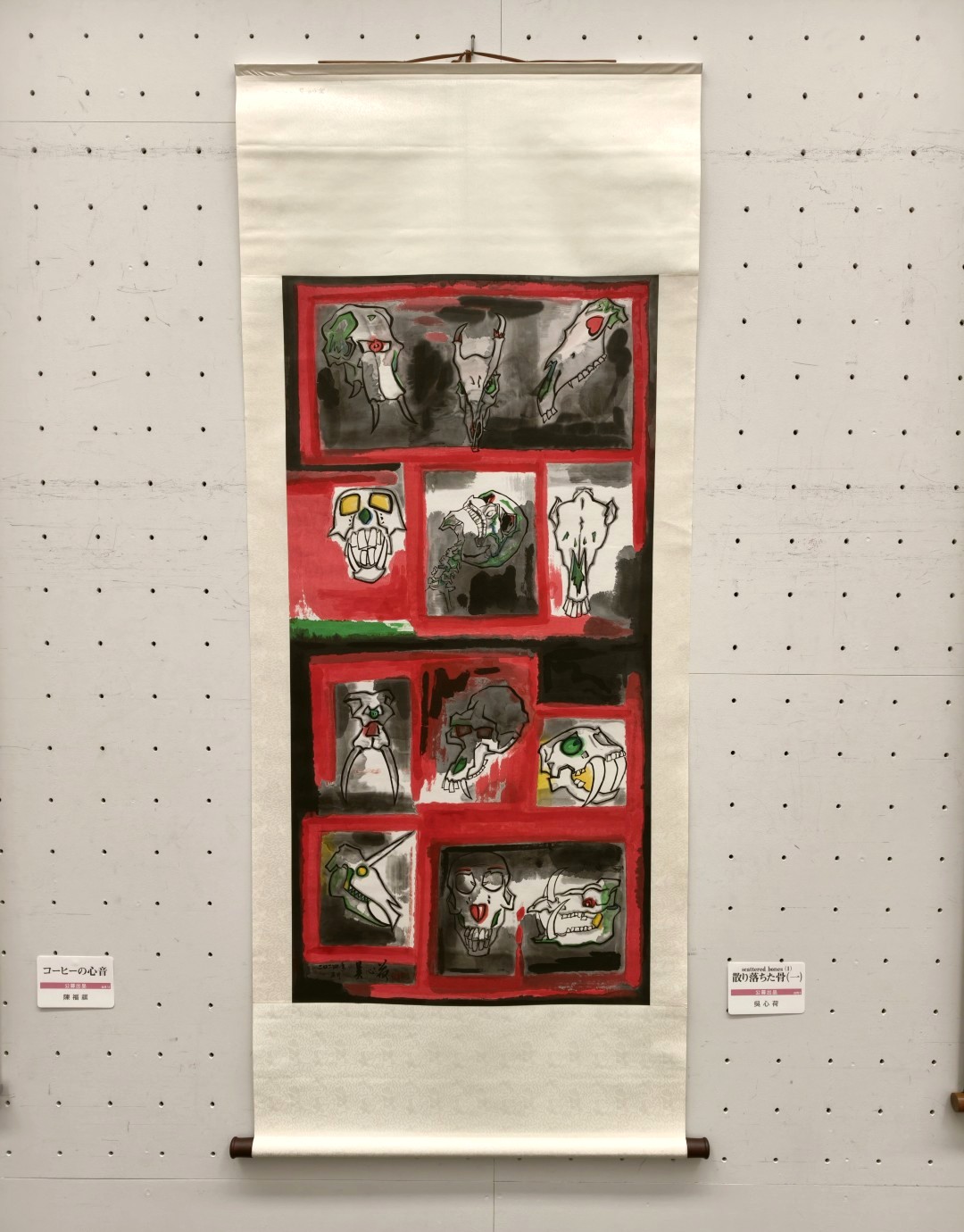
此作名為〈散落骨骼(一)〉,其「散落」二字,依我看來,比「骨骼」二字更有深意。因骨尚可被理解為結構,甚至仍保留一絲秩序與支撐之意;散落卻不同。凡散落者,皆已失其原位,失其原先被整合、被命名、被納入功能之狀態。一本書若散頁,尚可重訂;一室器物若散亂,尚可拾整;惟骨若散落,則其所召喚的並不單是一種形式上的凌亂,而更像是某種曾經活過、曾經有其整體性之存在,如今被拆解為殘片,被迫以局部之身與世界重新相遇。這便使我想到,人之一生,其實何嘗不是這樣?我們平日總以為自己是一個連續的、完整的、自圓其說的我,然而稍經挫敗、記憶衝撞、離散、失語,便知那所謂完整,多半只是方便生活的假設;實際上,人常常是由許多不相銜接的部分勉強組成,昨日之我與今日之我未必全能相認,心中諸念亦常彼此牴牾,而我們之所以看似仍能成其為一,不過因尚有某種看不見的習慣,把這些散落之骨暫時綴接起來罷了。
此畫之構成,正很能說明這一點。畫面並不以單一骨骸為核心,而是將若干獸形或近獸形的 skull 與骨構分置於多個紅框之內,彷彿一格一格的標本匣,一室一室的記憶櫃,又像一些被分割的意識單元,各自佔據自身那塊狹窄的領地。其上有長角者,有獠牙者,有似顱骨正面者,有偏側面骨相者,亦有近於未可明辨其類屬之混生形體。它們之間既互有近親之感,又不完全屬於同一物種;既像出自自然解剖,又像經由心象變形。這種既熟悉又陌異的狀態,甚合我意。因為真正使人久看不厭的圖像,往往不是全然陌生者,也不是全然可辨者,而是處在那一線之間:你知道它來自你曾經理解的世界,卻又在某處被扭轉了,所以不得不重新看它。吳心荷筆下這些散骨,便屬於此。它們既讓人想起博物館、標本學、死亡遺留、自然史圖譜,也讓人想到夢裡異常清楚卻又無法查證之物;像記憶中的真,也像潛意識的生成。 尤有可論者,是作品中色與墨之關係。所謂彩墨紙本,於此並非僅是媒材說明,而幾乎構成了作品的氣質本體。整體畫面以灰、黑、白為底,骨骼多以白色勾現,墨色則濕潤、暈散、沉著,形成一種既似煙塵、又似殘影的背景;而最強烈者,莫過於那些鮮紅的框界,以及若干局部的綠、黃、紅色點綴。若只論紅色,它在此畫中可謂兼具兩端:一方面,它是切割畫面的秩序,使散骨不致完全無所依歸;另一方面,它又像傷口、警示、血痕與危險的殘光,使這些本已脫肉而出的骨片不致落入過於冷靜的標本學觀看。這紅並非裝飾之紅,乃是一種熱度之餘跡;像是生命雖已退場,然其暴烈、其創傷、其曾經經血肉包裹的歷史,尚未完全散去。至於綠與黃,則有如病理切片中的異光,又如霉斑、腐蝕、毒性與生長的雙重象徵。於是整件作品便不單是一場死的陳列,反而是死與生、殘存與變異、冷靜與刺激彼此交纏的視覺地帶。
我向來不大相信純然死亡的圖像真的能打動人。死若只是死,久之便只剩象徵;惟當死亡仍然攜帶生命的痕、攜帶變化的可能、攜帶某種尚未結束的氣息時,它才會逼近人心。〈散落骨骼(一)〉正有此妙。這些骨並不完全乾燥,也不完全靜止,它們在墨色與彩痕之中,像尚留有某種被觀看時重新甦醒的力量。尤其那種帶角、帶齒、帶著某些獸性與神話感的輪廓,使它們不僅是屍餘,更像某種從史前、從夢中、從集體想像深處被喚出的遺蹟。故我寧願說,這不是一件單純關於死亡的作品,而是一件關於殘存如何繼續說話的作品。人死而骨存,然骨之存並非純粹物質上的留置,它亦攜帶著一種形之記憶。所謂「這曾是一具身體」,所謂「這曾在世界中佔有一個位置」,所謂「這曾有其力量、有其慾望、有其奔走與咬合」,都藉由這些骨相,無言地回返於紙上。
若再細看其形式,我尤喜歡這種近乎拼貼、像格櫃、甚至略帶漫畫分鏡感的分割法。因它使觀看不再是一口氣統攝全局,而成為逐格進入、逐格辨認、逐格累積不安的過程。每一格像一枚碎片,也像一種證詞;它們並不合而為一個敘事,卻共同構成一種已然碎裂的敘事環境。這種結構,恰如現代人記憶之真相。我們極少再以整體形式回想世界,多半是靠片段回想:一張臉、一句話、一枚牙齒般尖銳的細節、一個被鮮色框住而不能忘懷的瞬間。整件作品因此不僅「畫」了散骨,也在形式上實踐了散落;不僅主題是碎片,連觀看方法本身也是碎片。這種題與法之相應,我以為是一件作品難得的成熟。
不過,若我說此作只是關於死亡、標本與記憶的散落,仍似不足。因在我看來,它還有更深的一層,是關於人如何面對自身之獸性與殘酷的。這些顱骨並非人骨為主,而多近獸類,且多帶利齒、角、咬合、穿刺之勢。此一選擇,叫作品遠離了單純的哀悼,而走向更幽暗的心理地帶:人看獸骨,常比看人骨安全,因為可以將恐懼外置;然而真正讓人不安的,恰恰是我們明白自己並不全與獸相分。世界之中,那些撕裂、吞噬、競逐、生存的本能,並非只屬野地,也深藏於文明底下。於是這些骨骼便像某些被抽去皮相的衝動,被陳列出來,讓我們在藝術之名下重新觀看那平日不願承認的部分。它們既是死後殘餘,也像活著時未肯消失的掠奪、欲望與防禦姿態。故此畫所揭示的,也許不只是「終將成骨」,而是「我們從來未曾遠離骨」——未曾遠離那使我們成形、也使我們彼此傷害的硬質結構。
若依我之性情而言,我總喜歡把論藝術一事,牽回做人之事。因為我從不以為觀看與生存能截然分離;一件作品若全然不能照見人的處境,則再精巧亦只是手藝。吳心荷此畫之所以使我願久留心力,正在於它使我想到:人這一生,原來不止害怕消失,更害怕在消失之前已先散落。有人散落於記憶,有人散落於關係,有人散落於時代的切割,有人甚至在身體仍完整時,內裡早已分崩離析。這時候,骨便成了一種奇異的象徵:它既是最後所餘,也是最初支撐;既代表剝奪,也代表本體。當一切表面被拿走之後,剩下的是什麼?也許不是靈魂,不是名字,不是榮辱,而只是一些仍勉強指出形狀的骨節。這答案雖不悅耳,卻有一種近乎清潔的嚴酷。
然而我亦不願把這件作品讀得過分悲觀。因為凡有骨者,便表示曾有結構;凡能被散置而仍可辨識者,便表示其形尚未完全消滅。換言之,散落雖是分離,卻未必等於虛無。這些骨被畫於紙上,被框於紅界之中,被重新賦予墨色與彩點,也就等於被再度召喚進觀看的秩序裡。藝術在此所做的,也許不是哀悼,而是整理;不是復活,而是賦予殘餘以位置。這是藝術最莊嚴也最克制的功能之一:它無法使亡者返生,無法使碎裂復全,卻能使散落之物在另一種形式裡再次被承認。如此一來,〈散落骨骼(一)〉所完成的,便不只是一幅圖像,而是一種對殘存之物的再安置。它不替骨說話,卻讓骨有了被看見的場所;它不美化毀損,卻讓毀損不至於被棄置於無名之中。
我若還要再補一語,則是:此作最使人難忘者,並不單在其怪異,也不全在其色彩衝突,而在它成功地把紙上之骨畫成了某種介於標本、夢境與自畫像之間的東西。所謂自畫像,未必非得畫出眉目;有時一個人真正的內在樣貌,不在其容顏,而在其所保留的裂痕、所召喚的意象、所不願忘的遺留。若如此讀之,則這些散骨既可能是自然之骨,亦可能是記憶之骨、時間之骨、創傷之骨。它們各自占據一格,互不融通,卻又明明同屬一紙,正如一個人的內在常由許多不能整齊拼合的部分構成。畫家沒有把它們勉強合成一具完屍,這正是其誠實所在。因為真正重要的藝術,不是替世界編造一個好看的整體,而是有勇氣承認:碎裂,本身就是今日經驗的一種真相。
故我願以這樣一句話,為此篇作結:吳心荷之〈散落骨骼(一)〉,並非僅僅陳列死亡的形跡,而是在彩墨的衝撞與格框的分置之中,把「殘存」提升為一種可被凝視的存在狀態。它使骨不只是解剖學之物,而成為記憶與自我、獸性與文明、創傷與結構之間反覆折射的媒介。人看此畫,終將明白,所謂散落,未必只是失去,也可能是一種真相被迫解除偽裝後的顯現;而所謂骨,亦未必只是死後之物,它或許一直就在我們活著的內部,支撐我們,也提醒我們:凡不能被柔言長久掩蓋者,終究要以更硬的形狀,向世界現身。
其他相關內容:
【現場直擊】【台日交流展】東京都美術館開館100周年記念《第14回東京現展》展場:日本國立東京都美術館
台灣參展藝術家作品藝術評論
東京都美術館開館100周年記念【14回東京現展】廖純沂〈未盡・浮境〉未盡之物何以最能久留人心
東京都美術館開館100周年記念【14回東京現展】廖純沂〈游相〉花何以不止於花,與形相如何在漂游中成立
東京都美術館開館100周年記念【14回東京現展】廖純沂〈思域・沉靜〉沉靜何以不是空,與垂掛之物何以最像思念
東京都美術館開館100周年記念【14回東京現展】王詮富〈八月閑步一色秋〉的季節哲學、門徑意識與水墨的開敞性 在黑暗中閑步:秋色如何不是顏色,而是一種存在的轉身
東京都美術館開館100周年記念【14回東京現展】 王詮富〈一念菩提開翠微〉的開顯、同體、綿延與空性 一念未起,萬根已動
東京都美術館開館100周年記念【14回東京現展】蔡梅芳〈戀戀紫藤〉的痕跡、綿延與生成 花影之遲遲不散,與記憶如何在解構之後重返
東京都美術館開館100周年記念【14回東京現展】 王穆提《聖境・阿里山》蒼翠的紀念碑
東京都美術館開館100周年記念【14回東京現展】王穆提《中道之光》裂隙中的永恆
東京都美術館開館100周年記念【14回東京現展】吳心荷〈散落骨骼(一)〉散落之骨,與人之未能完全集成於自身
東京都美術館開館100周年記念【14回東京現展】陳福祺〈咖啡心音〉的存在寓言 沸點、晶化與心之熔爐
東京都美術館開館100周年記念【14回東京現展】張素蘭〈一棵開花的樹〉的場所哲學、過程生命與靜默中的新生
東京都美術館開館100周年記念【14回東京現展】吳亞倫〈藍與黑的交響詩(雙併)〉論藍何以不只為藍,黑何以不只為黑
東京都美術館開館100周年記念【14回東京現展】張碧鄉〈艷冠群芳〉的器物哲學、生成美學與過剩的顯現
東京都美術館開館100周年記念【14回東京現展】趙玉燕〈熾烈〉論火中的身體,與人何以不能只是自己
東京都美術館開館100周年記念【14回東京現展】許秀珠〈403地震後的太魯閣〉山川之裂,與人如何在震後重新學會自身的位置
東京都美術館開館100周年記念【14回東京現展】江麗香〈秋聲賦〉彩墨中的時間書寫 水痕與秋聲
東京都美術館開館100周年記念【14回東京現展】江麗香〈流轉的歲月〉水之無言,而歲月常藉其形以自見
東京都美術館開館100周年記念【14回東京現展】謝文倩〈驚夢〉的夢之碎片、感覺邏輯與夜的顯現
東京都美術館開館100周年記念【第14回東京現展】黃淑卿〈群鷗處處來(台灣澎湖)〉群鷗之所以來,與人終於學會不把世界全算作自己
東京都美術館開館100周年記念【14回東京現展】黃淑卿〈燕尾與戴勝(台灣金門)〉論屋脊、禽鳥與地方何以不只是地理
東京都美術館開館100周年記念【14回東京現展】謝正瑜〈蓮池映相〉的感知哲學與靈性空間
東京都美術館開館100周年記念【14回東京現展】周若梅〈流光之舞〉,光何以有身,與人如何在流動中暫時成形
On Scattered Bones, and the Human Inability to Fully Integrate Within the Self
— On Wu Xinhe’s Scattered Bones (I)
By WANG MUTI
I have often felt that what makes people fear bones is not merely their closeness to death, nor only the fact that flesh has fallen away and their true form is laid bare, but rather that bones are too honest. Flesh can sometimes deceive; skin can be adorned; clothing can conceal; and language, more often than not, leads people away from themselves. Bones alone do not. Bone is a form of existence that permits no argument. It does not seek affection, nor does it flatter. Unlike flowers and plants, it does not make beauty through blooming; unlike tools, it cannot justify itself through function. It lies deep within the body, silent all day long. As long as it remains unseen, it goes unnoticed; but once it is exposed, it almost always signifies stripping-away, exposure, depletion—or at the very least, that what was once whole has lost the surface by which it could be smoothly accepted in everyday life. Thus when I first beheld Wu Xinhe’s Scattered Bones (I), what first arose in me was neither horror nor grotesquerie, but rather a feeling of being forced into honesty. It was as if all that once clung to living flesh—softness, warmth, blood color, expression—had withdrawn, leaving only a number of structures that could no longer pretend to be anything else, scattered across the paper, allowing me to look at them one by one, and to admit one by one: that existence, in the end, does not always present itself as a whole; more often, its skeletal truth is revealed only after fracture.
The title Scattered Bones (I) itself is telling. In my view, the word “scattered” is even more profound than “bones.” Bones may still be understood as structure, and may still retain something of order and support. But to be scattered is something else. Whatever is scattered has already lost its original place, its original state of being integrated, named, and absorbed into function. If the pages of a book are scattered, they may still be rebound; if the objects in a room are in disarray, they may still be tidied. But if bones are scattered, what they summon is not merely formal disorder; it is more like the condition in which something that once lived, something that once possessed wholeness, has now been dismantled into fragments and forced to meet the world again in partial form. This makes me think: is not human life itself much the same? We ordinarily take ourselves to be continuous, complete, coherent beings; yet after even slight setbacks, memory collisions, estrangements, or losses of speech, we begin to realize that such coherence is often only a useful fiction for daily living. In truth, a person is frequently held together by many misaligned parts. The self of yesterday and the self of today do not necessarily recognize one another, and the thoughts within us often conflict with one another. If we still appear to remain somehow “one,” it is only because some invisible habit continues provisionally to stitch together these scattered bones.
The composition of this painting demonstrates this with unusual clarity. The picture does not center upon a single skeleton. Instead, a number of beast-like or near-beastly skulls and bone structures are distributed within multiple red frames, as if each were stored in a compartment of a specimen cabinet, or in separate memory drawers, or like divided units of consciousness, each occupying its own narrow territory. Among them are horned forms, fanged forms, frontal skulls, profile skulls, and hybrid forms whose species cannot be clearly determined. They seem related, yet not entirely of the same species; they seem to emerge from natural anatomy, yet also from psychic deformation. This condition—at once familiar and estranging—greatly appeals to me. For those images that one can return to again and again are seldom those wholly unknown, nor those wholly legible, but those that stand at the threshold between the two: you know they come from a world you once understood, yet something within them has been twisted, and so you must look again. Wu Xinhe’s scattered bones belong precisely to this order. They evoke museums, specimen studies, mortal remains, natural-historical charts; yet they also recall those things in dreams that are strangely clear and yet impossible to verify—like truths remembered from memory, and at the same time formations of the subconscious.
What is especially worth discussing is the relationship between color and ink in this work. The phrase “colored ink on paper” here is not merely a statement of medium; it almost constitutes the work’s entire temperament. The overall image is grounded in gray, black, and white. The bones are largely outlined in white, while the ink remains moist, diffused, and heavy, forming a background that is at once like smoke, like sediment, and like residue. Most striking of all are the vivid red boundaries, along with certain local accents of green, yellow, and red. If we speak of the red alone, it plays a double role. On the one hand, it cuts the image into order, preventing the scattered bones from falling into total visual homelessness; on the other hand, it resembles wounds, warnings, blood traces, or the afterglow of danger, preventing these exposed bones from sinking into too cool a taxonomic gaze. This red is not decorative red, but the remainder of heat itself: as if life had already withdrawn, yet its violence, its trauma, its history once wrapped in flesh had not entirely dispersed. As for the green and yellow, they resemble the strange light on pathological slides, but also the doubleness of mildew, corrosion, toxicity, and growth. Thus the entire work is not simply an exhibition of death; rather, it becomes a visual zone where death and life, residue and mutation, composure and stimulation intertwine. I have never much believed that a purely deathly image could truly move anyone. If death is only death, then sooner or later it remains only a symbol. Only when death still carries traces of life, possibilities of change, some atmosphere not yet extinguished—only then can it approach the human heart. Scattered Bones (I) possesses exactly this quality. These bones are not entirely dry, nor entirely still. Within the fields of ink and colored marks, they seem still to hold some force that might reawaken under the act of being seen. Above all, their horned, toothed forms—bearing hints of animality and myth—make them more than corpselike remains; they become relics summoned from prehistory, from dreams, or from the deep strata of collective imagination. Thus I would rather say that this is not merely a work about death, but a work about how remnants continue to speak. A person dies, and bones remain; but the remaining of bone is not merely material persistence. Bone also carries a memory of form. “This was once a body”; “this once occupied a place in the world”; “this once had force, desire, movement, and the power to bite”—all these return wordlessly through these skeletal forms onto paper.
If we look more closely at the formal composition, what I especially admire is this almost collage-like, compartmentalized, even faintly comic-strip-like way of dividing the image. It prevents the act of viewing from taking in the whole at one sweep, and instead makes it a process of entering, identifying, and accumulating unease frame by frame. Each compartment is like a fragment, but also like a testimony. They do not combine into a single narrative; instead, they jointly construct an environment of already fragmented narration. This structure corresponds closely to the truth of contemporary memory. We seldom recall the world any longer in total form; more often we remember it through fragments: a face, a sentence, a detail as sharp as a tooth, a moment enclosed by bright color and impossible to forget. Thus the work not only “depicts” scattered bones; it enacts scattering at the level of form. Not only is the subject fragmented, but the mode of looking itself becomes fragmented. Such correspondence between subject and method seems to me a sign of rare maturity.
Yet if I were to say that the work concerns only death, specimens, and the scattering of memory, that would still be insufficient. For in my view, it carries another, darker layer: it concerns how human beings confront their own animality and cruelty. These skulls are not predominantly human skulls, but mostly beast-like, and many bear teeth, horns, biting force, piercing menace. This choice shifts the work away from simple mourning and into a more shadowed psychological field. One feels safer looking at animal bones than human bones, because fear may be projected outward. Yet what truly unsettles us is precisely the knowledge that we are not wholly separate from the beast. In this world, those instincts of tearing, devouring, competing, and surviving do not belong solely to the wild; they are deeply hidden beneath civilization as well. These bones thus resemble impulses stripped of flesh and surface, displayed before us so that, under the license of art, we are forced once again to look at those parts of ourselves we ordinarily refuse to acknowledge. They are the remains of the dead, but they also resemble the predatory drives, desires, and defensive postures that did not disappear even while alive. Thus what this work reveals may be not only that “we all become bone,” but that “we have never truly been far from bone”—never far from that hard structure which shapes us, and by which we wound one another.
As for my own disposition, I have always liked to draw the discussion of art back to the question of how one lives. For I do not believe that seeing can ever be entirely separated from existing. If a work cannot in any way illuminate the human condition, then however skillful it may be, it remains only craft. What makes me willing to linger over Wu Xinhe’s painting is precisely that it makes me think: in this life, perhaps what people fear is not only disappearance, but scattering before they disappear. Some are scattered in memory; some in relationships; some by the cuts of history; and some, even while the body still seems whole, are already inwardly falling apart. In such a case, bone becomes a strange symbol: at once the last thing left, and the first thing that supported us; a sign both of deprivation and of essence. When every surface has been stripped away, what remains? Perhaps not soul, not name, not honor or disgrace, but only a few joints that still barely indicate a shape. The answer is not comforting, yet it bears a kind of near-clean severity. And yet I would not wish to read this work too pessimistically. For wherever there are bones, there was once structure; and whatever can be scattered and yet remain recognizable still indicates that form has not been entirely destroyed. In other words, scattering is separation, but not necessarily nothingness. These bones, having been placed upon paper, framed in red boundaries, and once more endowed with ink and color, have thereby been summoned again into the order of visibility. What art does here may not be mourning, but arrangement; not resurrection, but the granting of place to what remains. This is among the most solemn and restrained functions of art: it cannot restore the dead to life, nor mend the broken back into wholeness, yet it can allow what has been scattered to be recognized again in another form. In this sense, Scattered Bones (I) achieves more than an image; it becomes a re-situation of what remains. It does not speak on behalf of bone, yet it gives bone a place to be seen. It does not beautify damage, yet it prevents damage from being discarded into namelessness.
If I may add one final remark, it is this: what makes the work unforgettable lies not only in its strangeness, nor entirely in its chromatic conflict, but in its successful transformation of bones on paper into something between specimen, dream image, and self-portrait. A self-portrait, after all, need not always depict a face. Sometimes the truest likeness of a person lies not in features, but in the fissures preserved, the images summoned, the remains one refuses to forget. If read this way, these scattered bones may be natural bones, but they may equally be bones of memory, bones of time, bones of trauma. Each occupies its own compartment, each disconnected from the others, yet all clearly belong to the same sheet—just as the interior of a person is often composed of many parts that cannot be seamlessly fitted together. The artist has refused to force them into a single intact corpse. This is precisely where her honesty lies. For what matters in art is not the fabrication of a pleasing whole for the world, but the courage to admit that fracture is itself one of the truths of contemporary experience.
Thus I would close with this sentence: Wu Xinhe’s Scattered Bones (I) does not merely display the traces of death; rather, through the collision of color and ink and the partitioning of framed spaces, it elevates “what remains” into a state of being that can be contemplated. It makes bone no longer simply an anatomical thing, but a medium through which memory and self, animality and civilization, trauma and structure repeatedly refract one another. Whoever stands before this painting will finally understand that scattering may not merely be loss; it may also be the moment when truth, stripped of disguise, is forced to appear. And bone, likewise, may not be only what remains after death; perhaps it has always been there, within us while we live, supporting us, reminding us that whatever cannot long be concealed by gentle words will in the end come forth into the world in a harder form.
散らばる骨について、そして人が自分自身へ完全には統合されえないことについて
——吳心荷《散落骨骼(一)》を観る
文:王穆提(WANG MUTI)
私はよく思う。人が骨を恐れるのは、骨が死に近いからだけではなく、肉が剥がれ落ちて真の形を露わにするからだけでもなく、骨があまりにも誠実だからである。肉はときに人を欺き、皮膚は装い得るし、衣服は覆い隠し、言葉はしばしば人を自分自身から遠ざける。しかし骨だけはそうではない。骨とは、弁明を許さぬ存在である。それは人に媚びず、好かれようともせず、花木のように咲いて美を成すこともなく、器具のように用途によって自らを証明することもない。それは身体の深部にあり、終日沈黙している。ふだんは人の目に触れぬが、ひとたび露わになると、ほとんど必ず剥落、暴露、消耗、あるいは少なくとも——かつて完結していたものが、日常において円滑に受け入れられた表面を失ってしまったことを意味する。ゆえに、吳心荷の《散落骨骼(一)》を初めて見たとき、私の胸にまず湧いたのは、恐怖でも怪奇でもなく、むしろ一種の「強いられた誠実さ」に近い感覚であった。生きた身体に付随していた柔らかさ、温かさ、血の色、表情、そのすべてが退き、もはや他のものを装うことのできない構造だけが紙上に散らばっていて、私はそれらを一つずつ見、一つずつ認めざるをえなかった。存在とは、最終的に常に全体として姿を現すわけではなく、むしろ砕けた後にこそその骨相を示すことがあるのだ、と。
この作品の題名《散落骨骼(一)》において、私には「骨骼」よりも「散落」という二字のほうが、いっそう深い意味を持っているように思われる。骨はなお構造として理解可能であり、秩序や支えの意味をわずかに保っているかもしれない。だが散乱は異なる。散らばるものはすべて、本来の位置を失い、本来統合され、名づけられ、機能の中に組み込まれていた状態を失っている。本が頁を散らせば綴じ直すこともできようし、室内のものが散乱しても片づけられる。しかし骨が散らばるとき、それが喚起するのは単なる形式的混乱ではなく、かつて生き、かつて全体性を持っていた存在が、いまや残片へと解体され、部分的な姿のままであらためて世界と出会わされている、という感覚である。このことは私に、人の一生も実は似たようなものではないかと思わせる。私たちは普段、自分を連続的で、完結していて、首尾一貫した「私」だと考える。けれども、少しの挫折、記憶の衝突、離散、失語を経験するだけで、そのような完結性は多くの場合、生活を便宜的に成立させるための仮定にすぎないことがわかる。本当のところ、人はしばしばつながりきらない多くの部分によって辛うじて構成されている。昨日の自分と今日の自分は必ずしも互いを完全に認識せず、心中の諸念もまた互いに食い違う。なお何とか一つに見えているとすれば、それは目に見えないある習慣が、これら散らばった骨を仮に縫い合わせているにすぎない。
この絵の構成は、そのことを見事に物語っている。画面は単一の骸骨を中心に据えず、ある獣の形、あるいは獣に近い頭蓋骨と骨組みを、複数の赤い枠の中へと分置している。それはまるで標本箱の一区画ずつのようであり、記憶の引き出しの一室ずつのようでもあり、あるいは分割された意識の単位が、それぞれ狭い自分の領地を占めているかのようでもある。そこには角を持つもの、牙を持つもの、正面から見た頭蓋のようなもの、横顔の骨相を思わせるもの、さらには種別の判別しがたい異種混交の形まである。それらは互いに近縁の感触を持ちながら、完全に同一種ではなく、自然解剖の産物のようでもあり、心象の変形によって生じたもののようでもある。この「見覚えがあるのに異様である」という状態こそ、私のもっとも好むものである。真に見飽きぬ図像というのは、まったく未知のものでも、まったく既知のものでもなく、その狭間に立つものだからである。かつて自分が理解していた世界に由来することはわかる。だがどこかでねじれているので、もう一度見直さずにはいられない。吳心荷の描くこれらの散骨は、まさにそのようなものだ。博物館、標本学、死の遺留、自然史の図譜を思わせると同時に、夢の中で妙に鮮明でありながら確かめようのない何かをも想起させる。記憶の中の真実のようでもあり、潜在意識の生成のようでもある。
とりわけ論じるべきは、作品における色と墨の関係である。いわゆる「彩墨紙本」という言葉は、ここでは単なる媒体説明にとどまらず、ほとんど作品の気質そのものをなしている。全体の画面は灰、黒、白を基調とし、骨はおおむね白色で縁どられている。墨は湿りを帯び、滲み、沈着し、煙塵とも残像ともつかぬ背景を形づくる。その中でももっとも強烈なのは赤い枠線と、局所に置かれた緑・黄・赤の点景である。とりわけ赤は、この画面で二重の役割を果たしている。一方では画面を切り分ける秩序となって、散骨が完全に無縁のものとして漂うことを防ぐ。他方では、それは傷口、警告、血痕、危険の残光のようでもあり、肉を失った骨片があまりにも冷ややかな標本学的視線へ沈むことを防いでいる。この赤は装飾の赤ではなく、熱の名残である。生命はすでに退いていても、その激しさ、その外傷、そのかつて血肉に包まれていた歴史が、なお完全には散っていないことを思わせる。緑と黄もまた、病理標本の異様な光のようであり、黴、腐食、毒性と成長の二重の象徴のようでもある。ゆえに作品全体は、単なる死の展示ではなく、死と生、残存と変異、冷静と刺激とが絡み合う視覚領域となっている。
私は以前から、純粋に死だけを描いた図像が本当に人を打つとはあまり信じていない。死がただ死であるだけなら、やがては象徴しか残らぬからである。死がなお生の痕跡を携え、変化の可能性を携え、どこか未だ終わっていない気配を帯びているときにのみ、それは人の心へ迫る。《散落骨骼(一)》には、まさにその妙がある。これらの骨は完全に乾いてもいなければ、完全に停止してもいない。墨と彩痕のうちにあって、それらはなお、見つめられることによって再び目覚めうる何かの力を宿しているようである。とりわけ、角や歯を備え、ある種の獣性や神話性を帯びた輪郭は、それらを単なる死骸の残りではなく、太古から、夢から、あるいは集団的想像の深層から召喚された遺物のように感じさせる。ゆえに私は、これは単なる死についての作品ではなく、「残されたものがいかに語り続けるか」についての作品だと言いたい。人は死に、骨は残る。しかし骨の残留は、単なる物質の残存ではない。それは形の記憶をも帯びている。「これはかつて一つの身体であった」「これはかつて世界のある位置を占めていた」「これはかつて力を持ち、欲望を持ち、動き、噛みつくことすらできた」——そうしたすべてが、これらの骨相を通して紙上へと無言のまま回帰してくるのである。
さらに形式を細かく見れば、私はこの作品の、コラージュにも、区画棚にも、あるいはわずかに漫画的なコマ割りにも似た分割法をことのほか好む。これによって鑑賞は一息に全体を掌握する行為ではなく、ひと枠ずつ入り込み、ひと枠ずつ見分け、ひと枠ずつ不安を蓄積していく過程となる。各枠は破片でもあり、証言でもある。それらは一つの物語へ統合されないが、すでに砕けた物語環境を共同で構成している。この構造は、現代人の記憶の真実によく似ている。私たちはもはや世界を全体の形で思い出すことは少なく、多くは断片によって思い出す。一つの顔、一つの言葉、歯のように鋭い細部、鮮やかな色で縁どられた忘れがたい瞬間——。ゆえにこの作品は、散骨を「描いた」だけではなく、形式において散乱をも実践しているのである。主題が断片であるのみならず、見る方法そのものもまた断片なのだ。主題と方法がこれほど呼応していることは、作品の稀有な成熟だと私は思う。
しかし、この作品が死や標本、記憶の散乱についてのみ語るのだと言うだけでは、なお不足しているように思われる。私にはそれはさらに深い層、すなわち人が自らの獣性と残酷さとどう向き合うかという問題を抱えているように思える。これらの頭蓋は人骨よりも獣類に近く、牙、角、咬合、穿刺の勢いを備えたものが多い。こうした選択は作品を単純な哀悼から遠ざけ、より暗い心理の領域へ押しやっている。人は人骨を見るよりも獣骨を見る方がまだ安全に感じる。恐怖を外部化できるからである。だが本当に不安を生むのは、私たち自身が決して完全に獣と切り離されてはいないと知っていることなのだ。引き裂き、貪り、競争し、生存を求める本能は、野にのみ属するのではなく、文明の下にも深く潜んでいる。ゆえにこれらの骨は、皮相を剥がれた衝動のようであり、芸術という名のもとに、私たちがふだん認めたがらない部分を改めて見つめ直させる。それらは死後の残余であると同時に、生のあいだにも消えることのなかった捕食、欲望、防御の姿勢のようでもある。したがってこの絵が明らかにするのは、単に「やがて皆骨になる」ということだけではなく、「私たちはそもそも骨から遠く離れたことなど一度もない」ということなのかもしれない——私たちをかたちづくり、また私たちが互いを傷つけるための硬質な構造から、私たちは決して遠くなかったのである。
私の性情から言えば、私はつねに芸術の話を生き方の話へ引き戻したくなる。見ることと生きることとが截然と分かれるとは、私はどうしても思えないからだ。どれほど技巧に優れた作品であれ、人間の境遇を少しも照らし返さぬなら、それは結局ただの手技にすぎない。この作品が私に長く立ち止まることを促すのは、そこに一つのことを考えさせられるからである。人は一生のあいだ、単に消えることだけを恐れているのではなく、消える前にすでに散ってしまうことをむしろ恐れているのではないか、と。記憶の中で散る者もあれば、関係の中で散る者もあり、時代の切断の中で散る者もいる。身体がなお完のように見えていても、内側ではすでに崩れはじめている者もいる。そのとき骨は奇妙な象徴となる。それは最後に残るものであると同時に、最初に支えていたものでもある。剥奪を表す一方、本体でもある。あらゆる表面が取り去られたあと、何が残るのか。魂でもなく、名でもなく、名誉や屈辱でもなく、ただなお辛うじて形を指し示す骨節だけなのかもしれない。この答えは心地よいものではない。だがそこには、ほとんど清潔と呼ぶべき厳しさがある。
とはいえ、私はこの作品をあまりに悲観的に読みたくはない。骨があるということは、かつて構造があったということだし、散らばってなお識別できるということは、その形がまだ完全には消えていないことを意味するからである。言い換えれば、散乱は分離ではあるが、必ずしも虚無ではない。これらの骨は紙に描かれ、赤い枠によって区切られ、墨と彩点を与えられることによって、再び見ることの秩序へ呼び戻されている。ここで芸術がなしていることは、哀悼というよりも整理であり、復活というよりも残余に場所を与えることなのかもしれない。これは芸術の最も荘厳で、また最も抑制された機能の一つである。芸術は死者を生き返らせることはできず、砕けたものを元通りに戻すこともできない。だが、散らばったものを別の形式において再び「承認されるもの」にすることはできるのである。そうであるなら、《散落骨骼(一)》が成し遂げているのは単なる図像ではなく、残ってしまったものの再配置なのである。骨の代わりに骨を語ることはしないが、骨に「見られる場所」を与える。損壊を美化することはしないが、損壊が名もなく棄て去られぬようにするのである。
なお一言付け加えるなら、この作品をもっとも忘れがたいものにしているのは、その怪異性だけでもなければ、色の衝突だけでもない。それは、紙上の骨を、標本と夢像と自画像との中間にある何かへ変えてしまったことにある。自画像といっても、必ずしも顔を描く必要はない。人のほんとうの内的な相貌は、容貌ではなく、自分のうちに残してしまった裂け目、呼び寄せてしまうイメージ、忘れたくない遺留にあることも多い。そう読むなら、これらの散骨は自然の骨であるかもしれず、同時に記憶の骨、時間の骨、トラウマの骨でもありうる。それぞれが一つの枠を占め、互いに融け合わず、しかも明らかに同じ一枚の紙に属している。そのあり方は、一人の人間の内部が、整然と継ぎ合わぬ多くの部分から成り立っていることによく似ている。画家はそれらを無理に一体の完全な死体へまとめようとはしない。その誠実さこそが重要なのである。真に重要な芸術とは、世界のために見栄えの良い全体を捏造することではなく、破砕そのものが今日の経験の一つの真実であることを認める勇気を持つことだからである。
ゆえに私は、この一文をもって本稿を結びたい。 吳心荷の《散落骨骼(一)》は、単に死の痕跡を陳列しているのではない。彩墨の衝突と枠の分置を通して、「残存」を凝視可能な存在状態へと高めているのである。それは骨を単なる解剖学上の対象にとどめず、記憶と自己、獣性と文明、外傷と構造とのあいだで幾度も屈折しあう媒介へと変える。この絵を見る者は、やがて知ることになるだろう。散乱とは、単なる喪失ではないかもしれない。それは、真実が仮面を剥がされて露呈する瞬間でもありうる。そして骨とは、死後に残るものだけではないのかもしれない。それはおそらく、私たちが生きているあいだもずっと内部にあり、私たちを支え、また思い出させているのである——柔らかな言葉では長く覆い隠しえぬものは、結局いつか、より硬い形をとって世界の前に現れざるをえないのだ、と。