Why the Unfinished Lingers Longest in the Heart
—Liao Chun-Yi’s Unexhausted · Floating Realm
By: WANG MUTI
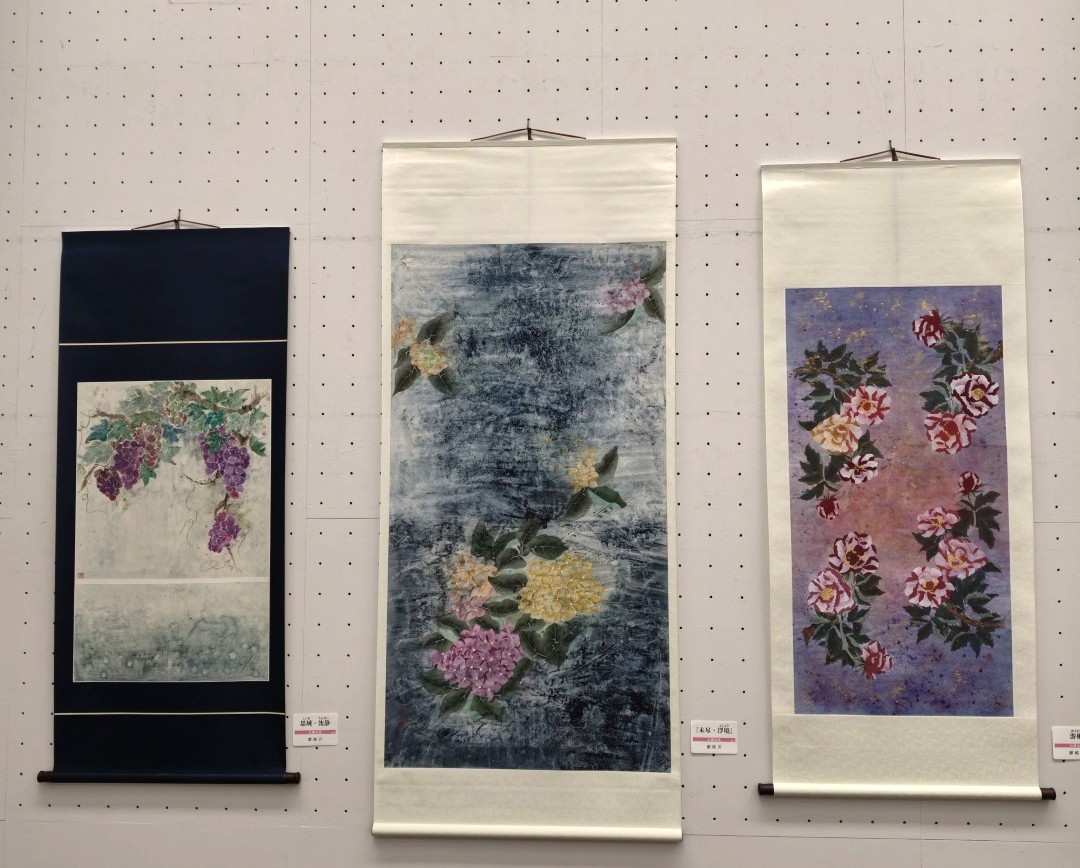
I often feel that humans are not particularly adept at facing completed things. Things that are too perfect often only elicit momentary admiration; conversely, it is those things with slight traces of damage, slight fading, the unsaid, the unsealed, and the unsettled that manage to remain in the heart long after they are gone. It is like a dampness that refuses to fully recede, like weather without a conclusion that deliberately refuses to end. Therefore, whenever I see truly enduring works of art, it is never because they explain the world with absolute clarity, but because they retain parts that cannot be speed-read, possessed, or immediately exhausted, allowing the viewer to walk deeper into them. Liao Chun-Yi’s Unexhausted · Floating Realm, in my eyes, is exactly such a painting. It does not speak loudly, does not show off technique, nor does it deliberately paint flowers realistically; yet, the more one looks, the more one feels that what it truly addresses is not flowers, but how flowers are gently held up in a world that is not yet complete.
The scale of the painting is large enough that when standing before it, one is not "looking at a floral painting," but rather feels slowly enveloped by an atmosphere somewhere between fog, water, old walls, clouds, and film scratches. Layers of grayish-blue, silver-white, dark ink, and washed traces form an extremely humid base on the sized Xuan paper. This base is neither a mere background nor a recognizable scene in nature, but more like a time that has not yet completely dried. Upon it, several clusters of softly colored yet decisively present flowers—pinkish-purple, pale peach, cream, and warm yellow—accompanied by grayish-green leaves, emerge ambiguously along the central axis and diagonal directions of the canvas. They do not seem firmly pinned to a specific plant branch, nor do they appear to grow steadily from the earth; rather, they seem temporarily anchored in an uncongealed space, held by a force slightly lighter than reality and slightly heavier than a dream. This sensation of "not fully landing" is the primary reason this work is so unforgettable.
I believe the word "Unexhausted" (未盡) in the title strikes the root of the work even before "Floating Realm" (浮境). To float is merely a state; to be unexhausted is a destiny. Floating can mean being light, drifting, suspending, or lingering in between; but being unexhausted implies much more: it implies the matter is not over, time has not been sealed, emotions have not entirely settled, and memory retains the capacity to return. This "unexhausted" nature, in my view, is not a flaw, but akin to a high level of self-restraint. Mediocre works in this world often fear the viewer will not understand, so they tell everything; mature works know that what truly remains in the heart is never the part that is fully spoken, but the meaning beyond words, the spirit beyond ink, the realm beyond form. Liao Chun-Yi understands this profoundly, which is why she does not paint flowers that belong entirely to the present, nor does she paint a background that provides a recognizable, definite space; she lets everything pause in a state between becoming and un-becoming, fading and un-fading, clear and unclear. This is not ambiguity, but an honest refusal of premature closure.
If I were to seek a philosophical thread for this feeling, I would think of Kitaro Nishida. The "Basho" (place/locus) Nishida speaks of is never a geographical location, but a deeper field that allows things to appear, encounter, and permeate each other without swallowing one another. Viewing Unexhausted · Floating Realm through this lens, one understands: the grayish-blue ink field in the painting is not the background of the flowers, but the locus where the flowers can manifest. It is not a blank space, nor a decorative foil, but a deep interface capable of bearing the emergence of flowers, the lingering of traces, and the adhesion of time. The reason the flowers are moving is not just because of their soft, beautiful colors, but because they slowly grow out of such a locus; they do not exist alone, but are permitted to exist by the locus. Thus, the flower and the background are no longer in a subject-object relationship, but in a mutually fulfilling co-presence: the flower makes the locus perceptible, and the locus gives the flower weight.
If Nishida helps me see the locus that establishes this work, Walter Benjamin makes me feel more clearly why it carries an unspeakable temporal aura. When Benjamin speaks of "Aura", he does not mean a mystical halo, but a mode of presence imbued with distance and diachronicity: an object is often moving not when it is clearly seen through, but when it retains a part that cannot be immediately exhausted. The flowers in Liao Chun-Yi's painting possess exactly this quality. They are not flowers so vibrant they are eager to please, nor are they specimen-like flowers awaiting identification; rather, they are flowers that emerge through a thin veil of mist, a period of time, a certain memory, and dampness. The softened edges of the petals, the light halation of the color layers, and the repeated washing and friction marks left on the background all imbue the overall image with a texture of "having experienced something." This texture is crucial, as it makes the flowers belong not just to the present, but seem to be present alongside the past. Therefore, "unexhausted" is not merely unfinished; it is more like time has not yet completely taken them away.
Taking a step further, I would even say that the reason this work is so moving is that it does not paint flowers, but the ethics of manifestation itself. Today, when people view things, they are often too anxious, wanting to immediately know "what is that," "what is this flower called," "how is this composition arranged," or "what does this background symbolize." But some paintings deliberately refuse to give you answers so easily; they demand that you slow down and allow everything to be perceived while remaining in incomplete certainty. Here I am reminded of Maurice Merleau-Ponty. Merleau-Ponty taught us that visibility is never an object being clearly laid out, but something slowly stepping into the visible from the depths of the invisible. The flowers in Unexhausted · Floating Realm are exactly like this: they are not forcefully placed at the forefront of the painting, but seem to float up little by little from the grayish-blue damp field, neither domineering nor retreating. The viewer's true task is not to identify, but to receive—to receive how these flowers slowly arrive before the eyes, and to receive how they still maintain a distance that is not entirely captured. Because of this, viewing this work is not a "possessive" act, but closer to a passive reception of manifestation. This is its brilliance.
Read through Gaston Bachelard's material imagination, this work reveals even more of its wonder. Bachelard said that the poetic nature of certain images lies not in the story they tell, but in how they awaken an ancient physical sensation of a certain material state within us. The strongest material sensation in Unexhausted · Floating Realm is "wetness." The wetness here is not just technical watermarks, but a wetness of the entire sensorium: the ink is not dry, the memory is not dry, the color is not dry, the time is not dry. The layered interactions of sized Xuan paper, ink, mineral pigments, and mixed media make the surface uneven, alive, and un-rigid, as if it is still breathing. Therefore, the flowers are not dryly attached to the canvas, but seem to dwell in a climate that is still flowing. Were Bachelard here, he would probably say: these are not botanical flowers, but flowers of the wet imagination. They belong to clouds, fog, memory, and flowing water—things that refuse to fully solidify. Thus, the "Floating Realm" is no longer just a visual effect, but a worldview: the world is not a solid plane, but a liquid interface that still allows things to float, traces to remain, and colors to speak slowly in low voices.
However, if it were only this, the work would not be enough to make one linger for so long. What truly makes me look back again and again is that it possesses a sense of potentiality akin to Giorgio Agamben. When Agamben speaks of potentiality, he always reminds us: true potentiality is not just what has already been completed, but retaining the capacity to be "not yet exhausted," "not yet terminated." Being unfinished is not necessarily a defect; sometimes, it is a higher state of life. The beauty of Unexhausted · Floating Realm comes from this potentiality. If the flowers were painted too fully, too solidly, too stably, they would lose their breath; if the background were treated too explicitly, too enclosed, that floating sensation would immediately die. Liao Chun-Yi knows how to stop at exactly the right place: the flowers have appeared, yet there is still room to maneuver; the background is formed, yet leaves gaps; the manifestation has occurred, but it has not fully concluded itself. This gives the entire work an extremely rare temperament: it is not a conclusion, but an ongoing state. The reason viewers are willing to stay is precisely because the work has not spoken its final word to death—it still holds a breath, a layer of fog, a short, undried edge, making you feel that these flowers could float once more, recede once more, manifest once more.
I am even willing to read a deep allegory of emotion from this painting. Because the things that truly matter rarely remain in our hearts in a "completed" form; they mostly exist in an unexhausted state. We remember someone not because we fully possessed them, but because a certain sentence remains unsaid; we long for a period of time not because it was perfect, but because in memory, it always carries a bit of dampness, a bit of fog, a bit of light that refuses to be sealed away. Thus, the flowers are no longer just flowers. They become something that is still ongoing: like an idea not yet shaped, an emotion not yet settled, an inner scene that always floats up again in the dead of night. Therefore, everything in the painting belongs not only to nature, but also to the heart. Just like those clusters of pinkish-purple and warm yellow flowers, they are not only placed on the canvas, but also seem placed in a time of "not having had the chance to say goodbye."
So, when I look at Unexhausted · Floating Realm, ultimately I do not just see a few flowers, but I see how existence itself is most moving when it is not yet finished. People often think completion is beauty, perfection is beauty, wholeness is beauty; yet this work seems to quietly say that truly profound beauty often resides in those things that have not been fully sealed. The reason the flower is beautiful is not only because it blooms, but also because it carries an air of being about to scatter yet not scattering, about to sink yet not sinking, about to fade yet not fading. Precisely because it is unexhausted, it is not merely an image, but gains a soul; precisely because it floats, it is not merely an object, but becomes a realm.
If I were to sum up this piece in a single sentence, I would say:
What Liao Chun-Yi’s Unexhausted · Floating Realm paints is not flowers floating on a background, but the world itself, still unfinished, gently holding the flowers up.
Summary
Liao Chun-Yi's Unexhausted · Floating Realm shapes a deep field possessing wetness, a floating sensation, and the remnants of time, using sized Xuan paper, ink, mineral, and composite pigments. The grayish-blue ink field in the painting is not a background for the flowers, but closer to what Kitaro Nishida called a "basho" (locus) that bears manifestation; the clusters of flowers seem to slowly float up from an undried time, making "unexhausted" no longer a regret of incompletion, but a presence that retains its aura in the Benjaminian sense. Viewed through Gaston Bachelard's material imagination, the most fascinating aspect of the work is its overall wetness and floating sensation, placing the flowers not in a hard reality, but as temporary dwellers of fog, memory, and a flowing world. Overall, what Unexhausted · Floating Realm touches upon is not just the manifestation of flowers, but how existence continues to maintain breath and luminosity within the unfinished.