裂隙中的永恆:評王穆提《中道之光》
摘要
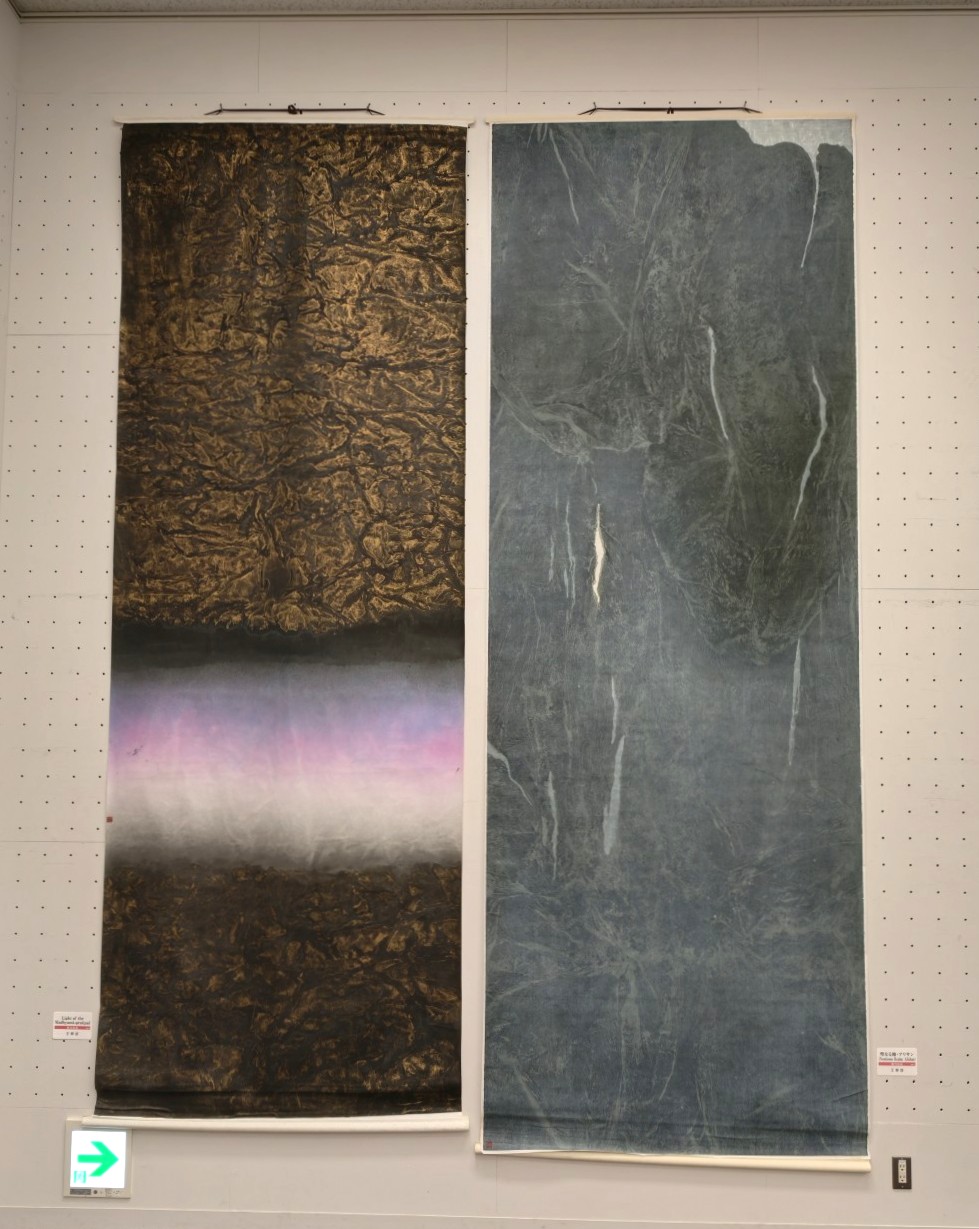
王穆提的《中道之光》是一件具有紀念碑式(Monumental)氣魄的當代水墨裝置繪畫。藝術家在近四米高的宣紙上,運用水墨、壓克力顏料與金屬色,構建了一個三段式的宏大結構。上下兩端是沈重、粗糲且帶有金屬光澤的物質積累,中間則是一道橫亙的、帶有紫羅蘭色調的光暈裂隙。作品標題直指佛教哲學中的「中道」(Madhyamaka),試圖在「空」與「有」、「斷」與「常」的二元對立中,尋找一種超越性的視覺平衡。本文將探討該作如何透過材質的肌理堆疊、色彩的象徵對話,以及對傳統卷軸形式的當代轉化,重新詮釋東方哲學中的宇宙觀。
作品名稱:《中道之光》
作品規格:寬度 138 x長度 390 cm
媒材:宣紙、水墨、壓克力顏料
年代:2025/12
垂直的崇高——尺度與空間現象學
《中道之光》首先以其驚人的物理尺度向觀者施壓。寬138公分、長390公分的垂直體量,超越了普通室內懸掛的範疇,使其具有了建築般的支撐感。
通天接地的軸線
在傳統中國山水畫中,立軸通常用於表現高遠或深遠的意境,引導視線做上下的游移。然而,王穆提將這一形式推向了極致。390公分的高度意味著作品幾乎連通了地面與天頂。觀者站在作品前,無法一眼覽盡全貌,必須仰頭凝視或低頭沉思。
這種觀看方式打破了西方透視法的「窗框」概念,轉而創造了一種「在場」(Presence)的體驗。作品如同一根巨大的圖騰柱或一塊太古的石碑,矗立在空間之中。上下兩端深沈的色塊彷彿是天與地的重壓,而中間的光帶則是人類視線唯一能夠棲息的水平線。這種垂直向度的拉伸,在心理上製造了一種神聖的肅穆感,迫使觀者進入一種宗教般的凝視。
空間的壓縮與釋放
構圖上,藝術家採用了極為大膽的「三明治」式結構:上下佔據絕大篇幅的深色塊面,擠壓著中間那一抹狹長的光暈。這是一種關於「壓力」的視覺實驗。沈重的物質(上下部分)似乎隨時要合攏,將中間的虛空吞噬;而中間的光帶卻以柔和而堅韌的力量,撐開了這兩塊巨石,維持著微妙的平衡。這種空間上的張力,直接映射了「中道」哲學中對於極端對立的調和。
肌理的沈積——金與墨的物質鍊金術
在材質語言上,《中道之光》展現了王穆提對於宣紙特性的深刻理解與顛覆性運用。他不再滿足於水墨的滲透與平整,而是追求一種浮雕般的「觸感」。
褶皺與時間的化石
觀察畫面上下兩端的深色區域,我們可以看到佈滿了不規則的、龜裂般的紋理。這顯然不是傳統毛筆的描繪,而是透過揉紙、堆疊顏料或拓印技法所形成的物理痕跡。
宣紙在這裡不再是承載筆墨的平面,它變成了具有體積感的「皮膚」。這些褶皺如同大地經過造山運動後的岩層,又像是歷經歲月風化的樹皮。黑色的水墨與壓克力顏料滲入紙張纖維的深處,形成了堅實的基底;而金色的顏料則掃過凸起的脊線,提亮了肌理的層次。這種處理方式讓畫面產生了金屬鑄造般的厚重感,彷彿這些紋理是時間的化石,記錄著物質生成的過程。
金色的神性與俗世
金色在藝術史上有著雙重隱喻:它既是佛教藝術中神聖的光輝(如佛像金身),也是世俗財富與權力的象徵。在《中道之光》中,王穆提將金色破碎化、斑駁化。這些金色的碎片散落在黑色的岩層中,不再是完整的榮光,而像是被埋藏的礦脈,或是文明廢墟中的餘燼。
這種「黑中透金」的處理,賦予了物質一種神秘的內在光澤。它暗示著即使在最沈重、最黑暗的物質世界(由黑色代表)中,也蘊藏著覺悟的種子(由金色代表)。這是一種「入世」的修行隱喻——真理不在彼岸,而在塵世的磨礪之中。
光譜的臨界——紫羅蘭色的形而上學
如果說上下兩端代表了沈重的「物質界」,那麼畫面中央那道橫亙的光帶,則代表了靈動的「精神界」。這是全作的靈魂所在,也是「中道之光」的具象化。
紫色的精神頻率
中間的色彩過渡極為迷人:從深沈的黑色邊緣,過渡到神秘的紫羅蘭色(Violet),再漸變為純淨的白與灰藍。紫色在色彩心理學中是波長最短的可見光,常與精神性、潛意識、冥想以及轉化相關聯。
這道紫光不像上下的金色那樣具有金屬的硬度,它是霧狀的、氣態的。它運用了壓克力顏料的噴繪或暈染技法,創造出一種發光體(Luminescence)的效果。這不是反射光,而是自發光。它像是一道切開混沌的激光,又像是黎明前地平線上的第一縷曙光。
虛實的邊界
這道光帶的邊緣處理非常微妙。它沒有生硬的界線,而是與上下的黑色肌理相互滲透。黑色的岩石邊緣侵蝕著光,而光也反過來消融著岩石。這種模糊的邊界暗示了「中道」並非絕對的劃分,而是一種動態的過渡。
在視覺上,這層紫白色的光暈提供了一個「呼吸孔」。在390公分的巨大壓迫感下,觀者的視線會本能地尋找出口,而這道光帶就是那個出口。它讓沈重的畫面瞬間獲得了昇華,將物理的重量轉化為精神的輕盈。
哲學的互文——中道與二元論的超越
標題《中道之光》(Light of the Middle Way)明確地將這件作品置於東方哲學的語境中。
離兩邊而行中道
在龍樹菩薩的《中論》中,中道旨在破除「有」與「無」、「生」與「滅」的執著。在王穆提的畫中,上下兩端巨大的黑色塊面可以被解讀為「兩邊」(Duality)——或許是生與死,或許是過去與未來,或許是物質與慾望。
這些「兩邊」是沈重的、固化的、充滿糾葛的(透過複雜的金色肌理表現)。而中間的光,則是「中道」。它不是兩者的平均值,而是兩者之間的「空隙」。正如老子所言「知其白,守其黑」,藝術家在黑色的包圍中守住了那一抹白。這道光是不偏不倚的覺知,它存在於矛盾的縫隙中,既不落入虛無,也不執著於實有。
裂隙作為啟示
海德格爾(Heidegger)曾論及「真理的敞開」(Aletheia)。《中道之光》中的這道橫向裂隙,正是一種「敞開」。它像是在堅固的現實牆壁上撕開了一道口子,讓真理之光得以透射進來。
這暗示了現代人的生存狀態:我們被夾在巨大的社會機制、物質慾望與歷史重負之間(上下的黑金岩層),感到窒息與壓抑。而心靈的自由(中道之光),往往就存在於那些稍縱即逝的縫隙與當下之中。
藝術史的坐標——抽象與崇高的對話
王穆提的《中道之光》雖然使用了宣紙與水墨,但在形式語言上與西方抽象藝術有著深刻的對話。
羅斯科的色域與紐曼的拉鍊
中間那道光帶,讓人聯想到巴尼特·紐曼(Barnett Newman)的「拉鍊」(Zip)——那條貫穿畫面的垂直線,象徵著創世的時刻。只不過王穆提將其旋轉為水平,並賦予了它東方的暈染氣質。同時,上下大面積的色塊與中間的微光,也呼應了馬克·羅斯科(Mark Rothko)對於悲劇性與崇高感的色彩探索。王穆提用東方的媒材,回應了西方抽象表現主義中對於精神性的追求。
當代水墨的物質轉向
在當代水墨的脈絡中,王穆提屬於「物質派」的探索者。他不再糾結於筆墨的傳統程式(如皴擦點染),而是直接利用紙、墨、色的物理屬性來造境。他將水墨從「書寫」解放為「塑造」,從「平面」推向「浮雕」。這種轉向使得水墨藝術能夠介入當代關於物質、環境與生存空間的討論。
在重力與恩典之間
總結而言,王穆提的《中道之光》是一件融合了物質奇觀與精神深度的傑作。
這幅390公分的巨構,如同一座懸浮在虛空中的精神紀念碑。藝術家通過對宣紙肌理的極致挖掘,以及金、黑、紫三種色彩的象徵性運用,成功地將抽象的哲學概念轉化為具體的視覺震撼。
畫面上下那沈重的、鍍金的黑色岩層,象徵著我們無法逃避的現實重負與歷史積澱;而中間那道紫羅蘭色的光暈,則是靈魂得以棲息的聖所。王穆提透過這件作品告訴我們:「中道」並非遠離塵世的逃避,而是在沈重的物質世界夾縫中,頑強撐開的一片精神淨土。
面對《中道之光》,我們不僅是在觀看一幅畫,而是在經歷一次從壓抑到釋放、從沈重到輕盈的升華過程。這是一道劃破長夜的閃電,也是一條通往內在寧靜的水平線。
其他相關內容:
【現場直擊】【台日交流展】東京都美術館開館100周年記念《第14回東京現展》展場:日本國立東京都美術館
台灣參展藝術家作品藝術評論
東京都美術館開館100周年記念【14回東京現展】廖純沂〈未盡・浮境〉未盡之物何以最能久留人心
東京都美術館開館100周年記念【14回東京現展】廖純沂〈游相〉花何以不止於花,與形相如何在漂游中成立
東京都美術館開館100周年記念【14回東京現展】廖純沂〈思域・沉靜〉沉靜何以不是空,與垂掛之物何以最像思念
東京都美術館開館100周年記念【14回東京現展】王詮富〈八月閑步一色秋〉的季節哲學、門徑意識與水墨的開敞性 在黑暗中閑步:秋色如何不是顏色,而是一種存在的轉身
東京都美術館開館100周年記念【14回東京現展】 王詮富〈一念菩提開翠微〉的開顯、同體、綿延與空性 一念未起,萬根已動
東京都美術館開館100周年記念【14回東京現展】蔡梅芳〈戀戀紫藤〉的痕跡、綿延與生成 花影之遲遲不散,與記憶如何在解構之後重返
東京都美術館開館100周年記念【14回東京現展】 王穆提《聖境・阿里山》蒼翠的紀念碑
東京都美術館開館100周年記念【14回東京現展】王穆提《中道之光》裂隙中的永恆
東京都美術館開館100周年記念【14回東京現展】吳心荷〈散落骨骼(一)〉散落之骨,與人之未能完全集成於自身
東京都美術館開館100周年記念【14回東京現展】陳福祺〈咖啡心音〉的存在寓言 沸點、晶化與心之熔爐
東京都美術館開館100周年記念【14回東京現展】張素蘭〈一棵開花的樹〉的場所哲學、過程生命與靜默中的新生
東京都美術館開館100周年記念【14回東京現展】吳亞倫〈藍與黑的交響詩(雙併)〉論藍何以不只為藍,黑何以不只為黑
東京都美術館開館100周年記念【14回東京現展】張碧鄉〈艷冠群芳〉的器物哲學、生成美學與過剩的顯現
東京都美術館開館100周年記念【14回東京現展】趙玉燕〈熾烈〉論火中的身體,與人何以不能只是自己
東京都美術館開館100周年記念【14回東京現展】許秀珠〈403地震後的太魯閣〉山川之裂,與人如何在震後重新學會自身的位置
東京都美術館開館100周年記念【14回東京現展】江麗香〈秋聲賦〉彩墨中的時間書寫 水痕與秋聲
東京都美術館開館100周年記念【14回東京現展】江麗香〈流轉的歲月〉水之無言,而歲月常藉其形以自見
東京都美術館開館100周年記念【14回東京現展】謝文倩〈驚夢〉的夢之碎片、感覺邏輯與夜的顯現
東京都美術館開館100周年記念【第14回東京現展】黃淑卿〈群鷗處處來(台灣澎湖)〉群鷗之所以來,與人終於學會不把世界全算作自己
東京都美術館開館100周年記念【14回東京現展】黃淑卿〈燕尾與戴勝(台灣金門)〉論屋脊、禽鳥與地方何以不只是地理
東京都美術館開館100周年記念【14回東京現展】謝正瑜〈蓮池映相〉的感知哲學與靈性空間
東京都美術館開館100周年記念【14回東京現展】周若梅〈流光之舞〉,光何以有身,與人如何在流動中暫時成形
Eternity Within the Fissure: A Critique of Wang Muti’s Light of the Madhyamā-pratipad
Artwork Title: Light of the Madhyamā-pratipad (also rendered as Illumination of the Middle Way in Madhyamaka Thought)
Dimensions: 138 (W) × 390 (L) cm
Medium: Xuan paper, ink, acrylic paint
Year: December 2025
Note: The term Madhyamā-pratipad refers to the “Middle Way” as articulated in Mādhyamika philosophy, particularly in the works of Nāgārjuna, signifying a non-dual path that transcends both eternalism and nihilism.
Abstract
Wang Muti’s Light of the Madhyamā-pratipad is a contemporary ink installation painting possessing a monumental grandeur. On a sheet of Xuan paper nearly four meters high, the artist employs ink, acrylic paint, and metallic colors to construct a macroscopic tripartite structure. The upper and lower extremities consist of a heavy, coarse accumulation of matter imbued with a metallic sheen, while the center features a transverse, violet-toned haloed fissure. The artwork's title directly references the "Middle Way" (Madhyamaka) of Buddhist philosophy, attempting to seek a transcendent visual equilibrium amidst the dualistic oppositions of "emptiness" (śūnyatā) and "existence" (bhāva), "nihilism" (ucchedavāda) and "eternalism" (śāśvatavāda). This essay explores how the artwork reinterprets the cosmology of Eastern philosophy through the layering of material textures, a symbolic dialogue of color, and the contemporary transformation of the traditional scroll format.
The Vertical Sublime: Scale and the Phenomenology of Space
Light of the Madhyamā-pratipad initially imposes itself upon the viewer through its staggering physical scale. With a vertical volume spanning 138 centimeters in width and 390 centimeters in length, it transcends the parameters of ordinary interior hanging, granting it an architectural sense of structural support.
An Axis Connecting Heaven and Earth
In traditional Chinese landscape painting, the vertical scroll format is typically utilized to express an atmosphere of lofty or profound distance, guiding the line of sight to wander up and down. However, Wang Muti pushes this format to its absolute extreme. A height of 390 centimeters signifies that the artwork nearly bridges the ground and the zenith. Standing before it, a viewer cannot take in the entirety at a single glance; one must either look up in contemplation or bow one's head in meditation.
This mode of viewing shatters the "window frame" concept of Western perspective, creating instead an experience of "Presence." The artwork stands in space like a colossal totem pole or a primordial stone stele. The deep, heavy color blocks at the top and bottom feel like the crushing weight of heaven and earth, while the band of light in the middle is the sole horizontal line where human vision can find respite. This stretching along the vertical dimension psychologically manufactures a sense of sacred solemnity, forcing the viewer into a gaze akin to religious devotion.
Compression and Release of Space
Compositionally, the artist adopts an exceedingly bold "sandwich" structure: dark blocks occupying the vast majority of the upper and lower expanses squeeze the narrow, elongated halo in the center. This constitutes a visual experiment regarding "pressure." The heavy matter (the upper and lower sections) seems perpetually on the verge of clamping shut to devour the central void; yet, the central band of light, with a soft but tenacious force, wedges these two boulders apart, maintaining a delicate equilibrium. This spatial tension directly maps onto the harmonization of extreme oppositions found in Madhyamaka philosophy.
The Sedimentation of Texture: The Material Alchemy of Gold and Ink
In terms of material language, Light of the Madhyamā-pratipad demonstrates Wang Muti’s profound understanding and subversive application of Xuan paper’s properties. He is no longer satisfied with the permeability and flatness of ink wash, but rather pursues a relief-like "tactility."
Folds and the Fossils of Time
Observing the dark areas at the upper and lower ends of the canvas, we can see they are covered in irregular, crack-like textures. This is clearly not the depiction of a traditional brush, but physical traces formed through techniques such as crumbling the paper, layering pigment, or ink rubbing.
Here, Xuan paper is no longer a flat surface carrying ink; it transforms into a "skin" possessing volumetric depth. These folds resemble rock strata shaped by tectonic orogeny, or tree bark weathered by the passage of time. Black ink and acrylic paint permeate deep into the paper's fibers, establishing a solid foundation, while golden pigment sweeps across the raised ridges, illuminating the hierarchical layers of the texture. This treatment endows the canvas with the heavy solidity of cast metal, as if these textures are the fossils of time, recording the very process of material generation.
The Divinity and Secularity of Gold
Gold carries a dual metaphor in art history: it represents both the sacred radiance in Buddhist art (such as the golden bodies of Buddha statues) and a symbol of secular wealth and power. In Light of the Madhyamā-pratipad, Wang Muti fragments and mottles the gold. These golden shards scattered within the black rock strata no longer represent a complete, intact glory; they resemble buried mineral veins, or the embers amidst the ruins of civilization.
This treatment of "gold shining through black" imbues the material with a mysterious inner luster. It suggests that even within the heaviest, darkest material world (represented by black), the seeds of enlightenment (represented by gold) are concealed. This serves as a metaphor for "engaged" (in-the-world) spiritual practice—truth does not reside on the distant shore (pāramitā), but within the grinding tribulations of the mortal realm.
The Threshold of the Spectrum: The Metaphysics of Violet
If the upper and lower extremities represent the heavy "material realm," then the transverse band of light across the center of the canvas represents the ethereal "spiritual realm." This is the soul of the entire work, the literal embodiment of the "Light of the Middle Way."
The Spiritual Frequency of Purple
The color transition in the middle is utterly captivating: from the deep black edges, it transitions into a mysterious Violet, and then gradually fades into pure white and grey-blue. In color psychology, purple represents the shortest wavelength of visible light and is frequently associated with spirituality, the subconscious, meditation, and transformation.
This violet light lacks the metallic hardness of the gold above and below; it is nebulous and gaseous. Employing the spray-painting or bleeding techniques of acrylics, it creates the effect of Luminescence. This is not reflected light, but self-emission. It resembles a laser cutting through chaos, or the first ray of dawn upon the horizon before daybreak.
The Boundary Between Void and Substance
The edge treatment of this light band is extremely subtle. It possesses no harsh dividing lines, but instead mutually permeates with the black textures above and below. The edges of the black rock erode the light, while the light conversely dissolves the rock. This blurred boundary implies that the "Middle Way" is not an absolute demarcation, but a dynamic transition.
Visually, this layer of violet-white halo provides a "breathing hole." Under the colossal oppressive force of 390 centimeters, the viewer's gaze instinctively searches for an exit, and this band of light is that very exit. It allows the heavy canvas to achieve an instantaneous sublimation, transmuting physical weight into spiritual lightness.
Philosophical Intertextuality: The Transcending of the Middle Way and Dualism
The title Light of the Middle Way explicitly situates this work within the context of Eastern philosophy.
Departing from the Two Extremes to Walk the Middle Way
In Bodhisattva Nāgārjuna’s Mūlamadhyamakakārikā (Fundamental Verses on the Middle Way), the Middle Way aims to dismantle attachments to "existence" (bhāva) and "non-existence" (abhāva), "arising" (utpāda) and "ceasing" (nirodha). In Wang Muti’s painting, the massive black blocks at the top and bottom can be interpreted as the "two extremes" (Duality)—perhaps life and death, perhaps past and future, or perhaps materialism and desire.
These "two extremes" are heavy, solidified, and laden with entanglement (expressed through the complex golden textures). The light in the center, however, is the "Middle Way." It is not the statistical average of the two, but the "void space" between them. Just as Laozi stated, "Know the white, keep to the black," the artist has safeguarded that sliver of white amidst the siege of black. This light is an impartial awareness; it exists within the crevice of contradictions, neither falling into nihilistic void nor attaching to substantial existence.
The Fissure as Revelation
Martin Heidegger once discussed the "openness of truth" (Aletheia). The transverse fissure in Light of the Madhyamā-pratipad is precisely such an "openness." It looks as if a tear has been ripped into the solid wall of reality, allowing the light of truth to shine through.
This alludes to the existential condition of modern humanity: we are wedged between gigantic social mechanisms, material desires, and the heavy burdens of history (the upper and lower black-gold rock strata), feeling suffocated and repressed. The freedom of the soul (the Light of the Middle Way) often exists exactly within those fleeting crevices and the immediate present moment.
Coordinates in Art History: A Dialogue Between Abstraction and the Sublime
Although Wang Muti’s Light of the Madhyamā-pratipad utilizes Xuan paper and ink wash, its formal language engages in a profound dialogue with Western abstract art.
Rothko’s Color Fields and Newman’s Zip
That central band of light evokes Barnett Newman’s "Zip"—the vertical line running through his canvases symbolizing the moment of creation. Only, Wang Muti has rotated it horizontally and endowed it with an Eastern quality of ink-wash bleeding. Simultaneously, the large color blocks at the top and bottom, alongside the central glimmer, echo Mark Rothko’s color explorations regarding the tragic and the sublime. Wang Muti employs Eastern media to respond to the pursuit of spirituality found within Western Abstract Expressionism.
The Material Turn of Contemporary Ink Art
Within the lineage of contemporary ink art, Wang Muti belongs to the explorers of the "Material Faction." He no longer fixates on the traditional formulas of brush and ink (such as cun, ca, dian, ran—texturing, rubbing, dotting, and washing), but directly utilizes the physical properties of paper, ink, and color to generate realms. He liberates ink wash from "writing" into "sculpting," pushing it from the "flat surface" into "relief." This shift enables ink art to intervene in contemporary discourses surrounding materiality, environment, and existential space.
Between Gravity and Grace
In conclusion, Wang Muti’s Light of the Madhyamā-pratipad is a masterpiece that merges material spectacle with spiritual depth.
This 390-centimeter colossal structure stands like a spiritual monument suspended in the void. Through his ultimate excavation of Xuan paper's texture and his symbolic application of gold, black, and purple, the artist successfully translates abstract philosophical concepts into concrete visual shock.
The heavy, gold-plated black rock strata at the top and bottom of the canvas symbolize the inescapable heavy burdens of reality and historical sedimentation; meanwhile, the violet halo in the center is the sanctuary where the soul can rest. Through this work, Wang Muti tells us: the "Middle Way" is not an escapist retreat from the mortal world, but a pure land of the spirit tenaciously wedged open within the crevices of a heavy, material world.
Facing Light of the Madhyamā-pratipad, we are not merely looking at a painting, but undergoing a process of sublimation—from repression to release, from heaviness to lightness. It is a bolt of lightning tearing through the long night, and a horizontal line leading toward inner tranquility.
裂け目における永遠:王穆提(ワン・ムーティ)《中道之光》に寄せて
作品名:《中道之光》(Light of the Madhyamā-pratipad または Light of the Middle Way in the Madhyamaka Tradition)
サイズ:幅 138 × 長さ 390 cm
素材:宣紙、水墨、アクリル絵具
制作年:2025年12月
※「中道(Madhyamā-pratipad)」は、龍樹(Nāgārjuna)に代表される中観思想(Mādhyamika)における存在論的・認識論的中道を指し、常見と断見の両極端を超える非二元的な道を意味する。
摘要(アブストラクト)
王穆提の《中道之光》は、記念碑的(モニュメンタル)な気迫を備えた現代水墨インスタレーション絵画である。芸術家は高さ4メートル近い宣紙の上に、水墨、アクリル絵具、そして金属色(メタリックカラー)を駆使して、三段構成の壮大な構造を構築した。上下の両端には、重厚で粗削りな、金属的な光沢を帯びた物質の堆積が配置され、その中間には、紫羅蘭色(バイオレット)の色調を帯びた、光の暈(ハロー)を伴う裂け目が横たわっている。作品のタイトルは仏教哲学における「中道(Madhyamaka)」を直接的に指し示しており、「空」と「有」、「断」と「常」という二元的な対立のなかにあって、ある種の超越的な視覚的均衡(バランス)を見出そうと試みている。本稿では、本作が材質の肌理(テクスチャ)の堆積、色彩の象徴的対話、そして伝統的な巻物形式の現代的転化を通じて、東洋哲学における宇宙観をいかに再解釈しているかを探求する。
垂直の崇高——スケールと空間の現象学
《中道之光》は、まずその驚異的な物理的スケールによって鑑賞者に圧力をかける。幅138センチ、長さ390センチという垂直のボリュームは、通常の室内に懸けられる範疇を超えており、それ自体が建築的な支柱(サポート)としての感覚を備えている。
天と地を繋ぐ軸線
伝統的な中国の山水画において、立軸(掛け軸)は通常、高遠あるいは深遠な意境(世界観)を表現し、視線を上下へと遊動させるために用いられる。しかし、王穆提はこの形式を極限にまで押し上げた。390センチという高さは、作品が地面と天頂をほぼ繋いでいることを意味する。鑑賞者が作品の前に立つとき、一目で全貌を見渡すことはできず、必然的に天を仰いで凝視するか、頭を垂れて沈思せねばならない。
このような観照(見方)は、西洋の透視図法(パースペクティブ)における「窓枠」の概念を打ち破り、代わりに「現前(プレゼンス)」の体験を創出する。作品は、空間の中にそびえ立つ巨大なトーテムポール、あるいは太古の石碑のようである。上下両端の深く沈んだ色塊は天と地の重圧のようであり、中央の光の帯は、人間の視線が唯一休息することのできる水平線である。このような垂直方向への引き伸ばしは、心理的なレベルにおいてある種、神聖なる粛穆感(厳かさ)を生み出し、鑑賞者に宗教的とも言える凝視を強制する。
空間の圧縮と解放
構図の面において、芸術家は極めて大胆な「サンドイッチ」式の構造を採用した。上下の絶大な面積を占める暗色の塊が、中央のあの狭く細長い光の暈を圧迫しているのである。これは「圧力」に関する視覚的実験だと言える。重い物質(上下の部分)は、今にも口を閉じて中央の虚空を呑み込もうとしているかのように見える。しかし中央の光の帯は、柔らかくも強靭な力をもって、これら二つの巨石を押し広げ、絶妙な均衡(バランス)を維持している。この空間的な張力は、「中道」哲学における、極端な対立に対する調和(調律)を直接的にマッピングしたものである。
肌理(テクスチャ)の堆積——金と墨の物質的錬金術
材質言語(マテリアル・ランゲージ)の面において、《中道之光》は王穆提が宣紙の特性を深く理解し、かつそれを転覆的に運用していることを示している。彼はもはや水墨の浸透性や平滑さに満足することなく、むしろレリーフ(浮き彫り)のような「触覚(触感)」を追求しているのである。
褶曲(ひだ)と時間の化石
画面の上下両端にある暗色の領域を観察すると、そこには不規則な、亀裂のような紋様(テクスチャ)がびっしりと覆っているのが見える。これは明らかに伝統的な毛筆による描線ではなく、紙を揉み込んだり、顔料を堆積させたり、あるいは拓本の技法(フロッタージュ)を通じて形成された物理的な痕跡である。
ここにおいて、宣紙はもはや筆墨を乗せるための平面ではない。それは体積を持った「皮膚」へと変容したのだ。これらの褶曲は、造山運動を経た後の大地の岩層のようであり、あるいは長きにわたり風化に耐えてきた樹皮のようでもある。黒い水墨とアクリル絵具が紙の繊維の深部へと浸透し、堅牢な基底を形成している一方で、金色の顔料が隆起した尾根の線を掃くように覆い、テクスチャの階層を明るく引き立てている。このような処理方式は、画面に金属鋳造のような重厚感をもたらしており、まるでこれらの紋様が時間の化石として、物質が生成されていくプロセスを記録しているかのようである。
金色の神聖性と世俗性
金色は、美術史において二重のメタファー(隠喩)を持っている。それは仏教美術における神聖なる光輝(仏像の金身など)であると同時に、世俗的な富と権力の象徴でもある。《中道之光》において、王穆提は金色を断片化させ、斑(まだら)模様にした。これらの金色の破片は黒い岩層の中に散らばっており、もはや完全な栄光の姿ではなく、むしろ埋蔵された鉱脈、あるいは文明の廃墟の中に残された余燼(燃え残り)のようである。
このような「黒の中から透けて見える金」という処理は、物質にある種の神秘的な内的光沢を与えている。それは、最も重く、最も暗い物質世界(黒によって代表される)の中にあってさえも、覚醒の種子(金によって代表される)が密かに蘊蔵(うんぞう)されていることを暗示している。これは「入世(世俗に身を置きながら悟りを求めること)」の修行のメタファーである。すなわち、真理は彼岸にあるのではなく、塵世(俗世)の摩耗と試練の中にこそあるのだ、と。
スペクトル(光譜)の臨界点——紫羅蘭色(バイオレット)の形而上学
もし上下の両端が重苦しい「物質界」を代表しているとすれば、画面の中央に横たわるあの光の帯は、霊動(生き生きとした動き)を帯びた「精神界」を代表している。これこそが全作品の魂の所在であり、「中道の光」の具象化である。
紫の精神的周波数
中央の色彩のグラデーション(過渡)は極めて魅惑的である。深く沈んだ黒い縁から、神秘的な紫羅蘭色(バイオレット)へと過渡(移行)し、さらに純粋な白と灰青色(グレーブルー)へとグラデーションを描いている。紫色は、色彩心理学において可視光線の中で最も波長が短く、精神性、潜在意識、瞑想、そして変容(トランスフォーメーション)としばしば関連付けられる。
この紫の光は、上下の金色が持つような金属の硬度は持っていない。それは霧状であり、気体状である。アクリル絵具の吹き付け(スプレー)や暈し(滲み)の技法を駆使することで、発光体(ルミネセンス)のような効果が創出されている。これは反射光ではなく、自発光である。それは混沌を切り裂くレーザー光のようであり、あるいは夜明け前の地平線に現れる最初の一筋の曙光のようでもある。
虚と実の境界
この光の帯の境界処理は極めて絶妙である。そこには生硬な境界線はなく、上下の黒いテクスチャと互いに浸透(交差)し合っている。黒い岩石の縁が光を侵食し、光もまた逆に岩石を融解させているのだ。このような曖昧な境界は、「中道」が決して絶対的な区画(分割)ではなく、動的な過渡(プロセス)であることを暗示している。
視覚的に見れば、この紫白色の光の暈(ハロー)の層は、一つの「呼吸孔(ブレスホール)」を提供している。390センチという巨大な圧迫感の下で、鑑賞者の視線は本能的に出口を探し求める。そして、この光の帯こそがその出口となるのである。それは重苦しい画面を瞬時に昇華させ、物理的な重量を精神的な軽やかさへと転化させているのだ。
哲学のインターテクスチュアリティ(相互文脈)——中道と二元論の超越
『中道之光(Light of the Middle Way)』というタイトルは、この作品を東洋哲学のコンテクスト(語境)へと明確に位置づけている。
両辺を離れて中道を行く
龍樹菩薩の『中論』において、中道とは「有」と「無」、「生」と「滅」への執着(とらわれ)を打破することを目指している。王穆提の画において、上下両端の巨大な黒い色塊は「両辺(二元性/Duality)」として解読することができる。——おそらくそれは生と死であり、過去と未来であり、あるいは物質と欲望である。
これらの「両辺」は重く、固着(固化)しており、複雑な金色のテクスチャによって表現されるように、糾葛(もつれ)に満ちている。そして中央の光こそが「中道」である。それは両者の平均値などではなく、両者の間にある「空隙(虚空のスペース)」なのだ。老子が「その白を知り、その黒を守る」と語ったように、芸術家は黒の包囲網の中で、あの一抹の白を死守したのである。この光は偏ることのない覚知(アウェアネス)であり、矛盾の隙間に存在し、虚無に落ち入ることもなく、実有に執着することもない。
啓示としての裂け目
マルティン・ハイデッガーはかつて「真理の開蔵(Aletheia/アレーテイア)」について論じた。《中道之光》におけるこの横方向の裂け目は、まさにそのような「開蔵(開かれること)」である。それは堅固な現実の壁に一つの切り口を引き裂き、真理の光を透過させたかのように見える。
これは現代人の実存状態(サバイバル・ステート)を暗示している。私たちは巨大な社会メカニズム、物質的欲望、そして歴史の重圧(上下の黒金の岩層)の間に挟まれ、窒息と抑圧を感じている。しかし、心の自由(中道の光)というものは、往々にして、それらの束の間消え去るような隙間(縫隙)と、「今ここ(当下)」の中にこそ存在するものなのである。
美術史の座標——抽象と崇高の対話
王穆提の《中道之光》は宣紙と水墨を使用しているものの、その形式言語においては西洋の抽象芸術と深い対話を行っている。
ロスコのカラーフィールドとニューマンのジップ
中央のあの光の帯は、バーネット・ニューマンの「ジップ(Zip)」——画面を貫く垂直の線であり、天地創造の瞬間を象徴するもの——を連想させる。ただ王穆提はそれを水平へと回転させ、それに東洋の暈染(滲み)の気質を付与したのである。同時に、上下の大面積の色塊と中央の微光は、マーク・ロスコの悲劇性と崇高感に対する色彩探求とも呼応している。王穆提は東洋のメディア(媒材)を用いて、西洋の抽象表現主義における精神性の追求へと応答したのである。
現代水墨の物質的転回(マテリアル・ターン)
現代水墨の脈絡(コンテクスト)において、王穆提は「物質派」の探求者に属する。彼はもはや筆墨の伝統的な様式(皴擦点染などの技法)に固執することなく、紙、墨、色彩の物理的属性を直接利用して「境(世界観)」を創出する。彼は水墨を「書写(描くこと)」から「塑造(彫刻すること)」へと解放し、「平面」から「浮き彫り(レリーフ)」へと押し上げた。この転回により、水墨芸術は物質、環境、そして生存空間に関する現代のディスコース(議論)へと介入することが可能となったのである。
重力と恩寵の間に
総結するならば、王穆提の《中道之光》は、物質的なスペクタクルと精神的な深度を融合させた傑作である。
この390センチの巨大構造物は、虚空に浮かぶ精神的記念碑(モニュメント)のようである。芸術家は宣紙のテクスチャ(肌理)の極限までの発掘と、金、黒、紫という三色の象徴的な運用を通じて、抽象的な哲学概念を具体的な視覚的衝撃へと転化させることに成功した。
画面の上下の重苦しく、金メッキされた黒い岩層は、私たちが逃避することのできない現実の重負と歴史の沈殿を象徴している。一方、中央のあの紫羅蘭色(バイオレット)の光の暈は、魂が休息することのできる聖所(サンクチュアリ)である。王穆提はこの作品を通じて私たちにこう告げている。「中道」とは塵世(俗世)から遠ざかる逃避ではなく、重苦しい物質世界の狭間にあって、頑強に押し広げられた精神の浄土なのだ、と。
《中道之光》を前にして、私たちは単に一枚の画を観ているのではなく、抑圧から解放へ、重さから軽やかさへという「昇華(サブリメーション)」のプロセスを体験しているのである。これは長き夜を切り裂く一筋の稲妻(閃電)であり、同時に、内なる静寂へと通じる一筋の水平線なのである。