台灣參展藝術家作品藝術評論
東京都美術館開館100周年記念【14回東京現展】廖純沂〈未盡・浮境〉未盡之物何以最能久留人心
東京都美術館開館100周年記念【14回東京現展】廖純沂〈游相〉花何以不止於花,與形相如何在漂游中成立
東京都美術館開館100周年記念【14回東京現展】廖純沂〈思域・沉靜〉沉靜何以不是空,與垂掛之物何以最像思念
東京都美術館開館100周年記念【14回東京現展】王詮富〈八月閑步一色秋〉的季節哲學、門徑意識與水墨的開敞性 在黑暗中閑步:秋色如何不是顏色,而是一種存在的轉身
東京都美術館開館100周年記念【14回東京現展】 王詮富〈一念菩提開翠微〉的開顯、同體、綿延與空性 一念未起,萬根已動
東京都美術館開館100周年記念【14回東京現展】蔡梅芳〈戀戀紫藤〉的痕跡、綿延與生成 花影之遲遲不散,與記憶如何在解構之後重返
東京都美術館開館100周年記念【14回東京現展】 王穆提《聖境・阿里山》蒼翠的紀念碑
東京都美術館開館100周年記念【14回東京現展】王穆提《中道之光》裂隙中的永恆
東京都美術館開館100周年記念【14回東京現展】吳心荷〈散落骨骼(一)〉散落之骨,與人之未能完全集成於自身
東京都美術館開館100周年記念【14回東京現展】陳福祺〈咖啡心音〉的存在寓言 沸點、晶化與心之熔爐
東京都美術館開館100周年記念【14回東京現展】張素蘭〈一棵開花的樹〉的場所哲學、過程生命與靜默中的新生
東京都美術館開館100周年記念【14回東京現展】吳亞倫〈藍與黑的交響詩(雙併)〉論藍何以不只為藍,黑何以不只為黑
東京都美術館開館100周年記念【14回東京現展】張碧鄉〈艷冠群芳〉的器物哲學、生成美學與過剩的顯現
東京都美術館開館100周年記念【14回東京現展】趙玉燕〈熾烈〉論火中的身體,與人何以不能只是自己
東京都美術館開館100周年記念【14回東京現展】許秀珠〈403地震後的太魯閣〉山川之裂,與人如何在震後重新學會自身的位置
東京都美術館開館100周年記念【14回東京現展】江麗香〈秋聲賦〉彩墨中的時間書寫 水痕與秋聲
東京都美術館開館100周年記念【14回東京現展】江麗香〈流轉的歲月〉水之無言,而歲月常藉其形以自見
東京都美術館開館100周年記念【14回東京現展】謝文倩〈驚夢〉的夢之碎片、感覺邏輯與夜的顯現
東京都美術館開館100周年記念【第14回東京現展】黃淑卿〈群鷗處處來(台灣澎湖)〉群鷗之所以來,與人終於學會不把世界全算作自己
東京都美術館開館100周年記念【14回東京現展】黃淑卿〈燕尾與戴勝(台灣金門)〉論屋脊、禽鳥與地方何以不只是地理
東京都美術館開館100周年記念【14回東京現展】謝正瑜〈蓮池映相〉的感知哲學與靈性空間
東京都美術館開館100周年記念【14回東京現展】周若梅〈流光之舞〉,光何以有身,與人如何在流動中暫時成形
Eternity Within the Fissure: A Critique of Wang Muti’s Light of the Madhyamā-pratipad
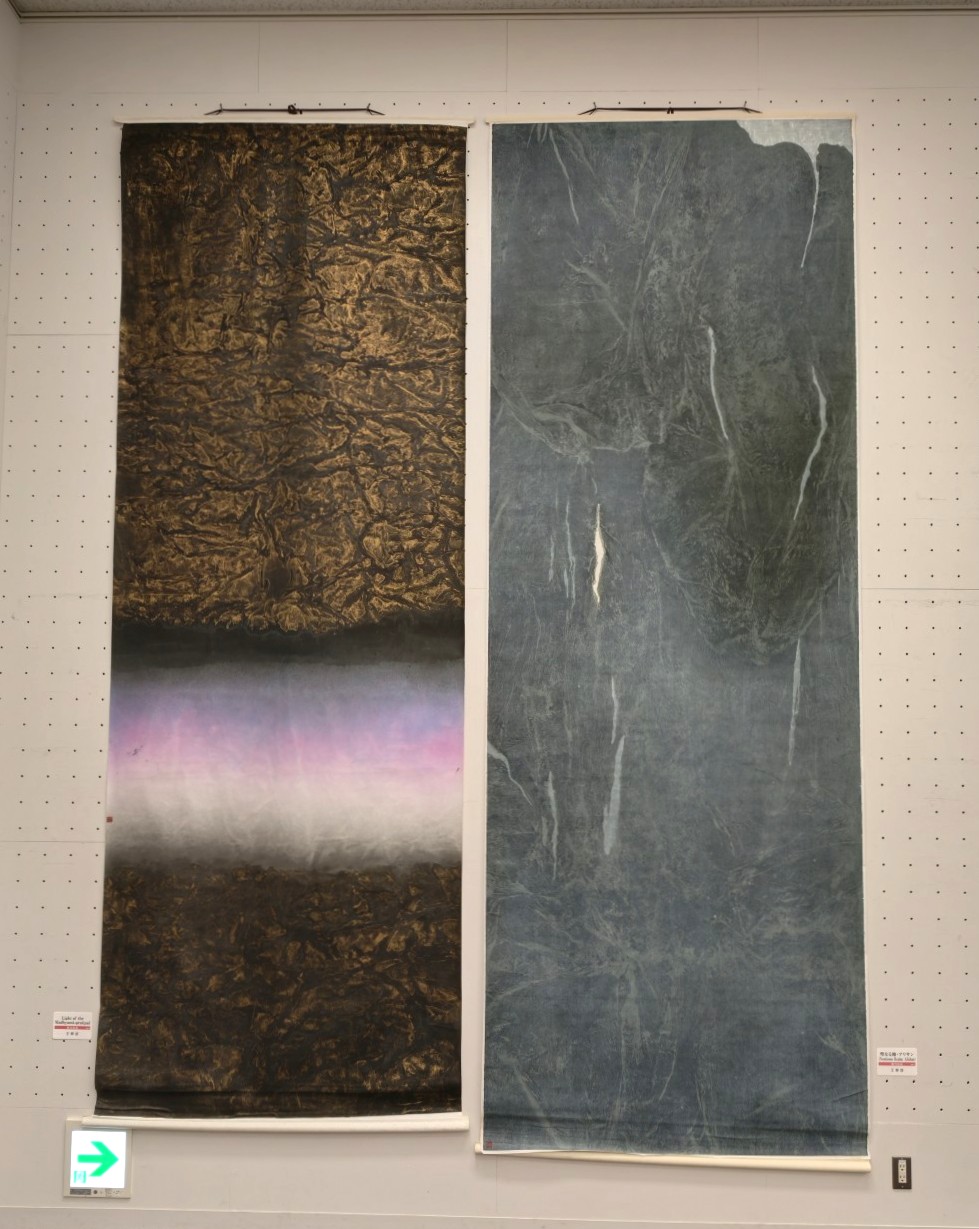
Artwork Title: Light of the Madhyamā-pratipad (also rendered as Illumination of the Middle Way in Madhyamaka Thought)
Dimensions: 138 (W) × 390 (L) cm
Medium: Xuan paper, ink, acrylic paint
Year: December 2025
Note: The term Madhyamā-pratipad refers to the “Middle Way” as articulated in Mādhyamika philosophy, particularly in the works of Nāgārjuna, signifying a non-dual path that transcends both eternalism and nihilism.
Abstract
Wang Muti’s Light of the Madhyamā-pratipad is a contemporary ink installation painting possessing a monumental grandeur. On a sheet of Xuan paper nearly four meters high, the artist employs ink, acrylic paint, and metallic colors to construct a macroscopic tripartite structure. The upper and lower extremities consist of a heavy, coarse accumulation of matter imbued with a metallic sheen, while the center features a transverse, violet-toned haloed fissure. The artwork's title directly references the "Middle Way" (Madhyamaka) of Buddhist philosophy, attempting to seek a transcendent visual equilibrium amidst the dualistic oppositions of "emptiness" (śūnyatā) and "existence" (bhāva), "nihilism" (ucchedavāda) and "eternalism" (śāśvatavāda). This essay explores how the artwork reinterprets the cosmology of Eastern philosophy through the layering of material textures, a symbolic dialogue of color, and the contemporary transformation of the traditional scroll format.
The Vertical Sublime: Scale and the Phenomenology of Space
Light of the Madhyamā-pratipad initially imposes itself upon the viewer through its staggering physical scale. With a vertical volume spanning 138 centimeters in width and 390 centimeters in length, it transcends the parameters of ordinary interior hanging, granting it an architectural sense of structural support.
An Axis Connecting Heaven and Earth
In traditional Chinese landscape painting, the vertical scroll format is typically utilized to express an atmosphere of lofty or profound distance, guiding the line of sight to wander up and down. However, Wang Muti pushes this format to its absolute extreme. A height of 390 centimeters signifies that the artwork nearly bridges the ground and the zenith. Standing before it, a viewer cannot take in the entirety at a single glance; one must either look up in contemplation or bow one's head in meditation.
This mode of viewing shatters the "window frame" concept of Western perspective, creating instead an experience of "Presence." The artwork stands in space like a colossal totem pole or a primordial stone stele. The deep, heavy color blocks at the top and bottom feel like the crushing weight of heaven and earth, while the band of light in the middle is the sole horizontal line where human vision can find respite. This stretching along the vertical dimension psychologically manufactures a sense of sacred solemnity, forcing the viewer into a gaze akin to religious devotion.
Compression and Release of Space
Compositionally, the artist adopts an exceedingly bold "sandwich" structure: dark blocks occupying the vast majority of the upper and lower expanses squeeze the narrow, elongated halo in the center. This constitutes a visual experiment regarding "pressure." The heavy matter (the upper and lower sections) seems perpetually on the verge of clamping shut to devour the central void; yet, the central band of light, with a soft but tenacious force, wedges these two boulders apart, maintaining a delicate equilibrium. This spatial tension directly maps onto the harmonization of extreme oppositions found in Madhyamaka philosophy.
The Sedimentation of Texture: The Material Alchemy of Gold and Ink
In terms of material language, Light of the Madhyamā-pratipad demonstrates Wang Muti’s profound understanding and subversive application of Xuan paper’s properties. He is no longer satisfied with the permeability and flatness of ink wash, but rather pursues a relief-like "tactility."
Folds and the Fossils of Time
Observing the dark areas at the upper and lower ends of the canvas, we can see they are covered in irregular, crack-like textures. This is clearly not the depiction of a traditional brush, but physical traces formed through techniques such as crumbling the paper, layering pigment, or ink rubbing.
Here, Xuan paper is no longer a flat surface carrying ink; it transforms into a "skin" possessing volumetric depth. These folds resemble rock strata shaped by tectonic orogeny, or tree bark weathered by the passage of time. Black ink and acrylic paint permeate deep into the paper's fibers, establishing a solid foundation, while golden pigment sweeps across the raised ridges, illuminating the hierarchical layers of the texture. This treatment endows the canvas with the heavy solidity of cast metal, as if these textures are the fossils of time, recording the very process of material generation.
The Divinity and Secularity of Gold
Gold carries a dual metaphor in art history: it represents both the sacred radiance in Buddhist art (such as the golden bodies of Buddha statues) and a symbol of secular wealth and power. In Light of the Madhyamā-pratipad, Wang Muti fragments and mottles the gold. These golden shards scattered within the black rock strata no longer represent a complete, intact glory; they resemble buried mineral veins, or the embers amidst the ruins of civilization.
This treatment of "gold shining through black" imbues the material with a mysterious inner luster. It suggests that even within the heaviest, darkest material world (represented by black), the seeds of enlightenment (represented by gold) are concealed. This serves as a metaphor for "engaged" (in-the-world) spiritual practice—truth does not reside on the distant shore (pāramitā), but within the grinding tribulations of the mortal realm.
The Threshold of the Spectrum: The Metaphysics of Violet
If the upper and lower extremities represent the heavy "material realm," then the transverse band of light across the center of the canvas represents the ethereal "spiritual realm." This is the soul of the entire work, the literal embodiment of the "Light of the Middle Way."
The Spiritual Frequency of Purple
The color transition in the middle is utterly captivating: from the deep black edges, it transitions into a mysterious Violet, and then gradually fades into pure white and grey-blue. In color psychology, purple represents the shortest wavelength of visible light and is frequently associated with spirituality, the subconscious, meditation, and transformation.
This violet light lacks the metallic hardness of the gold above and below; it is nebulous and gaseous. Employing the spray-painting or bleeding techniques of acrylics, it creates the effect of Luminescence. This is not reflected light, but self-emission. It resembles a laser cutting through chaos, or the first ray of dawn upon the horizon before daybreak.
The Boundary Between Void and Substance
The edge treatment of this light band is extremely subtle. It possesses no harsh dividing lines, but instead mutually permeates with the black textures above and below. The edges of the black rock erode the light, while the light conversely dissolves the rock. This blurred boundary implies that the "Middle Way" is not an absolute demarcation, but a dynamic transition.
Visually, this layer of violet-white halo provides a "breathing hole." Under the colossal oppressive force of 390 centimeters, the viewer's gaze instinctively searches for an exit, and this band of light is that very exit. It allows the heavy canvas to achieve an instantaneous sublimation, transmuting physical weight into spiritual lightness.
Philosophical Intertextuality: The Transcending of the Middle Way and Dualism
The title Light of the Middle Way explicitly situates this work within the context of Eastern philosophy.
Departing from the Two Extremes to Walk the Middle Way
In Bodhisattva Nāgārjuna’s Mūlamadhyamakakārikā (Fundamental Verses on the Middle Way), the Middle Way aims to dismantle attachments to "existence" (bhāva) and "non-existence" (abhāva), "arising" (utpāda) and "ceasing" (nirodha). In Wang Muti’s painting, the massive black blocks at the top and bottom can be interpreted as the "two extremes" (Duality)—perhaps life and death, perhaps past and future, or perhaps materialism and desire.
These "two extremes" are heavy, solidified, and laden with entanglement (expressed through the complex golden textures). The light in the center, however, is the "Middle Way." It is not the statistical average of the two, but the "void space" between them. Just as Laozi stated, "Know the white, keep to the black," the artist has safeguarded that sliver of white amidst the siege of black. This light is an impartial awareness; it exists within the crevice of contradictions, neither falling into nihilistic void nor attaching to substantial existence.
The Fissure as Revelation
Martin Heidegger once discussed the "openness of truth" (Aletheia). The transverse fissure in Light of the Madhyamā-pratipad is precisely such an "openness." It looks as if a tear has been ripped into the solid wall of reality, allowing the light of truth to shine through.
This alludes to the existential condition of modern humanity: we are wedged between gigantic social mechanisms, material desires, and the heavy burdens of history (the upper and lower black-gold rock strata), feeling suffocated and repressed. The freedom of the soul (the Light of the Middle Way) often exists exactly within those fleeting crevices and the immediate present moment.
Coordinates in Art History: A Dialogue Between Abstraction and the Sublime
Although Wang Muti’s Light of the Madhyamā-pratipad utilizes Xuan paper and ink wash, its formal language engages in a profound dialogue with Western abstract art.
Rothko’s Color Fields and Newman’s Zip
That central band of light evokes Barnett Newman’s "Zip"—the vertical line running through his canvases symbolizing the moment of creation. Only, Wang Muti has rotated it horizontally and endowed it with an Eastern quality of ink-wash bleeding. Simultaneously, the large color blocks at the top and bottom, alongside the central glimmer, echo Mark Rothko’s color explorations regarding the tragic and the sublime. Wang Muti employs Eastern media to respond to the pursuit of spirituality found within Western Abstract Expressionism.
The Material Turn of Contemporary Ink Art
Within the lineage of contemporary ink art, Wang Muti belongs to the explorers of the "Material Faction." He no longer fixates on the traditional formulas of brush and ink (such as cun, ca, dian, ran—texturing, rubbing, dotting, and washing), but directly utilizes the physical properties of paper, ink, and color to generate realms. He liberates ink wash from "writing" into "sculpting," pushing it from the "flat surface" into "relief." This shift enables ink art to intervene in contemporary discourses surrounding materiality, environment, and existential space.
Between Gravity and Grace
In conclusion, Wang Muti’s Light of the Madhyamā-pratipad is a masterpiece that merges material spectacle with spiritual depth.
This 390-centimeter colossal structure stands like a spiritual monument suspended in the void. Through his ultimate excavation of Xuan paper's texture and his symbolic application of gold, black, and purple, the artist successfully translates abstract philosophical concepts into concrete visual shock.
The heavy, gold-plated black rock strata at the top and bottom of the canvas symbolize the inescapable heavy burdens of reality and historical sedimentation; meanwhile, the violet halo in the center is the sanctuary where the soul can rest. Through this work, Wang Muti tells us: the "Middle Way" is not an escapist retreat from the mortal world, but a pure land of the spirit tenaciously wedged open within the crevices of a heavy, material world.
Facing Light of the Madhyamā-pratipad, we are not merely looking at a painting, but undergoing a process of sublimation—from repression to release, from heaviness to lightness. It is a bolt of lightning tearing through the long night, and a horizontal line leading toward inner tranquility.