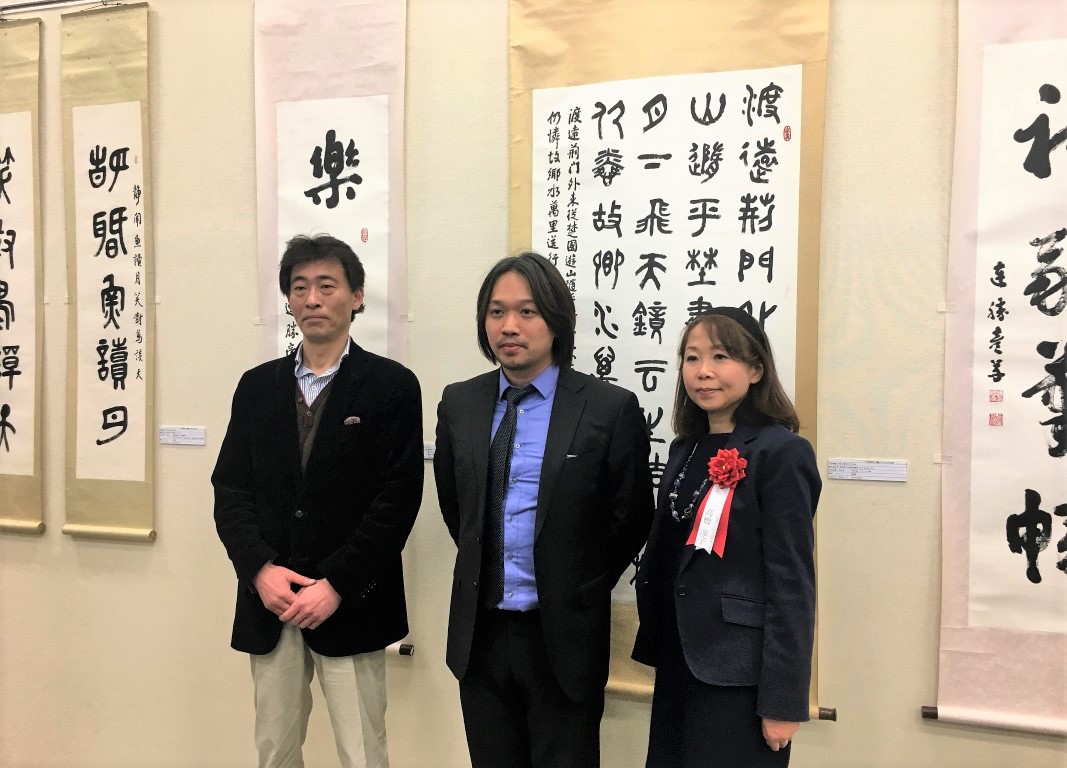
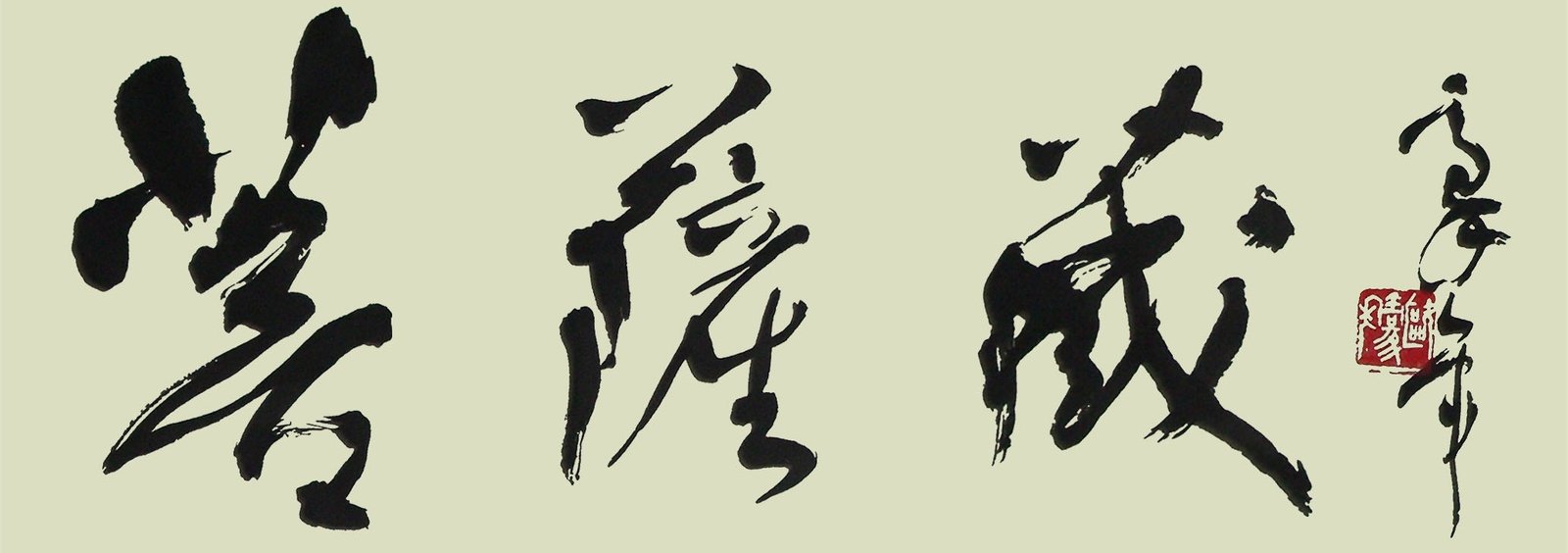
Portraits of Taiwanese Artists at the 82nd Genten Exhibition in Japan
Written by: WANG MUTI
General Introduction: A Transnational Scene of Viewing from Taiwan to Roppongi, Tokyo
Abstract
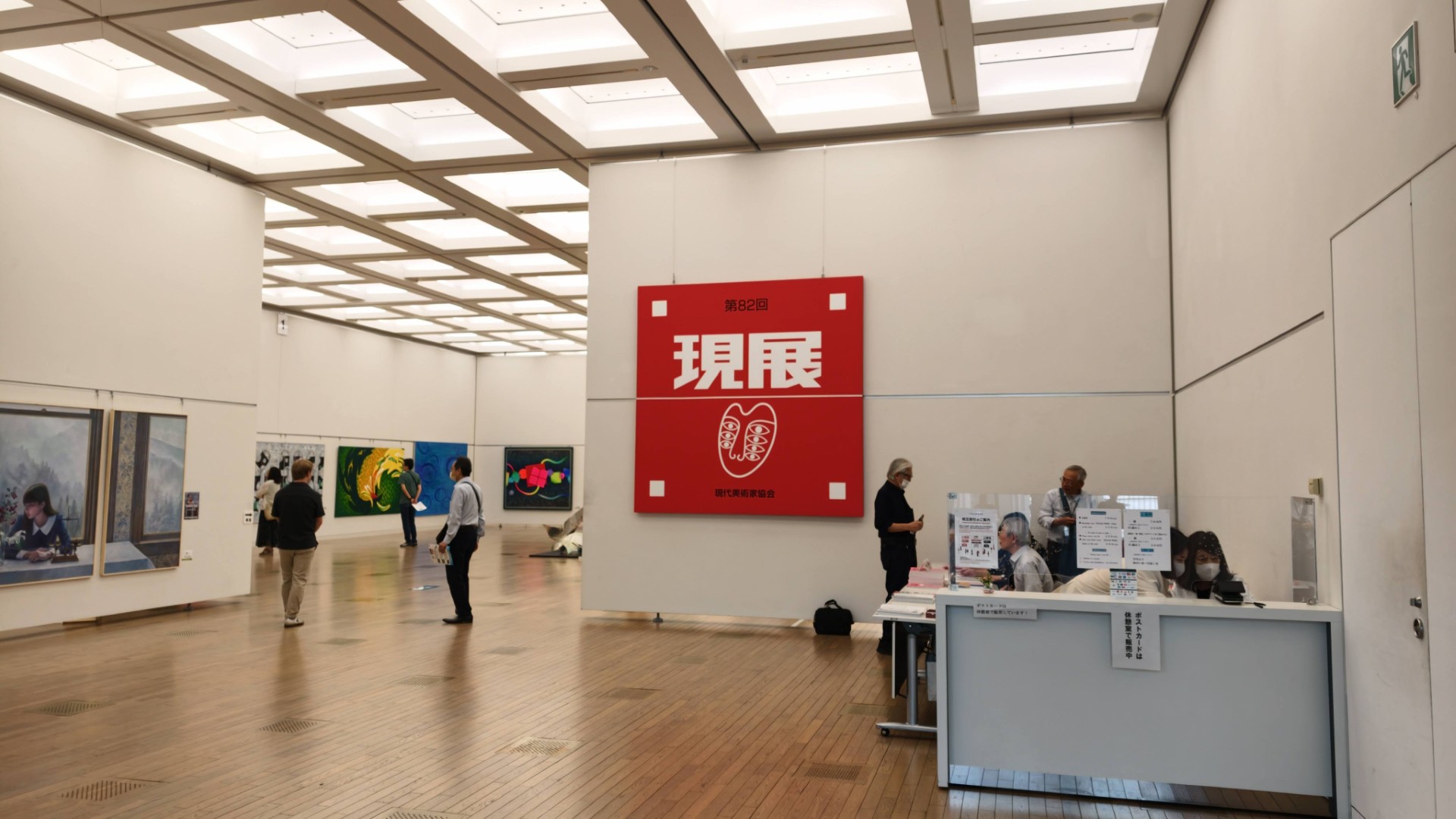
The participation of Taiwanese artists in the 82nd Japan “Genten” Exhibition should not be understood merely as an overseas group exhibition or as the accumulation of individual artists’ résumés. Rather, it should be regarded as a transnational art event jointly constituted by a public-entry system, a national-level exhibition venue, cross-language criticism, hanging-scroll display strategies, and digital archival preservation. This year’s Genten Exhibition was held from May 27 to June 8, 2026, at The National Art Center, Tokyo, in Roppongi, Tokyo, and was organized by the Modern Art Association of Japan, founded in 1948. Through the Taiwan liaison office, critical writing, Japanese translation, on-site documentation, and digital publication, the works of Taiwanese artists entered Japan’s public-entry system for modern art.
This article takes the form of a special report in art criticism and reexamines the works and institutional positions of seven Taiwanese artists: Tsai Mei-Fang, Liau Chun-Yi, Jiang Jinling, Chen Fu-Chi, Wang Chuan Fu, Wu Zhiyong, and Wang Muti. The core question of this report is not only “how Taiwanese artists are seen in Japan,” but further asks: How are works accepted by the exhibition system? How are they understood through criticism and translation? How do they generate new meanings of viewing within the field of The National Art Center, Tokyo? And how does digital archiving extend the life of the exhibition?
Keywords
The 82nd Genten Exhibition, Taiwanese contemporary art, The National Art Center, Tokyo, Modern Art Association of Japan, public-entry exhibition, hanging-scroll display, art criticism, Taiwan–Japan art exchange, digital archive, cross-cultural curating
I. Special Topic Positioning: This Is Not Simply Overseas Participation, but an Art-Institutional Event
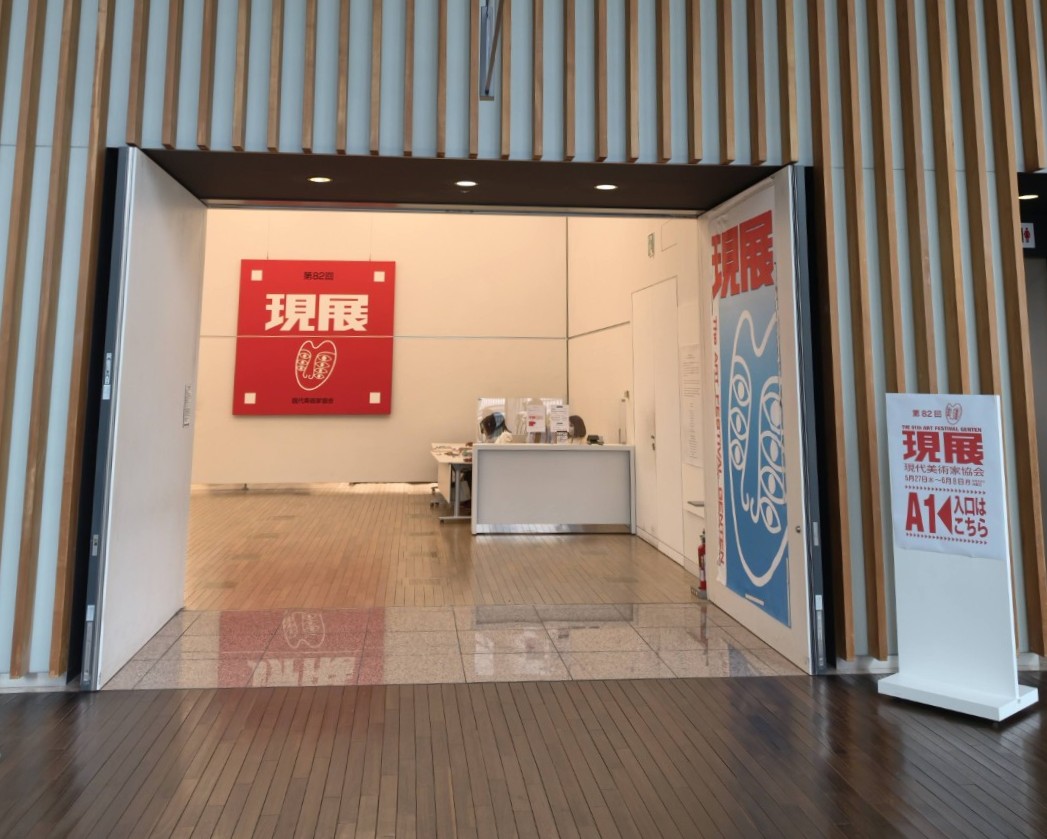
The portraits of Taiwanese artists in the 82nd “Genten” Exhibition should first be understood within an institutional framework. Japan’s “Genten” is not a temporary international group exhibition, but a public-entry modern art exhibition long promoted by the Modern Art Association of Japan. Its institutional context includes multiple mechanisms such as open calls, work review, selection, awards, recommendations, traveling exhibitions, and internal status hierarchies within the organization. Founded in 1948, the Modern Art Association of Japan has long accepted works in different media, including two-dimensional works, three-dimensional works, crafts, photography, and video, and continues the life of its exhibitions through the main exhibition at The National Art Center, Tokyo, as well as traveling exhibitions in Nagoya, Osaka, Kyoto, and other places.
Therefore, the significance of Taiwanese artists’ participation in the 82nd Genten Exhibition is not merely that “their works were sent to Japan for exhibition,” but that their works entered a Japanese modern art system with historical depth and evaluative mechanisms. For artists, this means that their works must face the review standards, exhibition scale, work specifications, and audience contexts of Japanese public-entry exhibitions. For Taiwanese contemporary art, it means that Taiwanese creators no longer enter overseas contexts only through private galleries, international fairs, or friendly exchanges, but through open submission and institutional evaluation, entering the public field of Japanese modern art.
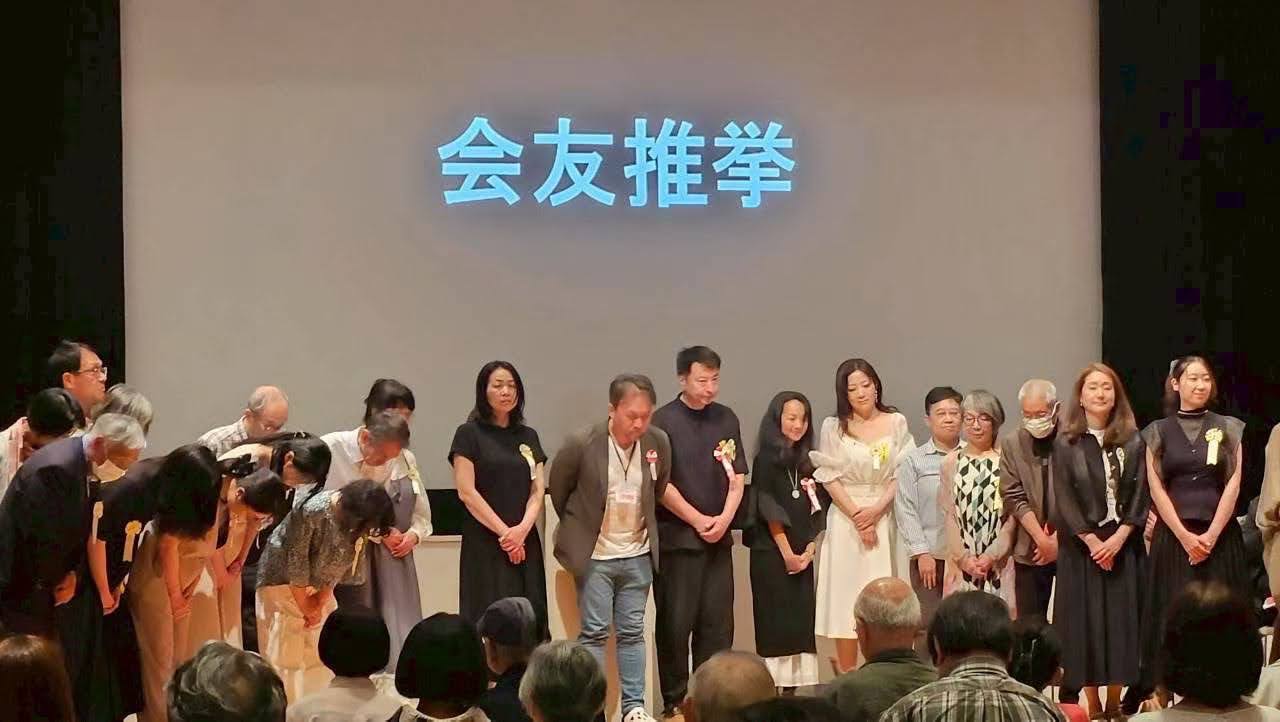
The Genten system includes classifications such as “selected artists, award recipients, and recommended artists,” and artists may accumulate institutional positions through participation and awards, such as associate friend, associate member, or member. This means that “participation” itself is not merely a one-time exhibition result, but a process through which artists gradually acquire symbolic capital within the Japanese art field. Tsai Mei-Fang is a “Genten associate friend, recommended in 2025”; Jiang Jinling was recommended this time as a “Genten associate friend”; and Wang Muti is a “Genten associate member, recommended after only two participations, and previously selected for the Young Talented Artists Exhibition and other awards.” These cases all show that Taiwanese artists are no longer merely external guests within this system, but have begun to enter the internal evaluative structure of Genten.
II. Exhibition Site: The National Art Center, Tokyo as a Contemporary Platform “Without a Collection”
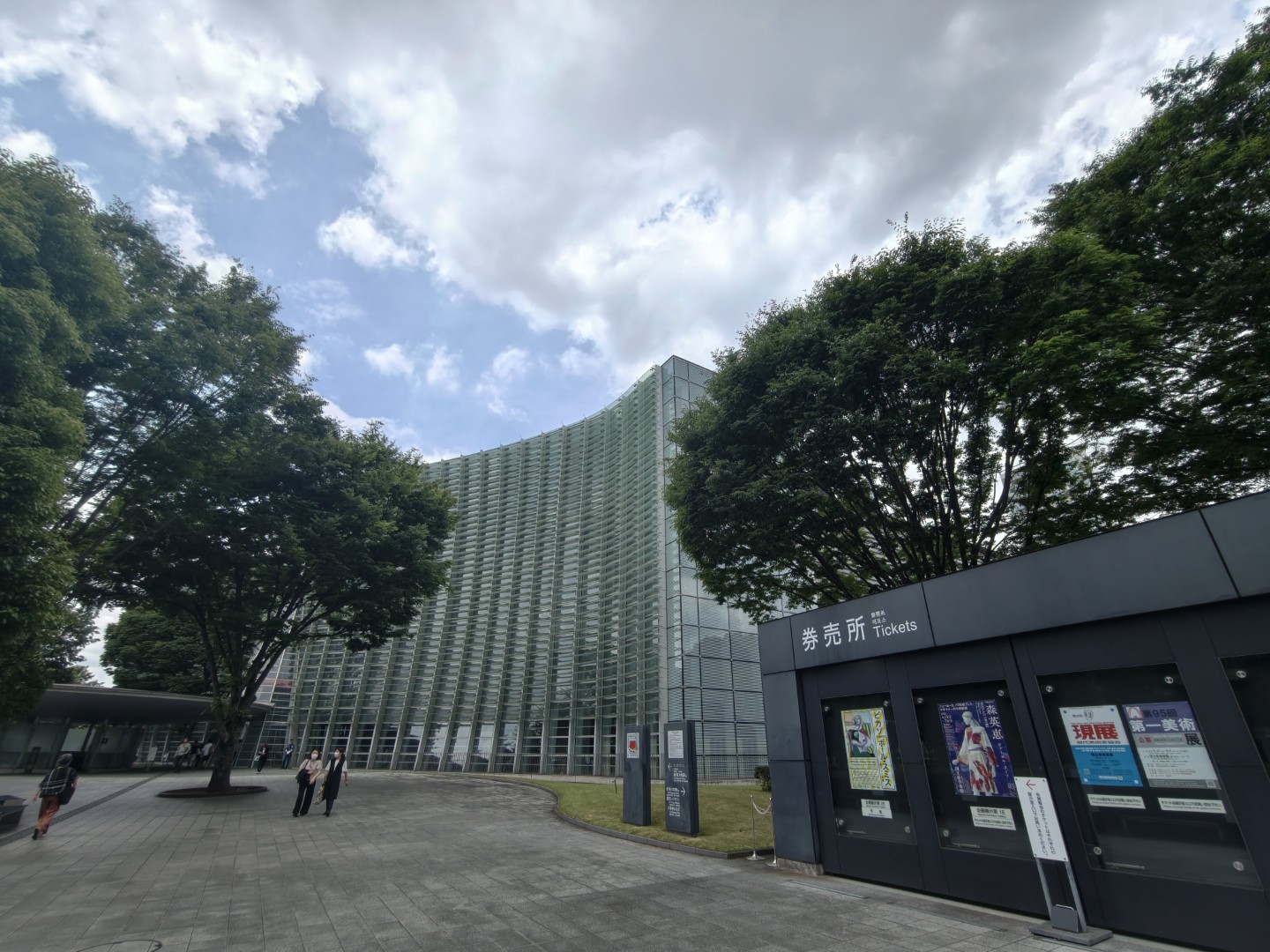
The importance of this exhibition also derives from its venue—The National Art Center, Tokyo, in Roppongi, Tokyo. The National Art Center, Tokyo is located at 7-22-2 Roppongi, Minato-ku, Tokyo. Opened in 2007, it is one of the important institutions within Japan’s national art museum system. Unlike collection-based museums, The National Art Center, Tokyo does not maintain a permanent collection, but instead takes large-scale exhibition spaces, diverse exhibitions, public access to art information, and educational outreach as its core missions.
This point is crucial for the works of Taiwanese artists. Traditional collection-based museums often establish historical authority through their collections. When works enter such museums, they are often forced into comparison with, or subordination to, existing art-historical narratives. However, the particularity of The National Art Center, Tokyo lies in the fact that it does not take a permanent collection as its center of power, but rather takes constantly changing exhibitions as its public platform. In other words, it is not a museum that defines the present through the past, but an open field centered on the “exhibition event of the present.”
We may describe The National Art Center, Tokyo as a “heterotopia without a collection,” indicating that this museum is a transitional container that is constantly emptied and constantly refilled by exhibitions. For Taiwanese artists’ participation, this spatial characteristic has a double effect: on the one hand, works do not have to be placed under the fixed narratives of Japanese classical art or Western modernist collections; on the other hand, within the brief exhibition period, works must quickly establish the conditions for being seen and understood through their own formal intensity, material language, and textual support.
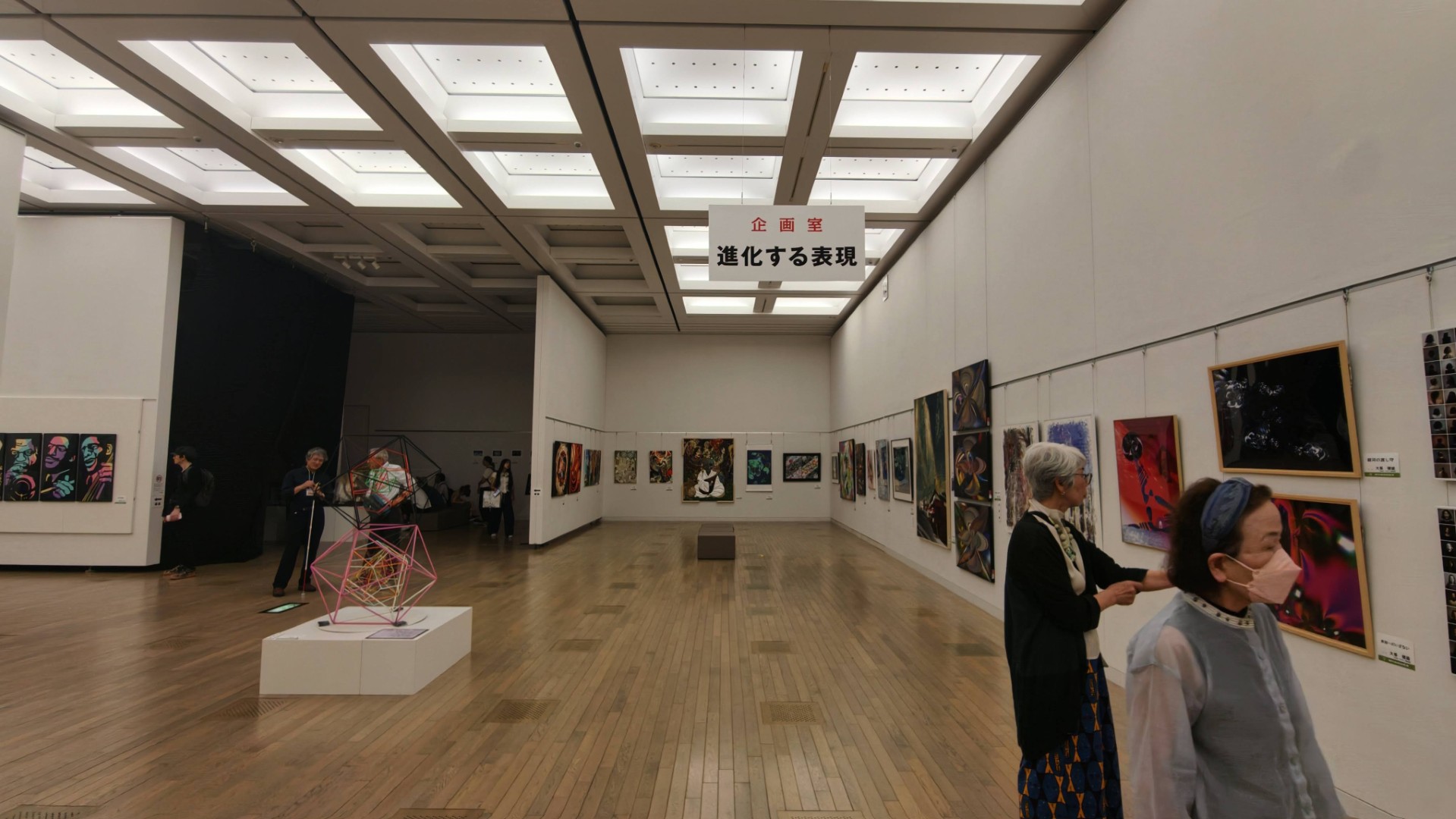
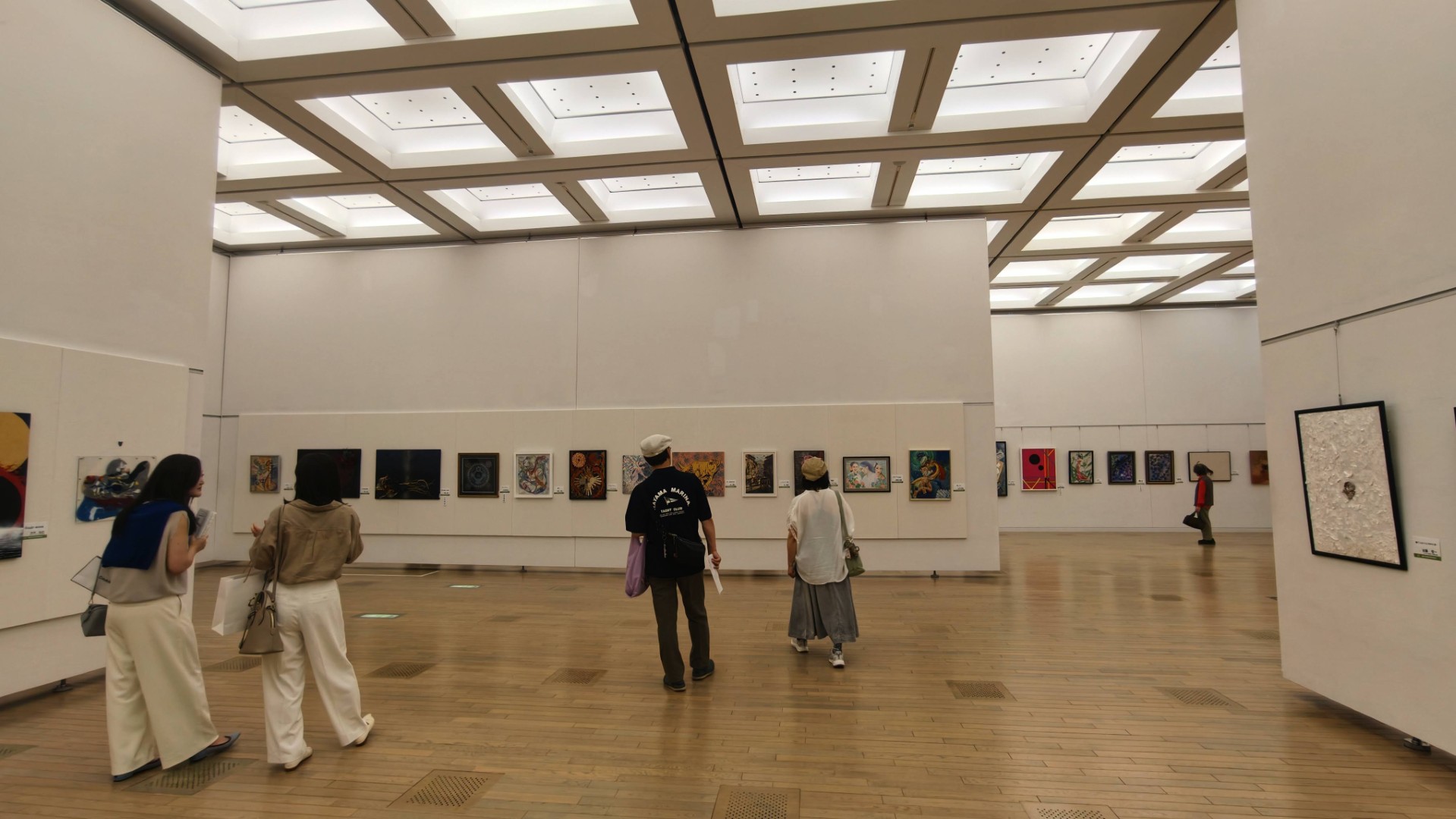
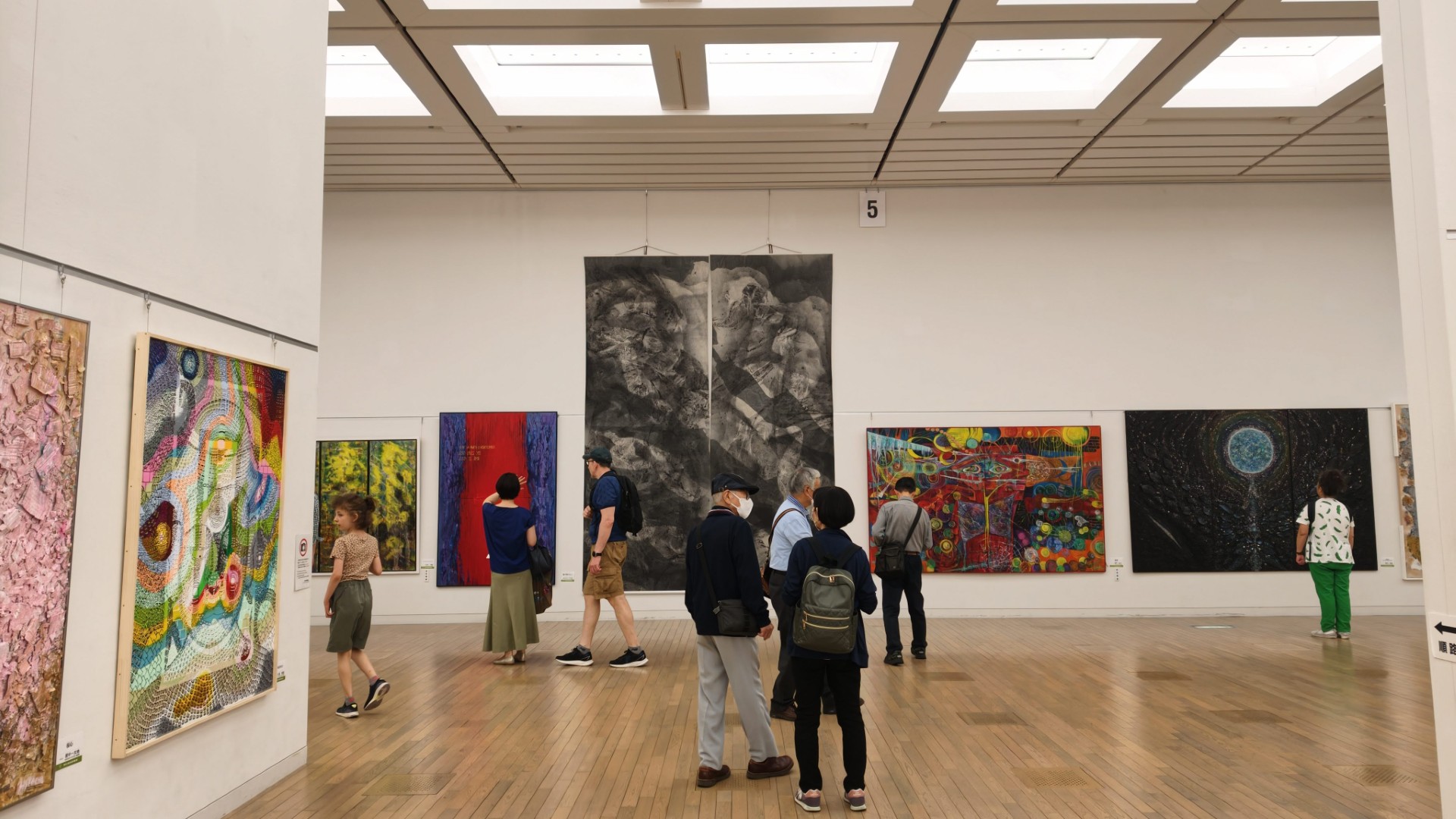
Therefore, The National Art Center, Tokyo is not a neutral background, but actively participates in the production of meaning for the works. Tsai Mei-Fang’s color-ink storm in Lingering Wisteria, Liau Chun-Yi’s weightless flowers in Unfinished・Floating Realm, Jiang Jinling’s subtropical colors in Emotional Journey in the Lotus Pond and Shell Ginger in Full Bloom Attracts Birds, Chen Fu-Chi’s digital simulacrum in The Pleasure of Fish, Wang Chuan Fu’s ink-wash voids in One Thought of Bodhi Opens the Verdant Mist, Wu Zhiyong’s watercolor city in Autumn of Nostalgia, and the ink-wash geometry and philosophical structure in Wang Muti’s Unbounded are not simply hung in isolation on the wall; rather, within the exhibition system and spatial scale of a national-level museum in Roppongi, they regain their publicness.
III. The Public-Entry Exhibition System: The Dual Structure of Openness and Hierarchy
As part of Japan’s postwar modern art public-entry exhibitions, “Genten” possesses a clearly open institutional spirit. Its submission categories include painting, printmaking, sculpture, crafts, photography, CG imagery, and other forms, and it does not restrict works to abstraction or figuration. This allows artists of different media, styles, and generations to be reviewed and exhibited within the same exhibition system.
However, openness does not mean the absence of hierarchy. Genten also includes recommendations and status ladders such as selection, awards, associate friends, associate members, and members. This structure enables artists to gradually accumulate recognition within the system through repeated participation, awards, and recommendations. In other words, Genten provides both an open entrance and an accumulative mechanism for artistic résumés.
For Taiwanese artists, this system has a special appeal. Many overseas exhibitions may provide exposure, but after the exhibition ends, artists’ works often leave behind only brief résumé entries. By contrast, selections, awards, and recommendations within the Genten system can form more explicit records. When these records are then preserved through art criticism, Japanese translation, personal pages, and digital publication, participation becomes not merely an event, but may become a long-term resource for artists entering Japanese art networks.
This institutional process may be called the accumulation of “transnational symbolic capital.” This formulation can be understood as follows: what Taiwanese artists obtain through Genten is not merely an opportunity to exhibit, but the possibility of being recognized, recorded, and circulated by the Japanese modern art system. Tsai Mei-Fang’s promotion from selected artist to associate friend in 2025, Jiang Jinling’s promotion from selected artist to associate friend in 2026, and Wang Muti’s rapid recommendation as an associate member after a short period of participation are all concrete examples of this conversion of symbolic capital.
IV. The Particularity of Taiwanese Participants: From “Being Seen” to “Being Read”
One of the core arguments of this special report is that the position of Taiwanese artists in the 82nd Genten Exhibition is not merely that of “overseas participants” on an exhibition list, but that they are established as readable artistic subjects through criticism and translation. The Taiwan-related information for this year’s Genten Exhibition specifically includes a section on “Art Criticism for Taiwanese Participants,” as well as artists’ individual pages, online news releases, Japanese translations of documents and works, on-site Chinese–Japanese interpretation, exhibition photography, video recording, and related content.
This point is extremely important. In overseas exhibitions, being seen does not necessarily mean being understood. Viewers may see colors, composition, materials, and labels, yet may not necessarily understand the cultural context, creative methods, life experiences of the artists, or choices of media behind the works. Especially in large-scale public-entry exhibitions, where the number of works is large and the viewing rhythm is fast, without critical texts and linguistic translation, works can easily remain at the level of superficial visual impressions.
Therefore, art criticism here plays the role of a “second site.” The exhibition wall is the first site of the work; criticism is the second site where the work is reorganized, interpreted, and circulated. It does not replace the work, but establishes an entrance for viewing it. For Tsai Mei-Fang, criticism allows Lingering Wisteria to be understood not merely as a bird-and-flower subject, but as an intersection of color ink, automatic technique, dynamic sublimity, and emotional anchors; for Liau Chun-Yi, criticism allows Unfinished・Floating Realm to be understood not merely as a floral composition, but as a suspended psychological field within liquid modernity; for Chen Fu-Chi, criticism makes The Pleasure of Fish not merely a digital image, but a meditation on simulacra, imitation xuan paper, and posthuman perception.
In other words, criticism allows works to move further from “being viewed” toward “being discussed.” This is also why this report adopts the form of professional art criticism: this article does not merely reorganize information about the works, but hopes to establish a clear analytical framework for each artist, so that their formal language, material logic, cultural context, and institutional position within the exhibition can be fully presented.
V. Hanging-Scroll Display: From Transportation Strategy to Visual Method
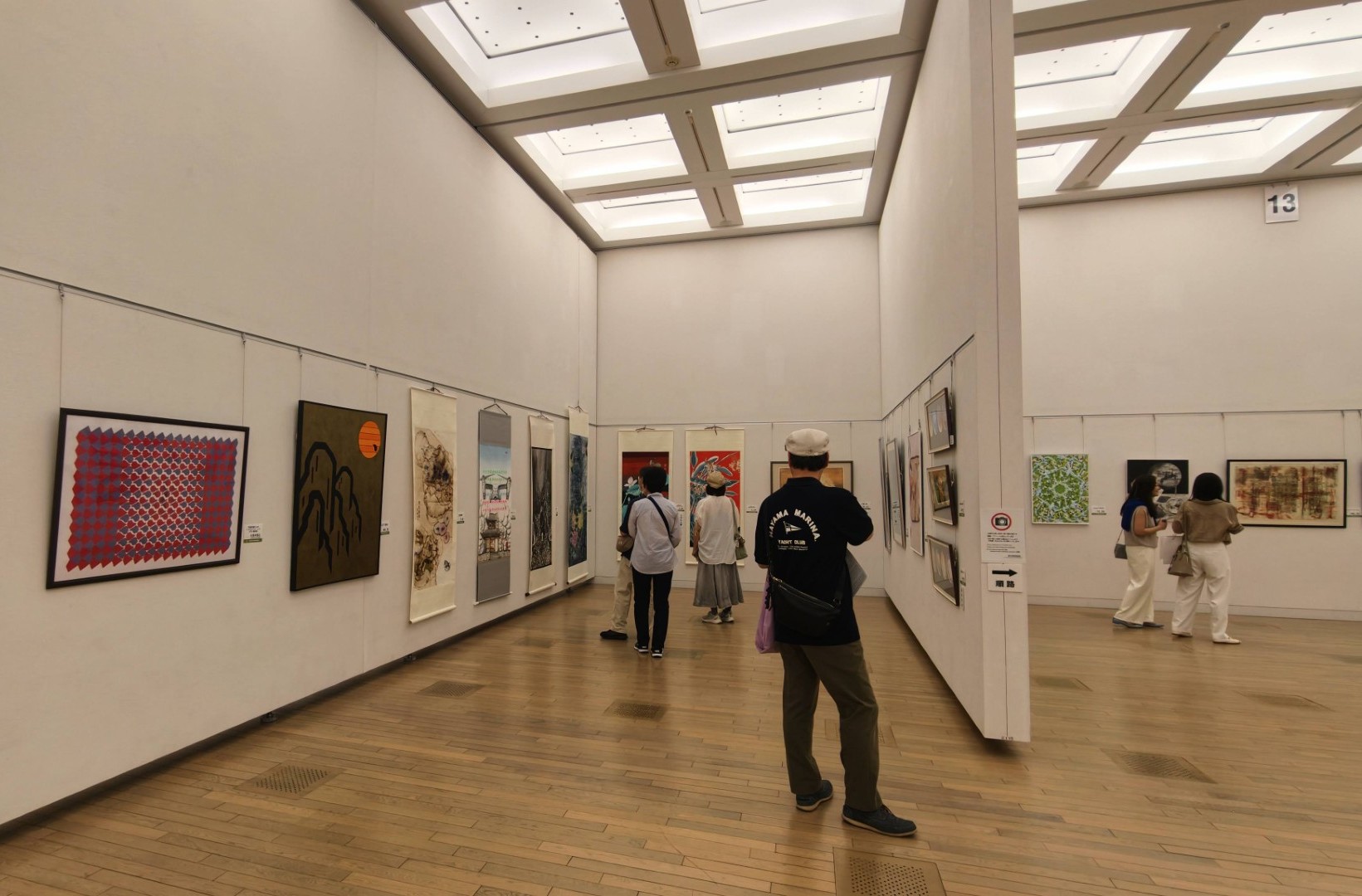
Many of the Taiwanese participating works in this exhibition are displayed in the form of “hanging scrolls.” This arrangement first has practical significance: transnational exhibitions involve the transportation, packaging, storage, installation, and dismantling of works, and compared with heavy frames or large panels, the hanging-scroll format offers greater flexibility in transport. Taiwan-related information for Genten lists sizes such as four-foot full sheets, six-foot full sheets, and even larger formats, and explains that this method enables Taiwanese participants to display large-scale works overseas.
However, the hanging scroll is not merely an exhibition-management technique; it is also a method of viewing. The hanging scroll has a long history in East Asian calligraphy and painting traditions. Its characteristics include vertical unfolding, storability, mobility, the softness of paper or cloth materials, and a viewing rhythm in which the viewer moves from top to bottom and from part to whole. When Taiwanese contemporary artworks enter the public-entry venue of Japanese modern art in hanging-scroll form, the works simultaneously connect two contexts: on the one hand, they enter the modern art exhibition system; on the other hand, they also create a visual dialogue with East Asian calligraphy and painting, paper-based art, scrolls, and hanging traditions.
This display form produces different effects for different artists’ works. In Wang Chuan Fu’s One Thought of Bodhi Opens the Verdant Mist, the voids and ink-wash resonance become more spiritually descending and unfolding because of the verticality of the hanging scroll; in Wang Muti’s Unbounded, the layered ink and geometric boundaries acquire a mode of reading similar to a geological cross-section because of the scale of the long hanging scroll; Tsai Mei-Fang’s flowing color ink in Lingering Wisteria, meanwhile, presents a kind of unframed and unfixed visual energy on the flexible support of the hanging scroll.
Therefore, this report regards the hanging scroll as an important curatorial condition for Taiwanese participation in this exhibition. It is both an administrative solution for transnational exhibition and a way for Taiwanese works to form a shared visual grammar within the Japanese exhibition venue. The hanging-scroll format allows these works of different styles and media to form a recognizable portrait of Taiwanese display within The National Art Center, Tokyo.
VI. Digital Archives: The Second Life After the Exhibition
Traditional exhibitions have clear temporal boundaries: opening, exhibition period, closing, and dismantling. The Tokyo main exhibition of the 82nd Genten Exhibition ran from May 27 to June 8, 2026. After the exhibition period ended, the collective presentation of the works in physical space came to a close.
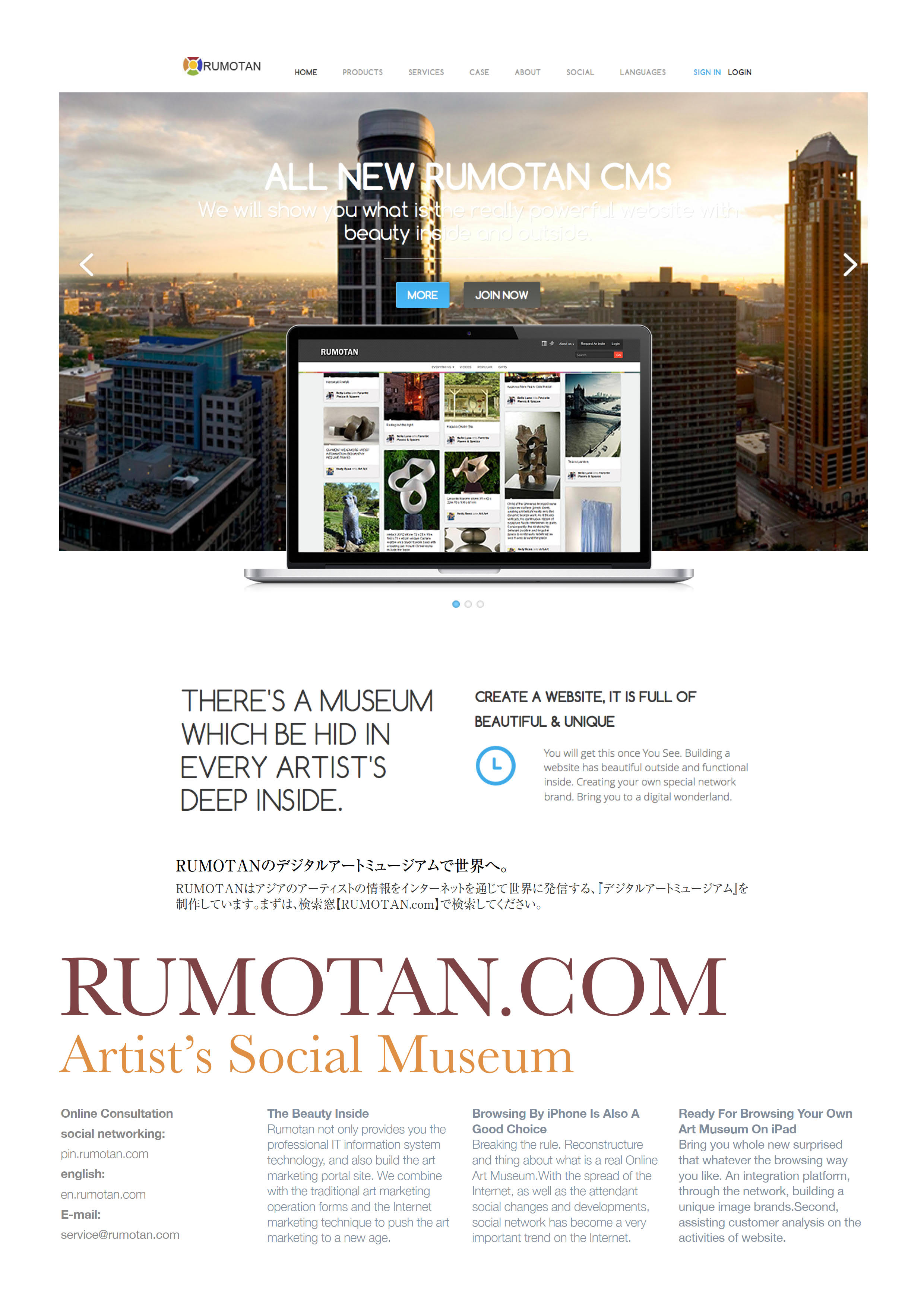
However, this year’s Taiwanese participation does not stop at the physical exhibition site. Through online platforms such as RUMOTAN, exhibition information, lists of participating artists, art criticism, on-site displays, and related records are established. This means that the exhibition is no longer merely a short-lived event, but is transformed into a searchable, citable, and sustainable digital archive.
For Taiwanese artists, the importance of digital archives cannot be ignored. If overseas exhibitions lack written, visual, and online records, they often quickly fade from public memory after the exhibition ends. Yet if images of works, exhibition-site photographs, critical texts, and artists’ individual pages are comprehensively preserved, these materials may later be rediscovered by curators, researchers, media, collectors, or other art institutions.
Therefore, the full significance of Taiwanese participation in this exhibition should include three temporal levels: first, the pre-exhibition phase of registration, review, translation, and preparation; second, the on-site viewing, evaluation, and exchange during the exhibition; and third, the continuing reading and dissemination that occurs after the exhibition through digital archives. The artists’ works are not only seen at The National Art Center, Tokyo, but also acquire an extended life within texts, images, and online databases.
VII. Critical Paths for the Seven Artists
The subsequent sections of this report will analyze the seven Taiwanese artists and their works one by one in the designated order:
1. Tsai Mei-Fang
Genten associate friend, recommended in 2025. Work: Lingering Wisteria.
Her work will be analyzed through color-ink automatism, material flow, Kantian dynamic sublimity, and the emotional anchors formed by the mandarin ducks in the picture.
2. Liau, Chun-Yi Liau, Chun-Yi
Selection internally confirmed. Work: Unfinished・Floating Realm.
The critique will focus on her heavy colors on processed xuan paper, spatial rupture, suspended flowers, and the psychological topology of liquid modernity.
3. Jiang Jinling
Genten associate friend, recommended in 2026. Works: Emotional Journey in the Lotus Pond, Shell Ginger in Full Bloom Attracts Birds.**
The analysis will revolve around subtropical color, impasto texture, Spinozist conatus, and the visual expression of erotic ecology.
4. CHEN FU-CHI
Selection internally confirmed. Selected for the Special Project Exhibition Area. Work: The Pleasure of Fish.
The critique will begin from digital art, imitation xuan paper, simulacrum theory, Zhuangzi’s “pleasure of fish,” and posthuman perception.
5. WANG CHUAN FU
Selection internally confirmed. Work: One Thought of Bodhi Opens the Verdant Mist.
His work will be analyzed through ink-wash voids, phenomenological reduction, bird imagery, clarity, and the spiritual structure of “one thought of bodhi.”
6. Wu Zhiyong
Selection internally confirmed. Work: Autumn of Nostalgia “ノスタルジックな秋”.
The critique will discuss watercolor wet-on-wet technique, the sense of urban dissolution, the Benjaminian flâneur, and the visualization of modern nostalgia.
7. WANG MUTI
Genten associate member, recommended after only two participations, previously awarded in the Young Talented Artists Exhibition and other awards.
The analysis will focus on his ink-wash geometry, the continuity of the five aggregates, the thought of the Abhidharmakośa, institutional advancement, and transnational symbolic capital.
VIII. Viewing Frameworks for the Taiwanese Portrait
To summarize this opening section, if one wishes to rewrite the portraits of Taiwanese artists in the 82nd Genten Exhibition through professional art criticism, four viewing frameworks must first be established.
First, the institutional framework. Genten is not an ordinary group exhibition, but a Japanese modern art public-entry system with history, review, awards, recommendations, and traveling structures. The participation of Taiwanese artists means that they enter this system and begin to accumulate artistic positions that can be recorded.
Second, the field framework. The collectionless nature of The National Art Center, Tokyo makes it a public platform centered on the exhibition event of the present. Taiwanese works are viewed here not by being incorporated into fixed collection narratives, but by establishing their own contemporaneity within the intensity of a temporary exhibition.
Third, the display framework. Hanging-scroll display is both a transnational transportation strategy and a combination of East Asian visual tradition with contemporary exhibition methods. It enables works in different media to form a vertical, flexible, mobile shared grammar within the same exhibition venue.
Fourth, the criticism and archive framework. Art criticism, Japanese translation, image documentation, and digital platforms allow works not only to be viewed in the exhibition site, but also to be read, cited, and preserved after the exhibition. This is the key for Taiwanese artists to move from “being seen” toward “being discussed.”