Liau Chun-Yi
Liquid Modernity, Suspended Flowers, and Psychological Topology in Unfinished・Floating Realm
I. The Artist’s Position: Constructing Psychological Space between Calmness and Rupture
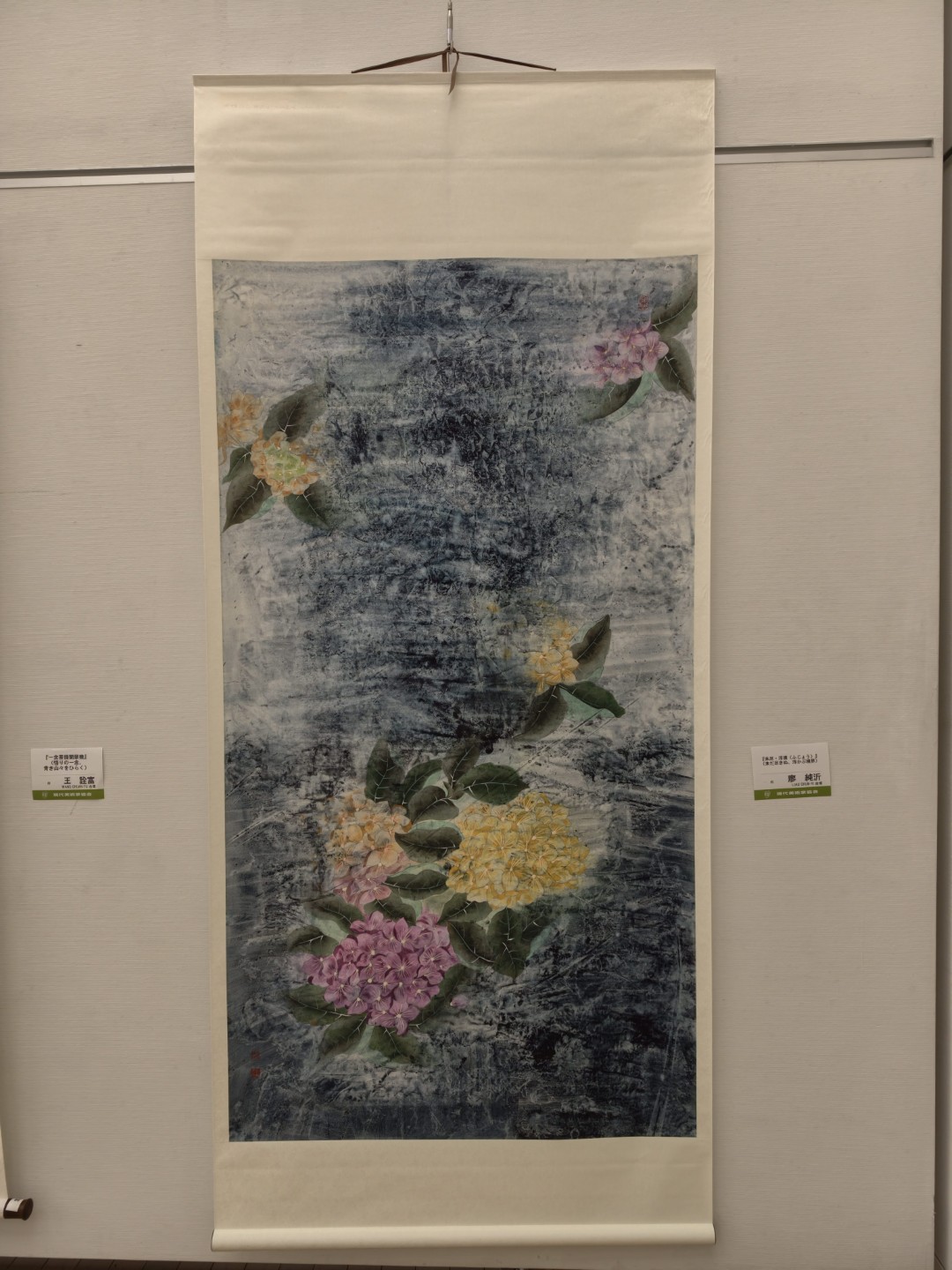
Among the portraits of Taiwanese artists in the 82nd Japan “Genten” Exhibition, Liau Chun-Yi’s work offers a viewing experience completely different from that of Tsai Mei-Fang. If Tsai Mei-Fang’s Lingering Wisteria forms strong visual tension through color-ink storms, natural sublimity, and emotional attachment, then Liau Chun-Yi’s Unfinished・Floating Realm is closer to an inner landscape that is calm, suspended, and marked by psychological rupture. Her work does not directly pressure the viewer with intense color, but uses unstable space, weightless flowers, and subtle textures to bring the viewer into a floating field between reality, memory, and consciousness.
Liau Chun-Yi makes use of the non-absorbent quality of processed xuan paper, combining heavy color, scraping, rubbing, and automatic techniques to form a visual topology with a distinctly modernist coldness and psychological rupture. Her Unfinished・Floating Realm is especially described as an image that has lost its horizon and gravitational coordinates, in which flowers appear rootless and suspended.
These characteristics allow Liau Chun-Yi to play an important role in this Taiwanese participating group: she does not win through external narrative or clear symbolism, but expresses the weightless experience deep within contemporary people through spatiality, materiality, and psychological atmosphere. Her work appears quiet, yet is full of instability; it seems to depict flowers, yet what it actually deals with is the psychological state of the modern subject in a fluid society.
II. The Title of Unfinished・Floating Realm: Unfinished Boundaries and a Floating Field
The title Unfinished・Floating Realm itself contains rich critical clues. “Unfinished” means not yet ended, not yet arrived, not yet completed; it points toward an open state and also suggests that the time within the work is not a closed, definite, or completed narrative. The work is not a landscape that has already been organized, but resembles a psychological fragment still being generated, still flowing, and still unsettled.
“Floating realm” is even more crucial. “Floating” includes meanings of drifting, suspension, emergence, movement, and instability; “realm” may refer to space, but also to state of mind, domain, or condition of consciousness. When the two are combined, “floating realm” is not merely a floating scene, but an unstable psychological space. It is neither a completely real natural environment nor a purely abstract spiritual image, but swings between the two. In other words, it is an “unexhausted, floating boundary.” This further strengthens the work’s concern with boundaries, incompletion, and states of suspension.
Therefore, the title Unfinished・Floating Realm does not merely describe the content of the picture, but first establishes a method of viewing: the viewer should not regard the work as a fixed landscape, but should understand it as a psychological field between formation and dispersal, memory and reality, flowers and abstraction, existence and weightlessness.
III. Processed Xuan Paper and Heavy Color: From Ink-Wash Flow to the Control of Surface Texture
One of the keys to why Liau Chun-Yi’s work differs from traditional ink wash or color ink lies in her treatment of the material surface. She uses the relatively non-absorbent physical quality of “processed xuan paper,” combining it with “mineral heavy color” and multilayered texture to create images with a sense of coldness and psychological rupture.
Processed xuan paper differs from raw xuan paper. Raw xuan is highly absorbent and suitable for ink diffusion, penetration, and the flow of vital resonance; processed xuan, having been treated, is less absorbent and allows pigment to remain on the surface, making repeated layering, depiction, scraping, and control easier. Liau Chun-Yi’s use of processed xuan makes the image less like traditional ink wash, which seeks a single-breath flow, and more like the construction of a calm, dense, repeatedly worked surface structure on paper.
This surface structure gives Unfinished・Floating Realm a special visual and psychological effect. The image is not transparent, nor can it be penetrated at a glance; it has layers, coverings, traces of friction, and textures resembling matte surfaces, sand, or fine particles. When viewing it, one feels that the image is not a single space, but is accumulated from multiple times and multiple actions.
The addition of heavy color allows the work to move beyond the simple ink resonance of ink wash. The colors of the flowers appear bright against a gray-blue, dim, or chaotic background, yet they are not sweet; they seem to be placed within an unstable climate or psychological layer, both emerging and surrounded, both clear and isolated. This is precisely what is most noteworthy about Liau Chun-Yi’s work: she does not let the medium serve floral representation, but makes the medium itself become the surface of a psychological state.
IV. A Space without Horizon: How the Sense of Floating Is Established
The most obvious spatial feature of Unfinished・Floating Realm is the lack of a stable horizon. Traditional landscape painting usually uses horizon lines, foreground, middle ground, and background to let viewers know where they stand and where they are looking. In Liau Chun-Yi’s image, however, such coordinates are deliberately weakened. Unfinished・Floating Realm creates a background that has lost horizon and gravitational coordinates; its blue-gray texture resembles a sea under a storm and also a screen filled with static interference.
This spatial treatment means that the image is no longer a natural scene one can enter, but more like a floating psychological zone. The viewer cannot determine whether the flowers are in the air, on the water, within memory, or in some abstract field of consciousness. The flowers do not grow from the ground, but seem to emerge from deep within the picture; they have no visible roots and no clear support.
This rootlessness is the core of the work’s psychological meaning. When flowers lose the ground, they are no longer merely natural objects, but become symbols of the modern subject: beautiful, fragile, still blooming, yet unable to determine where they are. This floating is not light, but anxious; it is not free flight, but suspension after the loss of support.
Liau Chun-Yi does not express anxiety through violent gestures, but allows anxiety to slowly emerge through spatial uncertainty. This treatment gives the work a calm yet profound emotional force.
V. Liquid Modernity: Rootless Flowers and the Psychological State of Contemporary People
We may use Zygmunt Bauman’s “liquid modernity” to understand Unfinished・Floating Realm. Liquid modernity refers to the loosening of stable structures in contemporary society: identity, relationships, values, work, and forms of life are no longer fixed, but continue to change within rapid flows. The flowers painted by Liau Chun-Yi have no roots connected to the earth, precisely visualizing the modern person’s “anxiety of rootlessness”; nevertheless, although these flowers are suspended, they still bloom passionately, presenting a kind of heroism that remains elegant even in extremity.
This may serve as the core for understanding Unfinished・Floating Realm. The flowers in the work are not decaying or withering, but still maintain their color and form. They have no stable position, yet they do not give up blooming; they are placed within a chaotic background, yet they are not completely swallowed. This state is extremely similar to the life condition of contemporary people: in an era that has lost stable values and fixed belonging, people must still live, feel, create, and maintain the self.
Therefore, Unfinished・Floating Realm does not simply express anxiety, but expresses a posture of life within anxiety. The beauty of the flowers does not come from stability, but from their continued manifestation of themselves within unease. This beauty is neither pastoral nor decorative, but an existential aesthetics with a sense of resistance.
Liau Chun-Yi’s work therefore possesses important contemporaneity. She does not directly depict the city, technology, or social landscape, yet through the relationship between flowers and space, she precisely expresses the flow, uncertainty, and self-maintenance deep within the modern person.
VI. Floral Imagery: From Natural Object to Psychological Subject
In Unfinished・Floating Realm, although the flowers can still be recognized, their meaning has already moved beyond the scope of natural objects. They are no longer merely plants, but more like substitutes for psychological subjects. Flowers are suitable for carrying this meaning because they themselves combine fragility and vitality: flowers wither easily, yet present an extremely high visual intensity at the moment of blooming; they depend on the environment, yet can declare their existence through color and form.
Liau Chun-Yi places flowers in a floating state, thereby amplifying their fragility. Without soil, without a vase, without branches to support them, the flowers seem to be left only with their own image and color. This makes them appear both isolated and firm. The flowers in the picture are not nourished by their environment, but seem to glow by themselves within an unstable space.
The flowers here may be regarded as metaphors for the contemporary subject. In modern society, people often also lose the support of traditional communities, fixed identities, or stable belonging; nevertheless, people must still establish their own forms within fluid environments. The flowers in Liau Chun-Yi’s painting are precisely the visualization of this modern subject: rootless, yet still blooming; floating, yet not disappearing; isolated, yet preserving form.
VII. Background Texture: Psychological Noise and the Screen of Perception
The background of Unfinished・Floating Realm is neither blank nor simply a color plane that sets off the flowers. We describe it as a blue-gray texture filled with scraping, rubbing, and automatic techniques, like the sea under a storm and also like a screen covered with static interference.
This description is crucial because it reveals the background’s dual nature. On the one hand, the background resembles nature: water surface, storm, cloud vapor, sea tides; on the other hand, it also resembles media: screen, signal, noise, interference. Nature and technology intersect here, making the work no longer merely a natural landscape, but more like a metaphor for contemporary states of perception.
If the background is regarded as “psychological noise,” then the flowers are fragments of consciousness emerging from the noise. This noise is not a clear event, but is woven from memory, anxiety, sensation, and external information. The inner world of contemporary people is not quiet, but filled with information flows, emotional residues, and perceptual interference. Liau Chun-Yi’s background texture captures precisely this state.
If the background is regarded as a “screen of perception,” then the work may also be understood as a psychological image of the digital age. The flowers appear as if emerging within signal interference, both real and unstable. They may be flowers in memory, or mediated images of nature. This gives Unfinished・Floating Realm a deep implication of modern visual culture beyond the traditional floral subject.
VIII. Cool Tones and Psychological Distance: Liau Chun-Yi’s Lyricism Is Not Warmth, but Suspension
The lyricism in Liau Chun-Yi’s work is not warm, sweet, or sentimental, but a kind of suspension within cool tones. Compared with the highly saturated life impulse in Jiang Jinling’s works, Liau Chun-Yi tends to establish the mood of the image through gray-blue, darkness, mistiness, and localized brightness. This chromatic language gives the work a sense of distance.
Distance does not mean that the work is indifferent; rather, it prevents the viewer from immediately consuming it emotionally. The image does not directly speak of sadness, nor does it clearly offer consolation; it simply lets flowers float within an unstable space, allowing the viewer gradually to become aware of a difficult-to-name state of weightlessness.
This mode of lyricism is quite mature. It avoids excessive narration and also avoids turning flowers into cheap emotional symbols. Flowers are not simple signs used to express “beauty” or “sorrow,” but constitute a psychological event through their position, color, and relationship with the background.
Therefore, Liau Chun-Yi’s lyricism is a cold lyricism. It relies not on warmth, but on distance; not on direct plot, but on spatial tension; not on clear symbolism, but on the viewer slowly sensing their own unease within the image.
IX. The Temporality of “Unfinished”: How the Work Refuses Conclusion
The “unfinished” in Unfinished・Floating Realm may also be understood as a temporal structure. The work has no clear beginning or ending; the flowers in the image seem neither just blooming nor about to wither. They are in a suspended time. The background also does not resemble a specific weather or a specific moment, but rather a layer of time that continues to flow.
This makes the work refuse conclusion. It does not tell viewers where these flowers come from, nor does it explain where they will go. It presents only an intermediate state: not yet completed, not yet settled, not yet dispersed.
This temporality corresponds very closely to modern psychological experience. In contemporary life, many things do not appear with clear endings, but remain for long periods in transition, waiting, delay, and uncertainty. Personal identity, relationships, careers, and emotions often remain in an “unfinished” state. Liau Chun-Yi transforms this sense of incompletion into visible form through the image of floating flowers.
Therefore, Unfinished・Floating Realm does not depict a single moment, but a continuous state. Its power lies not in dramatic climax, but in allowing the viewer to remain within a time that cannot reach conclusion.
X. Comparison with Tsai Mei-Fang: From Natural Sublimity to Psychological Suspension
If Liau Chun-Yi’s Unfinished・Floating Realm is placed alongside Tsai Mei-Fang’s Lingering Wisteria, analyzed in the previous section, the differences and complementarity between the two artists become clearer.
Tsai Mei-Fang’s image possesses outward energy. The flow of color ink forms a storm-like visual field, within which wisteria and mandarin ducks present natural sublimity and emotional interdependence. Her work faces vast natural forces and responds through the mutual dependence of small lives.
Liau Chun-Yi’s work, by contrast, is more inward. She does not pressure the viewer with a storm, but allows the viewer to enter a psychological space that has lost coordinates. The flowers do not depend on another life, but float in isolation; the focus of the work is not emotional relationship, but how the subject maintains its own form in a rootless state.
Both deal with uncertainty, but in different ways. Tsai Mei-Fang faces a cosmic, natural uncertainty; Liau Chun-Yi faces a psychological, social uncertainty. Tsai Mei-Fang responds to nihility with “lingering”; Liau Chun-Yi presents weightlessness through the “floating realm.” This also makes the portraits of Taiwanese artists in the 82nd Genten Exhibition more polyphonic: the same floral subject can unfold entirely different spiritual dimensions.
XI. Relationship with Hanging-Scroll Display: The Contradiction of Weightlessness within Verticality
Many Taiwanese participating works in this exhibition are displayed in hanging-scroll form, and this is equally important for Liau Chun-Yi’s work. The hanging scroll itself has clear verticality: the work unfolds from top to bottom, is drawn by gravity, and forms a viewing rhythm commonly found in East Asian calligraphy and painting traditions.
However, the content of Unfinished・Floating Realm is weightless. Flowers float within the image and lack ground or support. Thus, the verticality of the display form and the weightlessness of the image content form a contradiction: the hanging scroll reminds viewers of the existence of gravity, while the image lets the flowers escape gravity.
This contradiction instead strengthens the tension of the work. Standing before the hanging scroll, the viewer’s body senses the vertical scale of the work, while the eyes enter a space in which up and down, front and back, depth and shallowness cannot be located. This makes Unfinished・Floating Realm not only a floating within the image, but also a floating experience within the exhibition site.
In other words, the hanging scroll does not weaken the contemporaneity of Liau Chun-Yi’s work, but makes its sense of weightlessness even more apparent. When an East Asian traditional form carries modern psychological space, the work forms a subtle tension between tradition and contemporaneity.
XII. Relationship with the Field of The National Art Center, Tokyo: A Psychological Air-Raid Shelter inside the White Cube
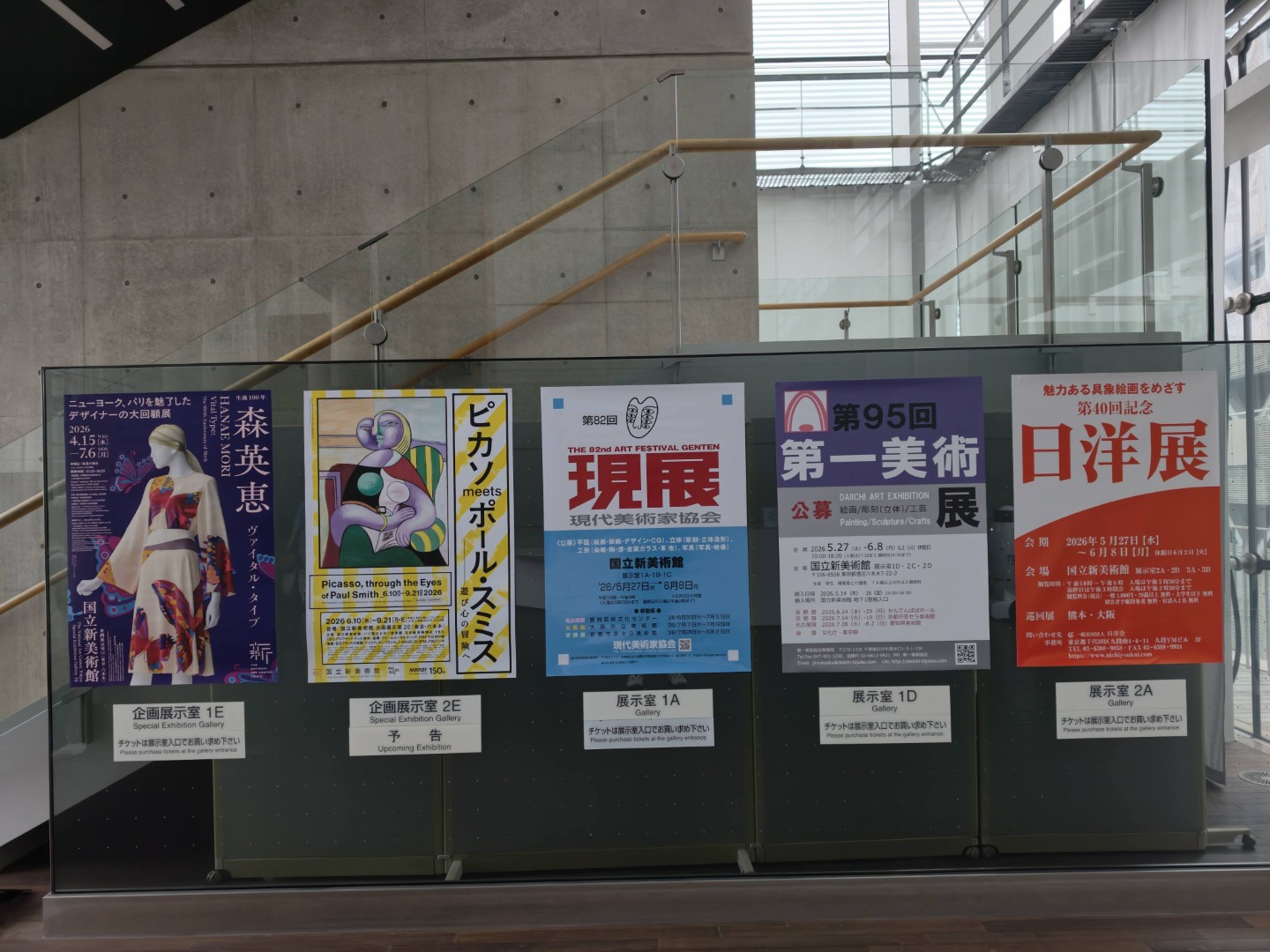
As a large-scale public-entry exhibition venue, The National Art Center, Tokyo is characterized by openness, brightness, large scale, and a great number of works. In such an exhibition space, the quietness and cool tones of Liau Chun-Yi’s work may instead create a special effect of pause. It does not immediately seize the viewer’s gaze like highly saturated works, but demands viewing at a slower pace.
With frost-like heavy colors and profound textures, Liau Chun-Yi constructs for viewers a spiritual air-raid shelter undisturbed by the flow of the outside world. This statement may be translated into a deeper language: Liau Chun-Yi’s work provides a psychological buffer zone in the exhibition site. When viewers move among numerous works and multiple media, the calmness, floating, and unfinished quality of Unfinished・Floating Realm force the rhythm of viewing to slow down.
Within the complex environment of a public-entry exhibition, such a work possesses rare contemplative quality. It does not require viewers to understand immediately through strong narrative, nor does it pursue visual competition through exaggerated form. Instead, it allows viewers to remain within uncertain space. This is precisely its professional value: it quietly resists the information overload of the exhibition site.
XIII. The Contemporaneity of Liau Chun-Yi’s Work: Not Depicting the Age, Yet Presenting a Sense of the Age
The contemporaneity of Liau Chun-Yi’s Unfinished・Floating Realm does not come from obvious symbols of the age. The work does not directly depict the city, machines, technology, politics, or social events; it still uses flowers, color, paper, and painterly texture. Yet it presents the psychological state of contemporary people with great precision.
This shows that contemporaneity does not necessarily rely on the modernization of subject matter. Painting a city is not necessarily contemporary, and painting a flower is not necessarily traditional. The key lies in how the artist handles viewing, space, subjectivity, and the sense of the age. Liau Chun-Yi uses flowers to express rootlessness, background texture to express interference, cool tones to express distance, and an unfinished floating state to express the long-term suspension of modern life. All of these give the work a distinct contemporary feeling.
Therefore, Unfinished・Floating Realm may be understood as a work of “psychological contemporaneity.” It does not mark the age on the surface, but responds to the age through the structure of feeling. The reason viewers can resonate with the work is not that it explains a particular social issue, but that it allows them to see their own unease, isolation, and continued effort to bloom within a fluid world.
XIV. Professional Critical Perspective: The Fourfold Value of Liau Chun-Yi’s Unfinished・Floating Realm
In summary, Liau Chun-Yi’s Unfinished・Floating Realm possesses the following fourfold critical value within the portraits of Taiwanese artists in the 82nd Genten Exhibition.
First, Material Value
The work demonstrates the surface-control capacity of processed xuan paper and heavy color in contemporary painting. Liau Chun-Yi does not pursue the traditional vital resonance of natural ink diffusion, but establishes a surface with psychological density through layering, scraping, rubbing, and cool-toned texture.
Second, Spatial Value
The work creates a space that has lost horizon and gravitational coordinates. This space is not a natural landscape, but a psychological field; it makes flowers leave the earth and enter a state of floating, suspension, and incompletion.
Third, Symbolic Value
Flowers are no longer merely natural objects, but become symbols of the modern subject. They are rootless yet still bloom, isolated yet do not disappear, precisely responding to the survival posture of contemporary people in a fluid society.
Fourth, Exhibition-Site Value
Within the large-scale public-entry exhibition venue of The National Art Center, Tokyo, Unfinished・Floating Realm offers a viewing rhythm opposite to visual overload through calmness, slowness, and contemplation. It does not declare loudly, but allows viewers to sense inner unease within floating.
XV. Chapter Summary: Still Blooming in a Rootless State
Liau Chun-Yi’s Unfinished・Floating Realm is a work about “floating,” but its floating is not light. It presents a modern psychological state that is rootless, unfinished, and lacking definite coordinates. The flowers in the image are no longer part of stable nature, but living forms emerging within blue-gray texture, visual noise, and weightless space.
These flowers have no soil, yet still bloom; no clear belonging, yet still maintain form; no stable background, yet are not swallowed by chaos. Precisely because of this, Unfinished・Floating Realm does not merely depict anxiety, but also expresses a life force that still maintains itself within anxiety.
Liau Chun-Yi’s professional value lies in her ability to handle extremely unstable psychological experiences through a calm formal language. She does not shout anxiety through violent brushstrokes, but lets anxiety sink into space, texture, and the suspended state of flowers. This gives the work a depth that rewards sustained viewing and makes it an important chapter in expressing modern psychological topology within the portraits of Taiwanese artists at the 82nd Genten Exhibition.