WANG MUTI
The Institutional Singularity of a Genten Associate Member and the Continuity of the Five Aggregates in Ink-Wash Geometry
I. The Artist’s Position: The Institutional Singularity from Participant to Genten Associate Member
Among the portraits of Taiwanese artists in the 82nd Japan “Genten” Exhibition, Wang Muti’s position carries a concluding institutional significance. He is identified as “Genten associate member, recommended after only two participations, and previously selected for the Young Talented Artists Exhibition and other awards.” This is not only a highlight in an individual résumé, but also a representative case of a Taiwanese artist rapidly obtaining an evaluative position after entering the institutional structure of the Modern Art Association of Japan. The Genten system contains ladders such as selection, awards, associate friend, associate member, and member; Wang Muti’s recommendation as an associate member after only two participations shows that his work has achieved high recognizability and institutional recognition within the field of Genten in Japan.
Viewed from the Genten system itself, associate membership is not merely a title, but a symbolic position. It means that the artist is no longer simply an external submitter or one-time selected participant, but has been incorporated into Genten’s internal system of evaluation and recommendation. For Taiwanese artists, such recommendation is especially transnational in significance: the work must cross differences in language, medium, cultural context, and judging system, while still being recognized by the field of Japanese modern art as a creation with sustained developmental value.
Wang Muti’s case may therefore be called an “institutional singularity.” Singularity here does not mythologize personal achievement, but indicates an institutional turning point: Taiwanese artists’ participation is no longer only exhibition exchange, but begins to enter the internal identity structure of Japan’s Genten. This transformation means that Taiwanese works in Genten are not only “seen,” but also begin to be “evaluated,” “recommended,” and “accumulated.” We may describe this process as the accumulation of transnational symbolic capital; that is, through selection, awards, criticism, and recommendation, the artist transforms personal creation into résumé resources recognizable within the international art field.
Therefore, Wang Muti’s importance in this special topic lies not only in the philosophical depth of his work, but also in how he embodies the way Taiwanese artists acquire a higher-level cultural position through the Genten system. His work and status together constitute a question: when Taiwanese contemporary ink wash enters Japan’s modern art public-entry system, how can it avoid being regarded as merely a continuation of traditional media and instead be understood as a visual language with contemporary intellectual intensity and international circulation?
II. The Work as Philosophical Structure: Wang Muti Does Not Simply Paint Ink Wash
The most noteworthy aspect of Wang Muti’s work is that it cannot be summarized simply as “ink-wash work.” Although the work uses xuan paper, ink wash, natural dyes, or similar Eastern paper-based media, its true core does not lie in traditional brush-and-ink taste, but in transforming the penetration, layering, boundaries, geometry, and spatial organization of ink wash into a highly philosophical visual structure.
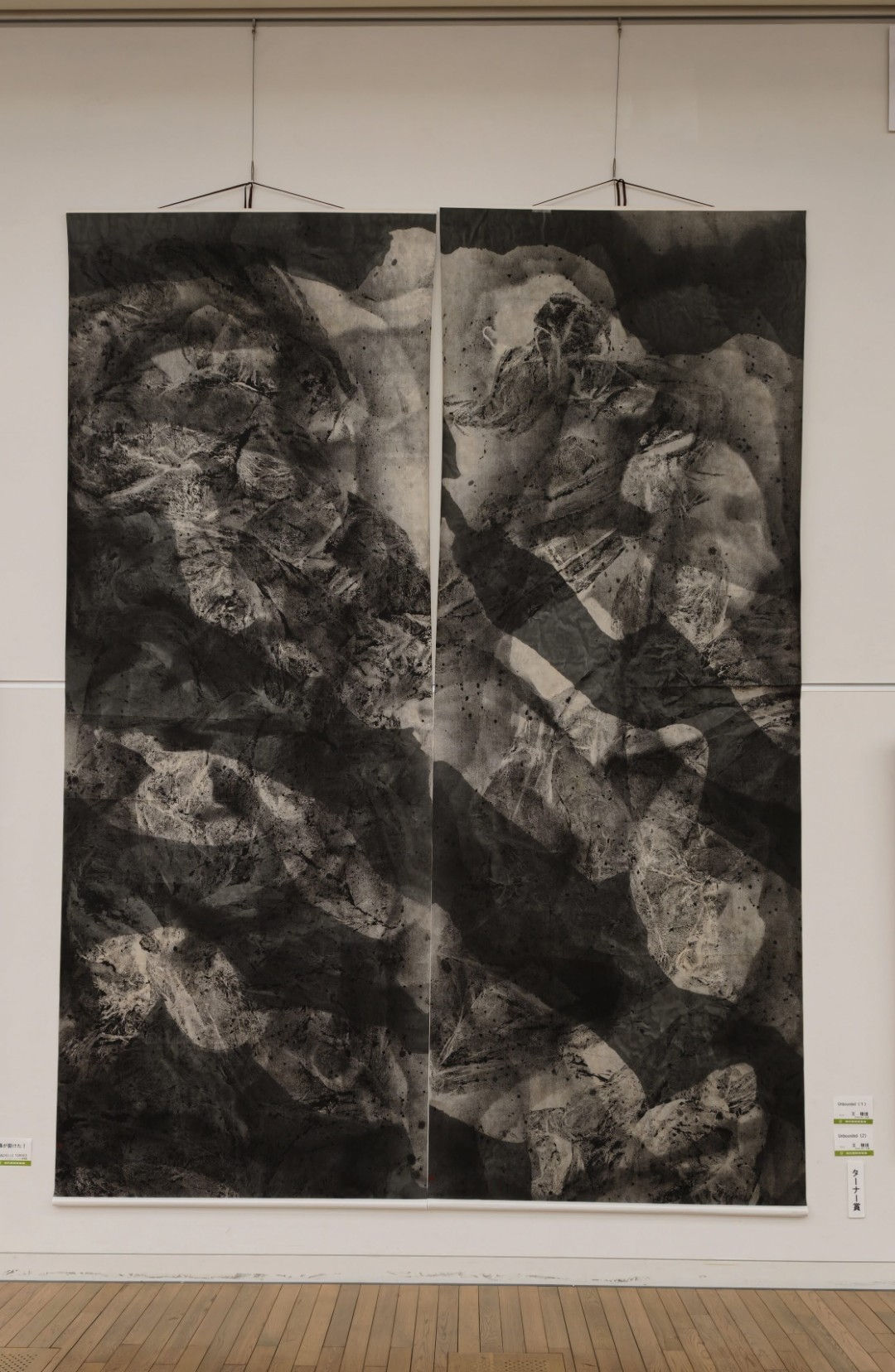
Taking Unbounded as an example, we point out that Wang Muti’s work appears on the surface to be a formal dialogue between Eastern ink wash and Western hard-edge abstraction, but on a deeper level it involves issues in Vasubandhu’s Abhidharmakośa: Refutation of the Self, including “attachment to a nominal self,” “continuity of the five aggregates,” “causal inheritance,” and “no-self.”
Wang Muti’s work does not paint landscape, nor does it reproduce traditional ink-wash mood. Instead, it addresses epistemological and ontological issues at the visual level. He is concerned with: How are boundaries formed? How is the self constructed? How are flowing physical and mental phenomena mistaken for a stable subject? How does causality continue without an eternal substance? These questions originally belong to Buddhist philosophy and metaphysical discussion, but Wang Muti translates them into visible formal relationships.
Therefore, when evaluating Wang Muti, one cannot merely ask whether the work has ink resonance, composition, or color; one must further ask: How do layers of ink become traces of time? How do geometric boundaries become cognitive frameworks? How does the penetration of xuan paper present causal continuity? How do the work’s “boundary” and “unboundedness” allow viewers to rethink the formation of the self?
This is also why he serves as the concluding artist in this Taiwanese portrait: his work possesses not only visual intensity, but also a high degree of theoretical charge, capable of pushing Taiwanese contemporary ink wash toward philosophical speculation.
III. Geometric Boundaries: Rational Order and “Attachment to a Nominal Self”
One of the most recognizable formal vocabularies in Wang Muti’s work is the geometric boundary on the picture surface. These geometric forms often carry sharp oblique angles, hard-edge structures, grayscale layers, or semi-transparent color blocks. They form an obvious contrast with the natural diffusion of ink wash on xuan paper: one is calm, rational, and defining; the other is flowing, diffusing, and not fully controllable.
On xuan paper, a material with strong absorbency and capillary action, Wang Muti uses almost precise control to draw boundaries by hand, temporarily restraining flowing liquid and forming a geometric “boundary.” This boundary may be understood as the visualization of “attachment to a nominal self” in the Abhidharmakośa.
“Attachment to a nominal self” may be briefly understood as follows: human beings mistake constantly flowing and momentarily arising-and-ceasing physical and mental phenomena for the existence of a stable, independent, and eternal “self” behind them. This “self” is not a substance, but a nominal construct formed by language, concepts, habits, and cognitive frameworks. Wang Muti’s geometric boundaries are like frameworks imposed by human consciousness upon flowing phenomena.
In the work, geometry is not merely decoration, nor merely a citation of modernist formal language. It symbolizes rational cutting into chaos, the consciousness’s framing of flowing life, and the self-boundaries people establish in order to gain a sense of security. These boundaries appear clear, yet are built upon flowing ink wash; they appear stable, yet depend on the momentary penetration, drying, and coagulation of material.
Therefore, Wang Muti’s geometric boundaries possess a dual nature: on the one hand, they demonstrate the artist’s control; on the other hand, they reveal the illusory nature of control itself. They let viewers see how “boundary” is established, and also make viewers realize that “boundary” is actually temporary, conditional, and constructed.
IV. The Materiality of Xuan Paper: A Flowing Field That Cannot Be Fully Dominated
If geometric boundaries represent rationality and control, then xuan paper and ink wash represent a material field of flow, penetration, and incomplete domination. Xuan paper is not a smooth, closed surface, but an active medium with fibers, absorbency, diffusion speed, and capillary action. After ink falls on xuan paper, it does not remain on the surface as it would on plastic or metal; it penetrates, spreads, sediments, and forms an irreversible relationship with the paper.
Wang Muti uses precisely this irreversibility to establish the depth of his work. The thick, sedimented black ink-wash blocks at the bottom layers of the work are formed through countless pourings, penetrations, dryings, and re-layerings of ink; each layer of ink trace represents the momentary arising and ceasing of the five aggregates. Although the previous layer has dried and disappeared, it changes the texture of the paper and affects the path of the next layer of ink.
This description is crucial because it closely connects the material process of the work with philosophical thought. Each penetration of ink is not an isolated event, but changes subsequent possibilities; after paper has absorbed ink once, it is no longer the same paper. When the next ink enters, it is affected by previous traces, humidity, thickness, and fiber conditions. This is like causal continuity: the past does not remain as a substance, but affects the present as a condition.
Therefore, Wang Muti’s xuan paper is not a passive background, but a carrier of time and causality. It records every ink-wash action and preserves the conditional changes caused by each action. On the surface, the work is a still image; in reality, it is the result of the accumulation of multiple times.
V. Continuity of the Five Aggregates: No Eternal Self, Yet Causality Is Not Lost
The deepest intellectual aspect of Wang Muti’s work lies in the fact that it may be understood as a visual enactment of the “continuity of the five aggregates.” In Buddhist thought, the five aggregates refer to form, feeling, perception, formations, and consciousness—the five aggregations that constitute bodily and mental experience. The five aggregates are not fixed and unchanging, but continuously arise, cease, continue, and transform. The illusion of “self” arises because these flowing aggregates are mistaken for a stable substance.
The Abhidharmakośa considers causality through the notion of “neither identical nor different”: the five aggregates that performed actions in the past and the five aggregates that receive effects today are not the same substance, but neither are they completely unrelated; they exist within the same stream of continuity.
Wang Muti’s layered ink wash precisely visualizes this abstract theory. Each layer of ink has already passed, yet has not completely disappeared; it leaves traces and changes the conditions for the next layer. The new ink layer is not the old ink layer itself, but it cannot be completely separated from it. They are neither entirely identical nor entirely different.
This point allows the work to transcend ordinary abstract ink wash. Many abstract ink-wash works emphasize ink resonance, spatial rhythm, or spiritual expression; Wang Muti further turns layered ink into a visual model of causal continuity. What viewers see in the image is not merely ink, but the nonlinear accumulation of time; not merely form, but how existence continues to flow without a fixed self.
Therefore, the “unboundedness” in Wang Muti’s work is not merely formal boundlessness, nor simple free abstraction, but points toward an existential state of no-self in which causality continues. True unboundedness does not mean the absence of a frame around the picture, but that life and causality themselves cannot be fully framed by a fixed self.
VI. Black Ink Layers: Abyss, Geology, and Temporal Sedimentation
The black ink-wash layers in Wang Muti’s work often possess a sense of abyss. It is not a single black, but a complex structure formed through repeated penetration, drying, and covering. This black differs from flat coloring and from purely visual darkness; it resembles a geological section, temporal sedimentation, deep memory, or the gathering of invisible causality.
We have described Wang Muti’s work as “a geological history formed by the interlocking of ink particles,” pointing out that its underlying ink blocks present unfathomable dark currents of causality.
This geological quality is very important. Geological strata are not formed in a single day, but are the results of long-term accumulation, compression, and transformation; Wang Muti’s ink layers are the same. Every lightness and darkness on the surface of the work may contain multiple actions, waits, dryings, and overwritings. What viewers see is a condensed result, yet they can sense the long generative process behind it.
This gives the work temporal thickness. It is not a performance of instantaneous brushstrokes, but the result of repeated accumulation. This temporal thickness resonates with the thought of continuity in the Abhidharmakośa: existence is not a fixed point, but an accumulation of conditions, traces, and transformations.
Black also gives the work an abyssal quality. It allows viewers to sense the unknowability at the bottom of the self, and to feel that life is not transparent or fully graspable, but constituted by countless invisible conditions. Geometric boundaries attempt to provide order, while the black depths continually remind viewers that any order is built upon deeper, more flowing, and less fully controllable causality.
VII. Grayscale and Semi-Transparency: Boundary Is Not Absolute, but a Filter
The geometric color blocks in Wang Muti’s work are often not completely opaque entities, but possess grayscale, semi-transparency, or layered qualities. This is quite important. If geometry were completely closed, it would form absolute division; but semi-transparent geometry allows the underlying ink color to remain visible, representing that rational boundaries cannot completely conceal underlying flow.
This semi-transparency may be understood as a “filter.” Human concepts of self, linguistic categories, and rational frameworks neither completely create the world nor are completely unrelated to it; they function like filters, allowing us to see flowing phenomena in certain ways. Wang Muti’s geometric color blocks are precisely the visualization of such filters.
They make the image seem planned, cut, and ordered, yet underlying ink traces still penetrate through. This means that no matter how humans establish self-boundaries, the flow of the five aggregates and causality continues to operate beneath those boundaries. Boundary is not nothingness, but neither is it substance; it is a temporary cognitive structure.
This treatment gives Wang Muti’s work great subtlety. He does not simply oppose rationality, nor romantically praise chaos, but lets rationality and chaos, boundary and flow, control and penetration coexist. The true intellectual force of the work comes precisely from the coexistence of these contradictions.
VIII. Natural Dyes and Ink Wash: Material Ethics and a Sense of Time
If natural dyes are used in Wang Muti’s work, this material choice also has important significance. Natural dyes differ from industrial pigments; they are often related to plants, minerals, land, time, oxidation, and color change. They are not completely stable or fully standardized colors, but carry the temporality and fragility of natural materials.
When natural dyes and ink wash enter xuan paper together, the work is no longer merely a visual image, but becomes the interactive result of natural material and artistic action. Dyes may penetrate paper fibers and produce subtle changes over time; ink wash leaves traces through sedimentation and diffusion. Together, these materials establish a sense of time that is neither industrialized nor purely digital.
This resonates with Wang Muti’s philosophical theme. If the work is to address the continuity of the five aggregates, causal conditions, and impermanence, then the materials themselves must also be able to present change, sedimentation, and incomplete domination. The qualities of natural dyes and ink wash enable the work to practice impermanence and continuity at the material level.
Therefore, Wang Muti’s materials are not neutral tools, but part of the thinking. Materials age, penetrate, sediment, and change; the work therefore becomes an existence that continues to relate to time, rather than a fixed and unchanging image.
IX. Ink Wash and Hard-Edge Abstraction: The Interweaving of Eastern and Western Formal Languages
Wang Muti’s work is often understood as a combination of ink wash and geometric abstraction. From the perspective of art history, this involves the interweaving of Eastern ink wash and Western hard-edge abstraction. Ink wash emphasizes flow, vital resonance, diffusion, accident, and brush nature; hard-edge abstraction emphasizes geometry, flatness, boundaries, rationality, and composition. Wang Muti places the two within the same picture not as simple collage, but as a way of making the two visual logics question one another.
The ink-wash part reminds viewers that the world is flowing, impermanent, and not fully frameable. The geometric part reminds viewers that human beings always attempt to establish order, boundaries, categories, and cognitive structures. The conflict between the two is precisely the intellectual core of the work.
This combination also gives Wang Muti’s work cross-cultural readability. Within the field of Japan’s Genten Exhibition, viewers can recognize both the cultural context of East Asian paper and ink wash and the compositional language of modern abstract painting. The work belongs neither to pure tradition nor entirely to Western abstraction, but establishes a new position for Taiwanese contemporary ink wash between the two.
This point is especially important for Taiwanese art. Taiwanese art has long existed among East Asian tradition, Western modernism, Japanese art institutions, and global contemporary art. The ink-wash geometry in Wang Muti’s work may be regarded as a condensation of these multiple contexts: it responds to Eastern philosophy while entering modern abstraction; it uses traditional media while possessing contemporary formal consciousness.
X. Unbounded: Not the Absence of Boundaries, but Seeing the Conditionality of Boundaries
If Unbounded is taken as representative of Wang Muti’s thought, one must note that “unbounded” does not mean the complete cancellation of boundaries. On the contrary, Wang Muti precisely uses numerous boundaries, geometry, layering, and ink traces to allow viewers to see how boundaries are constructed, how they temporarily take shape, and how they are continually questioned by underlying flow.
“Unbounded” is therefore not an empty formal freedom, but a deep reflection on “boundary.” Without boundary, there is no way to speak of unboundedness; only when viewers see the strong presence of geometric boundaries can they further realize that these boundaries are not ultimate truth. Wang Muti’s work does not easily deny boundary, but reveals its conditionality.
This resonates with the Buddhist thought of no-self. No-self does not mean that human beings do not exist; it means that there is no independent, eternal, and unchanging substantial self. Human beings as phenomena of the continuity of the five aggregates still exist, causality still operates, and experience still occurs; only all of this cannot be reduced to a fixed self. Wang Muti’s “unbounded” is the same: there are boundaries in the picture, but boundaries are not absolute; there is form, but form is not self-sufficient; there is continuity, but no fixed subject.
Therefore, the most profound aspect of Wang Muti’s work lies in the fact that it does not turn philosophical concepts into slogans, but allows viewers to personally experience the mutual generation of “boundary” and “unboundedness” through viewing.
XI. The Viewer’s Position: Viewing Itself as a Form of Breaking Attachment
Wang Muti’s work makes higher demands on viewers. It is not an image that can be consumed at a glance, nor does it guide viewers through plot or clear symbols. Viewers must repeatedly look among geometric boundaries, ink layers, transparent grayscale, and xuan-paper texture before gradually sensing the work’s intellectual structure.
This viewing process itself carries the meaning of breaking attachment. At first glance, viewers may be attracted by geometric forms and attempt to understand the compositional order; upon further viewing, the gaze is drawn into the depths by the underlying ink tones, realizing that beneath geometry there remains a more complex flow; finally, viewers may discover themselves moving back and forth between “seeing boundaries” and “seeing the instability of boundaries.”
This is precisely a visual form of breaking attachment. The work first allows viewers to establish cognition, then loosens that cognition; first to see boundary, then to feel unboundedness; first to believe in form, then to realize the conditionality of form. This viewing process is highly consistent with the Buddhist thinking of the work.
Therefore, the philosophical quality of Wang Muti’s work is not an external explanation, but is internal to the viewing experience. Even if viewers are not familiar with the Abhidharmakośa, they may still sense through visual experience that stable self and clear boundaries are not matters of course, but are temporarily generated within flowing conditions.
XII. Relationship with the Previous Six Artists: The Philosophical Finale of the Taiwanese Portrait
As the final artist discussed in this special-topic criticism, Wang Muti can form a kind of summary and elevation of the works of the previous six artists.
Tsai Mei-Fang’s Lingering Wisteria seeks an emotional anchor within natural sublimity; Liau Chun-Yi’s Unfinished・Floating Realm presents rootless suspension within liquid modernity; Jiang Jinling releases life impulse through Emotional Journey in the Lotus Pond and Shell Ginger in Full Bloom Attracts Birds; Chen Fu-Chi’s The Pleasure of Fish reinterprets free wandering within digital simulacra; Wang Chuan Fu’s One Thought of Bodhi Opens the Verdant Mist opens clarity through voids and birds; Wu Zhiyong’s Autumn of Nostalgia seeks lost belonging within a liquid city.
Wang Muti pushes these questions toward a deeper ontology: emotion, suspension, life, the digital, clarity, and nostalgia ultimately all concern how the “self” is constructed, how it continues through time, and how it flows within causality. If there is no fixed self, then who is lingering? Who is suspended? Who feels life impulse? Who wanders freely? Who opens clarity in one thought? Who feels nostalgia?
Wang Muti’s work does not answer directly, but raises visual questions through ink-wash geometry. This makes him the philosophical finale of the Taiwanese portrait: he does not merely display a style, but pushes the recurring questions of the modern subject throughout the entire portrait toward a more fundamental level.
XIII. Relationship with the Field of The National Art Center, Tokyo: No-Self Ink Wash in a Collectionless Space
The National Art Center, Tokyo has no permanent collection; it is an open field that is constantly emptied and constantly refilled by exhibitions. Wang Muti’s work entering such a space has special symbolic significance.
A collectionless museum does not establish an eternal narrative through fixed collections; Wang Muti’s work does not establish the foundation of existence through a fixed self. The exhibition site and the work form a subtle resonance here: the museum has no permanent-collection “self,” and the work also questions the eternal and unchanging “self.” Both emphasize the present, event, continuity, and temporary generation.
On the temporary exhibition walls of The National Art Center, Tokyo, Wang Muti’s ink-wash geometry appears like a visual proposition about time and existence. The exhibition will be dismantled, the work will move, and viewers will leave, yet the exhibition experience and digital archive will continue in another form. This continuity of the exhibition itself also resonates with the causal continuity in Wang Muti’s work.
Therefore, Wang Muti’s work is not merely placed in The National Art Center, Tokyo, but conceptually enters into dialogue with this collectionless museum. Together, they raise a question: if there is no permanent fixed center, how does meaning continue? If there is no substantial self, how is causality not lost?
XIV. Relationship with Hanging-Scroll Display: Gravity, Verticality, and the Descent of Causality
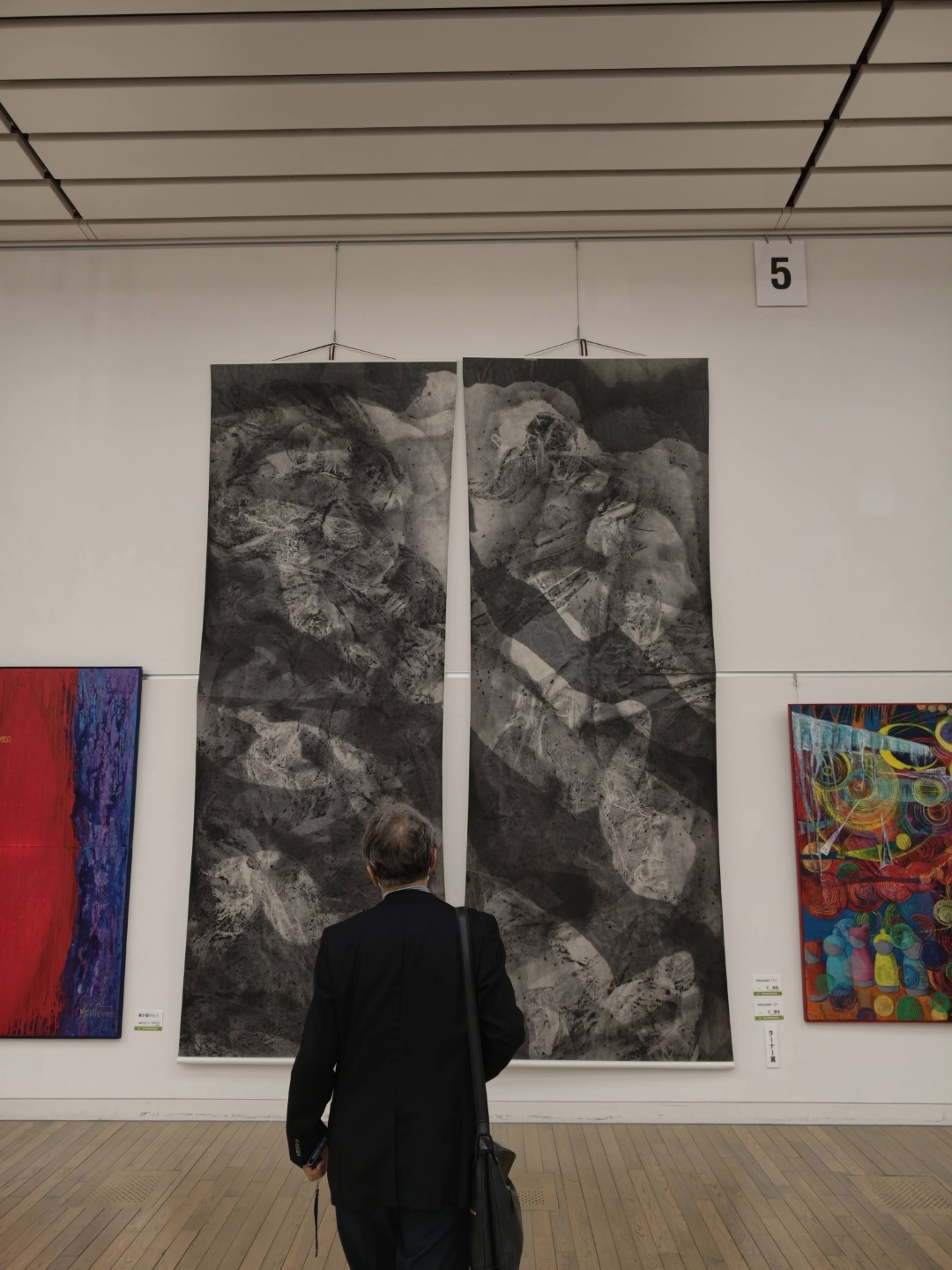
Many Taiwanese participating works in this exhibition are displayed in hanging-scroll form. For Wang Muti, the hanging scroll is not merely a transportation and mounting strategy, but can further strengthen the temporality and causality of the work. There is a physical complicity between the verticality of the hanging scroll and the flow of ink wash; when a nearly four-meter monumental work is hung vertically, the viewer’s gaze moves from top to bottom, as if reading a geological history flowing downward with gravity.
This point is especially fitting for Wang Muti’s work. Ink wash on xuan paper is already guided by gravity, moisture, and fibers; hanging-scroll display allows this vertical flow to be re-perceived within the exhibition site. Standing before the work, viewers may follow the layers of ink downward with their gaze and sense a descent of time, weight, and causality.
The hanging scroll also allows the work to retain flexibility. It is not enclosed by a heavy frame, but exists in a form that can be rolled, unfolded, and moved. This also resonates with the thought of “unboundedness”: the work is not a framed-dead object, but an unfoldable field of continuity. It can be rehung in different exhibition sites, and each display forms new viewing conditions.
Therefore, the hanging scroll is not merely a formal arrangement, but an extension of the work’s thought. It allows the gravity of ink wash, the flexibility of xuan paper, and the philosophy of causal continuity to enter the exhibition experience together.
XV. Intertextuality between Institution and Work: How Associate-Member Status Returns to Creation Itself
Wang Muti’s associate-member status should not be separated from the analysis of his work. There is an intertextual relationship between institutional position and work content. Genten associate membership means that he has obtained a recognized position of continuity within the Japanese art field; his work, meanwhile, considers how causal continuity still exists when there is no fixed self. Institution and work form an interesting contrast here.
The establishment of an artist’s identity itself is also a kind of “nominal designation.” Name, awards, selection, associate membership, and award records are all signs and positions given to the artist by institutions. They are not the artist’s entire substance, yet they truly affect how the artist is viewed, invited, written about, and recorded.
Wang Muti’s visual reflection on “attachment to a nominal self” also allows us, in turn, to see more clearly how art institutions operate: an artist’s identity is not naturally given, but is jointly constructed by works, exhibitions, criticism, recommendations, databases, and public memory. This does not mean that institutions are false and useless, but points out that institutions are also a kind of conditional continuity.
Therefore, Wang Muti’s associate-member status and the philosophy of his work are not contradictory. On the contrary, they allow us to see that the artist is named, recommended, and recorded within the institution, just as geometric boundaries in the work temporarily demarcate flowing phenomena. These names and boundaries are not ultimate substances, but they produce real effects.
XVI. Professional Critical Perspective: The Fivefold Value of Wang Muti’s Work
In summary, Wang Muti possesses the following fivefold critical value within the portraits of Taiwanese artists in the 82nd Genten Exhibition.
First, Institutional Value
Wang Muti was recommended as a Genten associate member after only two participations, and was previously selected for the Young Talented Artists Exhibition and other awards, showing that his work has achieved high recognition within Japan’s Genten system. This institutional position makes him an important case of Taiwanese artists’ accumulation of transnational symbolic capital.
Second, Material Value
His works use xuan paper, ink wash, natural dyes, and layering techniques to fully bring out the permeability, temporality, and irreversibility of Eastern paper-based media. Materials are not merely tools, but material carriers of causality and continuity.
Third, Formal Value
Geometric boundaries, grayscale color blocks, and hard-edge structures allow the work to enter into dialogue with Western abstraction; at the same time, the underlying flow of ink wash preserves the vital resonance and sense of impermanence of Eastern media. The work establishes high tension between rational order and material flow.
Fourth, Philosophical Value
The work transforms thoughts from the Abhidharmakośa—such as attachment to a nominal self, continuity of the five aggregates, neither identity nor difference, and no-self causality—into visual structures, making abstract Buddhist questions into formal experiences that can be viewed.
Fifth, Portrait Value
As the concluding figure among the seven artists, Wang Muti raises the questions of emotion, life, suspension, free wandering, clarity, and nostalgia found in the preceding works to the ontological level of how the subject is generated and continues.
XVII. Chapter Summary: Viewing the Generation of the Self between Boundary and Unboundedness
The reason Wang Muti’s work can serve as the finale of this special-topic artist criticism lies in its simultaneous possession of institutional strength, material depth, formal recognizability, and philosophical speculative power. His associate-member status shows that his creation has already obtained an important position within Japan’s Genten system; his works, through ink wash, xuan paper, geometry, and dyes, transform deep questions such as “self,” “boundary,” “causality,” and “continuity” into visual experience.
In his images, geometric boundaries resemble frameworks established by rationality and self; the underlying ink tones resemble the abyss of causality and the continuity of the five aggregates. Boundaries exist, yet are not absolute; ink traces flow, yet are not disorderly. What truly moves the viewer in the work is the way it makes one realize that the self may not be a fixed substance, but a temporary phenomenon formed by a series of conditions, traces, names, and continuities.
Therefore, Wang Muti’s “unboundedness” does not emptily cancel boundaries, but, after seeing boundaries, further reveals their conditionality. It does not escape form, but breaks form through form; it does not negate the self, but observes how the self is constructed, attached to, and then flows within causality.
Within the portraits of Taiwanese artists in the 82nd Japan Genten Exhibition, Wang Muti represents one of the most philosophically intense ends of Taiwanese contemporary ink wash. He makes ink wash not merely a symbol of cultural identity, nor merely a continuation of traditional media, but an intellectual art capable of entering dialogue with Buddhist epistemology, modern abstraction, transnational institutions, and contemporary questions of subjectivity.