Tsai Mei-Fang
Viewing Color-Ink Storms, Dynamic Sublimity, and Emotional Anchors through Lingering Wisteria
I. The Artist’s Position: The Institutional Significance from Participant to Genten Associate Friend
Among the portraits of Taiwanese artists in the 82nd Japan “Genten” Exhibition, Tsai Mei-Fang’s position carries clear institutional significance. She is a “Genten associate friend, recommended in 2025,” which means that her work is not limited to a single selection or an occasional exhibition appearance, but has already entered the recommendation ladder of the Modern Art Association of Japan. For an artist from Taiwan, the status of “associate friend” is not merely an administrative category, but also a symbol of sustained recognition within the field of Japanese public-entry exhibitions.
From the perspective of the exhibition system, the value of Genten lies not only in providing exhibition walls, but in its complete mechanisms of review, selection, awards, recommendations, and traveling exhibitions. The status obtained by an artist within this system is transformed into part of the artist’s transnational artistic résumé. Tsai Mei-Fang’s recommendation as a Genten associate friend in 2025 means that her creative language has established a certain recognizability within the field of Japanese modern art, and also shows that her work can cross the linguistic, material, and viewing differences between Taiwan and Japan and be incorporated into Genten’s evaluative system.
This institutional background is an important premise for understanding Lingering Wisteria. For Lingering Wisteria does not appear simply as a floral-themed work, but enters a Japanese exhibition system that emphasizes modernity, openness to multiple media, and public review through the juxtaposition of color ink, natural imagery, abstract flow, and figurative life. In other words, what Tsai Mei-Fang faces is not only “how to paint wisteria,” but how to allow wisteria, a traditional natural subject, to regain contemporaneity within a modern art public-entry exhibition.
II. The Titular Structure of Lingering Wisteria: From Plant Imagery to an Emotional Proposition
The title Lingering Wisteria appears on the surface to point toward the natural scene of wisteria blossoms, yet the word “lingering” shifts the work from simple botanical depiction into the realm of emotion and existence. “Lingering” contains semantic implications of attachment, reluctance to part, repeated looking back, and emotional bonds. It makes wisteria no longer merely a flower, but a symbol related to time, memory, and intimate relationships.
In the East Asian painting tradition, flowers often carry character, seasonality, emotion, and literati projection. Plum, orchid, bamboo, and chrysanthemum each have their cultural meanings; lotus may refer to purity and transcendence; peony symbolizes wealth and honor; wisteria is often connected with hanging forms, abundance, resilience, seasonal cycles, and garden memory. However, Tsai Mei-Fang does not treat wisteria as a gentle and lyrical garden flower, but pushes it into a more intense color-ink field closer to cosmic flow. Lingering Wisteria overturns the traditional bird-and-flower painting structure of “depicting objects and forms with gentle restraint,” emphasizing instead the natural flow, repulsion, and fusion of water, ink, and pigment within the fibers of paper.
Therefore, the “wisteria” in the title provides a natural entry point, while “lingering” opens an emotional dimension. What the work truly addresses is not the botanical form of wisteria, but how human beings, when facing nature, time, and impermanence, still maintain emotional attachment and connections of life.
III. The Language of Color Ink: Automatic Technique and Material Flow
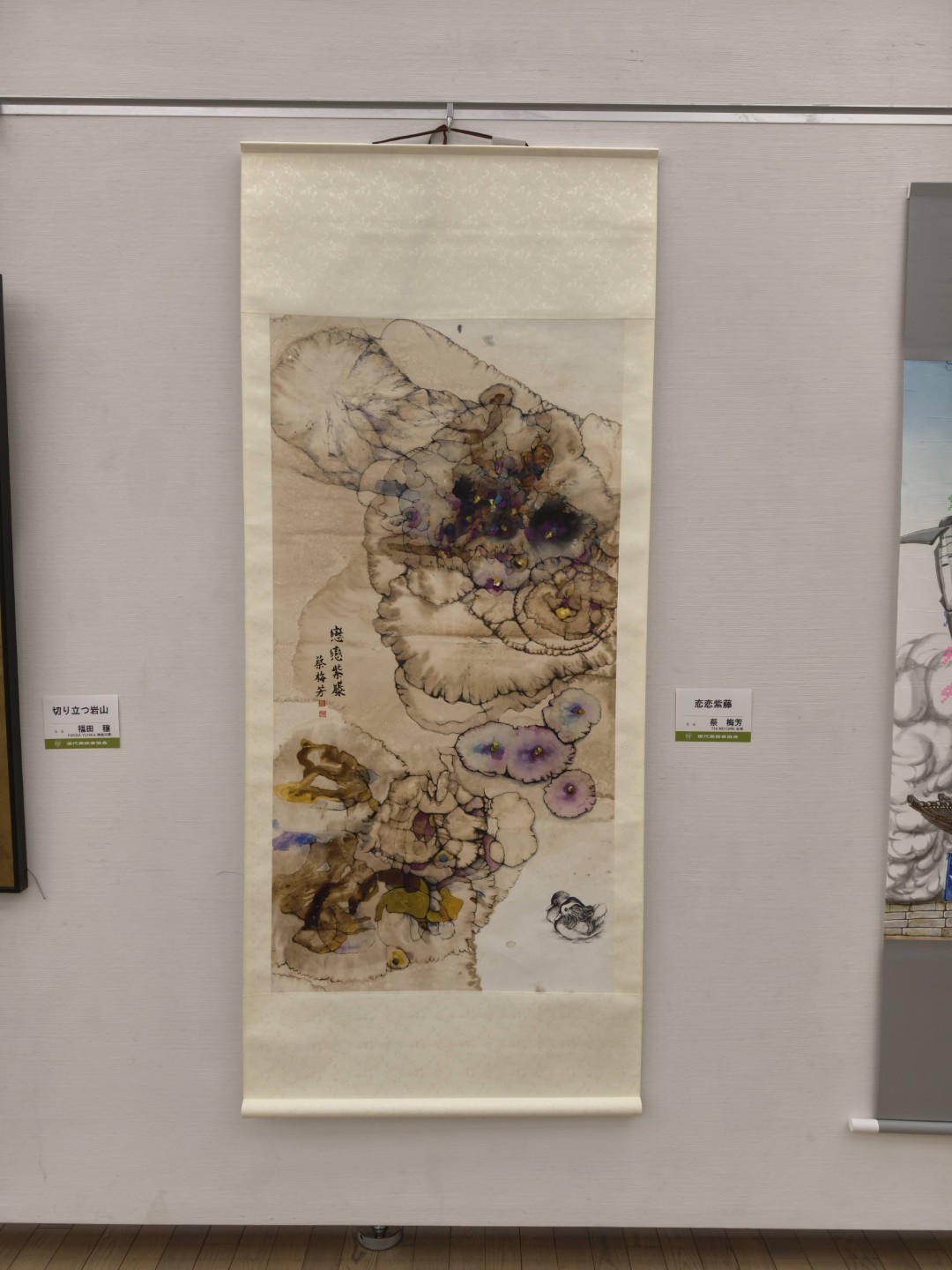
The most visually impactful aspect of Tsai Mei-Fang’s Lingering Wisteria lies in the fact that the picture does not rely on the precise outlining of traditional fine-line bird-and-flower painting, but extensively employs the fluidity, diffusion, and not fully controllable material reactions of color ink. This method may be called an “automatic technique,” indicating that the large tea-brown area in the picture is not deliberately depicted by the brush, but generated through the natural penetration, repulsion, and fusion of water, ink, and pigment on paper fibers.
This creative method gives the work a strong materiality. Materiality here does not merely mean that the work is composed of pigment, paper, and ink; rather, it means that the materials themselves possess agency within the image. Water spreads, ink settles, and pigment leaves boundaries, traces, and layers within the fibers. The artist does not completely dominate the materials, but completes the image together with them between control and loss of control.
This point is especially important for Lingering Wisteria. If wisteria were depicted entirely through fine-line technique, it would primarily present the form of the plant; but when wisteria is placed within the flow of color ink, it is no longer merely an identifiable flower, but a composite of natural energy, temporal sedimentation, and emotional fluctuation. The tea-brown, purple, yellow, and ink tones in the picture are not simply filled-in colors, but collide, cover, penetrate, and settle into one another, forming a visual effect close to geology, cloud vapor, or a cosmic nebula.
Therefore, the contemporaneity of Lingering Wisteria does not lie in the novelty of its subject, but in the way it allows a traditional floral subject to break away from the framework of “representing nature” and enter a state of “generating nature.” The image does not depict a single wisteria plant; rather, it lets wisteria be regenerated through the interaction of water, ink, paper, and pigment.
IV. From Bird-and-Flower Painting to Contemporary Abstraction: The Reconstruction of Traditional Subject Matter
If Lingering Wisteria is placed back into the context of East Asian bird-and-flower painting, Tsai Mei-Fang’s strategy of transformation becomes visible. Traditional bird-and-flower painting emphasizes the posture of objects, line, brush-and-ink rhythm, and symbolic meaning. Flowers and birds are often placed within recognizable natural environments and convey seasonality, emotion, and character through compositional arrangement.
However, although Lingering Wisteria retains elements of bird-and-flower painting, it does not obey the spatial order of traditional bird-and-flower painting. In the picture, wisteria is no longer a clearly arranged cluster of flowers among branches and leaves, but is dismantled into color, points of light, and traces of flow. Nature is no longer a quiet garden, but seems like an energy field undergoing violent transformation. This shifts the work from the traditional bird-and-flower painting mode of “depicting objects” toward the contemporary painting mode of “creating a realm.”
“Creating a realm” does not simply mean creating a background, but establishing a psychological and sensory field into which the viewer may enter. The background of Lingering Wisteria is not a neutral support, but the primary source of the work’s power. The large flowing tea-brown area forms an oppressive space; the purple and yellow appear like light spots, floral shadows, or fragments of memory flickering within it. This spatial relationship means that the viewer is no longer merely standing before flowers to look at them, but is drawn into the interior of a nature that is transforming, breathing, and expanding.
Therefore, Tsai Mei-Fang’s reconstruction of bird-and-flower painting is not a complete abandonment of tradition, but a pushing of traditional bird-and-flower subjects toward contemporary abstraction. She still retains identifiable elements such as wisteria and mandarin ducks, but places them within a highly fluid, almost abstract-expressionist color-ink environment, creating tension between figuration and abstraction.
V. Dynamic Sublimity: The Oppression and Shock of Natural Forces
We may use the “dynamic sublime” in Kantian aesthetics to understand Lingering Wisteria. The dynamic sublime refers to the shock, awe, and elevation of self-consciousness produced when human beings face vast, powerful, and not fully controllable forces of nature. Tsai Mei-Fang removes the pastoral filter, reducing wisteria to symbols of deep purple and bright yellow, embedding them within a violent tea-brown ground like points of light in a cosmic abyss.
This interpretation is highly suitable for Lingering Wisteria. The work does not treat wisteria in a soft, lyrical, or refined manner, but allows wisteria to appear within a huge and unstable visual field. What the viewer faces is not a quiet floral scene, but a color-ink field close to a storm, abyss, cloud layer, or temporal sedimentation. The flowers within it are both beautiful and fragile, both bright and surrounded, both proof of life and brief points of light that seem about to be engulfed.
This aesthetic differs from the elegance of traditional flower painting and is closer to the experience of the sublime. Beauty makes one feel harmony, intimacy, and graspability; the sublime makes one feel shock, transcendence, and what cannot be fully controlled. The reason the wisteria in Lingering Wisteria is moving is precisely that it does not bloom in a stable garden, but emerges within a vast color-ink storm. Its beauty is not a quiet beauty, but a beauty that still appears after confronting chaos.
Therefore, Tsai Mei-Fang’s wisteria is not merely a plant, but a symbol of life still blooming amid impermanence and pressure. It faces a vast background, flowing matter, and unpredictable reactions of color and ink; yet precisely within such a background, its existence becomes all the more precious.
VI. The Mandarin Duck Image: The Emotional Anchor of Small Lives
If the color-ink background constitutes the macrocosmic force of Lingering Wisteria, then the mandarin ducks in the picture provide a microcosmic emotional focus. At the edge of a grand chaos full of oppressive force, Tsai Mei-Fang places a pair of mandarin ducks painted in extremely realistic fine-line technique; this extreme juxtaposition of a grand abstract storm and microscopic figurative depiction may be understood as the visualization of an “I and you” relationship.
This pair of mandarin ducks plays a crucial role in the work. Without them, the image might mainly be understood as natural energy or color-ink abstraction; with the mandarin ducks, however, the work is brought into the realm of intimate relationship, companionship, and existential attachment. In East Asian culture, mandarin ducks are often regarded as symbols of partners, fidelity, and paired existence. Tsai Mei-Fang’s use of this image here does not fall into a folkloric auspicious formula, but places it under strong visual pressure, making it an emotional support when facing a vast world.
The mandarin ducks in the picture form a sharp contrast with the background. The background is flowing, chaotic, and uncontrollable; the mandarin ducks are figurative, delicate, and recognizable. The background represents natural force, temporal change, and existential uncertainty; the mandarin ducks represent intimacy, leaning together, and mutual confirmation between lives. This contrast gives the work an existential depth: in a vast world, human beings may not be able to control fate, but they can still establish the weight of their own existence through relationships with others.
Therefore, the mandarin ducks are not decorative elements, but the emotional core of the entire work. They make Lingering Wisteria not merely an image of natural sublimity, but a work about “how to depend on one another amid impermanence.”
VII. The Deeper Meaning of “Lingering”: Attachment Is Not Weakness, but Resistance to Nihility
When the title Lingering Wisteria is read in relation to the image of the mandarin ducks, one can see that Tsai Mei-Fang’s understanding of “love” is not simply romantic. Here, “lingering” is not a light rhetoric of love, but an emotional resilience in which human beings, or life and life, still refuse to break apart when facing a vast world.
In modern society, individuals are often placed in situations of rapid change, unstable relationships, and fluid values. In analyzing other artists, we have repeatedly mentioned “liquid modernity” and the modern experience of losing certainty; if this background is brought back to Tsai Mei-Fang’s work, we can understand that the “lingering” in Lingering Wisteria is not an escape from modern unease, but the establishment of connection within unease.
The mandarin ducks in the image are not located at a stable center, but depend on one another at the edge of chaos. This gives their existence greater tension. They do not symbolize happiness in a peaceful world, but still maintain closeness to each other within a visual field of uncertainty, oppression, and flow. Thus, “lingering” becomes a way of resisting nihility: not by opposing the world with grand declarations, but by resisting isolation and dispersal through small yet firm companionship.
From this perspective, what is truly moving about Lingering Wisteria is not how beautifully the wisteria blooms, but the way the work allows viewers to see that beauty and love do not exist in an environment free from wind and waves, but are reaffirmed amid chaos, pressure, and impermanence.
VIII. Color Structure: The Psychological Tension of Tea-Brown, Deep Purple, and Bright Yellow
The color structure of Lingering Wisteria may be divided into three main levels: the tea-brown background, the deep purple floral shadows, and the bright yellow points of light. These three colors are not arranged flatly side by side, but form relationships of depth, density, gathering, dispersal, and penetration within the flow of color ink.
The tea-brown occupies the dominant position in the picture and carries connotations of soil, withered leaves, temporal sedimentation, and deep memory. It is not a bright background, but resembles a heavy field formed after sedimentation. This tea-brown gives the work a certain temporality: the viewer seems to see pigment penetrating layer by layer into the paper, leaving water marks, boundaries, and mottled traces. It resembles both earth and the remaining clouds after a storm; it has both a natural feeling and a historical feeling.
The deep purple directly connects to the wisteria image. Purple here is not sweet or decorative, but a cold light emerging under the pressure of tea-brown. It gives the wisteria an unstable, subtle quality, as if the flowers were not illuminated from outside but glowing from within the shadows. The bright yellow provides visual pulsation, like stamens, light spots, or instantaneous memories, allowing the image to retain points of brightness within its heaviness.
This color relationship prevents Lingering Wisteria from falling into mere heaviness. Tea-brown provides pressure, deep purple provides depth of feeling, and bright yellow provides the brightness of life. The interweaving of the three allows the work to find balance between gloom and brightness, chaos and tenderness, oppression and hope.
IX. Compositional Logic: The Juxtaposition of Macrocosmic Background and Microcosmic Narrative
The composition of Lingering Wisteria may be understood as a dual structure of macrocosm and microcosm. The macrocosmic level is formed by large areas of flowing color ink, creating an overwhelming visual field; the microcosmic level is formed by the wisteria and mandarin ducks, providing specific focal points of viewing. This structure gives the work both abstraction and narrativity.
The abstraction comes from the background. At first, the viewer may be drawn by the large fields of color and ink, sensing flow, diffusion, pressure, and spatial depth. This part does not provide a clear story, but first allows the body to feel the weight of the image. The narrativity comes from the mandarin ducks. When the viewer discovers the living forms in the picture, the work shifts from pure visual experience into emotional reading.
This compositional strategy gives the viewer’s path of viewing a layered structure: first being surrounded by the overall atmosphere, then finding concrete life; first sensing the vastness of nature and time, then seeing the mutual dependence of small lives. Precisely for this reason, although the mandarin ducks are small, they can become the center of gravity in the image. They gain importance not through size, but through emotional density.
X. Medium and Spirituality: Color Ink as a Vehicle of Modern Emotion
Tsai Mei-Fang’s use of color ink is not merely a continuation of traditional ink-wash media, but a transformation of color ink into a vehicle of modern emotion. Ink wash possesses characteristics of penetration, diffusion, irreversibility, and temporal sedimentation; color ink adds stronger chromatic energy, allowing traditional ink resonance to move beyond the literati elegance of black, white, and gray and express psychological and sensory experiences of greater intensity.
In Lingering Wisteria, color ink is not used to decorate nature, but to express the internal pressure of nature and emotion. The flow of pigment resembles the diffusion of feeling, the sedimentation of ink resembles the accumulation of memory, and the boundaries of water marks resemble irreversible traces left by time. These material effects together constitute the spirituality of the work.
Spirituality here does not refer to religious imagery or explicit faith, but to the work’s ability to make the viewer feel a deep experience that transcends everyday appearances. When wisteria, mandarin ducks, color ink, and the flowing background come together, the image no longer merely represents nature, but suggests how life seeks reliance within vast time and impermanence. This is precisely the importance of Lingering Wisteria as an object of art criticism: it takes the bird-and-flower subject as an entry point, but what it truly addresses is the emotional-existential problem of modern people facing an uncertain world.
XI. Relationship with the Field of The National Art Center, Tokyo
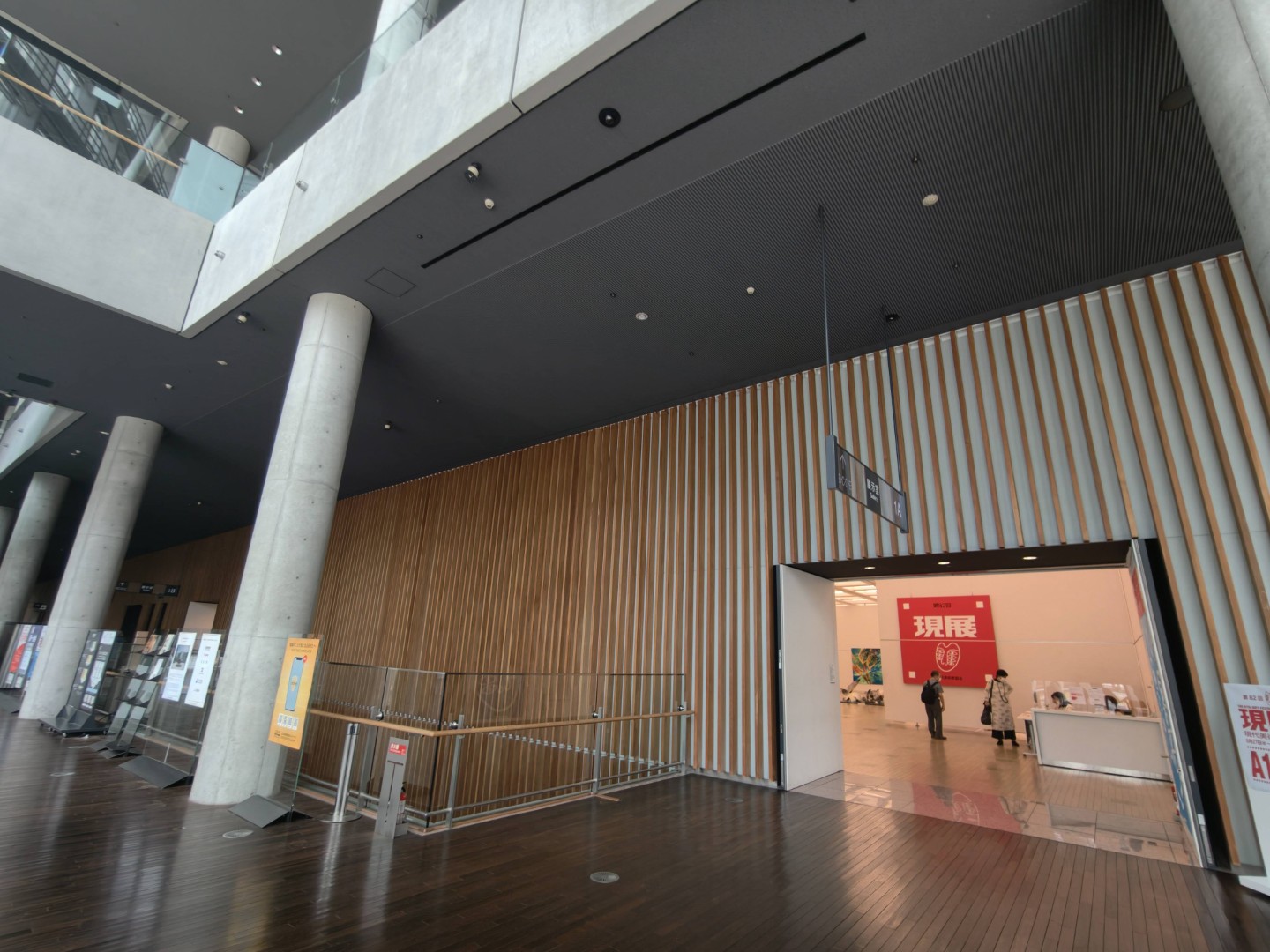
The significance of Lingering Wisteria in the 82nd Genten Exhibition must also be connected to the exhibition-site characteristics of The National Art Center, Tokyo. The National Art Center, Tokyo has no permanent collection and centers on large-scale exhibition spaces and diverse exhibitions, which means that the work must be directly juxtaposed in the exhibition site with works of other media, styles, and scales.
Within such a space, the color-ink storm of Lingering Wisteria possesses considerable visual recognizability. It is neither purely Western abstract painting nor entirely obedient to traditional bird-and-flower painting, but establishes its own position between East Asian media and contemporary abstraction. When the work is hung in hanging-scroll form at The National Art Center, Tokyo, its flexible paper support, vertical unfolding, and flow of color and ink form a contrast with the museum’s modern exhibition space: on the one hand, the rationality and neutrality of the white-cube space; on the other, the emotional and material traces of color ink penetrating paper.
This contrast makes Lingering Wisteria more than a single work within the exhibition site; it becomes a concrete case of how a Taiwanese artist brings Eastern media into a Japanese modern art platform. It does not please viewers through traditional symbols, nor does it completely imitate Western contemporary art vocabulary. Instead, through the materiality and emotionality of color ink, it establishes a visual expression with Taiwanese contemporary characteristics.
XII. Relationship with the Context of Taiwanese Contemporary Art
From the perspective of Taiwanese contemporary art, Tsai Mei-Fang’s Lingering Wisteria possesses a transitional quality between tradition and contemporaneity. Taiwanese art has long been situated at the intersection of multiple cultures: on the one hand, it inherits ink wash, glue-color painting, calligraphy and painting, and folk visual traditions; on the other hand, it has also been influenced by Western modernism, abstract expression, contemporary media experimentation, and global exhibition systems. Lingering Wisteria is formed precisely within these contexts.
The subject and medium of the work connect with East Asian tradition, yet its pictorial treatment clearly possesses contemporary consciousness. It does not take accuracy of representation as its goal, but centers on material flow, psychological tension, and visual energy. This makes it different from traditional bird-and-flower painting and also different from purely decorative color-ink works. What it presents is a possible direction for Taiwanese contemporary color ink: no longer treating ink wash as merely a classical medium, but allowing ink and color together to carry contemporary emotions, memories, and existential unease.
In addition, the emphasis on intimate relationships in Lingering Wisteria may also be seen as a response to the isolated condition of the modern individual. Contemporary art often deals with rupture, alienation, the body, memory, and identity. Tsai Mei-Fang does not enter these issues through intense political symbols, but responds to the spiritual predicament of modern people through natural and emotional imagery in a more implicit yet powerful way.
XIII. Professional Critical Perspective: The Threefold Value of Tsai Mei-Fang’s Work
In summary, Tsai Mei-Fang’s Lingering Wisteria may be understood in this special report as possessing threefold value.
First, Material Value
The work demonstrates the openness of color ink in a contemporary context. Water, ink, pigment, and paper are not passive media, but jointly participate in the generation of the image. Tsai Mei-Fang makes material fluidity the core of the work, allowing color ink to become not merely a traditional technique, but a medium with contemporary abstract expressive power.
Second, Iconic Value
The work reconstructs the language of bird-and-flower painting. Wisteria and mandarin ducks remain recognizable, but they no longer serve traditional auspicious or lyrical formulas. Instead, they enter a field of natural sublimity, emotional attachment, and existential anxiety. This allows the work to achieve balance between figuration and abstraction.
Third, Emotional Value
The work transforms “lingering” into a spiritual proposition. Within the vast, chaotic, and uncontrollable color-ink background, the mutual dependence of the mandarin ducks symbolizes connection between lives. This connection is not an escape from reality, but a force that resists nihility amid impermanence.
XIV. Chapter Summary: Confirming the Mutual Dependence of Life within a Color-Ink Storm
The reason Tsai Mei-Fang’s Lingering Wisteria can be representative within the portraits of Taiwanese artists in the 82nd Genten Exhibition lies precisely in its successful transformation of an apparently traditional bird-and-flower subject into an artistic proposition with contemporary spiritual depth. The wisteria in the work is not merely a flower, color ink is not merely a technique, and the mandarin ducks are not merely images symbolizing love. Together, they constitute a visual field concerning nature, time, impermanence, and intimate relationship.
Formally, the work establishes strong visual tension through color-ink automatism and material flow; aesthetically, it shifts from beauty toward sublimity, making nature no longer merely a view to be appreciated, but a force of existence filled with oppression and shock; emotionally, it uses the small mutual dependence of mandarin ducks to answer the question of how human beings seek spiritual anchors within a vast world.
Therefore, Lingering Wisteria is not a work that simply depicts wisteria and mandarin ducks, but a contemporary color-ink work about “how to maintain attachment within an uncontrollable world.” It enters an intense existential proposition through a soft floral subject, enters the modern exhibition site through Eastern media, and responds to a transnational art institution through personal emotion. This also means that Tsai Mei-Fang’s associate-friend status is not merely an institutional label, but corresponds with the maturity, recognizability, and cross-cultural readability of the work itself.